Issue 1, June 2026
Analysis
Trading Sovereignty
Brazil claims its role in a multilateral order

In July of 2025, the Trump administration unilaterally imposed a 50 percent tax hike on US imports of Brazilian products. The measure was politically motivated: alongside targeted sanctions and the revocation of visas for Brazilian officials, it was aimed at pressuring the Brazilian judiciary to change course in its prosecution of ex-president Jair Bolsonaro. Tariffs therefore represented an explicit attempt at political interference in Brazilian democracy.
This performance of economic strength in fact came to reveal underlying fragility. Not only was Bolsonaro arrested and prosecuted, but Brazil’s economy exhibited rapid economic adjustment, with exports to China and Argentina more than offsetting declining exports to the US. In a period marked by the ominous threat of the Donroe Doctrine, Brazil’s record-breaking economic performance represents a defiance of US aggression.
It also indicates Brazil’s changing position in the global political economy. Since its return to democracy in 1985, Brazilian trade relations have increasingly emphasized multilateralism, regional integration, and South–South cooperation. Economic diversification has been core to this strategy. China supplanted the US as Brazil’s largest trading partner as early as 2009, and Mercosur countries have gradually gained prominence as its chosen commercial partners. The Trump administration’s tariffs thus merely served to accelerate a transition that was already underway, pushing the Brazilian economy away from Washington and drawing it to more stable partners, both old and new.
Three decades of foreign trade
Prior to democratization, Brazil’s military dictatorship financed industrialization with external debt, combining a mix of protectionism and working-class repression to generate highly unequal economic growth. The electoral victories of Fernando Collor in 1989, and of Fernando Henrique Cardoso in 1994 and 1998, changed this arrangement, ushering in a new, neoliberal approach: open trade, widespread privatizations, incentives for foreign capital, and a monetary stabilization plan designed to address the inflationary aftermath of profit-led growth.
Collectively, these developments exposed domestic industry to new vulnerabilities. Currency appreciation made imports cheaper, while trade liberalization intensified internal competition. As a result, Brazil’s industrial dynamism was gradually replaced by rising trade deficits. The United States consistently proved the most important purchaser of Brazilian exports throughout this period, with the value of US sales comprising more than 24 percent of all Brazilian exports between 1990 and 2000.
But it was the adoption of the Washington Consensus in the 1990s that helped pave the way for Brazil’s partnership with China. Increasingly reliant on the export of its abundant raw materials, Brazil’s economy benefitted from the demand shock brought by China’s entry into the global trading system. In the 2000s, surging commodity prices boosted Brazil’s foreign trade. The country’s wealth in natural resources and arable land—combined with the need to restore equilibrium to its trade balance—solidified its position as a key supplier to world markets.
Beginning in 2001, Brazil once more began recording trade surpluses. Between 2000 and 2010, the Chinese share of Brazilian exports had grown from 2 to 15.3 percent, while that of the US declined to 9.7 percent. Subsequent years only reinforced this trend: by 2015, China had already reached an 18.8 percent share of exports, and by 2025, it had become the primary destination for Brazilian products globally, accounting for nearly 29 percent of the total. The share of exports destined for the US, meanwhile, stood at 12.9 percent in 2015 and 12 percent in 2024. Following the tariff imposition in 2025, this number fell to just 10.8 percent.
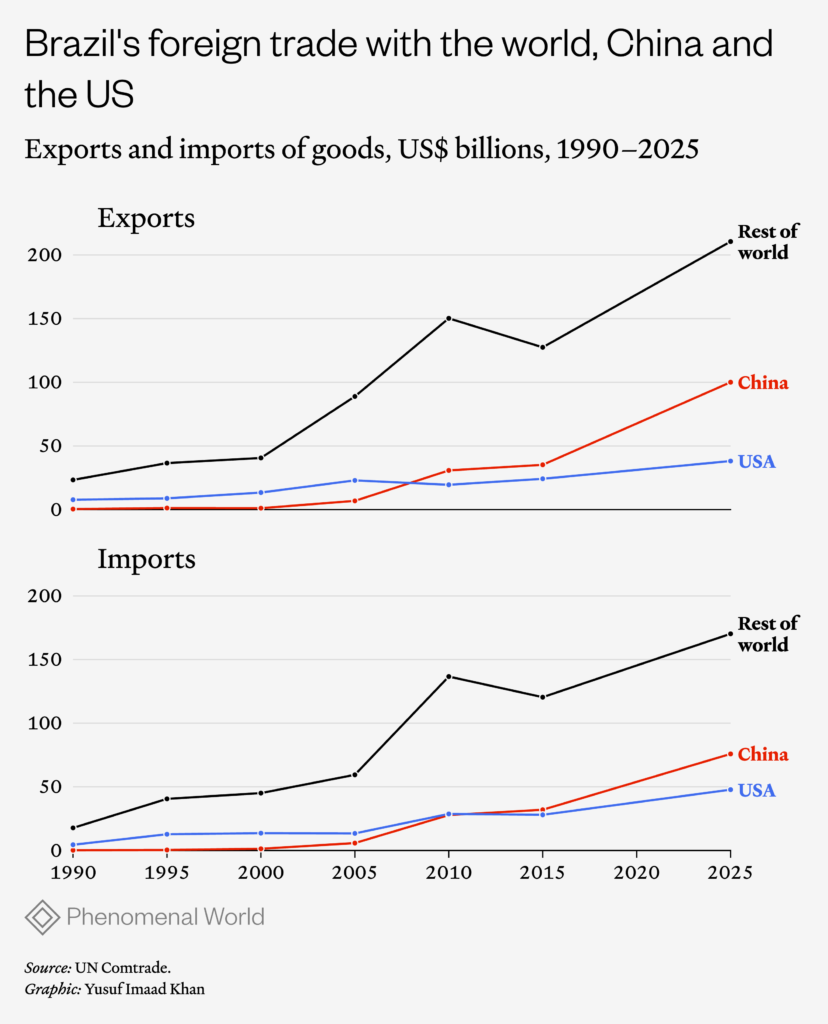
Brazil’s tightening links to China are just part of the story. Data from UN Comtrade reveals a persistent expansion of trade relations with other partners throughout this period. Under the “active and assertive” (ativa e altiva) strategy of the Workers’ Party, Brazil’s trade relations shifted away from G7 countries and toward other parts of the world. Between 1990 and 2025, the country’s foreign trade underwent a veritable reorientation. By 2010, not only had China replaced the US as Brazil’s largest export partner by value, but Brazil’s sources of foreign exchange earnings had diversified considerably. As a result of the commodities boom, Brazilian exports reached 161 destinations in 1990; 201 countries in 2000; and 215 countries in 2025. Today, Brazil trades with nearly all internationally recognized economic partners.1In addition to sovereign states, this includes independent territories and separate customs zones.
Brazil’s relative share of global trade would temporarily decline in the mid-2010s when a domestic crisis, combined with China’s economic slowdown and falling international prices, reduced the value of exports and compressed imports. But this shock was eventually overcome thanks to an active diplomatic and trade strategy, with new trade partnerships solidified in the Middle East, Southeast Asia, Africa, and within Latin America itself.
These new partnerships have proven useful in light of the repoliticization of global supply chains. Since the onset of the pandemic and the outbreak of the war in Ukraine, Brazil’s neutral geopolitical profile has positioned it as a reliable supplier, thereby reviving demand for Brazilian products. Its posture of “active non-alignment,” as well as its advocacy for multilateral trade bodies and systems, have similarly enabled it to successfully navigate a more fragmented global market.
“An insidious attack on free elections”
Since his campaign for a second term, tariffs have occupied a central place in Donald Trump’s foreign-policy agenda. If the promise itself was already ambiguous—the administration’s first wave of tariffs had been entirely passed on to American importers and consumers—its execution proved chaotic. In February 2025, the President announced 25 percent tariffs against Mexico and Canada, the US’s closest trading partners and signatories to the US-Mexico-Canada Agreement (USMCA), which Trump himself had negotiated in 2018.
“Liberation Day” proved to be the great disruptor. It was “as if The Price Is Right had arrived in Washington,” The Guardian reported. Based on spurious claims about the US trade deficit, Trump slapped a 34 percent tariff on China, a 20 percent tariff on the EU, and a 46 percent tariff on Vietnam. The measure was set to take effect one week from the announcement, sending US bond markets into panic. But just a week after the announcement, Trump announced a ninety-day suspension of the tariffs—a period during which all US imports, regardless of origin, would be subject to a flat 10 percent tax rate. The “Ninety Deals in Ninety Days” initiative was thus born; a capitulation to financial interests remodeled as a pressure tactic for bilateral agreements more favorable to US interests.
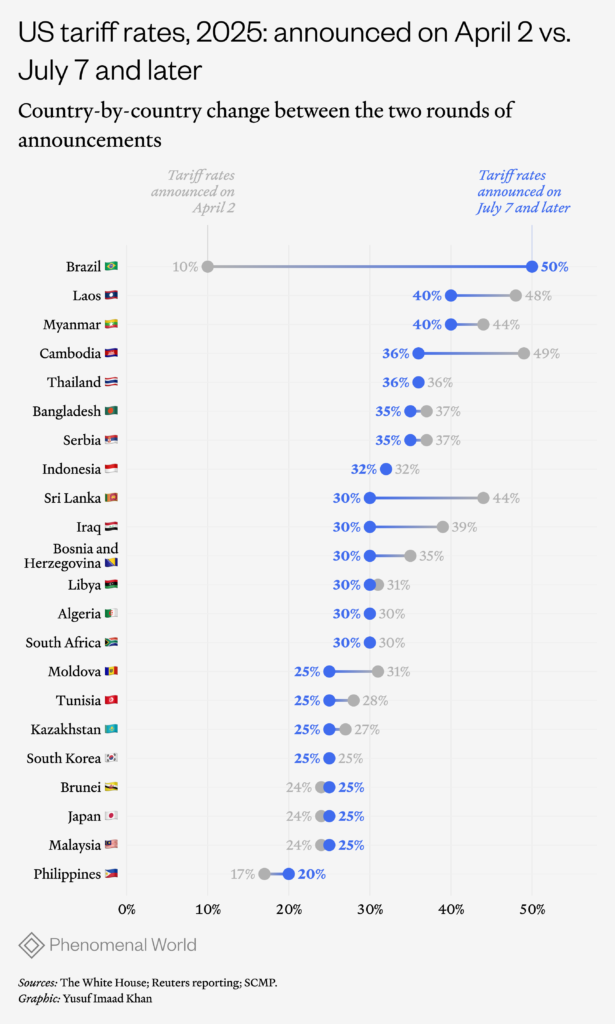
Brazil emerged from Liberation Day practically unscathed, subject only to the universal 10 percent tariff rate. Newly competitive against higher-taxed trading partners, Brazil’s exports to the US increased. Between January and June 2025, coffee exports grew by 40 percent, while meat exports doubled. Coffee and meat ranked, respectively, third and fourth on the list of top-selling Brazilian products exported to the US, behind crude oil and aircrafts.
This amity was short-lived. Ninety days later, on July 9, 2025, Trump announced that all Brazilian exports would be subject to an additional 40 percent surcharge, bringing the total levy to 50 percent. At the time, this constituted the highest tariff imposed anywhere in the world. Any competitive advantages created in April were effectively suspended. In just three months, Brazil went from being a potential winner in the tariff war to becoming its biggest loser.
The justification for these trade restrictions was political. The prosecution of former President Jair Bolsonaro for attempting to organize a military coup after the 2022 elections was, in Trump’s view, an “insidious attack on Free Elections.” In addition to the 40 percent tariff increase, the Magnitsky Act—created to link human rights violations and commerce—sanctioned Alexandre de Moraes, a Justice of the Supreme Federal Court and the rapporteur for the case that would lead to Bolsonaro’s imprisonment shortly thereafter. In a letter issued with the decision, Trump explained that the alleged “witch hunt” against Bolsonaro and recent regulation of social media, including Elon Musk’s X, represented “censorship orders” threatening the “freedom of speech” of the American people.
In response, Lula issued a statement asserting that “Brazil is a sovereign nation with independent institutions.” As such, the Brazilian Judiciary held exclusive jurisdiction over the legal proceedings against those involved in the attempted coup d’état of January 2023. Lula also refuted Trump’s claim that the US ran a trade deficit with Brazil. According to the White House’s own data, Lula noted, the trade balance between the two nations had favored the United States since 2008.
Initially, public attention highlighted the tariffs’ unprecedented political motives. “Does Trump really imagine he can use tariffs to bully a massive nation . . . into abandoning democracy?,” asked the liberal Paul Krugman, noting that sales to the US comprised less than 2 percent of Brazilian GDP. For corporate America, however, the business case against the steep tariff hike quickly overtook the conversation. Recognizing that consumers would ultimately bear the cost, representatives of US industry advocated for a suspension of the tariffs. The US Chamber of Commerce pleaded that “more than 6,500 small businesses in the United States depend on products imported from Brazil, while 3,900 American companies invest in the country. Brazil is one of the top ten markets for US exports and the destination for approximately $60 billion in American goods and services every year.”
Within Brazil, hopes for the revision or postponement of the tariffs would soon be replaced with realistic adaptation. Lula’s team authorized a temporary credit fund for affected sectors. The Ministry of Finance announced a contingency plan, and the government declared that it would work to further diversify its trading partners and strengthen multilateralism. This was done while maintaining an openness to dialogue. Lula affirmed that, “If Trump wishes, our relationship will be the best it can possibly be.”
“Trump fez Lula great again”
For the American public, Trump’s decision to raise the price of Brazilian imports was ill-timed. Even before the 50 percent tariff went into effect, the US domestic market was feeling the inflationary impact on two common household food products heavily imported from Brazil: coffee and orange juice. In 2024, Brazil supplied more than half of all orange juice sold in the US and 30 percent of its imported coffee beans. Trump’s July announcement caused the prices of both commodities to skyrocket: in the week following the dispatch of the letter to Brazil, prices for frozen orange juice futures had already risen by 10 percent, and those for coffee by 6 percent.
For Lula, the moment was one of triumph. Not since the commodities boom had the country’s export performance done so much to boost a president’s image. “Trump fez Lula great again,” proclaimed a columnist for Veja, a notoriously conservative magazine. Opinion polls confirmed these gains. As The Washington Post put it, “Santa Claus came early for Lula, and the gift was sent by Trump.” While the Brazilian left rallied around Lula, his political opposition could not have had it worse. Headlines like “Reaction to Trump widens rift among Bolsonaro’s allies” and “Trump exposes Bolsonaro’s cost to the Right” were blazoned across the country’s major media outlets. Opinion polls highlighted the negative impact of the tariff on the Brazilian right’s approval of Trump.
Lula’s decision to stand ground and seek dialogue proved successful. On July 30, a new executive order listed 694 exceptions, including 43.3 percent of Brazilian exports, to the tariff hike. Among these exceptions were fuels, raw minerals, civil aircraft, and fertilizers.
On September 11, Bolsonaro was sentenced to twenty-seven years and three months in prison. Trump’s stated objective for the tariffs had been disregarded. But rather than attacking Brazil in response, the US continued to soften its stance. On September 23, during the UN General Assembly, Trump commented on the “excellent chemistry” he felt during his “thirty-nine seconds” with Lula backstage. On October 6, the two spoke by phone and initiated formal negotiations for tariff relief. Six weeks later, following a meeting between Mauro Vieira and Marco Rubio in Washington, the list of exemptions was expanded: an additional 269 products reverted to the baseline rate of 10 percent, including coffee, orange juice, and meat. “Brazil Defied Trump—and Won,” declared The New York Times.
After the US Supreme Court declared the use of the International Emergency Economic Powers Act (IEEPA) to impose tariffs unconstitutional in February 2026, the US–Brazil economic relationship returned to its April 2025 state. This time, however, conditions for Brazil were even more favorable. In response to the ruling, which struck down the massive tariff hike of July, Trump instituted a new global tariff of 10 percent. Products previously subject to the 40 percent surcharge would now be subject only to the global 10 percent rate.2The legal battle is ongoing, (<)a href='https://www.nytimes.com/2025/02/20/us/politics/supreme-court-trump-tariffs.html?searchResultPosition=1'(>)and once again the tariffs have been overturned by the Supreme Court(<)/a(>). Brazil’s list of exemptions, however, remained in place. While allies like Japan and the European Union succumbed to Trump’s intimidation and signed unfavorable bilateral agreements, Brazil regained its comparative advantage without acceding to Trump’s demands.
Brazil’s navigation Trump’s tariff onslaught reveals central economic and political elements of contemporary international relations. The diminishing importance of the US in Brazil’s export portfolio explains the limited impact of Trump’s tariff policy on the trade balance of Latin America’s largest economy. Far from forcibly drawing Brazil back into its orbit, Trump accelerated its reorientation. An analysis of Brazil’s foreign-trade data not only corroborates this hypothesis, but also suggests a broader repositioning of the country—one that extends beyond its relationship to China and points toward its role within the broader global economy.
The world as an alternative
Brazil’s performance during Trump’s second term is partly due to its relatively closed economy. While the value of total exports measured in dollars reached an all-time high of $348.7 billion in 2025, a 3.5 percent increase over the prior year, this accounts for only about 17 percent of the country’s GDP—a low level by international standards. According to the World Bank, exports accounted for 30 percent of global GDP in 2024, 25 percent of Latin America’s GDP, and 50 percent of the OECD’s GDP.
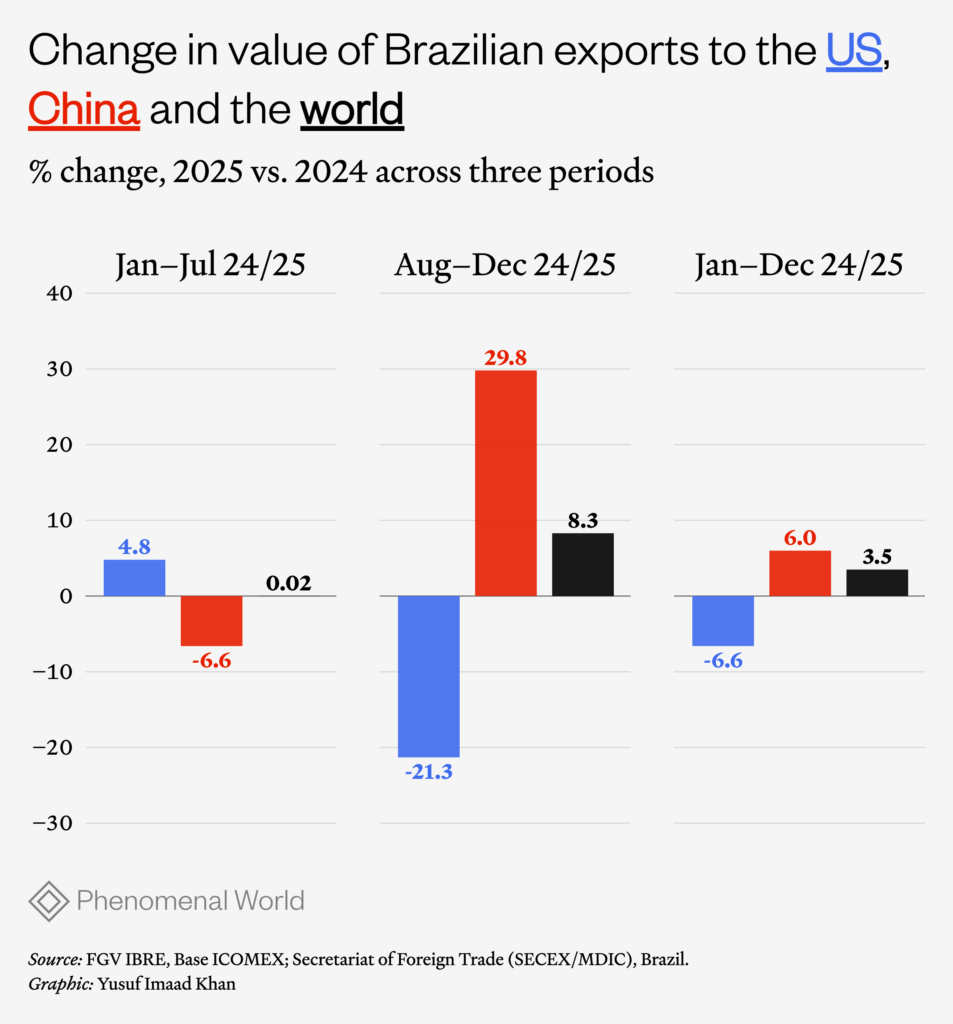
But equally responsible for the innocuous effect of Washington’s tantrum was the growth of Brazilian trade in the world. Though Brazilian exports to the US contracted by by 6.6 percent in 2025, its exports to China grew by 6 percent, to the European Union by 3.2 percent, and to Mercosur by 26.6 percent. By the end of the first quarter of 2026, the US share of Brazilian sales was its lowest in recorded history; in value terms, the total fell by 18.7 percent compared to the same period in 2025. In 2024 and 2025, Brazil’s exports to the US accounted for no more than 2 percent of the country’s total output. Brazil’s exposure to the US market is therefore increasingly limited.
The record growth in exports during the year of the tariff hike demonstrates how the primary impact of Trump’s aggressive measures was to accelerate Brazil’s diversification strategy. A comparison of Brazil’s trade performance in the first half of 2025 (prior to the tariffs) versus the second half (following the tariffs) illustrates this trend. In the first seven months of 2025, before Trump’s July letter, sales to the US grew by 4.8 percent compared to the same period one year earlier. In the final five months, they contracted by 21.3 percent compared to August–December 2024. The Brazilian trading relationship with China moved in the opposite direction. Brazilian exports to China in 2025 declined by 6.6 percent in the first seven months and increased by 29.8 percent in the last five, compared to the same period one year earlier. Exports to other destinations—particularly to countries in Asia, Africa, and the Middle East—also grew after July 2025. Sales to Morocco rose by 62 percent, and to India by 52.9 percent, for example.
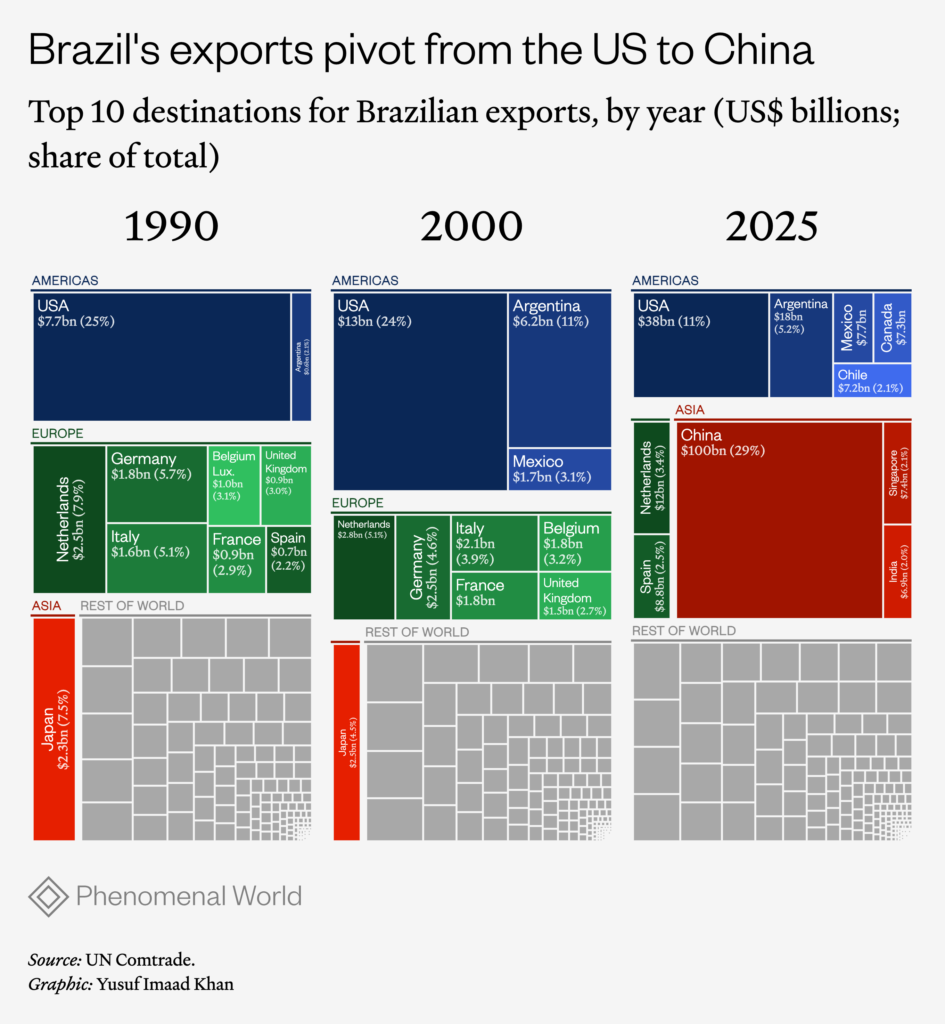
US tariffs, then, did not constrain Brazil’s exports. On the contrary, the country averted potential losses by turning to other markets. Between August and December, China alone absorbed 37 percent of the trade impacted by the US surcharge. A large portion of this volume was linked to China substituting commodities previously imported from the US. On the domestic front, the Brazilian government achieved an unusual degree of cohesion among political and economic forces, to the point of isolating the right-wing opposition on this issue. Inadvertently, Bolsonaro’s US allies secured for Luiz Inácio Lula da Silva his highest approval ratings of the year. On the international front, the country reaffirmed national sovereignty as the guiding principle of its global engagement—something that not even European powers had managed to sustain with such consistency. If one of the driving forces behind the “Donroe Doctrine” was to diminish China’s relevance in the Americas, the tariff hike achieved precisely the opposite.
Although Brazil largely mitigated the macroeconomic effects of US trade policy, it was not able to offset declining exports to the US through market diversification in all sectors. According to Icomex:
Among the twenty-eight sectors analyzed, twenty-four recorded a decline in exports between the first quarter of 2026 and that of 2025. Of these, fifteen recorded positive growth in exports to the rest of the world while seeing sales to the United States decline, whereas nine recorded a drop in sales to both the United States and the rest of the world. Four sectors increased their sales to the United States.
Brazil made concerted efforts to alleviate these sectoral impacts. One of the primary mechanisms employed was the creation of the Brasil Soberano (Sovereign Brazil) program, administered by the Banco Nacional de Desenvolvimento Econômico e Social (National Bank for Economic and Social Development, BNDES). This initiative consists of a dedicated credit line designed to assist affected exporters. In 2025, BNDES’s total disbursements reached R$ 169.7 billion—a 27 percent increase over the previous year. Of this total, the Brasil Soberano program accounted for R$19.5 billion, more than half the increase, allocated to 676 companies. In 2026, BNDES established a new credit line to support sectors affected by global crises.
The substance of sovereignty
The uncertain end of the “post-Cold War era” and the increasingly fragile remnants of its Washington Consensus have brought the problem of sovereignty to the center of national politics across the globe. In Brazil, sovereignty has been reasserted, but its future remains to be seen. Despite the political boost that Trump’s attack gave to Lula, high interest rates, severe levels of household debt, and rising costs of living continue to inform Brazil’s political landscape. Although Washington’s attempt to intervene in Jair Bolsonaro’s trial failed, Bolsonarismo will remain the primary adversary in Brazil’s forthcoming general elections. The choice between an active and assertive stance on the one hand, and a subordinate alignment with the US on the other, is bound to reemerge.
Leading the electoral race are the far right—represented by Flávio Bolsonaro, the former president’s eldest son and an equally ardent admirer of Trump—and Lula—seeking yet another presidential term on a platform of defending democracy and multilateralism. Flávio Bolsonaro is currently tied with Lula in the polls.
Much will unfold between now and the elections in October. But Brazil’s recent experiences with Trump’s tariff regime hold some insights for understanding future developments. First, the US trade offensive illustrated the decline of imperial power over Brazil. Second, while the growing importance of China in Brazil’s trade balance is significant, it alone does not explain the country’s capacity to absorb US attacks. This success extends beyond bilateral relations and points to an ability to operate outside a single axis of dependency.
The Brazilian case suggests that the construction of a multipolar order depends not exclusively on the emergence of new powers, but also on the room for maneuver available to important regional actors. Washington’s miscalculation was not merely economic; it was also geopolitical. Given the possibility of non-alignment among middle powers, coercive policies have diminishing impact. Brazil’s defense of multilateralism is not merely rhetorical, but material.
In Brazil’s October elections, the choice is thus not just between two governing platforms, but also between two approaches to international engagement, one rooted in subordination and the other in multilateralism. The lesson to be drawn is that sovereignty is neither an abstract concept nor an electoral promise. It is, rather, the effective capacity to resist, decide, and negotiate under pressure. And this, too, will be contested at the voting booth.
Further Reading
Histories of Decline
Politics and economics in American “declinism”
American elites have raised the question of US decline periodically for most of the last sixty years. What can we learn from this march of...
The Dollar’s Dominance
Currency primacy in historical perspective
Is de-dollarization on the horizon? One of the mainstays of the global order for the past seventy years has been American economic leadership and the...
Empire Suicide Watch
Examining the anatomy of US power
What kind of empire is American empire? Does Trump's belligerent protectionism mark a break in American hegemony, or the reconstitution of a prior era of...