July 15, 2026
Analysis
Who Owns the World Cup?
FIFA's commercial machine
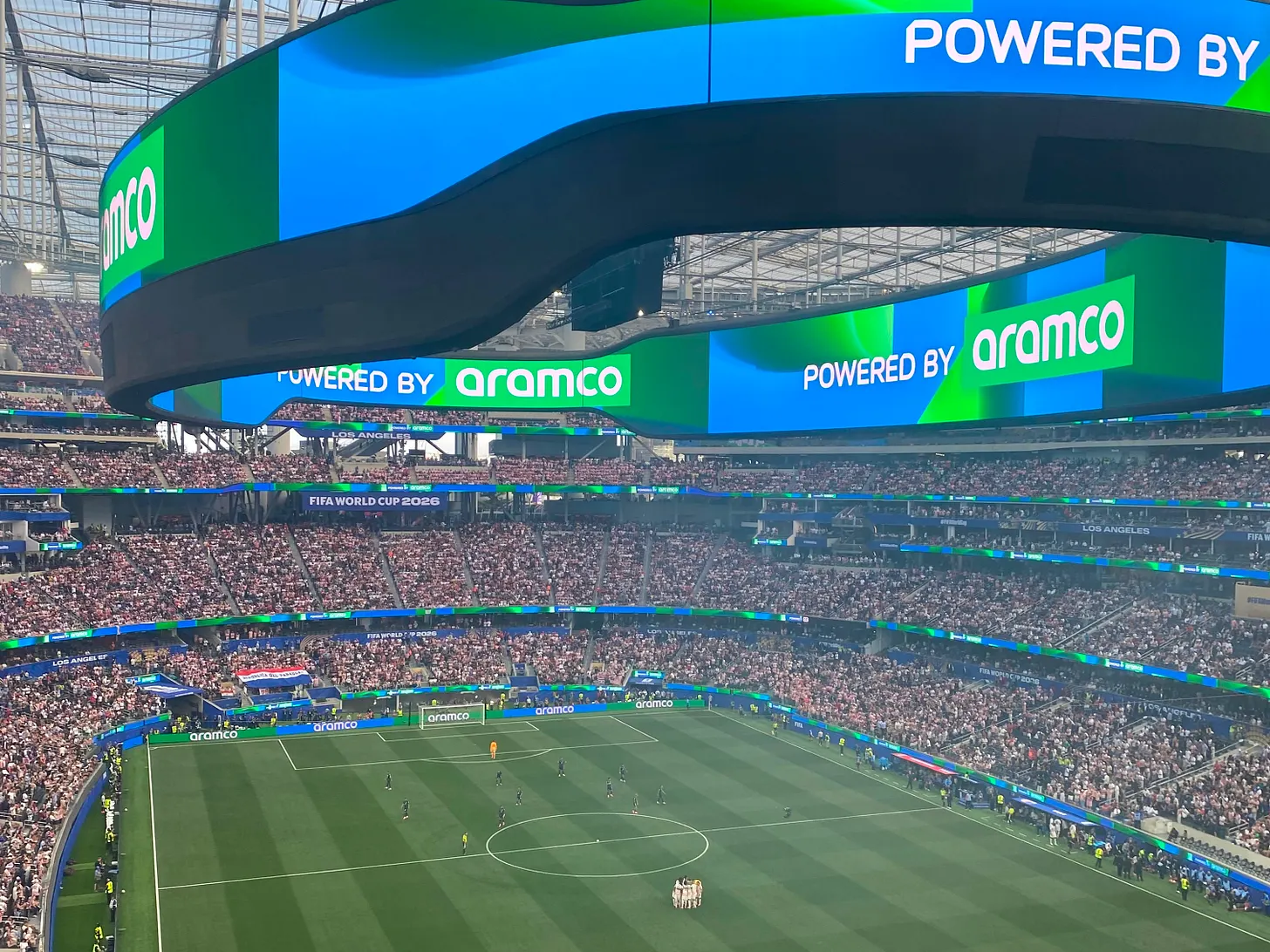
This weekend the FIFA Men’s World Cup 2026 ends. Since its location was announced in 2018, this was set to be a tournament like no other, spread across three countries and sixteen cities and featuring a bumper list of forty-eight teams, playing matches over five weeks. It is projected to be the most emissions-intensive tournament in the competition’s nearly century-long existence (due in part to FIFA president Gianni Infantino’s private jet), as well as the first in which a host team has been bombing a competitor (the United States began its war against Iran barely two months after Infantino awarded President Trump the federation’s inaugural Peace Prize). Forecast to generate record revenues for FIFA, this World Cup is a watershed moment in both the evolution of sports tourism and the history of advertising and sponsorship.
But behind the spectacle of the World Cup sits a quieter story that far outlasts the lifting of the trophy. To stage a World Cup, governments do not simply build stadiums and erect fan parks; they grant FIFA a bespoke legal and fiscal regime of tax exemptions and commercial monopolies, alongside policing, security and transport investment, and, on occasion, new laws written to sponsor specifications. The states and cities that host a World Cup are left irrevocably changed. While the benefits flow to FIFA and its corporate partners, the costs and the legislation stay behind.
This tournament has seen a new level of integration between FIFA and its host countries. No previous host country government has run the World Cup operation out of its head of state’s office. On March 7, 2025, flanked by Infantino in the White House, Donald Trump signed an executive order establishing the “White House Task Force on the FIFA World Cup 2026,” chaired by Trump and vice-chaired by Vice President JD Vance. FIFA, meanwhile, has dispensed with the customary local organizing committee model, in which a national entity is established to organize and run the tournament. Instead, it has run the 2026 tournament through its own subsidiaries, dealing directly with host cities and working closely with the White House Task Force. Under this arrangement, FIFA controls media relations, sponsorship, and ticketing revenue, while the host cities carry the cost of fan safety and security. The tournament’s operations are run from the heights of FIFA’s new office space in Trump Tower, paying what it describes as “market rent.” FIFA, long a machine designed to convert football’s global audience into politically brokered rents for international monopoly brands, is seeking a new degree of closeness with the state to make that process as seamless as possible.
The Dassler template
The World Cup is a commercial juggernaut that has developed according to FIFA’s operating logic: moving across the globe, maximizing revenue for corporate partners and, in so doing, securing its own longevity and continued growth. The institution’s engine is advertising. It was Adidas scion Horst Dassler, known as the father of sports sponsorship, who grasped before anyone else that the real money in football was not in selling boots to players, but in controlling the federations that governed them. This innovation was critical for the future of the World Cup.
An opportunity arose in 1974, when FIFA selected Brazilian João Havelange as its next president on a platform of expanding the tournament’s diplomatic and commercial reach. Havelange unseated the long-serving English incumbent by promising an ambitious twenty-four-team World Cup (it had previously had sixteen teams, barring a few notable exceptions) and new development money for the club federations of Africa and Asia. FIFA could not afford those promises, so Havelange turned to Horst Dassler and his connections in order to enlist Adidas and Coca-Cola as the primary sponsors of FIFA’s tournaments.
The resulting design was not simply an avenue for advertising revenue, but a new structure for commercial partnership that entrenched advertising monopolies. Four years later, at the 1978 World Cup in Argentina, FIFA debuted the bundling of advertising rights into packages sold to brands as exclusive ownership of a specific product category, such as sportswear or alcoholic beverages. As a marketing tactic, these bundled rights went far beyond the communicative reach of traditional advertising campaigns, and also excluded competitors entirely. It is the model that has ensured that Pepsi has not advertised at the World Cup since 1978 and that Adidas has designed every match ball for nearly five decades.
A generation later, broadcasting followed the same arc. For decades FIFA had sold World Cup television rights to the European Broadcasting Union (EBU), the public broadcasters’ consortium, at prices that treated the tournament as a public good. The three World Cups of the 1990s earned some $310 million in combined worldwide TV rights. Then, on July 5, 1996, FIFA’s executive voted to bypass the EBU and sell the 2002 and 2006 tournaments as a single bundle, with European rights going to the German media group Kirch, and worldwide rights to ISL, stipulating only that the final, the semifinals, and national-team matches remain free to air. The deal was valued at 2.8 billion Swiss francs, roughly ten times what the EBU had paid for France 1998 and a per-tournament increase of some 1,000 percent.
This model was hugely lucrative for FIFA. An exclusive sponsorship position before the largest recurring audience on earth is a coveted perch that undoubtedly justifies prices no ordinary advertising campaign could. The value of this position to companies becomes apparent when such arrangements are threatened. In 2006, for example, FIFA sold the advertising rights for the payment-card category to Visa for $180 million over eight years, despite MasterCard, the incumbent since 1990, holding a contractual right of first refusal. MasterCard sued in federal court in New York, won an injunction awarding it the sponsorship, and was ultimately paid off by FIFA in a 2007 settlement reported at £45 million enabling Visa to keep the slot. It has been reported that the bidding for broadcast rights to the 2030 and 2034 World Cups could start at $1 billion.
The Dassler template has been applied to every sponsorship deal since. The system wobbled momentarily when Dassler’s marketing agency, ISL, which had become FIFA’s marketing arm, collapsed in 2001 amid revelations of bribes paid to sports officials through offshore accounts. In 2012, Havelange was found to have taken millions in kickbacks on marketing rights from ISL. But the commercial architecture that enabled Havelange’s corruption held, and the federation solidified its model of generating corporate rents as a way to secure its grip on football’s global infrastructure. The organization redistributes a slice of its advertising revenues as patronage, with each of its 211 member associations now receiving $1.5 million through the FIFA Forward program to develop the game in their region.
Advertising revenues have compounded. Sports sponsorship is now a global industry worth over $70 billion, and FIFA, which is the industry’s central player, earned $5.7 billion in the Qatar 2022 cycle and expects more than double that from the 2026 tournament, with an estimated record-breaking take of $13 billion. In 2024 FIFA created an entirely new tier of sponsorship, “Major Worldwide Partner,” and the inaugural slot went to the world’s largest oil company, Saudi Aramco. The deal is reported to be worth around $100 million a year and will run for four years. According to FIFA, the revamped commercial program ahead of 2026 generated more advertising and sponsorship revenue than any previous standalone sporting event—and this was before a ball was kicked.
New opportunities to advertise proliferated at the 2026 tournament. Perhaps most controversial of all is advertising during the hydration breaks—a mandatory break introduced across all matches due to the heat and humidity experienced in some of the stadiums. “The Americans will want to divide the game into four halves instead of two to insert advertisements,” Diego Maradona predicted in 2018. “Compare it, you will see.” Though these breaks are too short to actually cool players, and FIFA has failed to implement its already meagre heat protocol guidelines when heat and humidity reached dangerous levels for players, these breaks provided plentiful opportunities for advertisers: they are expected to earn Fox $250 million in revenue.
New marketing opportunities are also appearing as online streaming increasingly displaces older forms of television broadcasting. Industry press reported a frenzy in “adtech” spending, as companies experimented with tailored advertising for viewers across streaming services. In Brazil, FIFA hired a private equity-backed media company, LiveMode Serviços Digitais, to negotiate the sale of broadcasting rights in the country. LiveMode sold the rights to CazéTV, which it also owns, in a partnership with YouTube—the first time in living memory that Globo, the nation’s historic media conglomerate, has not controlled the broadcast of the tournament. The rise of sports betting, in turn, has fueled CazéTV, with gambling opportunities advertised in the promotional material accompanying the tournament’s broadcast in the South American country.
Home advantage
The asset underneath all of this—the audience’s attention—has only appreciated. Football’s reach has grown into something the historian David Goldblatt has likened to organized religion in its capacity to pervade and structure everyday life. Approximately 51 percent of humans on earth identify as football fans. The last World Cup final, hosted in Qatar in 2022 between France and Argentina, was watched by an estimated 1.42 billion people. It is believed that the 2026 final will surpass the 2022 Qatar final by some margin. The sheer scale of advertising revenues generated by FIFA and the World Cup is precisely why they have become worth contesting at the level of states.
Only nineteen countries have hosted a World Cup since the inaugural tournament in Uruguay in 1930, despite many professing their hopes to do so. Economics alone cannot explain these hopes. Twelve of the last fourteen World Cups since 1966 have produced financial losses for their hosts, and the last three delivered an average return on investment of minus 31 percent. Even the 1994 tournament in the United States, remembered as a commercial triumph, fell between $5.5 and $9.3 billion short of its projections. Despite these documented losses, the bidding process has grown fiercer since Havelange’s 1970s growth strategy, suggesting that would-be hosts are pursuing objectives beyond financial remuneration.
For the World Cup’s first half-century, hosting was less a prize and more an assigned obligation. Colombia was awarded the 1986 World Cup in 1974 without a rival bid, and in 1982 became the first and only country to hand a World Cup back, when President Belisario Betancur—facing hosting requirements transformed by Havelange’s expansion of the tournament to 24 teams—announced on national television that Colombia had no time to “attend to the extravagances of FIFA and its members.” Within three decades the calculus had reversed entirely. When FIFA’s executive committee met in December 2010 to award the 2018 and 2022 tournaments simultaneously, the right to make precisely the concessions Betancur refused had become valuable enough to try and purchase. According to the US Department of Justice’s 2020 indictment, FIFA committee members were bribed by states for their votes.
For South Africa in 2010 and Brazil in 2014, successful bids were a developmental spectacle of modernity and creditworthiness that proved lucrative less for governments than for those in their patronage networks: the construction firms and urban coalitions that captured the contracts while the “white elephant” stadia stayed behind as an enduring drain on public budgets. For Russia in 2018 and Qatar in 2022, hosting a World Cup was an attempt to bolster its international standing amid shifting geopolitics and fossil fuel trade flows. Qatar spent an estimated $220 billion ahead of the 2022 tournament, viewing the outlay as an investment in the country’s reputation.
Tactical concessions
After being selected to host a World Cup, both FIFA and the host enter into a Host City Agreement (HCA) that sets out a series of enforceable legal obligations. Far more than simply a logistical exercise of arranging a program of matches, the HCA can contain stipulations on passing new legislation on corporate and marketing matters, tax exemptions, aligning local policing with the operational specifications of the tournaments, and allowing FIFA to circumvent international arbitration. While capturing the bulk of the commercial revenue the tournament generates, FIFA leaves the hosts to bear the full cost of stadiums, security, and preparation.
Organized as a nonprofit association under Swiss law, FIFA pays no tax on the revenues it draws from the World Cup. Its subsidiaries are taxed locally, which is why the choice of host turns, in part, on what governments are prepared to exempt. Brazil’s Lei Geral da Copa (the General World Cup Law), signed by President Dilma Rousseff in 2012, granted FIFA and its commercial partners a sweeping package of tax breaks, commercial monopolies around stadiums, and legal protections for FIFA and its corporate partners, as well as overturning a national ban on the sale of alcohol in stadiums, which had been introduced in 2003 to curb deadly crowd violence. The ban was lifted because a longstanding FIFA sponsor, Budweiser, required it. FIFA’s then-secretary general Jérôme Valcke put it plainly: “alcoholic drinks are part of the FIFA World Cup, so we’re going to have them. Excuse me if I sound a bit arrogant, but that’s something we won’t negotiate.”
The same demands recur wherever the tournament travels. Russia legislated special tax provisions for 2018 at an estimated cost of $80 million in forgone income tax; Qatar’s exemptions for 2022 covered income taxes, excise duties, and customs for every entity involved; and Mexico, having granted FIFA a full income-tax exemption in 2018, passed a 2020 constitutional reform prohibiting exactly such exemptions only to grant FIFA a comprehensive one anyway in its 2026 Revenue Law. Nor is the residue from hosting World Cups only fiscal. The security apparatus a host assembles tends to outlive the tournament, as in Brazil, whose first standing anti-terrorism statute—passed for its sports mega-events with a safeguard for social movements and unions stripped out in the Senate—remained on the books for the Bolsonaro era, when his allies moved repeatedly to expand it to include social movements like the Landless Workers’ Movement.
Trump ball
When it was announced that the World Cup would be coming to North America in 2026, FIFA set out on a multi-year lobbying process with its main host, the USA. Infantino has appeared repeatedly at the White House since Trump’s reelection, and FIFA created a Peace Prize that it awarded to the president after Trump missed out on the Nobel Peace Prize, which went to María Corina Machado despite Infantino lobbying the Nobel committee on behalf of Trump.
The friendship runs in both directions: Infantino was first been welcomed to Trump’s Mar-a-Lago residence in January 2025, and attended the inauguration days later. More bizarrely, Infantino reportedly joined Trump on a political trip to the Middle East, attending the Summit for Peace held in Sharm El-Sheikh, Egypt, promising that FIFA would “help to bring football back” to Palestine because “football brings hope to children, and it’s very, very important.” (During the World Cup, an Israeli airstrike killed an Palestinian aid worker, Mohammed al-Wahidi, who had become well-known for organizing public screenings of the games amid a genocide supported by the US that has killed 20,000 children and injured 44,000 more since October 2023.)
Ahead of 2026, FIFA’s bidding requirements demanded a full tax exemption covering income taxes, customs duties, and sales taxes on ticket revenue. Missouri, Georgia, and Florida each passed legislation exempting World Cup ticket sales from state and local sales taxes, a condition FIFA had set for host-city selection. The public absorbs the loss: the Institute on Taxation and Economic Policy estimates that Georgia stands to forgo as much as $25 million in revenue, Florida some $7.4 million from the Miami matches, and Missouri roughly $1.9 million for each of the six games at Kansas City. It is for these reasons that Chicago, the third-largest city in the United States, refused to host 2026 matches after officials concluded it would leave the city in debt.
At this World Cup, FIFA introduced dynamic pricing, the airline-style model in which prices float in real time with demand. The most expensive tickets (for the final) initially sold at $6,730, but had reached $10,990 by the spring sales windows. Seats on FIFA’s own resale platform, from which it takes a 15 percent cut from both buyer and seller, climbed into six and even seven figures. At the Qatar World Cup, the top price for a ticket was roughly $1,600. Infantino defended the prices as simply “market rates” for the American entertainment economy, but even Trump said he would not pay the four-figure sums being asked for some seats at the USA’s opening game. A tournament FIFA marketed under the slogan “Football Unites the World” had, one European supporters’ group charged, committed a “monumental betrayal” of the fans.
Such practices have drawn the attention of regulators: in May 2026 the attorneys general of New York and New Jersey, Letitia James and Jennifer Davenport, subpoenaed FIFA, opening a joint investigation into ticketing practices that they said had “far exceeded the prices for any previous World Cup.” And in Brazil last week, during the tournament’s quarterfinals, the Ministries of Finance and Justice announced new rules restricting commentator and network suggestions on sports betting (the industry purchased the bulk of advertising from the Brazilian distributors).
Trump has been candid about what the tournament is worth to him politically. The 2026 World Cup arrives as he wages a trade war against the two countries cohosting it. When asked about the tension, he told reporters in the Oval Office that “tension is a good thing. It makes it much more exciting.” A tournament sold to the world under the banner of unity is, for its most powerful host, an instrument of leverage like any other.
The long game
This Cup’s “Major World Partner,” Aramco, is inseparable from the state that owns it—and Saudi Arabia will have a major role in FIFA’s future. In late 2024, not long after Aramco became FIFA’s biggest sponsor, FIFA was struggling to sell broadcasting rights to its new, expanded Club World Cup tournament, also hosted in the US. At the last minute, the streaming service DAZN, which had been reporting losses of more than a billion dollars a year, acquired the global rights in a deal reported at around $1 billion. Weeks later, SURJ Sports Investment, owned by Saudi Arabia’s sovereign wealth fund, the PIF, bought a stake of under 10 percent in DAZN for a reported $1 billion, the fund effectively underwriting the broadcaster that had rescued FIFA’s club tournament experiment.
Not long after this, FIFA awarded Saudi Arabia the 2034 World Cup as the sole bidder. That outcome was not left to chance: the 2030 tournament was handed to three continents (Europe, Africa and South America) at once, such that FIFA’s own confederation-rotation rules left only Asia and Oceania eligible for 2034, and the bidding window was open for just twenty-five days. Saudi Arabia declared within minutes, and Australia eventually withdrew its bid. Observers read the situation as the governing body bending its rules to clear a path for the Kingdom.
This is a shift in kind, not degree. Dassler’s structure allowed corporate monopolists to rent football’s audience in defense of a product. Aramco deploys the same structure, at $100 million a year, in defense of something larger. The state has gone further still, from buying the advertising, to underwriting one of FIFA’s broadcasters, to hosting the tournament. Sponsor, financier, then host—a position inside the institution rather than a pitchside billboard. The price tag of this statecraft is currently being written. The stadiums for 2034 largely do not yet exist; the tax exemptions, commercial monopolies, and security arrangements are still to be legislated, but one can expect little tension between FIFA’s demands and the host’s laws. Half a century ago, a Colombian president handed the World Cup back on the grounds that a country should not serve it. In 2034, a country will own it.
Further Reading
Miami Syndrome
Competing factions debate Cuba's future amid unfolding catastrophe
Anticipation defines Miami. The city was developed in the early twentieth century on previously uninhabitable ground, built on islands dredged from the ocean and financed...
OPEC Plus
Economics and politics in an expanding exporters organization
While OPEC's economic stratagem has always trumped the political orientation of some of its members, wide geopolitical shifts have diminished the role of some nations...

Rebuilding the Kingdom
Transformations of state, economy, and class in Saudi Vision 2030
Crown Prince Mohammed bin Salman’s Saudi Vision 2030 promises to transform the oil power’s economy and society. The plan has prompted an enormous wave on...