July 6, 2026
Analysis
Miami Syndrome
Competing factions debate Cuba's future amid unfolding catastrophe
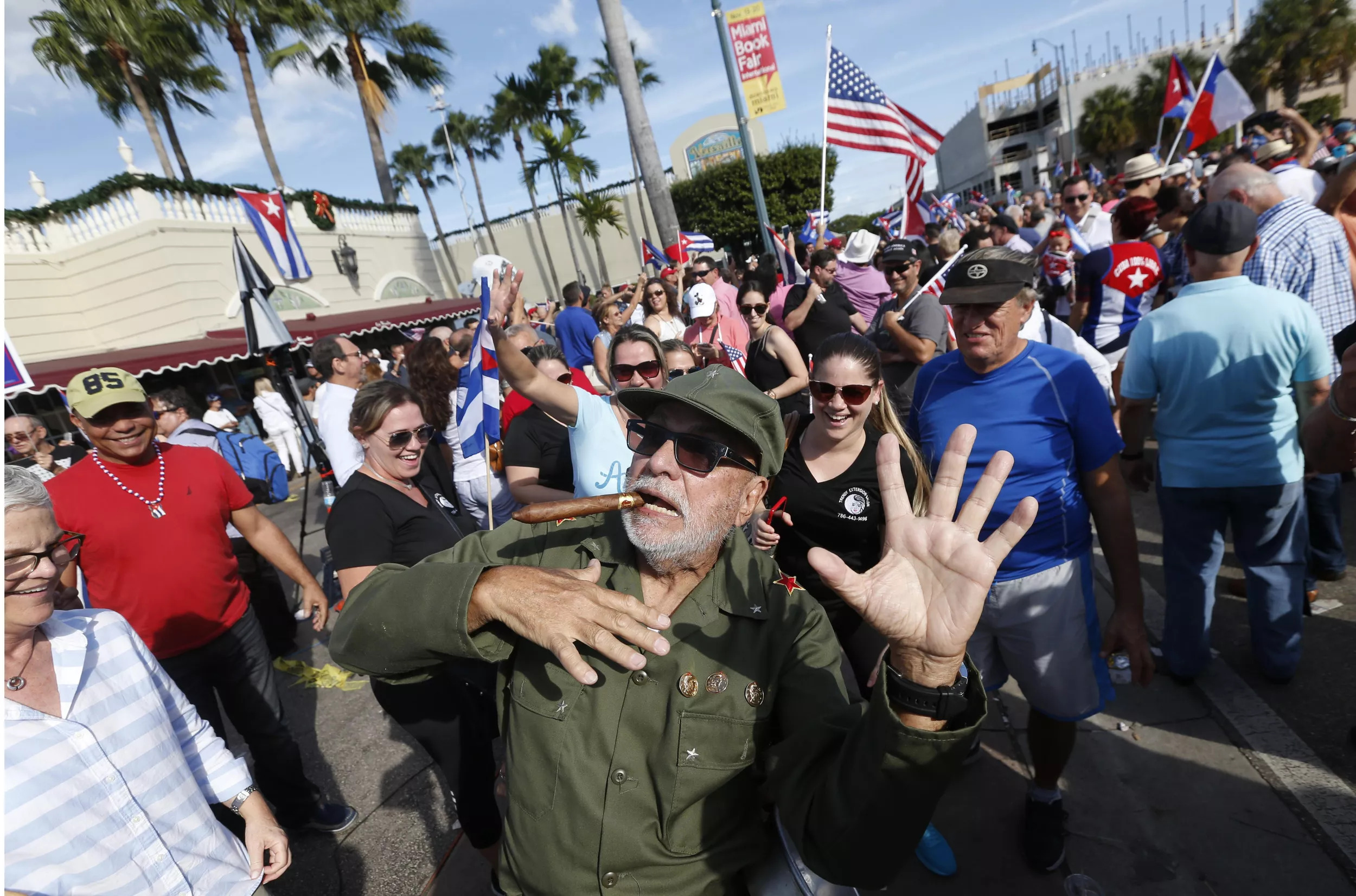
Anticipation defines Miami. The city was developed in the early twentieth century on previously uninhabitable ground, built on islands dredged from the ocean and financed by the state-supported land speculation that has since shaped its growth throughout repeated boom-and-bust cycles. Wealth is generated by what is perceived to be coming: waves of new inhabitants, new construction, capital inflows, asset inflation. Anticipation also plays a fundamental role in Florida’s regime of risk governance—in markets for both private insurance and public finance—which attempts to adapt to the climate change that is threatening to submerge South Florida by the end of the century.
But for more than half a century, nearly all eyes in Miami have been particularly fixed on one horizon: the prospect of political change in Cuba. Havana is just 230 miles away from Miami—closer than the distance between Miami and Florida’s second city, Tampa. Miami City Hall in Coconut Grove, on the shores of Biscayne Bay, is housed in the old Pan American Seaplane Terminal, which connected the city to Havana via daily flights during the Great Depression. It was requisitioned by the Navy during World War II, when Miami served as a military base, and the postwar return of servicemen sparked a population boom and suburban sprawl.
However, it still had a relatively limited tourist economy, and was riven by vicious racial divisions in the 1950s and 60s, which were exacerbated by highway development that isolated black neighborhoods. The city was revitalized after 1959 with the exodus of people and capital from the Cuban Revolution. Cuban exiles—many of them members of the pre-revolutionary elite—transformed Miami from a winter resort town for those coming from the Northeast into an international business hub. Currently 1.2 million Cuban Americans reside in Miami-Dade County—more than 50 percent of the county’s total.
The Cuban Missile Crisis of 1962 established Florida as a major ideological and military bulwark in the struggle against communism and other enemies of conservative causes. It is a role that the state—currently home to three major US military combatant commands—continues to play with gusto to this day. Since the Covid-19 pandemic, which Florida’s GOP leadership saw as a lucrative opportunity to attract people and businesses to their free state, Miami has become a billionaires’ playground, exploding with commercial activity—the “Wall Street South.”
Over the last several months, thanks to the Trump administration’s intervention in Venezuela and the intense oil blockade of Cuba, expectations of political change in Havana have been running high. The Trump administration has been moving warships from the Middle East to Cuba at the same time as it has been intensifying its economic sanctions and intelligence operations in Havana and Santiago. On May 17, the US began accusing Cuba of preparing drone attacks on the US military in Guantanamo and possibly Key West in Florida. Several days later, the US Justice Department secured an indictment against Raúl Castro, former Cuban President and Fidel’s brother. For many onlookers in Miami and beyond, Cuba appears to be on its knees, its revolution’s gains imperiled. As the crisis on the island deepens, Miami is preparing contingency plans for public celebrations and a possible new influx of migrants—as it did in the early 1990s, when the demise of the Soviet Union put Miami on the Cuban regime’s deathwatch. But, as back in the 90s, no one really has “the slightest idea of what would happen were Castro’s regime to fall.”
The shared horizon has never implied a shared vision. Since the revolution of 1959, a persistent feature of Miami’s political life has been the effort to push Washington toward regime change in Cuba. Washington repeatedly raised those expectations only to postpone them again. Though today there is broad support for regime change among Cuban Americans in South Florida, there is by no means unity on the question of how to get there, or how best to benefit from it. While virtually all factions anticipate the end of communism on the island, they disagree profoundly over what should replace it. The maximalists—including major US corporations, like Exxon—continue to seek the complete vanquishing of the regime in Havana, accompanied by restitution and reparations. The more pragmatic, liberal groups advocate a managed transition built around market reforms and the avoidance of state collapse. Miami’s wealthiest business elites, meanwhile, remain reluctant to invest until Washington assumes the political and financial risks of reconstruction. Whether big US business, Cuban American wealth, or small business owners drive the transition will have consequences for the future of Cuba, though given the unfolding crisis on the island, it’s unclear how realistic any of these visions is in the short-term.
In the meantime, Miami continues to build—literally and figuratively—on anticipation itself. Miami sits at the forefront and increasingly at the center of global financial and political power, presenting itself as a hemispheric capital and a gateway to and from a Latin America that the Trump administration is attempting to place under increasingly direct control. The future, no matter how vague or uncertain, remains the project the city knows best how to sell, finance, and monetize.
From Coral Gables to Hialeah
Administratively, the City of Miami is only one municipality within a larger metropolitan area spanning Florida’s three most populous counties, Miami-Dade, Broward, and Palm Beach, which stretch from the Atlantic Ocean to the Everglades. Extreme racial and wealth disparities are inscribed in this political geography. Multiple generations of Cuban exiles crisscross South Florida, differentiated by the time of their arrival and the neighborhoods they can afford to inhabit.
Wealthy (mostly white) landowners and urban bourgeoisie who were dispossessed by the revolution and arrived in Miami in its immediate aftermath are now firmly grafted into the power structures of their adopted country, living in the prime real estate areas of Coral Gables, Pinecrest, or Key Biscayne. After the Bay of Pigs fiasco and a series of unsuccessful clandestine attempts to assassinate Fidel Castro and overturn the regime, exiled militants remade themselves as ethnic entrepreneurs and gained major footholds in politics and economics. These early emigres were able to determine both the business and social success of those who followed them largely due to the spatial concentration of Cubans in South Florida and their sense of isolation from others, be it their American hosts or Latin American neighbors. The political intolerance of the enclave, according to sociologists Alejandro Portes and Alex Stepick, “imposed a monolithic outlook on the city, often with little regard for the concerns and interests of other segments of the population.”1Alejandro Portes and Alex Stepick, (<)em(>)City on the Edge: The Transformation of Miami(<)/em(>) (University of California Press), 138. In the mid-1980s, Joan Didion described Cuban exilios in Miami advocating for the complete dismantling of the communist regime and rejecting any possibility of dialogue.
The staunch opposition of these generations to the regime in Havana found its political expression in activities of the Cuban American National Foundation (CANF), a lobbying organization established in 1981 and modeled after the American Israel Public Affairs Committee (AIPAC). CANF’s founder, the construction magnate Jorge Mas Canosa, was a mercurial figure who towered over the exile community for decades. In 1992, Time magazine described him as “the man who would oust Castro.” In 1994, in exchange for a tougher US embargo on Cuba, Mas Canosa endorsed the Clinton Administration’s detention of Cuban refugees at Guantanamo, reversing the long-standing policy of granting Cubans political asylum. Clinton introduced the “wet foot/dry foot” interpretation of the Johnson-era Cuban Adjustment Act, which specified that Cubans intercepted at sea would be sent back, while those who made it to US soil could legally pursue the right to stay. This tightening of Cuban immigration policy was followed by the CANF-endorsed Cuban Liberty and Democratic Solidarity Act of 1996. Popularly known as the Helms–Burton Act, it codified the US economic embargo against Cuba and imposed penalties on foreign companies doing business there.
The original generation of el exilio is now mostly gone. Their children and grandchildren often continue the commitment to regime change, but have made their lives in the US. One prominent example is Secretary of State Marco Rubio. In his autobiography—notably titled An American Son—Rubio, a son of Cuban pre-revolutionary working-class immigrants, describes himself as “an heir to two generations of unfulfilled dreams.”
Subsequent waves of migrants from Cuba have come to Miami under different circumstances, such as those who arrived in 1980 as part of the Mariel boat lift, when, under pressure, the Cuban government allowed nearly 120,000 of its citizens—many of them prisoners and the mentally ill—to migrate to the US. Another wave came during the Special Period—a euphemism for one of the most severe peacetime economic contractions in the modern Americas. With the fall of the Soviet Union, Cuba’s main financial backer, the country’s GDP plummeted by 35 percent. Trade fell by 75 percent, and food and energy shortages reshaped everyday life. During the 1994 Rafter (Balsero) Crisis, thirty to fifty thousand Cubans left the island for Florida, many of them drowning while making the crossing. Mas Canosa’s stricter embargo after 1994 stemmed the flow of Balseros, but there have been subsequent streams of less prosperous migrants into Florida, such as the most recent “walkers,” who since 2017, thanks to Obama’s ending of the “wet foot/dry foot” policy and remaining special privileges for Cuban immigrants, have been reaching the US on foot via Mexico and requesting asylum like many others from around the world. A massive emigration wave from the island starting in 2021 helped plunge its population to under 10 million people—a quarter of whom are aged 60 and over.
With friends and families still in Cuba, and sometimes decades of experience under communism, these more recent migrants have often been treated with suspicion by elite Cuban Americans. Upon arrival, there is enormous pressure to adopt el exilio’s obligatory anti-Castro narrative, even as many maintain connections with the world they left behind. Miami, wrote Maria de los Angeles Torrres, “is a city in which the desire to relate to one’s homeland has been treated as an act of betrayal.”
Many newcomers have settled in Hialeah, a lower-middle-class city with a 90–94 percent Latino population, at least 75 percent of which is Cuban. There are estimates that 80,000 Cubans moved to Hialeah between 2022 and 2024 alone. A hub for thousands of small businesses (nearly 93 percent have less than ten employees) and the self-employed, Hialeah is the main conduit for remittances and shipment of goods to Cuba. The MAGA champions continue to discipline the activities of Hialeah’s working-class Cubans in line with el exilio: Hialeah’s young mayor, Bryan Calvo, is currently leading a crackdown on mom-and-pop businesses that send food, medicine, and other essential goods to relatives in Cuba. On May 8 of this year, Governor Ron DeSantis used the Bay of Pigs Museum in Miami as the backdrop for the signing of the Foreign Interference Restriction and Enforcement Act. Commonly known as the FIRE Act (HB 905), this piece of legislation takes aim at “hostile foreign influence” in Florida, targeting businesses that trade with Cuba in particular. Although these actions are sheer political posturing—trade regulation falls under federal jurisdiction and is already controlled by the Helms–Burton Act—the threats of license revocations aim to dampen political support for dialogue with Havana, as well as material and emotional support for those in Cuba.
Reform and/or regime change?
CANF exerted its maximum influence in the 1980s and ’90s. But by the mid-2000s, it was obvious that the longest-running embargo in US history had not produced the anticipated results in Havana. The apparent failure of the Helms–Burton Act created an opening for a different and more liberal Cuban American group to come to prominence. The Cuba Study Group (CSG) was formed in the early 2000s by an elite grouping of Cuban Americans in the Miami area, most of whom are offspring of the pre-revolutionary elite and the first generation of arrivals. Although similarly opposed to the regime in Havana, since its emergence the CSG has advocated dialogue and engagement with the Cuban government. Aligned with the bipartisan faith in colored revolutions and democratic transitions that characterized the end of history and America’s unipolar moment, the CSG viewed Cuba’s communism as anachronistic and headed towards obsolescence.
As for the question of transition, it would have to be slower and more pragmatic than anything CANF has advocated; neither embargoes nor military intervention would do. If nudged properly, CSG argued, the change would come from within Cuba itself by way of market reforms, rule of law and an “open society.” This emphasis on questions of timing and pace had come from its members’ close study of the post-communist transitions in Eastern Europe. With the benefit of hindsight, and alert to the dangers of violence during transition, as in Romania in 1989, or of long-term democratic backsliding as in Orban’s Hungary, they advised the Obama administration on a path of slowly opening to Cuba during the two terms of his presidency.
Obama’s visit to Havana in March 2016, the first visit by a sitting US president since 1928, was the apex of this opening. CSG leader Carlos Saladrigas was a key participant in the US negotiations with the Cuban government during that period, which resulted in the restoration of diplomatic ties, the facilitation of commerce and remittances, and the easing of travel restrictions. Although many of the measures were subsequently reversed by the Trump administration the following year, the US continued to encourage private business connections with Cuba. CSG, via its Cuba Emprende Foundation, has trained 15,000 small business owners in Cuba and hosted its entrepreneurs in Miami. The networks established through these contacts are viewed by the CSG and other pragmatists as the foundation for what would be a peaceful transformation in Cuba, in which the communist regime would be simply “phased out” without a great deal of disruption.
The group has also spoken out against the prospect of a transition that would set Cuba along the Caribbean path of development—an economy dependent on tourism and cruises. Instead, the CSG would like to transform Cuba into a financial and technological hub analogous to Singapore, Israel, or the Baltics. Fintech, healthcare, and artificial intelligence are thought to be the way forward, in addition to the possibilities of capitalization and remortgaging for the private sector given the high rate of homeownership in Cuba. CSG reports emphasize the role of “the remarkable dynamism of private businesses” in cushioning, if not preventing, the pains of Cuba’s devastated economy. In the view of Cuban American leaders in the CSG orbit, Hialeah, not Coral Gables, should be driving the transition.
The CSG has close ties to the law firm that helped broker a deal last month in which the Coral Gables company Vanguard Energy would be allowed to deliver oil to the Cuban private sector, and their executive director spoke out when Rubio ultimately blocked the shipment. They view the harsh sanctions as unfortunate in that they devastate the Cuban economy and block Cuba’s access to the international financial system, making foreign investment extremely challenging. At the same time, they have argued that sanctions were necessary to pressure the Cuban government to accept reforms: “It is clear that the main obstacle was the authorities and their much-invoked political will, rather than the feasibility or necessity of the reforms.” Regime change remains the inevitable end-point for the CSG: even if the exact moment of the collapse cannot be foreseen and a softer landing should be encouraged, they view the end as driven by the exhaustion of the communist experiment and the ineptness of its elite, rather than the result of US actions. Like el exilio, CSG leaders implicitly agree with Rubio that Cuban communists are not just communists, “that’s bad enough, but they’re incompetent communists.”
A “sweet deal” at home
Far from Hialeah, the most influential group within the Cuban American diaspora is the coterie of enormously wealthy and, by now, politically powerful individuals who have found a place for themselves at Mar-a-Lago’s lavish patios and at White House state dinners. But since Trump stepped up the siege on Cuba earlier this year, these donors and supporters have been surprisingly quiet on the question of transition in Cuba.
The Fanjuls, the Mas brothers, and Benjamin Leon Jr. are scions of three of the most prominent business families in Florida. Vociferous anti-communists, free-marketeers, and Cuba hardliners, they have made their fortunes in the US thanks to their political connections and government subsidies. The Fanjul siblings, now in their eighties, are Florida’s sugar barons; their vast fields and sugar mills on the edges of the Everglades have long been regarded as key culprits in water pollution. A decade ago, when Alfonso—Aly—Fanjul indicated that he might be open to investing in Cuba, he was immediately chastised by the key political figures in the Cuban community. Rubio, the Fanjuls’ political protégé, said at the time that he was “surprised and disappointed” by the proposition. This time, the Fanjuls are waiting in the sidelines, content with the “sweet deal” they already received from Donald Trump—the US Coca-Cola switch to sugar cane.
The Mas brothers—Jorge and Juan—are sons of Jorge Mas Canosa, the founder of CANF. They have chosen to focus on business rather than politics, and have led their father’s construction company MasTec onto the Fortune 500. Jorge Sr. had founded the company in 1969 as a utility contractor; its rise mirrored the broader trajectory of postwar Florida. Operating in a right-to-work state, the company relied on non-unionized labor and expanded from electrical utilities into telecommunications, pipelines, renewable energy, and, more recently, data-center infrastructure. It received the contract for the repair of Puerto Rico’s power grid after the hurricane in 2018.
The Mas brothers have parlayed this industrial construction wealth into becoming co-owners (with David Beckham) of the soccer team Inter-Miami, which two years ago signed the Argentine superstar Lionel Messi. They are currently putting the finishing touches on the Miami Freedom Park, a 131-acre development east of Miami Airport, which includes a 25,000-seat soccer stadium, luxury real estate, public parks, and shopping areas. The name of the project evokes the nearby Freedom Tower, a processing center for generations of Cuban arrivals. In an important symbolic move, Miami City Hall is also scheduled to relocate to Freedom Park from its historic 1931 Pan Am building in Coconut Grove. Given Cuba’s infrastructural needs, MasTec is well-positioned to become a crucial player in its rebuilding, provided—and this is the main caveat—that the US government foots the bill.
Benjamin Leon Jr. is a Donald Trump mega-donor, and currently US Ambassador to Spain. (Two other Cuban Americans serve as Trump’s ambassadorial appointees, in Argentina and Panama.) In 1964 Leon’s father, Benjamin Leon Sr., established a small clinic in Miami for the arriving Cuban exiles. In 1972 the father and the son successfully lobbied the Florida legislature to pass the Health Maintenance Organization Act. Their Clínica Asociación Cubana was granted the first HMO license in Florida, paving the way to a healthcare empire, the medical centers of which now serve more than 40,000 Medicare patients in South Florida. Leon might be expected to lead the charge of privatizing Cuban healthcare, the one sector generally agreed to be world-class, but he has so far been silent on the topic, focusing instead on patching US–Spain relations. Most Cuban Americans have family ties with Spain, which hosts the second-largest Cuban diaspora in the world; many diplomatic backchannels to Havana often run through Madrid.
In March, Cuba’s deputy prime minister, Oscar Pérez-Oliva Fraga, announced that Cuban nationals living abroad would be welcome to invest in the private sector, but none of these Cuban American millionaires are rushing into the fray. For some, Cuba is too far gone to attract investors. The real estate developer Jorge M. Pérez, for example, a defining force in Miami’s “biggest boom ever,” has publicly expressed interest in restoring historic Havana to its former glory—but nothing else. In April, a group of Cuban American businessmen linked to the Republican Party met to agree that they were interested in investing millions on the island, but not without backing from the US. Michael Fux said investors would need federal oversight “at least until Cuba gets back on its feet. Once it does, I think it can continue on its own.” Uninterested in making investments in an uncertain legal and political environment, big business appears happy to wait in the background.
In Miami, Didion wrote, “revolutions and counterrevolutions are framed in the private sector, and the state security apparatus exists exclusively to be enlisted by one or another private player.” In Trump’s America, ruled from Mar-a-Lago in nearby Palm Beach, adventurous and interventionist foreign policy schemes remains couched in the language of business—Trump has said he wants to “make Cuba investable”—but it’s not yet clear if the state will go as far as the private sector would require in order for it to take a considerable stake in Cuba’s future.
A downward spiral
Historian Greg Grandin argues that the United States has been constituted through repeated, often violent, encounters within the Americas. Conquest and revolution in South America and the Caribbean defined the United States’ own political horizons. The Haitian Revolution of 1791 haunted the Founding Fathers, intensifying their fears of slave revolt and racial disorder, though it also enabled the territorial expansion of the Louisiana Purchase. Bolívar’s republican projects inspired generations of anti-colonial movements even as they provoked anxiety in Washington about alternative modernities emerging beyond US control. And after 1959, the Cuban Revolution transformed Florida into a militarized and ideological frontier of the Cold War, binding Miami’s destiny to the Caribbean island ninety miles offshore.
Florida’s political radicalization, argues Grandin, cannot be understood without understanding its role as a sanctuary state for those who are running away from leftist challenges elsewhere in the Americas. “There they plot,” writes Grandin, “as they have since the days of JFK and Nixon, their return to power. And there they deepen ties with US conservative comrades, understanding their struggle as hemispheric in scope.”
Thus, much like the Haitian Revolution, the Cuban Revolution amplified what Richard Hofstadter called in 1964 “the paranoid style” of American politics. For decades, Cubans—communists and anti-communists alike—appeared as shadowy figures behind America’s defining political conspiracies, from the Bay of Pigs and the assassination of JFK to Watergate, Iran-Contra, and the contested presidential election of 2000.
At the same time, intergenerational differences, wealth, income, and class disparities—in pre- and post-revolutionary Cuba and in its exiled communities—continued to influence South Florida politics and presidential elections. The Clinton Administration’s response to the 1999–2000 saga of Elián González, a six-year-old rescued at sea while emigrating who became locked in a custody battle between his father in Cuba and his relatives in Miami, contributed to the loss of Cuban support for Al Gore in the contested election of 2000. Obama’s successful courting of younger Cubans and the promise of economic opening to Cuba swung the Cuban American vote to the Democrats in 2008 and 2012. Dissatisfaction with the pace of political and economic change in Cuba as a result of Obama’s gradualist policies shifted it back to the Republicans in the three subsequent presidential elections.
But the more Cuba became central to Miami’s—and the US’s—political imagination, the less likely was its socialist experiment to succeed. Again, much like Haiti, which was burdened by the crushing indemnity imposed by France in 1825 and isolated by the racial angst of slaveholding powers, Cuba was subjected to the longest trade embargo in modern history, alleviated through the Cold War period only by Soviet subsidies, and to some extent afterwards by Chinese, Mexican, and Brazilian aid—as well as Venezuelan oil.
The current crisis is different from Cuba’s prolonged economic crisis of the nineties. Since roughly 2016—hastened by the retrenchment of the state in Cuba, renewed US sanctions during Trump’s first administration, the pandemic’s destruction of tourism revenues, and mounting foreign debt—the Cuban economy has entered a downward spiral from which it may no longer be able to recover, even without military aggression from the warships now encircling the island.
Today, images emerging from Havana resemble those from Port-au-Prince. Mountains of uncollected garbage accumulate in the streets. Hospitals lose electricity during surgical procedures and critical treatments. Pharmacies stand empty. Entire neighborhoods disappear into darkness for hours or days at a time as the electrical grid repeatedly fails. Professionals, doctors, engineers, and young people leave the island in numbers unprecedented even by post-revolutionary standards. The tightening US oil blockade, and the severance of all foreign transactions, have brought the already-weakened Cuban economy to its knees.
Miami’s leadership—mainly consisting of Cuban Americans—observes this deterioration with remarkable indifference. Public expressions of empathy are disavowed by the ritualized language of anti-communism and regime change—now so entrenched such that any alternative is barely discernible. Humanitarian gestures are treated with suspicion. Deliveries of aid by solidarity organizations such as CODEPINK have been denounced by state politicians as “tasteless communist tourism,” and targeted by hardline exile activists who fear that any alleviation of suffering might prolong the life of the regime. The same city that once celebrated Cuban arrivals now participates enthusiastically in the anti-immigrant machinery of the contemporary American state. Miami’s ICE field office has led the nation in deportations. Cuban immigrants, who used to be welcomed as refugees from communism, are now chased like all others under Trump-era immigration policies. Alligator Alcatraz, Florida’s notorious detention center in the Everglades, was developed by second-generation Cuban immigrants: Carlos Duart and his wife, Tina Vidal-Duart, and their CDR group of companies.
Meanwhile, Miami is in the middle of a construction boom, funded by private capital and fleeing foreign wealth. Tax exemptions are stimulating high-rise developments. There are approximately ninety skyscrapers currently under development, from the Waldorf Astoria and Delano skyscrapers, to the planned Donald J. Trump Presidential Library. FIFA has transformed Coral Gables into the administrative center of the summer 2026 World Cup championship, while Doral, Trump’s golf resort, prepares to host the G20 summit in September. Stephen Ross, Jorge Pérez’s partner in the Related Group, and Citadel’s founder Ken Griffin, have launched “Ambition Accelerated”—a $100 million advertising and branding campaign that seeks to bring CEOs and business leaders to South Florida. Palantir, purveyor of algorithmic surveillance and violence, has already moved to Aventura. Miami is thriving on speculation and Trump’s promise of Florida’s geopolitical centrality in a reorganizing hemisphere.
Even from the tallest high-rises in Miami, Cuba cannot be seen. The horizon curves, rendering the island invisible. Distracted by its own success, Miami shines brightly as the lights in Cuba go out. Even before this latest wave of intensified economic coercion, Cuba’s economic indicators increasingly resembled those of Haiti. Unlike Venezuela, Cuba possesses neither oil reserves nor strategic commodities capable of sustaining a prolonged transition. And there is little evidence that Washington’s pressure campaign has prepared a viable political successor capable of governing the island should the current regime collapse or fracture. Trump, always the accelerationist and spectacle-maker, may wish to stage Cuba’s surrender alongside the 250th anniversary of American independence and the World Cup celebrations in Miami. Whether or not Cuba Libre arrives in time for the World Cup finals, any change that would genuinely benefit Cubans remains very far away.
Further Reading
Monroe Doctrines
Imperialism and anti-imperialism in Nuestra América
The “Donroe Doctrine” is the latest iteration of long-standing claims to regional domination in the absence of hegemony—an exaggerated reformulation of the Monroe Doctrine and...
Socialism Under Siege
The US closes in on Cuba
In January of 2026, the Trump administration imposed a total blockade of oil shipments to Cuba, plunging its oil-dependent electricity grid into chaos. The administration’s...
Bolivarian Twilight
The recolonization of Venezuela
After the US invasion of Venezuela, acting President Delcy Rodríguez was named as a “friend” and ”partner” of the Trump administration. Why has Rodríguez managed...