June 29, 2026
Analysis
A Better Bargain for Mexico
Raising incomes and negotiating development priorities in the USMCA review
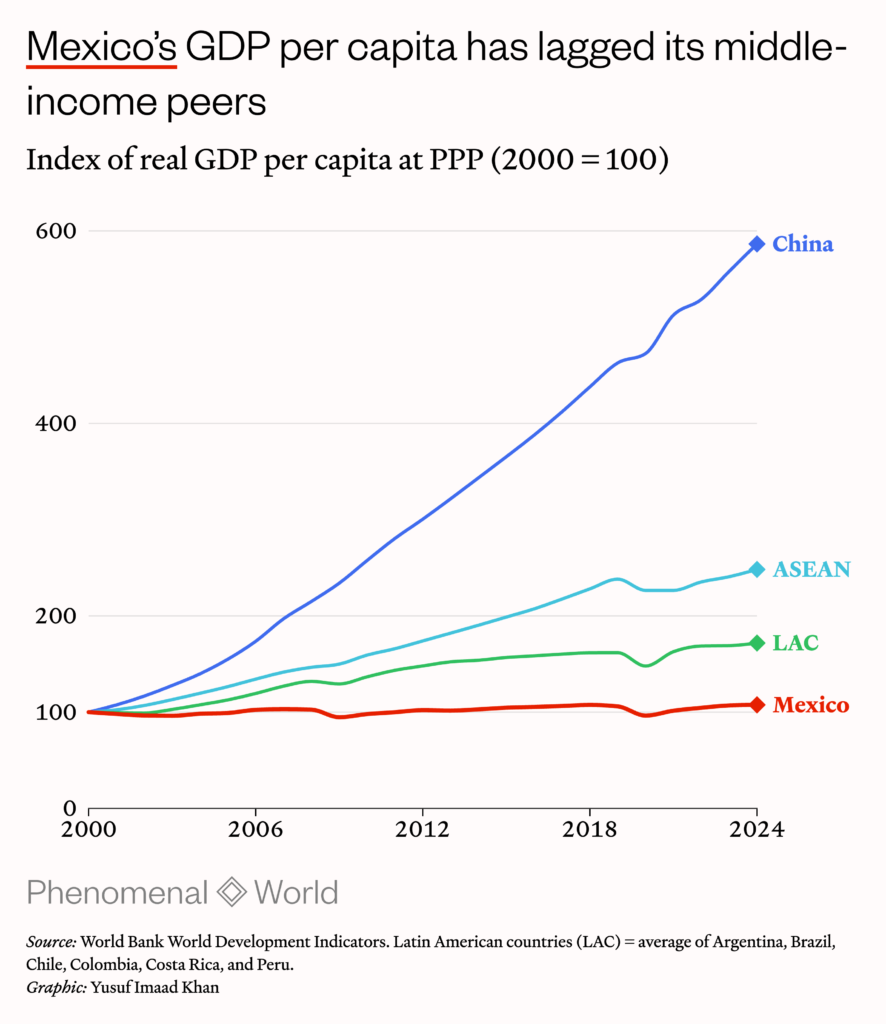
As North American countries undertake the first joint review of the US-Mexico-Canada free trade agreement (USMCA) in July, the stakes are high for Mexico. Integration into the North American—primarily US—economy has been the dominant strategy of Mexican policy makers for three decades. While this approach increased trade, it failed to address Mexico’s core (and interrelated) developmental problems: slow growth, high poverty, and extreme inequality. Mexico’s economic performance has lagged that of other middle-income developing countries (see Figure 1).
Both President Claudia Sheinbaum and former President Andres Manuel Lopez Obrador have attempted to directly address the issue of poverty. To tackle slow growth, President Sheinbaum laid out a six-year strategy for “economic and sustainable development with a shared prosperity” known as Plan México, which seeks to increase domestic production, investment, and jobs in strategic, high value-added sectors. She aims to build on her predecessor’s successful “first floor” of poverty alleviation, achieved through raising minimum wages and incomes for poor households, by constructing a “second floor” of economic transformation and industrial development.
The review of the USMCA in the coming weeks poses both risks and opportunities for Mexico as it seeks a new development path. The US may make proposals that would hamper Mexico’s ability to carry out industrial, energy or technological upgrading or to diversify its trade and investment patterns. Preferential trade agreements (PTAs) like the USMCA have long been criticized by development economists for the ways that they constrain developing countries’ ability to engage in industrial policy and move up the technological ladder, given that they are designed in the interests of developed countries’ established sectors.
Conversely, there are opportunities in the USMCA review that stem from the US’s interest in “level[ling] the playing field” by seeking improved Mexican wages and labor rights enforcement in order to reduce the attraction for US firms to offshore jobs from US communities to Mexico. The US is pursuing these goals for domestic reasons, but they present a chance for Mexico to pursue its own goal of more inclusive development.
Improved wages and household incomes would lead to stronger domestic demand, which in turn would gradually lessen Mexico’s excessive dependence on trade with the US. Mexico has taken strong steps to increase minimum wages and incomes for poor households, but there are still large remaining deficits for the majority of workers and households, as well as stubborn inequality and wealth concentration, with the attendant consequences of weak domestic demand and slow growth. The government should thus take a strategic view of the negotiations as an opportunity to increase its autonomy by strengthening its domestic economy and reducing its reliance on export demand, which it cannot control.
Preserving policy space for development
President Sheinbaum’s Plan México is primarily a public sector-led development strategy. Leveraging direct government purchasing and activity by state-owned enterprises, it aims to significantly scale up public works investment in energy, water, transportation, professional and technical education, and housing. It also seeks to attract new private investment and increase national production in strategic industries such as automobiles and electric vehicles, chemicals and petrochemicals, pharmaceuticals, aerospace, semiconductors, and consumer goods.
Many of the public procurement initiatives aim to develop domestic economic linkages by introducing local content requirements. Policies involving state-owned enterprises (SOEs) provide specific mandates to ensure Mexican sovereignty over its energy sector and hydrocarbon resources and facilitate the flow of finance for Mexican borrowers and firms. These two pillars of Plan México—procurement and SOEs—form the foundation for the rest of Mexico’s development policies, which include subsidies, reducing administrative barriers, promoting public-private partnerships, improving secondary and post-secondary education, and more.
To realize the ambitions laid out in Plan Mexico, it is likely that Mexico will need to introduce even more measures, drawn from a historical toolkit of industrial policies. These include additional specific subsidies to strategic firms and sectors, local content incentives and requirements, new strategic trade restrictions, and export promotion through performance requirements.
Mexico’s existing commitments under the USMCA, which was initially signed in 2018, as well as the new pressures coming from the joint review of the agreement, pose obstacles to its industrial development strategy. The USMCA, like most PTAs, contains many commitments that go far beyond trade liberalization, reaching behind the border to interfere with domestic regulation of investment, intellectual property and data flows. It also puts guardrails on public procurement and SOEs.
The USMCA does differ from some other PTAs in two ways: specific carve-outs and investor-state dispute limitations. Mexico managed to negotiate several key carve-outs for its priority sectors in the 2018 agreement. These carve-outs make space for national content requirements in procurement contracts for electricity, Mexican firm preferences in large infrastructure and public works projects, and national development banks’ ability to offer preferential terms for Mexican borrowers. Moreover, the agreement has a more limited investor-state dispute mechanism, which, in selected sectors (power generation, telecommunications, and oil and gas, for example), only provides access to the full arsenal of investment claims to investors with government contracts.
Nonetheless, the USMCA incorporates Mexico’s 2018 commitments under the Comprehensive and Progressive Trans-Pacific Partnership, which enshrined the country’s energy sector reforms from 2013—reforms that, among other things, allowed greater foreign investor access. Mexico’s state-owned electric utility, Comisión Federal de Electricidad (CFE), and state-owned petroleum and gas company, PEMEX, are also bound by rules that require SOEs to operate on par with commercial operators, despite recent legal changes to the contrary. Canada and the United States have already brought claims against Mexico for changes to the Mexican Electricity Sector Law, which prioritizes the CFE over private renewable electricity generators in terms of grid access, among other complaints.
In addition to this threat of state-state disputes, the structure of Mexico’s electricity market exposes the country to the risk of investor-state disputes as well. Under the current energy sector law, the CFE controls 54 percent of electricity generation and 100 percent of transmission and distribution. Together, this means that all US investors engaged in electricity generation in Mexico will automatically have full access to Investor-State Dispute Settlement claims through their government contracts for transmission and distribution. Perhaps more importantly, the additional policies that Mexico will need to introduce to fully reach its development goals under Plan México are highly likely to run into obstacles through USMCA disputes, domestic trade remedies (challenging subsidies), or even disputes brought before the World Trade Organization.
Mexico’s priorities for industrial development are already in tension with many commitments and rules that exist in the USMCA. There is a chance that the tension may increase after the review. In the past several years, the US has announced policy priorities that include building up its competitiveness and protecting national security, with a specific focus on limiting China’s access to the US market. It also has identified a desire to increase access for outgoing foreign investment in various sectors, especially energy generation, critical minerals and, more recently, AI. The combination of these aims and the US’s current aggressive approach to foreign policy puts Mexico in a difficult place in these negotiations as it seeks to both maintain existing exceptions for strategic industries and expand its leeway to build up its productive economy. However, there may be some areas where the priorities of Mexico and the US align, which can provide Mexico with more leverage.
A strategic opportunity to increase wages and household incomes
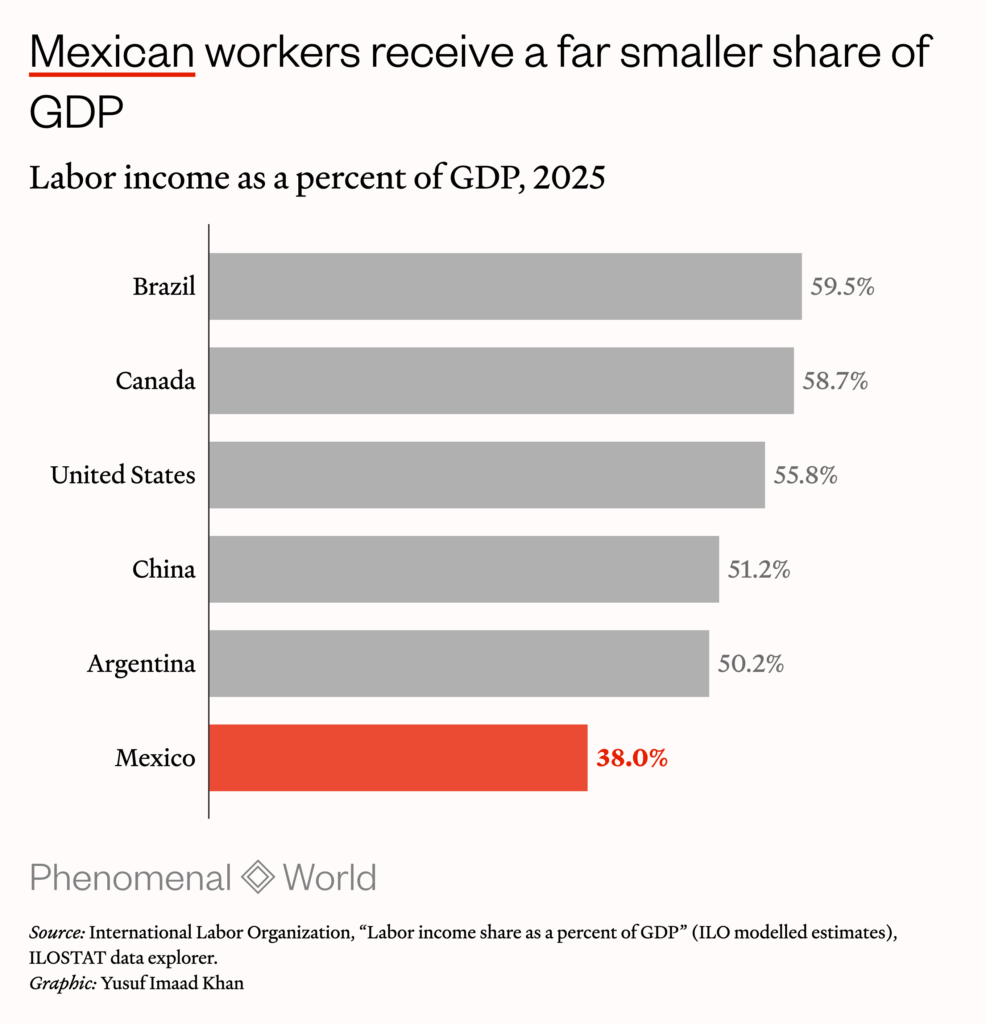
As part of the export-oriented strategy of Mexican administrations beginning in the 1980s, wages were severely repressed in order to lock in the country’s status as a low-cost manufacturer, regardless of the consequences for poverty and inequality. From 1980 to 1995 the minimum wage lost 66 percent of its purchasing power, then largely stagnated for two decades. Presidents Lopez Obrador and Sheinbaum broke with that approach and instead have increased minimum wages by double digits each of the last eight years. The result has been a marked reduction in poverty, one of the most acclaimed achievements of the two Morena administrations. That said, over 34 percent of the population remained in working poverty at the end of 2025. Despite the increase in the minimum wage tier, average wages have increased only 3.8 percent a year in real terms over the last seven years on average, from a very low base, and inequality and wealth concentration remain at very high levels. The share of Mexican GDP that goes to labor as wages is one of the lowest in the world (see Figure 2). This in turn depresses domestic demand, since labor income makes up 66 percent of household income, and serves as a continuing drag on economic growth.
These social and distributional problems should command policy makers’ attention at any time, but in the context of the USMCA review they take on a particular significance. The US has made the failure of Mexican wages to converge upward toward its own wages a major complaint and in particular has targeted the failure of Mexico to enforce its labor laws as a contributing factor (see Figure 3). At the initiation of the US, the USMCA contains a dispute settlement tool known as the Rapid Response Labor Mechanism (RRLM) which workers can use for remedy when their rights to freedom of association and collective bargaining are denied by employers and not remedied by the Mexican administration.
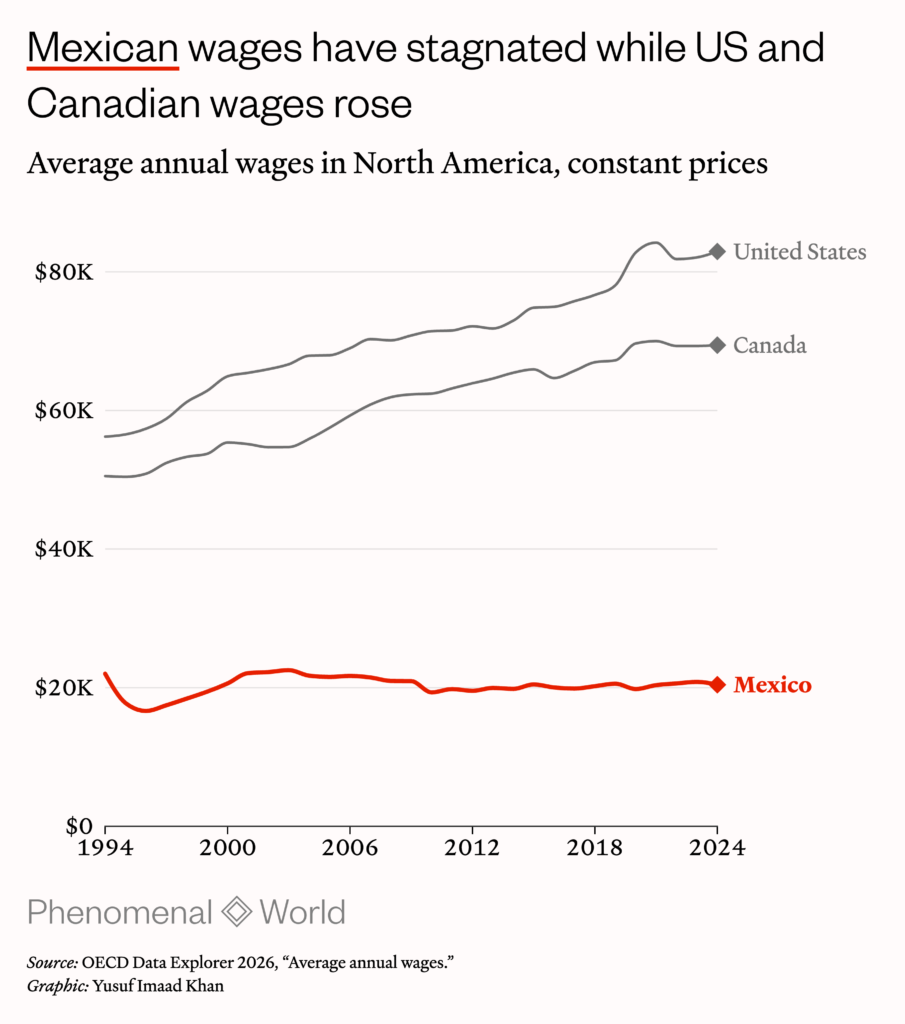
The stagnation of average Mexican wages results from a number of factors, including the low share of workers organized into unions, the persistence of corporate collusion with corrupt unions, and, indeed, weak enforcement of labor laws by Mexican authorities. Mexican workers and unions have turned to the RRLM in forty-eight cases since 2021. Luis Munguía has also argued in Phenomenal World that monopsony in Mexican labor markets, where one or a few employers control hiring, produces highly asymmetric bargaining power between workers and employers. Sheinbaum’s government can make tactical use of the US pressure in the negotiations as leverage to further raise wages beyond the minimum tier and improve labor law enforcement—for the country’s own benefit—in the face of perennial Mexican elite resistance to these measures.
At a broader level, increasing average wages and the labor share of GDP is a necessary step to increase domestic consumption demand. As an upper-middle-income country with a population of 132 million, Mexico has the heft to shift away from its export-led growth model. Indeed, both the risk of getting stuck in the middle-income trap and the vulnerability arising from excessive dependence on US export demand suggest that this shift is overdue. There is a broad consensus in Mexico that the country should diversify its trade relationships, but this will be a long and slow process as many countries attempt the same in light of US tariffs. Meanwhile, expanding domestic demand offers a more profound diversification away from the export-led growth strategy and toward economic policies that are much more under Mexico’s control. To do this it must relax the constraint of low wages and the extremely low labor share of GDP.
Concrete and feasible policies to do so could include significant increases to minimum wages in export sectors, where productivity is higher than in the economy at large. Despite using the same technology in Mexico as in factories in the US and Canada that produce similar products in industries such as auto and aerospace, Mexican workers’ wages remain a fraction of their northern counterparts’, while employers capture a disproportionate share of the value-added. The dualism of the Mexican economy—with high-productivity, high-profit firms mainly in the export sector and lower-productivity small and medium firms mainly focused on the domestic market—provides a strong rationale for higher minimum wage requirements for export sectors.
In addition, the government should require that all employees of exporting firms be formally employed, registered with the Mexican Institute of Social Security, covered by all formal sector benefits and be certified as such in order for the firms to legally export. There are also numerous aspects of Mexican labor law that need to be clarified or better enforced in order to support workers’ rights and wages.
Many of Mexico’s industrial development priorities risk legal challenges under the existing state-state dispute environment and the potential for investor claims in the energy sector, and attaining the additional policy tools needed to achieve the transformation that Plan México seeks may be made difficult by US demands in the review.
On the other hand, the review provides a key opportunity for the Sheinbaum administration, which is committed to a more inclusive development path that involves reducing the current high levels of poverty and inequality. These efforts can align with the US negotiating priorities to narrow the wage gap between Mexico and the US and to improve enforcement of Mexican labor laws. Moreover, Mexico can offer agreement with these policy improvements as a bargaining chip to gain additional policy space in other areas. At the same time, it will realize the benefits of a more just economy for its own sake.
Further Reading
Missing Links
Will July's USMCA review promote true regional integration in North America?
Mexico’s Big Green State
Claudia Sheinbaum plans to repurpose the country's state-owned enterprises towards decarbonization
How Mexico Doubled the Minimum Wage
Monopsony, corporate power, and the labor market
Further Reading
Missing Links
Will July's USMCA review promote true regional integration in North America?
Since 2024, North America has seen a surge in industrial investment. Mexico, the United States, and Canada—the three signatories to the USMCA, the free-trade agreement...

Mexico’s Big Green State
Claudia Sheinbaum plans to repurpose the country's state-owned enterprises towards decarbonization
AMLO's government emphasized the importance of state-owned enterprises for reviving Mexico's energy sector. With her announced regulatory reforms, President Claudia Sheinbaum is reorienting these enterprises...
How Mexico Doubled the Minimum Wage
Monopsony, corporate power, and the labor market
The minimum wage in Mexico has more than doubled in real terms over the last six years. This is no small feat, especially if we...