June 5, 2026
Analysis
Bolivia After MAS
A crisis of legitimacy amid institutional collapse
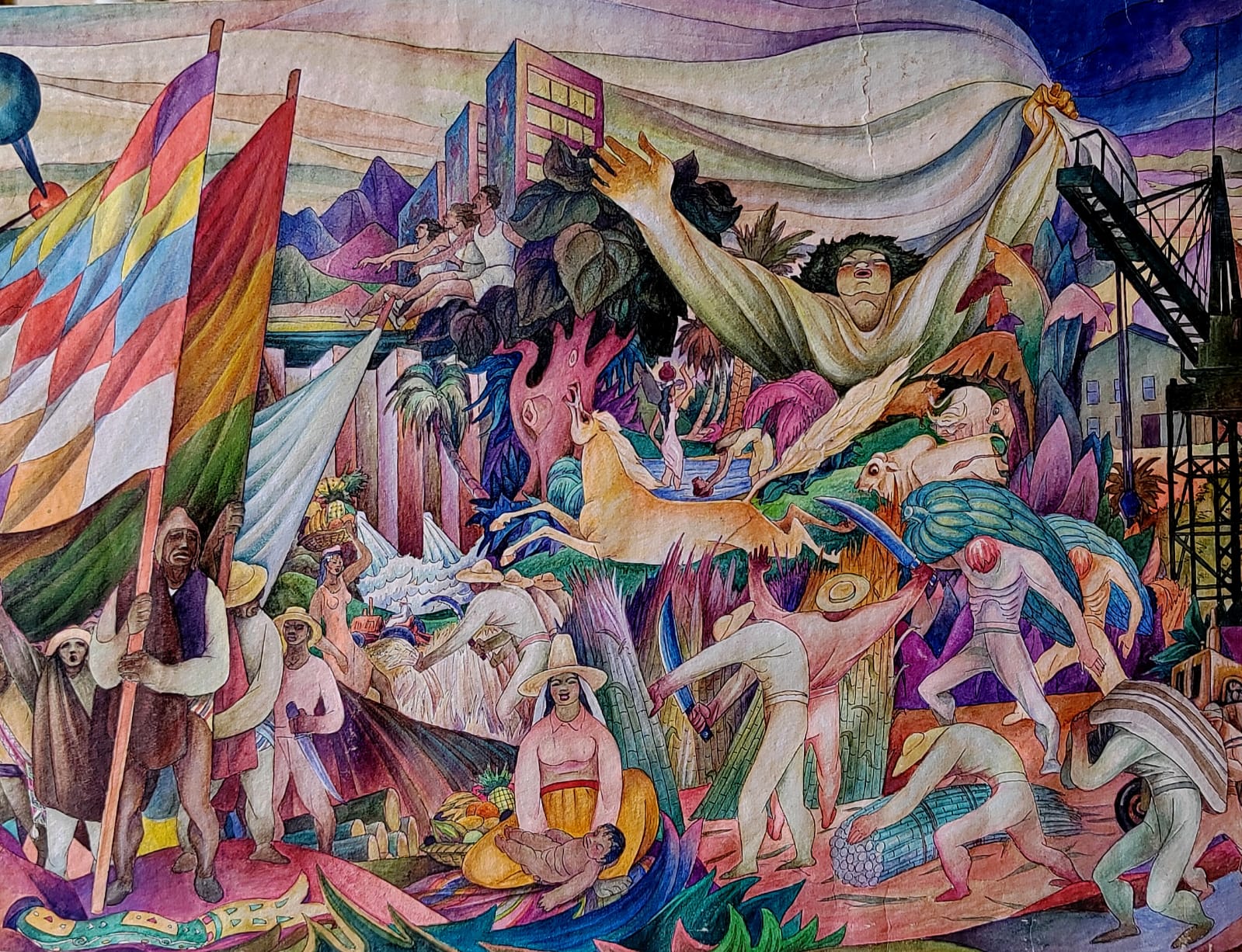
For the past month, Bolivia has experienced massive roadblocks across eight of its nine departments, which have upended logistics, trade, and daily movement. Protesters have launched these roadblocks to call for the resignation of President Rodrigo Paz, who took office just seven months ago after winning a runoff election in October 2025. Led by labor unions and peasant organizations—including those linked to former President Evo Morales—the protests are an expression of growing social unrest amid a deep economic crisis. Fuel shortages, a dollar crunch, rising inflation, and high public debts have driven up the cost of living. Austerity measures proposed by the Paz administration—including spending cuts and reductions in fuel subsidies—served as the immediate trigger for the nationwide mobilization.
After twenty years of rule under the Movimiento al Socialismo (Movement for Socialism, MAS), Paz’s new government proposed transforming the Bolivian state. His platform, shared with vice-presidential candidate Edman Lara, responded to the exhaustion of MAS’s neo-statist, extractivist model. MAS’s fall from grace can in part be attributed to divisions between two major factions within the party, but it points to a broader crisis of legitimacy in the wake of repeated political and economic failures. Popular distrust of MAS as well as of historic opposition leaders—including former President Tuto Quiroga and Samuel Doria Medina, leader of the Frente de Unidad Nacional (National Unity Front, UN)—led to voters’ rejection of traditional political parties.
Amid this tidal shift, Bolivia’s historically high level of political engagement and organizational capacity has ebbed, leaving an absence of institutionalized political representation. Clientelist negotiations and corporate mediations have come to dominate the state-society relation. MAS reinforced this tendency through its alliances with peasant unions and other aligned organizations, which limited the political power of opposition parties.
More than the emergence of a strong alternative, the 2025 elections reflected the collapse of MAS’s strength. The winning candidates lacked a party structure, a political ideology, or even a clear platform. This ambiguity explains the Paz government’s weakness today, in the face of unprecedented mobilizations across civil society. De-institutionalization, economic crisis, and the revitalization of organized social sectors have already led to another crisis of legitimacy. The new government has quickly been placed on the defensive, forced to respond to the powerful remnants of MAS in Bolivian politics.
The rise and fall of MAS
In 2005, MAS came to power with an unprecedented electoral victory, promising a transformation of Bolivian society and winning with an absolute majority of votes. Evo Morales’s rise followed the social crises wrought by country’s longstanding neoliberal model. Morales served as the country’s first Indigenous president, replacing the old ruling elites with a corporate system of mediation between the state and social movements—Indigenous movements and peasant unions. This process of change began with the convening of a Constituent Assembly and the subsequent adoption of the 2009 Constitution. The Bolivian Republic was dead, and in its ashes rose a plurinational and autonomous state.
The new government embarked on an ambitious developmentalist economic model, one which proved highly successful during its early stages due to high international market prices for gas and hydrocarbons. In 2006, MAS introduced the “Community-Based Productive Social Economic Model” (MESCP),1“The Community-Based Productive Economic and Social Model identifies two pillars: the strategic sector that generates surpluses and the sector that generates income and employment. The model identifies four strategic sectors for generating economic surpluses for Bolivians: hydrocarbons, mining, electricity, and environmental resources. Among the sectors that generate income and employment are manufacturing, tourism, housing, agricultural development, and others that have not yet been revitalized. The state is the redistributor, which must have the capacity to transfer resources from surplus-generating sectors to those that generate employment and income (social programs).” which promised the development of a plural and sustainable economy. The model identified four strategic sectors for generating economic surpluses—hydrocarbons, mining, electricity, and environmental resources—in addition to sectors that would generate income and employment. Initially, economic surpluses resulted from hydrocarbon revenues, but employment generation stalled. Nonetheless, in the first years of MAS, increased state revenues enabled redistributive policies that supported the most vulnerable sectors through subsidies, reductions in the cost of public services, and infrastructure projects for poor rural communities. These measures reduced poverty and bolstered the government’s legitimacy across the country.
While this state-led redistributive project strengthened governance in the short-run, it limited medium- and long-term structural economic investments. The fragility of the model soon became evident as international gas and hydrocarbon prices fell beginning in 2013. This revealed the state’s dependence on extractive revenues and led to a severe contraction in GDP growth.
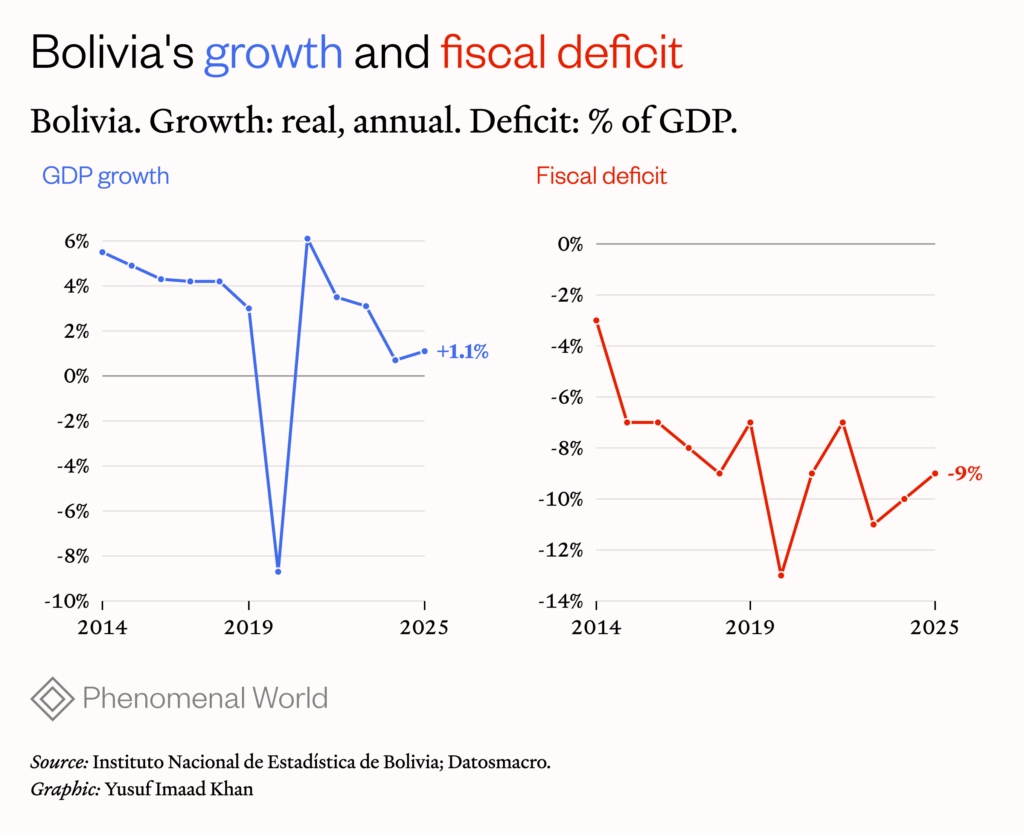
Overall, GDP growth has declined since 2014, despite volatility and periodic rebounds. The decline in hydrocarbon revenues squeezed public spending, leading to persistent fiscal deficits. Over the past decade, inflationary pressures and external currency constraints have stifled the Bolivian economy. According to a study by the UMSS,2“Academic Position of the Faculty of Economic Sciences of the Universidad Mayor de San Simón on the Current State of the Bolivian Economy,” Working Paper (Faculty of Economics, UMSS, Cochabamba, 2025). by mid-2025 cumulative inflation had reached approximately 25 percent year-over-year, while international reserves declined steadily. This placed pressure on the exchange rate and created concerns around the availability of foreign currency. In response to these tensions, the government turned to various sources of financing, including borrowing and the use of reserves, to meet immediate fiscal needs.
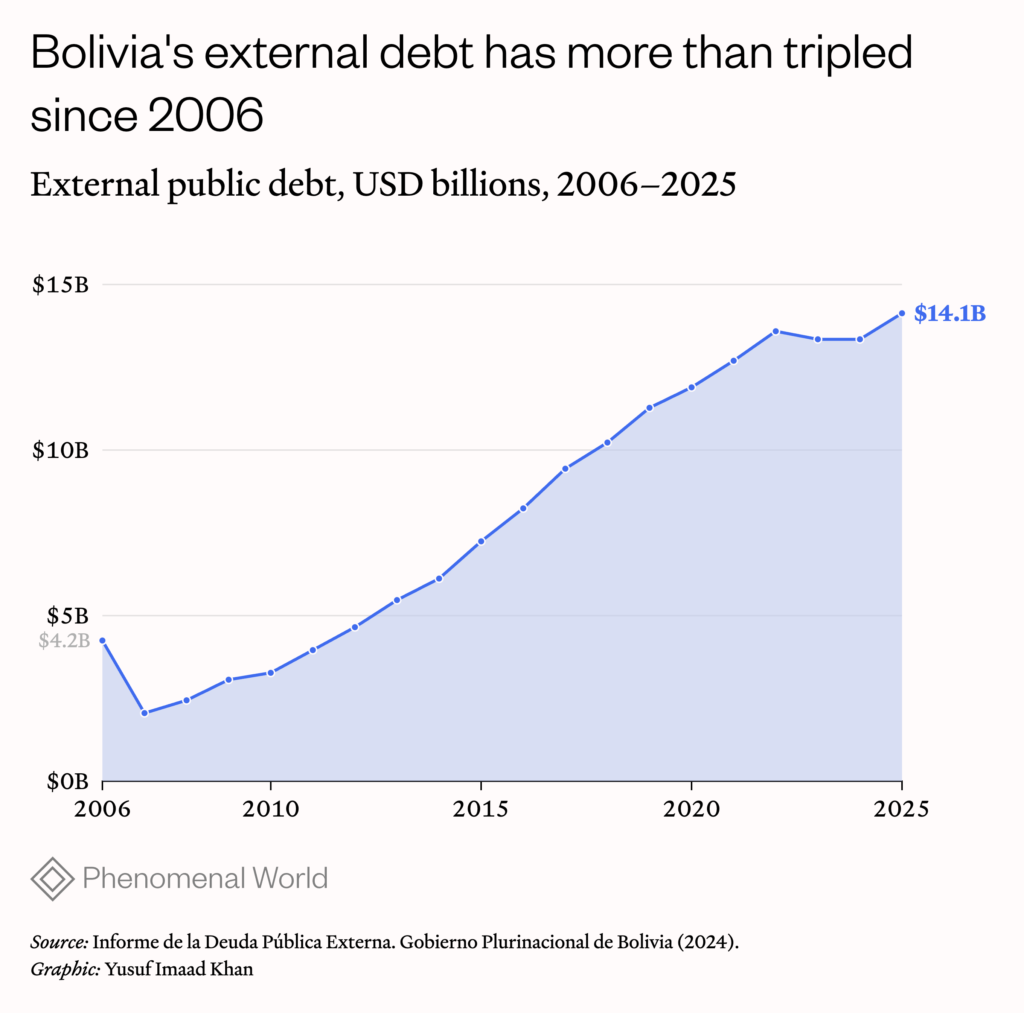
In many ways, Bolivia’s economic decline reflects the limits of MAS’s neo-statist extractivist model. As a result of the pressures on the domestic economy, Indigenous rights were systematically violated in favor of continued extractivist projects,3This includes the implementation of megaprojects without conducting the prior consultation required by the CPE and ILO Convention No. 169. A prime example is the highway through the Isiboro Sécure National Park (TIPNIS) in 2011. This information is documented by the Ombudsman’s Office (which identifies 46 projects between 2013 and 2023), as well as by NGOs such as (<)a href='https://cedib.org/wp-content/uploads/2020/01/InformeAndino-LibroBOL.pdf'(>)CEDIB(<)/a(>) , (<)a href='https://www.cejis.org'(>)CEJIS(<)/a(>) , (<)a href='https://www.ftierra.org/index.php'(>)Fundación Tierra(<)/a(>) , and in the media generally. Devastating forest fires have also been recorded in protected areas due to agribusiness activities and the expansion of the agricultural frontier by unionized smallholder farmers. Finally, there have been devastating effects of pollution from mining operations in the Amazon. leading to a rupture in MAS’s Indigenous base—not to mention a glaring contradiction of the 2009 Constitution. Economic collapse—rising cost of living, fuel shortages, and the lack of dollars to sustain trade and production—generated social unrest. The Ombudsman’s Office identified 841 episodes of social unrest in 2025 alone, mostly around economic and labor rights. Various social sectors, including trade unions, retail and wholesale merchants, neighborhood associations, mining cooperatives, civic committees, heavy transport workers, health workers, teachers, business chambers, as well as workers and peasants formerly aligned with MAS, found themselves converging in protest.
Elections without parties
The resignation of Evo Morales in November of 2019 sparked a series of conflicts within the ruling party. MAS insisted on nominating Morales as its sole presidential candidate for a fourth time, in direct violation of a 2016 referendum on term limits. When Morales emerged victorious in the October 2019 elections, several parties disputed the results, and protests opposing his election lasted twenty-one days. An interim government, led by Jeanine Áñez of the Movimiento Social Democrático (Social Democratic Movement), was put in place, but it lasted for less than a year: MAS candidate Luis Arce Catacora won in the 2020 general election with 55 percent of the vote. Arce had served as the former Minister of Economy under Evo Morales, and his victory allowed Morales to return to the country and exert political influence from his union stronghold in the Cochabamba highlands. Soon enough, however, Arce’s disagreements with Morales led to a rift within the ruling party, leading to the formation of two opposing intra-party factions.
As the 2025 elections approached, these factions engaged in a power struggle over the nomination, until Arce emerged as the political candidate carrying the MAS name.4In response, Morales tried to create a new political option called “Evo es Pueblo,” which never managed to register with the Electoral Authority due to failure to meet requirements. He also tried to to run as a candidate under another acronym, but failed due to a ruling issued by the Plurinational Constitutional Court in December 2023 that disqualified him as a presidential candidate.These disputes spilled over into the legislative arenas, within the labor movement, and across mainstream and social media.5One example is the(<)a href='https://www.opinion.com.bo/articulo/pais/exdiputado-arce-caso-enriquecimiento-ilicito-rafael-arce-entrara-reserva/20260129000058987783.html'(>) complaint(<)/a(>) filed by then-MAS deputy Hector Arce against the son of then-president Arce for illicit enrichment. Finally, a series of corruption scandals involving union leaders, the state-owned oil company Yacimientos Petrolíferos Fiscales Bolivianos, and even human trafficking allegations further derailed the possibility of Morales’s comeback. The Arce government, however, also faced accusations of corruption, and MAS ultimately withdrew his candidacy and expelled him from party ranks. Arce remains in prison on pretrial detention pending ongoing charges for corruption and economic mismanagement. As a result of these controversies, MAS experienced a dramatic fall from grace. The party won only 3 percent of the vote in the most recent election. Its current standing suggests a disillusionment with the statist project and the collapse of the Bolivian left.
Back in 2005, voters’ desire for an alternative to the established political parties culminated in Morales’s first stunning victory, which represented a political pact between a broad national-popular social base and peasant and Indigenous organizations.6For more on the concept of the national-popular within a heterogenous society, see René Zavaleta Mercado’s (<)em(>)Towards a History of the National-Popular in Bolivia(<)/em(>). Two decades later, this pact has imploded. Today, the MAS has broken up into three factions: Alianza Popular (Popular Alliance) led by the candidacy of Andrónico Rodríguez and Mariana Prado; MAS, led by Eduardo del Castillo and Milán Berna; and MORENA, led by Eva Copa and Jorge Richter. MORENA withdrew their candidates at the last minute, while Evo Morales instructed his supporters to call for a null vote instead of supporting Alianza Popular. Paz and Lara were one of several opposition candidates, representing the Christian Democrats essentially in name only. They won the first round with 32 percent of the vote, followed by Alianza Libre (Free Alliance) with 26 percent of the vote, and Alianza Unidad (Unity Alliance), another opposition party with 19 percent of the vote. Invalid ballots accounted for a striking 20 percent of the vote, representing 1.3 million votes cast. A prominent minority of voters, it appeared, followed Morales’s call.
Paz won the runoff with a commanding ten-point lead. His winning alliance was geographically concentrated in the Andean and central regions where the MAS had historically dominated, while Alianza Libre won support in the east, where business groups predominate.7We refer above all to agribusiness centered on the production of soybeans, sugarcane, and livestock, led by powerful groups organized within the Chamber of Industry and Commerce (CAINCO). The Paz-Lara victory surprised many observers. Candidates without the real backing of a party or clear platform, the pair launched their campaign only a few months before the first round, and their names only appeared in the polls weeks before the election. They relied on a social media strategy and a grassroots, door-to-door operation.
Since the 1980s, Bolivian democracy has lacked a consistent set of political parties. In the period in which the MAS dominated the political system, other parties failed to become viable electoral alternatives. Rather, the fragmentation of the party system forced alliances and coalition agreements to support specific candidacies. Lacking institutional structures, leaders “rent” party acronyms, and electoral contests are increasingly devoid of ideological content. The Christian Democrats, now the current ruling party under Paz and Lara, initially had little connection to the winning candidates. The party struck deals with various citizen groups and social organizations to compete in the elections. Similarly, the Alianza Libre, which came in second place, is composed of at least four political parties; the Alianza Popular—a MAS offshoot—formed a coalition with three other parties.
Alongside this fragmentation of the party system, non-executive branches of government also experienced a crisis of legitimacy. The legislative branch ended its term in 2025 divided, with scant legislative achievements to its name. Between 2005 and 2020, MAS held an absolute majority in the legislature, allowing the executive branch to dictate policymaking and limiting the bodies’ oversight role. In 2020, with the ruling party split, the “Evista” faction blocked legislation, contributing to widespread ungovernability. The most recent session of the Plurinational Legislative Assembly (ALP) recorded the lowest legislative output of the past decade. Between 2010 and 2015, 653 laws were passed; between 2015 and 2020, 691 laws; and between 2020 and 2025, only 284, most of which were administrative in nature or symbolic recognitions.
The judiciary is currently facing the most intense scrutiny. Long plagued by accusations of inefficiency, corruption, and political interference, judicial authorities began to serve the political interests of the ruling party. Senior judicial officials are elected by popular vote in Bolivia, making them highly vulnerable to political pressures. Low vote counts in 2011, 2017, and 2023 further placed into question the judiciary’s legitimacy. In the most recent election in 2023, judicial officials of the Plurinational Constitutional Court—the supra-state power that determines the constitutionality of legal acts—remained in their position illegally, supported by Arce. Meanwhile, under Arce, the judiciary targeted opposition leaders and the Evista faction.
The Plurinational Electoral Body (OEP), which oversees general elections, was also subject to various forms of political pressure from Arce’s MAS. After annulling the results of the 2019 elections, the OEP leadership was replaced by the Arce government, and new elections were called for the following year. Under Arce, the OEP blocked the Evismo wing’s ability to retain the party name and prevented Morales from participating in the 2020 elections. In response, the Evista camp declared a legal battle against the country’s main political institutions, accusing the Arce government of orchestrating an “electoral coup.”
Despite its institutional fragility, the OEP was able to secure the legitimacy of the 2025 elections, but the broader crisis of institutional legitimacy remains. Does the new government merely represent a change of leadership and political elite, or does it suggest the establishment of a new political regime? Will there be a new pattern of accumulation and hegemony in Bolivia? Are we—as René Mercado Zavaleta would say—facing a new social equation? 8According to Zavaleta’s definition, “By social system or equation, we mean the mode of interconnection between civil society, mediations, and the political-state sphere.” See René Zavaleta Mercado, The State in Latin America (La Paz: Los Amigos del Libro, 1990).
Revitalized movements
A month after taking office, Paz’s government held meetings with the Inter-American Development Bank, the Andean Development Corporation, and the International Monetary Fund to request loans in the face of economic crisis. The government also commenced proceedings to prosecute the former MAS government, accusing it of economic embezzlement, while welcoming the return of the US Drug Enforcement Agency (DEA) to the country to combat alleged drug trafficking. Bolivia no longer positioned itself as a voice of the Latin American left. Paz’s administration reestablished relations with liberal and far-right governments and distanced itself from Venezuela, Nicaragua, and Cuba in the wake of US aggression.
By Christmas of last year, the Paz government had proposed an overhaul of the state’s economic policies, seeking to reopen the economy to domestic and foreign capital and relax regulatory requirements imposed by MAS rule. The new government proposed a “fast track” mechanism so that investment contracts could evade legislative approval, bypass mandatory consultation processes with Indigenous groups, and circumvent environmental protection regulations. Opponents argued that the decree sought the “tacit privatization of natural resources.”
The Central Obrera Boliviana (Bolivian Workers’ Union, COB)—which had practically disappeared from the political scene in the later years of MAS in part due to a rift with Morales—was revitalized in response to the decree. Its most radical voices called for Paz’s resignation. After several days of mobilization in late December, COB leadership entered negotiations with the government, culminating in the decree’s repeal. COB further demanded that the government consult the union on future economic measures.
While the government conceded to COB’s demands, it simultaneously passed another decree to eliminate state subsidies for hydrocarbons. Fuel shortages in the market meant that as a result, gasoline prices nearly doubled, and diesel prices tripled. To mitigate the impact, the decree provided for a wage increase of approximately 20 percent—with the exception of public sector workers—alongside an Extraordinary Protection and Equity Program (Bono PEPE) for particularly vulnerable sectors. These concessions failed to substantially transform the country’s economic structure, and they provoked a fervent political response from peasants and workers. This first battle confirmed the internal weaknesses of the Paz government, which lacked the legitimacy to address economic crises and social unrest. This legitimacy was further imperiled by Vice President Edman Lara himself, who publically opposed Paz and defended workers’ interests.
Paz attempted to outline a new relationship to social movements. He stated that he would govern for social organizations, and not with social organizations, drawing a clear boundary with the movement and a departure from MAS’s earlier alliances. This decision, however, amplified opposition and unrest. Now, six months into his administration, Paz faces an unprecedented social crisis, even as he has yet to actually implement any major structural reforms. COB, the Tupac Katari Peasants’ Federation in the Andean region, as well as other peasant unions—especially the coca growers of the Cochabamba tropics—have organized roadblocks paralyzing the country since early May 2026. Facing rising prices and economic distress, these groups have escalated their demands—which began as calls for wage increases and opposition to structural reforms—to calling for Paz’s resignation. The costs of the protests are high for producers, citizens, and the country’s overall economy.
In the wake of the uprising, the Paz government appears weak, while the popular sectors reflect a renewed power. Morales himself has supported the mobilizations, criticizing Paz from social media accounts and encouraging protests. Unions and peasant federations have refused to partake in negotiations with the government. Clashes between citizens themselves might be on the horizon, with some sectors of the public angered by the disruptions caused by the roadblocks. Bolivia today is living through a critical period of transformation, characterized by the absence of leadership in the ruling government and across political institutions. While peasant and worker organizations have reorganized themselves as the opposition, they have yet to offer a clear vision for a Bolivia after Paz—and after MAS.
Further Reading

What Future for the Global South?
Brazil’s leading diplomat on navigating global instability
Lula’s Chief Advisor discusses the assault on Iran, the concept of multipolarity, and how Brazil can defend its sovereignty in an age of imperial conflict.
How Mexico Doubled the Minimum Wage
Monopsony, corporate power, and the labor market
The minimum wage in Mexico has more than doubled in real terms over the last six years. This is no small feat, especially if we...
Monroe Doctrines
Imperialism and anti-imperialism in Nuestra América
The “Donroe Doctrine” is the latest iteration of long-standing claims to regional domination in the absence of hegemony—an exaggerated reformulation of the Monroe Doctrine and...