March 18, 2026
Analysis
War and Succession
The Islamic Republic's new Supreme Leader
Speculation about the rise of Sayyid Mojtaba Khamenei was once the preserve of eccentric Iranian exiles on obscure satellite channels, who drew tired analogies with courtly intrigue or with Game of Thrones. Now, the prospect that long fuelled this insider gossip and strained Kremlinology has finally come to pass. The assassination of Supreme Leader Sayyid Ali Khamenei by the United States and Israel on February 28 precipitated one of the most consequential moments in the elite politics of the Islamic Republic. The elevation of his second-eldest son to the position of Supreme Leader, under the unprecedented conditions of an ongoing war with two nuclear-armed states, demands explanation. This is not simply a story of dynastic succession, but of how this war of choice has violently reordered the terrain on which succession takes place. The circumstances of the elder Khamenei’s killing, the mobilizing power of martyrdom, and the political imperatives of an embattled Islamic Republic—determined to survive at any cost—have shaped the field of possible successors in ways that would have been unlikely in peacetime.
For years, Mojtaba Khamenei was a shadowy yet significant presence in the Iranian political system. Born in 1969 in the northeastern shrine city of Mashhad, he joined the Iran–Iraq War at the age of seventeen. In 1986 he made several short deployments to the front and briefly served with the Habib ibn Mazaher Battalion of the 27th Mohammad Rasulullah Division, one of the most prominent formations of the Islamic Revolutionary Guard Corps during the war. Many veterans of that division went on to occupy influential positions within Iran’s security and political institutions. Mojtaba’s participation in these deployments, though brief, nonetheless placed him within the social and political networks of what is often described as the Islamic Republic’s “war generation,” a cohort that derived its authority and influence from the experience of conflict with Iraq.
Thereafter he pursued religious studies in the seminaries of Qom, following in his father’s footsteps, and is said to have studied under a number of esteemed as well as state-aligned clerics, including Ayatollahs Vahid Khorasani, Mahmud Hashemi Shahrudi, Musa Shubayri-Zanjani, Muhammad-Taqi Misbah Yazdi, as well as his father. According to accounts circulated in IRGC-adjacent media, he has taught dars-e kharej, the highest level of Islamic jurisprudential instruction, for nearly two decades. Whether this narrative reflects his real level of erudition, given how highly politicized the Iranian seminaries have become, remains an open question.
Within clerical circles, the reaction to Mojtaba’s appointment as Supreme Leader has been telling. While a small number of senior clerics, such as Ayatollah Naser Makarem Shirazi and Ayatollah Hossein Nuri Hamedani, have issued statements of support and calls for unity, the broader response has been far more muted. In many instances there has been a marked silence, or an offering of general prayers and well-wishes, which should not be mistaken for endorsement. Among the Iranian public, meanwhile, Mojtaba Khamenei remains largely unknown. Few have heard him speak, let alone formed any clear sense of how he might rule the country. This is in sharp contrast to his father, who, before becoming Supreme Leader, had already been a visible revolutionary activist, a member of the Revolutionary Council, a prominent figure within the Islamic Republic Party, a Friday prayer leader, and a two-term president.
Yet despite his low public profile, Mojtaba has had repeated brushes with political controversy. Former parliamentary speaker Mehdi Karroubi wrote a blistering open letter to Ali Khamenei after the disputed 2005 presidential election, alleging that Mojtaba had intervened behind the scenes in support of one of his rival candidates. Karroubi expressed wider suspicions among reformists and centrists in the political class that Mojtaba was being groomed by his father, and that he had gained quiet but considerable influence within the system, particularly through networks linked to the Revolutionary Guards and the Supreme Leader’s office. The episode gave rise to a perception that he operated as a powerful intermediary within the opaque structures surrounding the leadership.
These suspicions, in turn, fuelled anxieties that the Islamic Republic was drifting toward some form of hereditary rule. Ayatollah Khomeini himself had denounced monarchy in unequivocal terms in a famous 1971 speech: “The title of King of Kings,” he declared, “is the most hated of all titles in the sight of God . . . Islam is fundamentally opposed to the whole notion of monarchy . . . it came in order to destroy these palaces of tyranny.” He likewise baulked at the idea that his son Ahmad might assume his position after his death. In so doing he cut a rare figure in Iranian history for refusing to pass the baton of leadership to his progeny. Against this backdrop, critics have long viewed the prospect of Mojtaba’s succession as a profound violation of the revolution’s founding ethos.
Yet the institutional terrain in Iran has been slowly shifting over the past few decades. The 1989 revision of the constitution removed the requirement that the Supreme Leader be a marjaʿ al-taqlid—or “source of emulation,” the highest rank of clerical authority—thereby facilitating Ali Khamenei’s accession. This did not resolve the question of clerical legitimacy so much as displace it. Tensions came to the fore most clearly in 1997, when Ayatollah Hossein Ali Montazeri publicly challenged Khamenei’s religious qualifications and, by implication, his fitness to lead. The episode, which led to Montazeri’s house arrest, underscored the contradictions at the heart of the post-1989 order. Those earlier disputes offer a clear preview of the debates Mojtaba’s appointment is likely to provoke within the seminaries of Qom, Najaf, and beyond. Even now, the decision of state-aligned media to address Mojtaba with the honorific “Ayatollah” has raised some eyebrows.
The official line in Tehran has long been that Ali Khamenei never designated a successor and that the Assembly of Experts—eighty-eight clerics elected every eight years—would select the next leader in accordance with the constitutional provisions outlined in Articles 107 and 109. This is certainly still plausible. For years now it has been claimed that Khamenei had identified three potential successors, none of whom were his son. Recent reporting in the New York Times appears to support this claim, even suggesting that a written will was presented explicitly rejecting the possibility of hereditary succession. Given the depth of public distrust in the political system, however, this story will inevitably elicit scepticism.
Candidates for the Assembly are vetted by the Guardian Council, whose clerical members are themselves appointed directly by the Supreme Leader. The institutional architecture therefore ensures that the leadership retains considerable scope to shape both the terrain and the composition of the very body tasked with selecting its successor. The presence of influential clerics such as Ayatollah Ali Reza Arafi—a member of the Guardian Council, a senior figure in the administration of the seminaries, a former chancellor of the powerful al-Mustafa International University, and a member of the short-lived transitional leadership council formed in the immediate aftermath of Khamenei’s assassination—raises further questions about how clerical opinion within the Assembly may have been steered during the succession process.
The extraordinary conditions under which the Assembly convened only deepen these uncertainties. Israeli airstrikes destroyed the building where the Assembly of Experts would have ordinarily met on March 3, forcing them to make alternative arrangements. While participants claim that a quorum was achieved, it remains unclear who was present, what forms deliberation took, and which figures exercised decisive influence. Reports from the Times also suggest that Ali Larijani, who headed Iran’s Supreme National Security Council until his assassination on 16 March, sought to intervene in favor of a more broadly unifying candidate.
Other potential successors who might once have been considered plausible became far less likely in the context of full-scale war. A figure such as Hassan Rouhani, president between 2013 and 2021 and generally associated with efforts to pursue détente and normalization with Western powers, was always an unlikely choice in the midst of a war of aggression waged by the Islamic Republic’s two principal adversaries. Rouhani has immense experience within the institutions of the Islamic Republic and has long been embedded in its national security establishment. Yet his political identity is closely tied to diplomacy and negotiation with the West, particularly the nuclear talks that culminated in the 2015 Joint Comprehensive Plan of Action. During his presidency, Rouhani also clashed repeatedly with the Revolutionary Guards and objected to their expanding role in Iran’s politics and economy, which did little to endear him to the principal power brokers within the system. It was therefore difficult to imagine that, in the midst of an existential confrontation with the US and Israel, the Assembly of Experts would coalesce around a figure associated with a strategy that might demobilize or unsettle the Islamic Republic’s core social base.
Still, Mojtaba’s succession cannot simply be explained through backroom dealing and Machiavellian intrigue. The war appears to have decisively altered the political calculus. The assassination of Ali Khamenei, alongside reports that Mojtaba himself was injured in the same strike on February 28, turned his candidacy into a potent symbol of martyrdom. Official media have already begun referring to him as the janbaz-e ramazan, the “Ramadan war veteran,” linking his injury to a broader tradition of sacrifice in the Islamic Republic’s political culture since the revolution. This language of sacrifice was valorised during the eight-year war with Iraq, a conflict that more than any other shaped the Islamic Republic and the complex security architecture that continues to define it today.
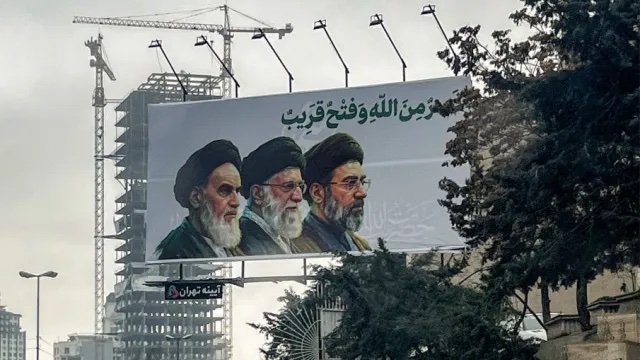
The symbolism of martyrdom carries particular resonance within Shi‘i Islam, where the memory of Karbala and the martyrdom of Imam Husayn occupy a central place in both religious imagination and political rhetoric. The Iranian state has long invoked this symbolic repertoire in moments of crisis. The assassination of Ali Khamenei has therefore been framed not only as a geopolitical event of immense consequence but also as a sacred act of sacrifice, situated within a longer trajectory of resistance and suffering in the name of the Iranian nation. State-aligned elegists, or maddahs, have already cast Ali Khamenei’s death as part of a “final battle” that will resist the return of taghut—shorthand for the corrupt, Western-aligned Pahlavi order—at the hands of Iran’s foes. Billboards across Iranian cities now bear the slogan “The hand of God has revealed itself; Khamenei has become young again,” at once invoking divine providence and signalling generational renewal within the leadership.
This symbolic politics has been accompanied by a visible and deliberately orchestrated mobilization of the regime’s core base of support. Despite ongoing bombardment and the risks associated with public assembly, supporters of the Islamic Republic have taken to the streets in multiple cities, staging demonstrations, mourning rituals, and commemorative gatherings. These are not spontaneous eruptions of grief so much as politically mediated performances of loyalty, activated through groups of veterans, Basij organisations, mosques, and local clerical networks. The leadership appears intent on converting the assassination of Khamenei into a moment of collective reaffirmation, directed not only against an external enemy but also at a fragmented and restive domestic landscape. This capacity to summon and stage support from below, even if uneven and far from universal, has long been a constitutive feature of the Islamic Republic’s durability. In moments of acute crisis, the state has repeatedly shown that it can still call parts of its social base into motion. The signal is calibrated in two directions. Domestically it seeks to stabilize a shaken political order and reassert a hierarchy of loyalty. Internationally it is meant to demonstrate that the decapitation of the leadership has not produced paralysis, fragmentation, or the prospect of imminent collapse.
Mojtaba’s elevation therefore reflects both continuity within the Islamic Republic’s power structure and a significant generational shift, as the revolutionary generation recedes thanks to age, attrition, and targeted killings. If he consolidates power, leadership will pass to a cohort shaped less by the upheavals of 1979, or even the Iran–Iraq War, than by the formative experiences of the Islamic Republic’s interventions in Iraq and Syria in the late 2000s and 2010s, the pressures of prolonged sanctions, and the dilemmas of post-revolutionary entrenchment and resilience. Many of these figures are deeply embedded in the security institutions of the state, above all the Revolutionary Guards, whose influence has expanded steadily over decades of confrontation with the US and Israel. The fact that Mojtaba himself is widely understood to be closely tied to these networks helps explain why influential actors within the security establishment appear to view his rise as a means of preserving strategic continuity at a moment of profound uncertainty.
This orientation was made explicit in Mojtaba’s first written declaration. Framing escalation as both necessary and popular, he declared that “the continuation of effective and punishing defence” was the demand of the masses, while insisting that “the lever of blocking the Strait of Hormuz must continue to be used.” At the same time, he reaffirmed the centrality of the so-called Axis of Resistance, describing it as “an inseparable part of the values of the Islamic Revolution,” and explicitly invoking its active components. “Brave and faithful Yemen,” he noted, “has not ceased defending the oppressed people of Gaza,” while Hezbollah, “despite all obstacles,” has come to the aid of the Islamic Republic, alongside Iraqi militias that have “courageously followed the same path.” The address also signalled the possibility of further escalation, indicating that plans had been developed to open additional fronts in arenas where the enemy is “highly vulnerable.”
Supporters of Mojtaba have suggested that he could play a role in curbing corruption within the Iranian political system, but such claims have gained little traction. Over the past decade, persistent allegations have linked networks close to the Supreme Leader’s office to sanctions-evasion schemes and opaque financial structures that flourished under conditions of economic warfare. Figures such as Ali Ansari, associated with the now notorious Ayandeh Bank and repeatedly accused of large-scale corruption and money laundering, are often cited as emblematic of these shadow economies. These networks are widely believed to intersect with powerful political and security interests inside the state, where illicit financial flows and sanctions-busting operations have frequently operated with the tacit backing of elements within the security apparatus. In this context, claims of an anti-corruption agenda appear less as a program of reform than as part of an internal struggle over control of rents generated under sanctions.
The late Khamenei’s household, or bayt, also exercised control over vast financial and property holdings, most notably through the sprawling parastatal conglomerate known as the Execution of Imam Khomeini’s Order (Setad-e ejra’i-ye farman-e Emam). This organization controls dozens of companies and extensive real-estate assets across Iran. Control over Setad will now pass to his son, and there were clearly powerful interests invested in ensuring continuity in its management, given the considerable economic dividends and patronage networks tied to access to its resources.
At the time of writing, there are real doubts as to whether Mojtaba Khamenei will survive the coming days and weeks, which naturally makes any assessment of his prospective rule provisional. His addresses to the Iranian public have only been made in written form. He has not made any public speech or video appearance: a silence that has fuelled speculation about his condition as well as signalling the extreme security precautions being taken to protect him. The Revolutionary Guards appear intent on shielding their preferred candidate from further attacks that could once again reopen the question of succession and potentially elevate a figure who is less aligned with their interests. This situation reflects a striking paradox. The man who now occupies the most powerful office in the country remains largely unknown to the society he is expected to lead. His elevation has been used by Iran’s ruling institutions to send a clear message. The decapitation of the leadership has not produced capitulation. If anything, it has arguably accelerated the consolidation of power in the hands of a younger and more militant generation within the political and security elite. This cadre has been formed by war, sanctions, and permanent confrontation. It may be committed to resisting the ongoing US–Israeli onslaught, yet it is otherwise increasingly distant from the aspirations of much of Iranian society.
Further Reading
The Venezuela Illusion
The limits of “regime management” in Iran
Iran’s security structure ensures that the US will struggle to contain the dynamic of military escalation or determine its political outcomes.
What Future for the Global South?
Brazil’s leading diplomat on navigating global instability
Lula’s Chief Advisor discusses the assault on Iran, the concept of multipolarity, and how Brazil can defend its sovereignty in an age of imperial conflict.
Mosaic of Deterrence
Iranian resilience in the face of US-Israeli assault
The US-Israeli war on Iran has foregrounded a question that has become increasingly urgent since the onset of the genocide in Gaza: how should we...