Analysis
Walmart Concedes to the Union
North America's largest employer grants a first for its workers: an adversarially-bargained union contract
In our hyperpolitical age, when mass protests come and go without much clear sense of what was won or lost, the strategies of social movements can seem quixotic, their benchmarks of success fuzzy. In the union world, however, success or failure can be measured in more cut-and-dried terms: by the ratification of a union contract. A contract between a union and an employer does not simply lay out the terms of employment at a particular worksite. It is also a symbol of the begrudging respect that an employer has for the collective organization of its employees.
Until this year, Walmart had not put pen to paper on a union contract in Canada or the US. As the largest employer in North America (with a headcount of 1.6 million in the US alone, it is still larger than Amazon) and with annual gross profits last year of $171 billion, Walmart has tremendous resources with which to fight off unions, and has developed a sophisticated playbook for doing so. It is not surprising that the company that labor historian Nelson Lichtenstein has called the “template organization” of neoliberal capitalism should have been, for most of its existence, an impenetrable anti-union fortress.
This is why we should appreciate the weight of some recent news from Canada’s warehousing sector: on May 7, 2026, eight hundred workers at a Walmart Regional Distribution Center in Mississauga, Ontario (in the greater Toronto area) won a two-year contract after certifying their union with Unifor Local 252 in 2024. Though it has received relatively little coverage in the left-labor world, it is a truly historic victory, and a story that ought to be studied for its broader implications. No union gets a contract with a company as imposing as Walmart without there being lessons for organized labor to take from the strategy, tactics, and conditions that enabled the victory. The lumbering corporate retail giant that has for so long set the industry standard for working conditions has finally conceded to the union. Why now?
Certification for Mississauga
Before Unifor won in Mississauga in 2024, there had only been two prior union certifications—official government recognition that a group of workers is represented by a given union, creating a legal obligation to bargain—at Walmart facilities in Canada. One was at a store in Windsor, Ontario in 1996 with the United Steelworkers, and it was only certified by labor board order in 1997 due to Walmart’s serious unfair labor practices during the election. The union never got a contract and was eventually decertified. The other was with the United Food and Commercial Workers (UFCW) in 2005 at a store in Jonquière, Quebec, which Walmart closed just after the union requested binding arbitration from Quebec’s minister of labor. As will become important in this story, Quebec, the neighboring province to Ontario, has strong enough labor law that certification there will almost always result in a contract. This is the dynamic that led Amazon to shutter its entire operation in the last province last year.
In the US, the only successful election at a Walmart was in 2000, to unionize ten meat cutters at a Supercenter in Jacksonville, Texas. Days later, Walmart responded to what would otherwise have been minor news in rural East Texas by announcing that it was getting rid of all meat cutting in their Supercenters across the nation. In 2011, the UFCW attempted to organize the company as a whole with the multimillion dollar OUR Walmart campaign, organizing workers to engage in a wide variety of actions. Union elections, however, were not part of the mix, reflecting the recognition that the official path to unionization in the United States had been effectively blocked in cases where the employer was a corporation as well-resourced and with as much anti-union animus as Walmart. OUR Walmart had some notable wins, but the UFCW pulled funding from the campaign in 2015 when Marc Perrone assumed the presidency of the union.
I am less familiar with Walmart’s arrangements with unions in Mexico, but it appears that many of the contracts that Walmart has signed there are so-called “protection contracts,” i.e., a collective bargaining agreement made without the workers’ knowledge or consent. By claiming to represent workers, those contracts, often signed by politically-connected unions, “protect” the employer from any efforts by its employees to bargain more aggressively. Many such contracts were targeted by reforms promised by Andrés Manuel López Obrador after he won the presidency in 2018. The next year, when the Revolutionary Confederation of Laborers and Farmworkers (CROC) planned a strike on a number of Walmart facilities, the company averted it with a 5.5 percent annual wage increase. But it is not clear that any new contract was signed between Walmart and CROC as a result of the settlement.
So when Marty Gaouette, a worker in the shipping department at Walmart’s Mississauga Regional Distribution Center (RDC), reached out to Unifor Local 252 in December 2023 about the possibility of starting a union that would secure its gains through a legally binding contract, there was no real template in North America for doing so.
But there were plenty of worker frustrations. At the start of the Covid-19 pandemic, Walmart had temporarily offered a wage bump (“hero pay,” the company called it, as part of the broader pattern of pandemic wage increases in the in-person retail sector) and flexible working hours. As unemployment numbers climbed, however, Walmart understood it had a relatively captive workforce and reversed course, eliminating the wage bump after just six months. “It was like the worst thing that they could have done to us,” explained Rhaddy Que, a utility associate in the maintenance department and eventually a member of the workplace’s bargaining team. “We were committed to work, but [they were] taking those dollars away from us.”
Forced overtime was also a major issue. Unlike Amazon’s “mandatory extended time,” which is mostly enforced around holidays and Prime days, forced overtime became a year-round regularity in Mississauga, leaving workers with little control over their work-life balance. Speed up, in addition to longer hours, was increasingly an irritation. The Mississauga distribution center does what Walmart calls “store replenishment”—filling trucks destined for retail locations—and so has not traditionally been under the same management pressure as Amazon fulfillment centers, with their rapid delivery promises. But competitive pressure from Amazon has led Walmart to invest in its e-commerce capacity, offering last-mile delivery from its stores, and as it has done so, the need for greater and greater efficiency in replenishing inventory at Walmart stores has increased. Rodolfo “Tito” Pilozo, who was also on the Unifor bargaining team and works in receiving, says that the volume increase in the shipping department was what pushed Gaouette to contact the union. Management would say that they would have to process a certain number of cases of goods per hour, when in reality the amount was 10 percent more than announced.
Speed-up, forced overtime, clawed back wages and benefits offered during Covid: these were swirling in the well of worker frustration in late 2023. The organizing work went quickly at first. A number of workers at the facility had been working there more or less since 1994, when Walmart first came to Canada. Back then, the warehouse had been located in Brampton, a neighboring auto manufacturing town also part of the greater Toronto area. It had been owned and operated by a third-party company, Tibbett and Britten, though those working there understood it was a warehouse for Walmart. Many of the workers who would lead the organizing in Mississauga had been previously involved with a unionization effort with the Teamsters at the facility in Brampton in the late nineties. Tibbett and Britten moved the operation to Mississauga in 2002, according to Pilozo, and Walmart took full control of it in 2014. It was workers like Pilozo, with a great amount of seniority, who formed the core of the organizing team.
Around April 2024, however, the organizing momentum slowed. Walmart’s captive audience meetings began to have an effect. “There was a lot of fear,” Que says about that moment. “They gave us that fear. We would have meetings, and they would just say how it’s not worth having a union. And that the company will do what the union is promising you.” Angela Drew Kimelman and Gary Rumboldt, the Unifor staff organizers assigned to the campaign, met with key worker organizers and they decided they were ready to make the campaign more visible. They formed “Team Red,” a group of workers who were willing to wear Unifor red to work on Wednesdays and who would leaflet outside the warehouse about the union. Unifor got so-called “protection letters” sent to Walmart on behalf of many of the organizing workers, which reminded the company that it was a violation of the rights of pro-union workers to be treated any differently than other workers. This gave Team Red the cover and confidence to organize publicly rather than in secret, as is often done in the early months of union drives.
Justin Gniposky, Unifor’s organizing director, credits the strength of the team for patiently building strong connections during this time:
We had a really strong inside committee. They spent the time, did the work. . . . Sometimes you don’t have that kind of structure on the inside, but these guys built that structure, they built it to succeed, and it showed. They had the respect of their co-workers, and respect’s one thing, but their co-workers also believed they had their best interests in mind. They had their trust to move through this.
Part of building this trust lay in making sure that all union materials were translated into Punjabi, Tagalog, and Chinese. It also lay in getting workers who spoke these languages to reach out to other workers directly. This proved particularly important for getting the sizable part-time workforce on board with the union program. Most of the part-timers were international workers, some on temporary visas. Que estimated that even though at least 30–40 percent of those workers are no longer with Walmart, most of them supported the union when they were at the warehouse, despite many knowing they would not be around long enough to benefit from a contract.
The Mississauga workers voted for their union from September 10 to September 12, 2024. Participation was high, and the union won with a reported 56 percent majority. Que expressed the disbelief that many felt about the victory:
We weren’t sure at all [that we were going to win]. It was sort of embedded in our heads that Walmart is anti-union. You heard a lot that it was impossible to have a union, and that Walmart will not allow it. That’s what they made us feel. But later on, we started to feel like there was more power in people wanting to have the union than in Walmart not wanting one.
Stemming the tide
The day after Ontario certified the union to represent the Mississauga warehouse workers, Walmart issued an across-the-board wage increase for every single logistics worker in Canada (warehouse workers and drivers both)—except for the eight hundred workers who had just unionized. As Gniposky summed it up, “Here’s the congratulations on getting a union. You are now making less than every single one of your coworkers.” Walmart also brought in workers from temp agencies to staff the Mississauga facility, signaling to the newly unionized workers that they could be easily replaced.
Meanwhile, Unifor had other battles to fight with the company. In October 2024, the month after the election victory in Ontario, 120 Walmart truck drivers in British Columbia won card check certification. Soon after, 280 Walmart truck drivers in Alberta did the same. Peter Pearce, a driver out of the Nisku, Alberta depot and member of the bargaining team there, said that it was “favoritism, nepotism, and unfair treatment by certain supervisors” that led the Alberta drivers to organize for union representation. To stem the tide of pro-union sentiment across the company’s Canada operations, Walmart issued yet another across-the-board wage increase. This made for two unprecedented country-wide wage increases, in the span of a month and half, but the company made the message of these wage increases clear with the workplaces it excluded—the Mississauga RDC workers and the two units of truck drivers.
Due to the particularities of Canadian labor law, the Mississauga warehouse workers’ and the western Canada truckers’ campaigns were run slightly differently. The warehouse workers petitioned for certification at the provincial level by the government of Ontario, while the drivers petitioned the federal government, as truck drivers crossing provincial or international borders are regulated federally. In Ontario, unions need 40 percent of workers to sign a union card before filing for an election, and a simple majority in an election to be certified. Federal elections are run by “card check,” meaning that a union need only get 50 percent plus one on cards to certify. Canadian labor law also has what is called a “freeze provision,” which prevents employers from altering workers’ terms and conditions during a certification drive, including by withholding standard wage increases. As the wage increases and other retaliatory actions by Walmart clearly violated the freeze provision, Unifor filed unfair labor practice (ULP) charges at both the provincial and federal levels. The Ontario labor board delayed the decision on the union’s charges until after collective bargaining ended, but the federal ULP was settled in November 2025.
In the meantime, in May 2025, Walmart had sold off its Canada fleet service to a third party named Canada Cartage. This meant Unifor had to update its certification, which delayed negotiations, and Canada Cartage began a decertification drive. Pearce, the Alberta truck driver, described those negotiations as “extremely difficult.” The bargaining team pushed for a three-year contract, a 2.5 percent wage increase per year, and a limitation on “lease ops” subcontracting to no more than 10 percent of their work. Even though the federal labor board halted the decertification drive, as decertification is not allowed during active collective bargaining, Canada Cartage management did everything to slow things down. During the negotiations, the bargaining team got word that a sizable group of previously anti-union drivers in Calgary decided they now wanted the union to sign a sweetheart deal: a one-year contract, a 1.5 percent wage increase, and a lease ops limitation to 25 percent. “It made absolutely no sense,” Pearce said. “It scream[ed] of manipulation by management. ‘Please don’t give me extra money.’ I’ve never heard anybody say that.” The Unifor drivers eventually settled on a one-year collective agreement with Canada Cartage that expires in May 2027. But things ended quite differently for workers at the RDC across the country in Ontario.
First contract
Collective bargaining in Mississauga finally started in May 2025, eight months after a majority of the warehouse’s workers voted for Unifor representation, and the same month Walmart sold off its Canadian trucking operations to Canada Cartage. As is often the case with intransigent employers, Walmart offered Unifor only a few sporadic dates over the subsequent months when it would be available for negotiations. With longer deadline rules for negotiations than there are in Quebec, Walmart intended to drag out the Ontario process as long as possible.
Unifor’s bargaining team consisted of seven workers as well as Unifor’s national bargaining representative, Shayne Fields, and the longtime president of Local 252, Eamonn Clarke, who the year before had won a strike by four hundred workers at a plant owned by Nestlé. This team brought an intimidating amount of collective experience at Walmart. According to Pilozo,
The good thing about our bargaining committee is that the people chosen were very senior people: twenty-nine, thirty, thirty-one, twenty-eight years with the company, and so on. When we first introduced each other, they [the Walmart negotiators] were very impressed. Their facial expressions showed that, “Wow, these guys have been there for a long time, almost since the beginning.” Even their lawyer was stunned.
To negotiate, Walmart sent a delegation of nine company representatives. There was little indication that the company intended to bargain in good faith. According to a few of my interviewees, company management was actively supporting a decertification campaign, giving some anti-union workers special lockers in the building to hold decertification petitions and anti-union literature. Some workers who spoke out against the union got special treatment. Verbal altercations would break out, and at one point there was a physical fight between two employees, one pro- and the other anti-union, both of whom were suspended and later fired. According to Que, however, on the basis of Team Red’s inside connections, most workers understood these altercations to be a product of Walmart’s actions, not the union’s.
I asked everyone I interviewed for this story if there was ever a moment where it felt like negotiations shifted, where Walmart seemed to turn a corner and begin to negotiate in good faith. That moment never seemed to come for anyone. It seemed more that, unlike in the US, there was a limit on just how long the company could drag out negotiations because in Ontario, Unifor had the right to apply for an arbitrated settlement if collective bargaining ran aground.
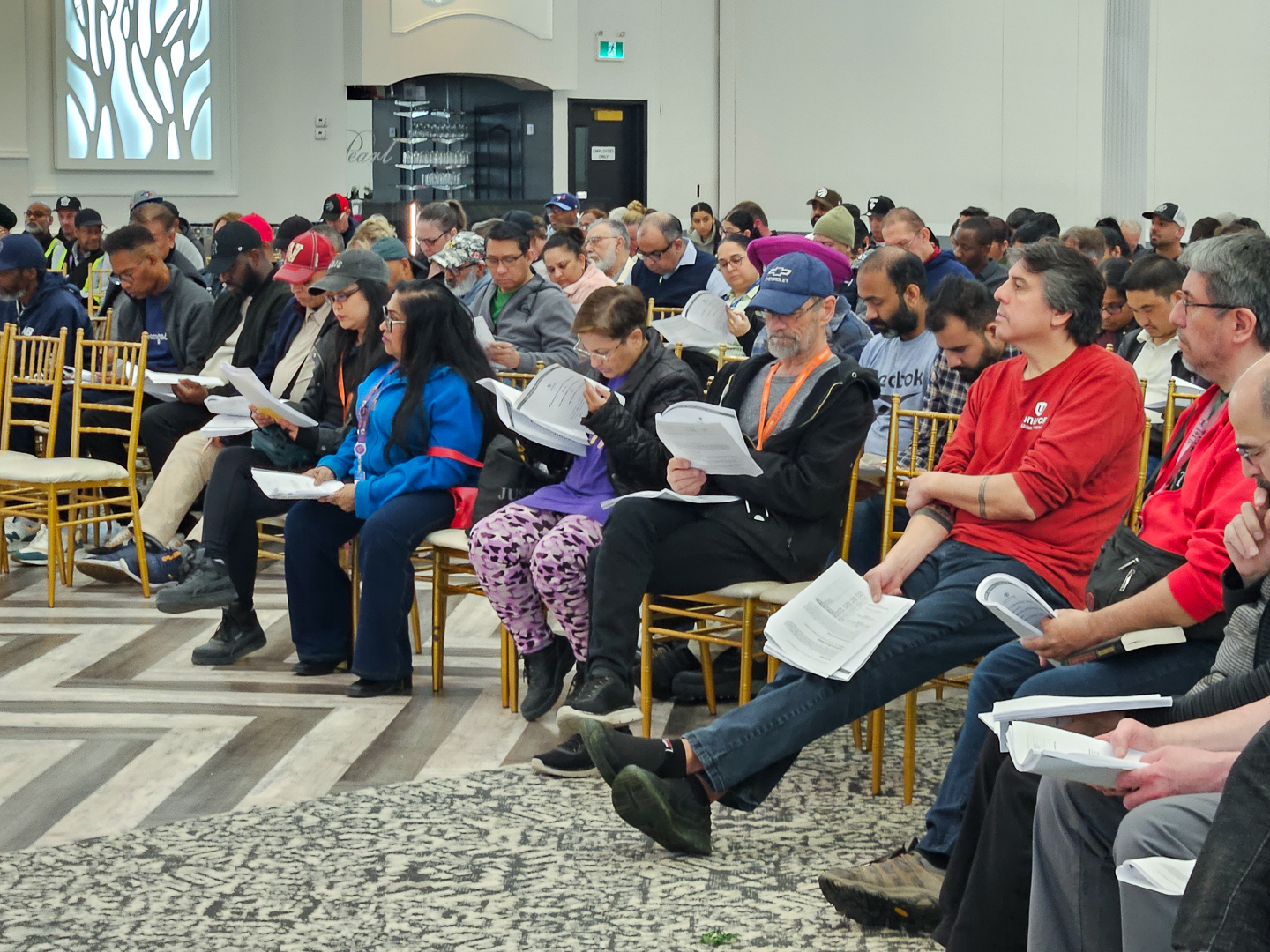
On May 7, 2026, a year after negotiations had officially begun, Walmart and Unifor announced they had reached an agreement. The resulting two-year contract was, by everyone’s account, not the “best” contract they could have gotten, but it was a meaningful one: wage parity with other warehouses; retroactive back pay for violating the freeze provision, in the form of a lump sum payment in the range of $4,000 to $9,000 per worker in July of this year; a “me too” clause preventing Walmart from raising wages elsewhere without raising wages in Mississauga, as they had done in the fall of 2024; planned wage raises in 2027 and 2028; a grievance procedure; and a limit on temporary workers. That last bit, according to Gniposky, got the biggest applause at the contract ratification meetings. The next day, Local 252’s Walmart members ratified the contract by a whopping 93 percent.
Que and Pilozo told me that management is slowly acclimating to the new environment. Pilozo said he corrected a manager the other day who was complaining to workers about “your” contract: “It’s our contract, because it was signed collectively by the employer and us.” The manager apologized on the spot. Que said the new grievance procedure is working well, and that communication between stewards and management has improved to the point where they only invoke it occasionally. When I was interviewing them for this story, the lump sum payment was just days away, and workers were giving knowing nods to each other around the warehouse. In Pilozo’s words, where tension had existed not so long ago, “you’re starting to see smiles.”
Location, resources, regulatory constraint, leadership
“Workers at Walmart in the US and Canada have long made it clear that they want a union,” Nelson Lichtenstein told me. “To actually have a signed contract is a major breakthrough and something genuinely new when it comes to the largest private employer in North America.” Still, this story might seem a bit anti-climactic: big union wins are supposed to end in heroic confrontations before the company concedes. But no dramatic confrontation ensued here. Again, the billion dollar question is: Why was this the moment for Walmart to finally cave and sign a union contract? Are they getting soft in their old age, without Sam Walton’s infamous hatred of unions to guide the way?
I would boil down the key factors in this historic victory to four: location, resources, regulatory constraint, and leadership. First, the fact that this happened in Mississauga was no accident. “Mississauga is a hub for most of Ontario and Quebec,” Gniposky explained. “That facility is important. It’s not as easy for them to move.” The company regularly warned workers that a pro-union vote could lead the facility to shut down, but the threat was a weak one. For one, the facility was an RDC and not a store (unlike the location in Jonquière, which Walmart shut down after they won union certification), and, in the Walmart supply chain, the RDC is in a key staging ground for two of Canada’s major metro markets, Toronto and Montreal. Walmart doesn’t have distribution centers in Quebec—having already closed them allegedy on account of the province’s strong labor law—but that market is easily supplied from Mississauga.
Unlike the largest warehousing area in the United States, the sprawling Inland Empire in southern California, Canada’s primary warehousing cluster is nestled in a narrow corridor of the west Toronto suburbs. Stretching from Mississauga to Brampton, it is constrained on all sides: to the south by Lake Ontario, the east by Toronto, the west by suburban residential development, and the north by lack of infrastructure (and eventually Lake Huron). In other words, it would be a huge pain for Walmart to relocate this RDC. Distribution centers are already more strategic organizing targets than stores, on account of the disruptive impact that labor can theoretically cause through their organization. But distribution centers that can’t easily be moved are ideal targets.
Chokepoint analysis—based on the idea that organized labor is going to be most successful at points in the production and distribution process where the disruptive impact of labor actions is relatively high—has a mixed reputation in the labor world. In part, this is because it involves the idea that some sites of work are more structurally important to a company’s operation than others, and thus that some workers’ struggles are more strategic or important than others. But when it comes to the contemporary logistical economy, in which the flow of commodities has increased in speed and efficiency but also fragility, and at a moment when labor is limited in the resources it can allocate to any organizing campaign, chokepoint analysis matters more than ever. Organized labor ignores it at its own peril.
None of this is to say that Walmart will not attempt to move the RDC in Mississauga. Unifor and the RDC workers are well aware of this, which is why Pilozo, Que, and their fellow members of Team Red have been leafleting at other Walmart distribution centers all over the western suburbs of Toronto, aiming to saturate the area with union drives to give Walmart no geographic out. When Mississauga workers had been excluded from the prior wage bumps, their plight served as a cautionary tale for other Walmart workers, who benefited from disengagement. But now that the Mississauga workers have a hefty lump sum of back pay and contractually-guaranteed raises set for 2027 and 2028, Unifor can persuasively make the case that the Team Red workers at Mississauga have been setting the standard for warehouse workers throughout the entire region.
Second, this was not simply a scrappy, bottom-up drive. Unifor had invested serious resources into becoming Canada’s warehousing union. Gaouette reached out to Unifor because he had heard of the union’s Warehouse Workers Unite campaign, the fruit of its strategic analysis of the warehousing sector. Unifor was one hundred percent committed to seeing the campaign through and leveraged the threat of arbitration, a costly and time-consuming process, as well as the combination of federal and provincial ULPs, to push the Mississauga campaign to the finish line. Note that the federal disclosure from the trucking negotiations hung over the provincial proceedings only because Unifor was willing to pursue Walmart on multiple fronts. This is the story of a committed group of trusted workplace leaders, but it is also one of a union with a long-term strategic vision and the will to back up that vision with resources.
Third, Unifor strategically used the constraints of Canadian labor law to make it so that Walmart ultimately had nowhere to go. This is the big difference between the Canadian and American contexts: especially now, when most of the gains of the Biden-era National Labor Relations Board have been reversed, it’s difficult to imagine even a very skillful union in the United States using ULPs and the lingering possibility of arbitration to push toward a contract, as Unifor did in this case. This is not to say, however, that the question of regulatory constraint is not applicable, simply that it must be asked differently: in New York City, for instance, the Delivery Protection Act under consideration by the City Council could upset Amazon’s delivery driver subcontracting model, providing the conditions for major wage gains and organizing drives. In many states, and many more municipalities, ballot initiatives can be used to put such regulatory questions governing employment relationships directly before voters. Looking longingly over the border at Canadian regulatory constraint should be cause not for lamentation, but for creative approaches to improving the odds of union drives in the US.
Finally, it’s overwhelmingly clear that the Mississauga RDC has a robust layer of trusted workplace leaders who not only bore an intimidating amount of collective work experience at Walmart and were committed to the union but also had the respect and trust of their colleagues to easily weather any storm that the company created. “Walmart saw that they weren’t going to be able to manipulate and turn these workers against each other,” Gniposky said. “Certainly there were anti-union people, as there are in any workplace, but they were a minority, and the majority was clearly on the side of their union. This was the strongest inside committee I’ve seen in my career.”
It’s notable that there were no strikes, walkouts, or even marches on the boss in this story. As Que explained, “We educated all our members and said, ‘Maybe the best thing would be to have a strike.’ But we didn’t have to to get this collective agreement done.” If a strike was what was needed, Team Red was prepared to make it happen, and by all accounts, it would have had high, if not total, participation. But they were reluctant to go down that road. Most stories of successful first contract fights will not be so free of confrontational workplace actions, but they will certainly feature workplace leaders focused more on the resolution than the conflict—people who want to work, to put in the work, and to proudly wear a union shirt while doing so.
Further Reading
The Anti-Amazon
Costco's model and the future of retail
Trucking’s Window of Opportunity
The coming restructuring of US motor carrier logistics
Unstitching America
No private company is logistically capable of delivering the mail. So what does privatization of the US Postal Service mean?
Further Reading
The Anti-Amazon
Costco's model and the future of retail
We are in a new age of logistical prowess, led by the dynamism of Amazon as it strives to carry out dizzyingly complex forms of...
Trucking’s Window of Opportunity
The coming restructuring of US motor carrier logistics
Will the Trump administration, the Supreme Court, and the data center boom bring about a restructuring in motor carrier logistics?
Unstitching America
No private company is logistically capable of delivering the mail. So what does privatization of the US Postal Service mean?
No private company is logistically capable of delivering the mail. So what does privatization of the US Postal Service mean?