Analysis
Has the Autonomous Trucking Revolution Arrived?
Startups are adamant that autonomous technology will solve the safety issues in the trucking industry, but many questions remain
The trucking industry is currently in a bind. On the one hand, it has a miserable safety record, with over five thousand trucking-related fatalities annually. As 60 Minutes highlighted to the world, many small carriers are shady, fly-by-night operations that regularly break even the most basic rules of the road. And now that the Supreme Court has decided that freight brokers can be held liable for accidents caused by carriers they book—the biggest of those brokers, C.H. Robinson, recently lost a whopping $604 million suit—it seems inevitable that the trucking industry is going to have to clean up its act.
On the other hand, due to a crackdown on “non-domiciled” commercial drivers licenses, i.e., those issued to foreign nationals, and a new emphasis on English language proficiency for drivers, trucking also has a new labor shortage. This is reflected in recent wage increases for drivers but also in high spot rates and tender rejection rates, driven primarily by a loss of carrier capacity rather than heightening demand.
With safety concerns becoming more pressing and increasing labor market tightness, the appeal of autonomous driving in the trucking industry is growing. As Waymos enter more cities, it no longer seems like a far off dream: if autonomous vehicles can navigate around San Francisco, how hard can it be to drive them straight along a freeway? The startups leading the new technology, such as the venture capital–backed Aurora, Kodiak, and Waabi, are all confident that their products are ready for commercial deployment and scaling, as well as that the economics of autonomous trucking will soon be in their favor. They are also adamant that autonomous technology will solve the safety issues in the trucking industry.
Just how far along is autonomous trucking? While autonomous drivers are indeed moving to commercial deployment, there are still many unanswered questions around their adoption, the answers to which may considerably slow their progress. In any event, autonomous deployment is not happening so quickly that it would spoil what I have previously argued in these pages is a massive organizing opportunity for truck drivers. But the bigger question concerns safety: the autonomous vehicle (AV) companies would like us to believe that safety is a technical problem, and that their systems’ technical capabilities simply outmatch those of their human equivalents. But in narrowing their focus to technical questions, the AV proponents risk missing what truly creates safe outcomes on the road: a regulatory environment supported by social investments.
The state of autonomous trucking
With Waymo operating in ten US metropolitan areas, why have we seen much slower progress in autonomous trucking than in light-duty vehicles? The first barrier has been regulatory: Waymo piloted its robotaxis and then eventually launched its commercial taxi service in Phoenix because the city and state of Arizona offered a lax regulatory environment, among other reasons. Trucks, by contrast, necessarily move between cities and states, and with competing regulatory authorities between different locales and no national framework for autonomous deployment, getting permission has been a hassle.
That is all quickly changing, however: in April, a major roadblock was lifted when the state of California allowed for the testing of autonomous trucks in preparation for eventual commercial deployment. Many states, including Arizona and Texas, have already created friendly environments for autonomous trucking startups, but California is a key domino to fall, as companies can now imagine automated journeys from the Inland Empire to Fort Worth, a key trucking corridor. The Department of Transportation also recently allowed autonomous trucking companies to use cab-mounted warning beacons when their trucks are stopped on a freeway shoulder, in place of the typical warning triangles placed by a driver at a distance behind a trailer. The autonomous tech company IMAMS Technology described the rule about warning triangles as the “one thing standing in [autonomous trucks’] way from being truly driverless.” And California congressman Vince Fong has introduced legislation to override state laws and create a national framework for autonomous truck deployment, which has been incorporated into the Build America 250 Act, the surface transportation bill currently making its way through Congress.
A second key barrier has been some trepidation around the consequences of failure: if something goes wrong with a truck on the freeway, the results can be disastrous, given the weight and velocity of the vehicle. This barrier, too, has largely been overcome, thanks most importantly to the development of sensor stacks—for most companies, a “sensor fusion” of radar, LiDar (Light Detection and Ranging, a remote sensing device that measures features in the environment using laser pulses), and camera systems—which have grown by leaps and bounds in sophistication. Now they can also benefit from the development of vision language models (VLMs), which help both with further sensory precision but also with dealing with the persistent problem of “edge cases,” i.e., situations well outside the driving norm. Inference appears currently to be too slow to really be useful in real time, but it’s only a matter of time before these models are brought to bear in the AV space.
The goal with all of these developments is Level 4 autonomy (as defined by the Society of Automotive Engineers), in which no human driver is present in situ and the autonomous system is fully responsible for driving tasks most of the time (but will call for remote assistance when needed) and in limited service zones. No one really thinks Level 5 autonomy (full autonomy in all situations with no remote assistance) will happen any time soon, but the industry would really like to avoid settling on Level 3, “conditional” autonomy, where a human driver is there to handle any situations that the autonomous system cannot. Level 3 is less of a technological and safety problem for the companies—indeed, there’s a good argument to be made that in situ assistance rather than remote assistance is safer—than an economic one. AV trucking adoption pencils out if labor is displaced; commercially it’s a nonstarter if human beings remain in the cab (indeed, if there even is a cab).
The current leaders in AV long-haul trucking are Aurora and Kodiak, both of which’s CEOs once worked on Google’s self-driving car project. Aurora, which was started by Chris Urmson in 2017, recently began its commercial scaling phase, promising roughly two hundred trucks by the end of the year and signing an agreement with the auto engineering company Roush to “upfit” (i.e., add autonomous systems to already built tractors) about one thousand trucks per year after that. Their trucks have been doing regular runs between Dallas and Houston on I-45 but are now expanding to New Mexico and Arizona, having logged 500,000 driverless miles so far. The “Aurora driver” (their autonomous driving system) is built directly into Volvo’s autonomous trucks during the latter’s own manufacturing process, in an unusual industrial partnership between the two companies. Volvo is projecting $3 billion of annual revenue in just five years from its autonomous segment. Aurora also has a commitment from Hirschbach Motor Lines to add five hundred tractors equipped with the Aurora driver through 2027 and 2028. Urmson confidently stated on Aurora’s most recent quarterly earnings call: “If you’re not using our stuff in the next five years, you’re not going to be competitive in long-haul.”
Kodiak is a tad behind Aurora by the numbers: they have deployed thirty-five customer-owned vehicles and logged forty thousand hours of paid driverless operations (more on the particularities of these claims in a moment). To my knowledge, the only customer with deployed vehicles thus far is their “launch partner,” Atlas Energy Solutions, which uses Kodiak-driven trucks to move fracking sand in the Permian Basin. Kodiak also has many connections in the defense industry—for example, they are working with General Dynamics Land Systems “to create autonomous ground vehicles (AGVs) for defense applications.” Kodiak’s CEO, Don Burnette, touts the more rugged industrial and defense applications of their technology as hard testing their vehicles for broader commercial deployment: the company plans for driverless long-haul to launch by the end of the year.
I interpret Kodiak’s emphasis on “customer-owned” vehicles to be a slight dig at Aurora. While Aurora claims it will scale with a “Driver-as-a-Service” (DaaS) model, in which trucking companies own and insure the trucks and the Aurora driver is provided as a service through a subscription fee, it thus far has only deployed under a “Transportation-as-a-Service” (TaaS) model, in which Aurora owns the trucks involved itself. While TaaS brings in more revenue, it has a lower margin than DaaS given the costs of running an actual trucking company, which of course lies outside the core competencies of any autonomous vehicle player. Aurora’s CFO David Maday revealed that TaaS revenue is in the “$2 plus” per mile range, while its DaaS target is “$0.85 plus” per mile. The industry average to operate a truck in 2025 was $2.34 per mile, and driver compensation accounted for $1.03 of that cost. The DaaS proposition to trucking companies is thus essentially: instead of paying a human driver $1.03 per mile, pay us $0.85 per mile (17 percent less) for a safer driver with better fuel efficiency and no hours of service limitations—and who will never go on strike.
Other key players here include Waabi, which is aiming for something approximating Level 5 autonomy, with end-to-end driving capabilities; Bot Auto, which is building a bottom-up TaaS service, not as a placeholder for DaaS like Aurora but as an autonomous trucking company; Gatik, which is uniquely focused on middle-mile transportation in box trucks; and Torc, the autonomous program of the truck manufacturer Daimler. Many analysts think Torc could very quickly become the industry leader, as Daimler has 40 percent market share among Class 8 (i.e., heavy-duty) tractor manufacturers. Grayson Brulte, founder of The Road to Autonomy, told me that he believes that “Daimler’s redundant chassis . . . could become the most important part of autonomous trucking. If Daimler opens that up to everybody, they could have a 90 to 95 percent market share.”
How quickly will this happen?
Perhaps the two most common refrains that one hears from the autonomous vehicle companies and their boosters are, first, that “the autonomous revolution is here,” meaning that autonomous vehicle adoption is imminent and will be rapid over the next decade, and second, that we should welcome this revolution because autonomous driving systems are much safer than their human counterparts. Both claims deserve some scrutiny here, as the reality is messier than the industry portrays.
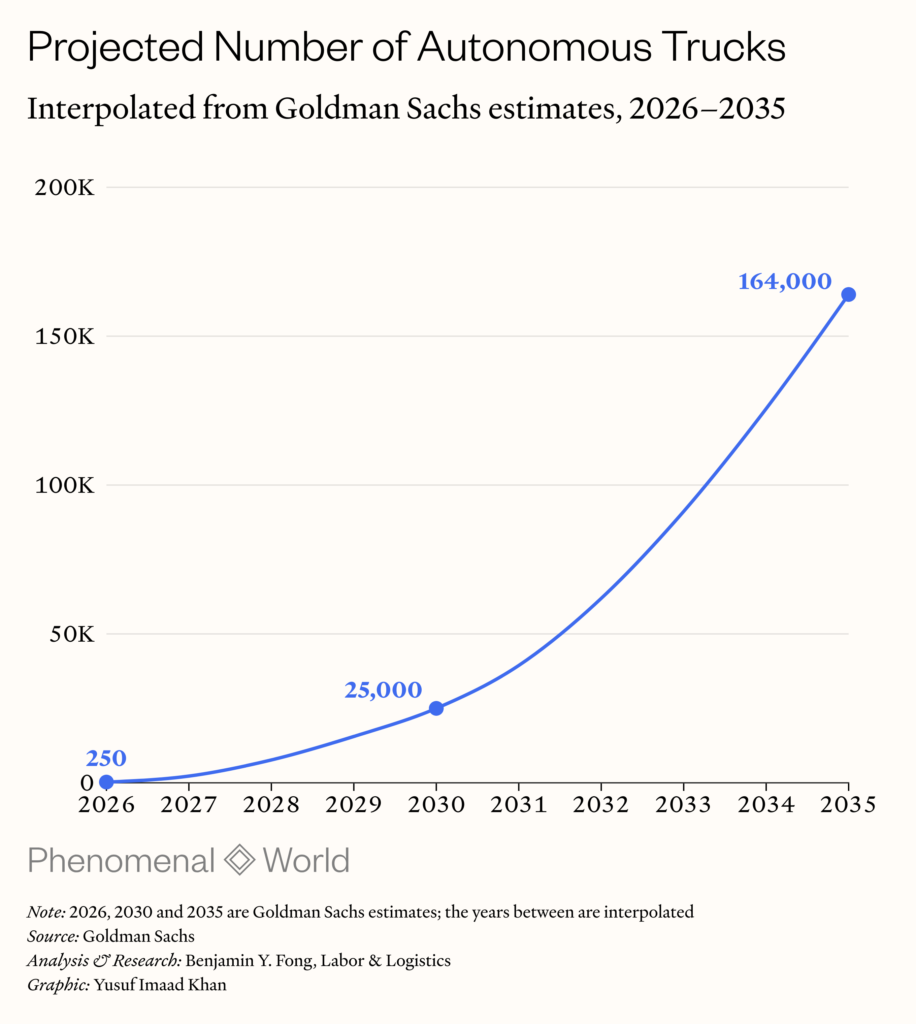
McKinsey has estimated that 13 percent of trucks will be autonomous within a decade, driven primarily by labor market tightness. With roughly three million tractor-trailers on the road today, that would mean an astonishing 390,000 autonomous trucks operating in the United States in 2035, if the semi fleet size remained the same. With the leading autonomous company ramping up to one thousand trucks per year starting in 2027, however, that seems like a distant possibility. Goldman Sachs more conservatively estimates that AV truck revenue in the US will jump from $16 billion in 2030 to $105 billion in 2035, with about 25,000 autonomous trucks on American highways in 2030. If AV truck numbers tracked the revenue growth they project, there would be more like 164,000 autonomous trucks in 2035—closer to 5.5 percent of trucks. This more modest projection corresponds roughly to Aurora’s own estimate of 170,000 autonomous trucks by 2035.
Brulte predicts a key inflection point will come in 2028:
An overwhelming majority of truck OEMs [Original Equipment Manufacturers] are heavily investing in it. Carriers and shippers are experimenting with it, as are Walmart, Amazon, FedEx, UPS. I’d say it’s 18 to 24 months until you start to see this incredible increase in the adoption of autonomous trucking.
Goldman too sees 2028 as the year when AV trucking will be competitive with traditional trucking: while the cost-per-mile for AV trucking is projected to drop from $8.56 in 2025 to $2.03 in 2030, the cost-per-mile for traditional trucking will jump from $2.55 to $2.84 in that same period. (Note that Aurora’s estimate of “$2 plus” per mile revenue for their TaaS service puts their operation significantly in the red if Goldman’s cost numbers are correct.) From one angle, these simple economics matter more for a technology like autonomous trucking than for other innovations that require vast organizational and infrastructural changes to be viable (such as containerization for ocean freight) or whose ultimate value lies in revolutionizing demand (such as the jet engine enabling passenger air travel). In those other cases, many other considerations went into technological adoption than, “is it cheaper?” By contrast, Aurora and Kodiak’s proposition to trucking companies is simply to pay a bit more up front for an upfitted tractor, and then after that roughly 17 percent less for a robot driver who’s never going to complain. “Keep everything else the same, just use our driver instead of a human one,” is the message.
However, there are many questions yet to be resolved that complicate this proposition. For one, there will still be many human beings involved in ferrying autonomous trucks on to their preset destinations: people to attach and detach trailers, drive the trucks around yards once they reach depots, and refuel them along the way. The companies themselves claim that their products will create at least as many jobs as they displace (a curious thing to say while promising labor savings). Who will be responsible for these costs? The DaaS or the carrier? And if the latter, how much is passed on to the shipper? What about when the truck inevitably breaks down? As one anonymous trucking industry professional put it, “We would like to think that [a breakdown is] an infrequent occurrence, but it is not. Currently, if you break down you can typically limp to the next exit or at least to the side of the road. Would an AT be able to do that?” And again, the all important question: who is paying for it if it is?
Then there are the inevitable lawsuits that will come with greater autonomous adoption. As Freightwaves analyst Thomas Wasson told me, “[the companies haven’t really] been sued yet. That’s what they tell me. How do we know how safe something is? We get sued a bunch of times to get the case law. So there’s a weird scenario here where all the providers are waiting for other providers to get sued, so they can take notes and not mess this up.” Insurance costs will be adjusted when these suits are decided, and as another anonymous industry professional claimed, “the insurance companies run our industry. I mean, they truly are more powerful than our customers.”
Add up all the costs involved in these questions and processes sorting themselves out and the AV company’s economic argument looks much less attractive. Trucking is a low-margin industry, where everyone is going to want a great deal of certainty that DaaS is indeed cheaper on the whole and in the long run before committing to the autonomous future. The AV companies might get there soon, but for the moment, what they are touting as a simple one-to-one swap for a cheaper alternative is anything but. Given all of this, even 5 percent adoption of Level 4 autonomous trucks by 2035 looks aspirational for the moment. As Wasson reminded me,
When we see Morgan Stanley and other folks talking about those percentages, these are aspirations. If you’re smart like an autonomous company, you’re going to pay someone to [produce projections], so there’s always a tie-in. These companies are burning tens to hundreds of millions of dollars a year to get this thing off the ground, so it behooves them to also build consensus.
The de-socialization of safety
Again, the business case for autonomous trucks comes down to bringing the cost of running an AV down below that of a traditional, human-driven one. With rapid improvements in autonomous technology, that case could become very convincing in the next few years, but it is currently far from the elegant proposition that aspiring DaaS companies would like it to be.
The safety case for AVs is also presented in simple terms but proves much more complicated upon closer inspection. That case goes something like this: human beings are flawed creatures. We get distracted. We need sleep. Sometimes we’ll take a last-second detour on a particular trip to stop by a restaurant whose burgers we like, and sometimes we’ll drive a little faster than we might need to to get home for the night after a long day. When autonomous trucking companies talk about safety, it is these things they have in mind. Replace that imperfect creature with a sophisticated mechanical system, their argument runs, and our highways will be much safer than they currently are.
These same creatures, however, fly large metal tubes through the sky, and the United States regularly sees zero onboard fatalities in commercial aviation (2025 being a notable exception). How is it that commercial aviation, surely a much more technically challenging endeavor than ground transport, is relatively safe, while commercial trucking is responsible for more than five thousand deaths per year? The simple reason is that commercial aviation is highly regulated, and the overseeing government administration is relatively well-funded: the Federal Aviation Administration has a budget of $25 billion per year and employs more than four thousand safety inspectors, while the Federal Motor Carrier Safety Administration is working with less than $1 billion per year and 350 safety investigators. After the Supreme Court’s Montgomery decision, which made freight brokers liable for accidents involving carriers they work with, there has naturally been greater scrutiny of carriers and a desire to know who should count as “unsafe.” It is challenging to do so given that fully 94 percent of interstate motor carriers have no safety rating from the FMCSA.
The autonomous vehicle companies would like us to believe that safety is a question of individual capacity, when it is in fact one of regulation and public investment. Under perfect conditions, all other things being equal, it seems undeniable that we are at a point technologically where autonomous systems could perform at least as well as the best of human drivers. But all other things are not equal in the low margin, cutthroat world of commercial trucking. As but one illustration: last May during International Roadcheck, a three-day period when the Department of Transportation conducts random inspections of roughly fifty thousand commercial vehicles, about one in five trucks were placed out of service for safety violations. In other words, about twenty percent of the semis on the road today are in such bad shape that the DoT thinks they should not be operating. Without changing the incentives around vehicle maintenance and upkeep, why should we expect tractors outfitted with autonomous systems to be any more well-kept in five to ten years, when they have hundreds of thousands of miles on them, instead of emerging sparkling new from the OEMs?
Wasson and Brulte both believe that the AV trucking companies simply can’t afford to have vehicles out of service, and for the moment, while all eyes are on them, that seems true enough. But with trucking’s extremely thin margins, and with no federal regulator capable of validating the safety of American carriers, the industry is simply not one that will carefully maintain the new sophisticated systems that their trucks will be outfitted with. And until it is, the idea that the tech alone will make trucking safer is just AV marketing.
Progress is not automatic
“We are led to believe that technology automatically confers benefits on society. Technology is represented as the independent variable, the causal factor,” wrote Jack Conway, administrative assistant to United Auto Workers president Walter Reuther, for Business Topics in June 1955. “The purpose of attributing to inanimate machinery the ability to make progress automatically is clear. If machines can automatically give us higher living standards, more leisure, and the better life, then on what grounds do unions make demands for higher wages and for better working conditions? Why struggle to make progress when automation automatically provides progress?”
Conway was intervening in a fevered discourse taking place at the time about the “Second Industrial Revolution” and the inevitable social dislocation that cybernation and automation would bring. Search and replace a few key words in his article and it reads like a contemporary commentary on AI. The same is true of much other writing on automation from the 1950s. Though the overlords of technology are far more hubristic now than they were then, our problems with technological displacement are nothing new, and neither is the ideological cover with which the technologists attempt to blanket them.
American highways are unsafe because trucking industry deregulation in the 1980s created a situation in which it is tremendously easy for inexperienced, unvetted, and shady operators to move freight. The autonomous companies are proposing to replace those operators with experienced, vetted, and transparent robotic ones, but no technological fix can, on its own, change the broader incentives of the trucking industry. It was a social decision that got us into this mess, and it must be a social decision to re-regulate the trucking industry and to invest in modernizing public infrastructure and oversight that gets us out of it. While developments in autonomy unquestionably promise to lighten the burden of human toil and make industrial society safer, in order for that promise to be realized, there must be a corresponding social struggle that both reverses the mistakes of the neoliberal period and translates productivity gains into social benefit. Without this struggle, we are simply introducing spinning plates into a society unprepared to balance them.
Further Reading
Trucking’s Window of Opportunity
The coming restructuring of US motor carrier logistics
Will the Trump administration, the Supreme Court, and the data center boom bring about a restructuring in motor carrier logistics?

Cyborg Trucking
An interview with Karen Levy on surveillance and automation in the trucking industry
The supply and demand whiplashes of the Covid-19 pandemic snarled global supply chains, shaking up labor markets and well-established migration patterns. In the process, existing...

Crisis and Recovery
The underlying problems in the US economy
Today’s Bureau of Labor Statistics (BLS) report hardly registers the cataclysm in the US job market. The sharp 0.9 percent uptick in unemployment—itself newsworthy—only grasps...