March 19, 2026
Analysis
Fiscal Democracy
How Lula’s third term has combined social spending, tax reforms, and fiscal stability to safeguard popular sovereignty

There is less than one year left in Luiz Inácio Lula da Silva’s third term as president of Brazil. With elections scheduled for October, what is the balance sheet of his Workers’ Party (PT) administration to date? Economic indicators suggest that the period from 2023 to 2026 will see the lowest unemployment rates on record, the lowest average inflation rate in Brazilian history, and a reduction in the primary deficit of nearly 90 percent. Spending on social policies surpasses that of any previous government, while poverty and extreme poverty have also reached their lowest rates in the country’s history.
These statistical milestones were reached during a period of fierce debate about the country’s economic management, which has centered on the fiscal policies adopted by Lula and his Finance Minister Fernando Haddad. Critics on the left have charged the government with taking an excessively austerian approach, while those on the right have alleged financial irresponsibility. An objective assessment of the Lula–Haddad reform program, however, must reckon with a series of achievements that seemed exceedingly unlikely when the government took office in 2022. Today, the needs of poor Brazilians are directly represented in the budget; the super-rich are for the first time paying income tax; social spending has been expanded; and a new tax regime has become the law of the land.
Together, these changes amount to a major transformation of the institutional framework of Brazilian fiscal policy, loosening the strictures that have long been placed on the PT’s political program. Understanding the nature of this transformation is essential if future governments are to build on its legacy. To define its salient features, we can start by comparing the current iteration of lulismo to its predecessors in the 2000s and 2010s.
Inequality
Brazil is one of the most unequal nations on the planet. Reducing the enormous disparity between rich and poor after centuries of slavery and just sixty years of democracy is the country’s major structural challenge. Much discussion of the previous PT governments naturally focuses on this metric. Between 2003 and 2014, there was a significant improvement in the income of the poorest population, as well as greater dynamism in the formal labor market. The real appreciation of the minimum wage played a central role in reducing income disparities, while the dramatic expansion of social benefits stimulated demand and accelerated the formalization of the economy. Household surveys show that income inequality in the country fell consistently over this period.
Yet Brazil’s overall national income is heavily concentrated at the top, where income consists mainly of dividends, profits, and financial income. Labor market statistics and traditional data collection rarely capture the economic reality of this upper stratum, where inequality is at its most extreme. Only recently have new methods, based on income tax returns, begun to bring this asymmetry among the elite into sharper focus. Whereas the bottom 80 percent of Brazilian society is relatively homogenous, inequality begins to intensify among the richest 20 percent, deepens in the top 10 percent, and reaches eye-watering levels in the top 1 percent. There is a greater disparity among the richest 10 percent of Brazilians than among the remaining 90 percent of the population.
So, while inequality decreased under Lula (2003–2010) and Dilma (2011–2016), it did so to a lesser extent than the standard surveys suggest. Income concentration remained virtually stable in the top 1 percent. The chart below illustrates this dynamic by comparing the evolution of income for the poorest 50 percent with that of the richest 1 percent between 2002 and 2014. For each group, we have two indicators: market income, and income after taxes and cash transfers. The comparison makes it clear how fiscal policy affects each stratum: the pre- and post-transfer income of the top 1 percent grew slightly, while the share of national income of the poorest 50 increased significantly post-transfer.
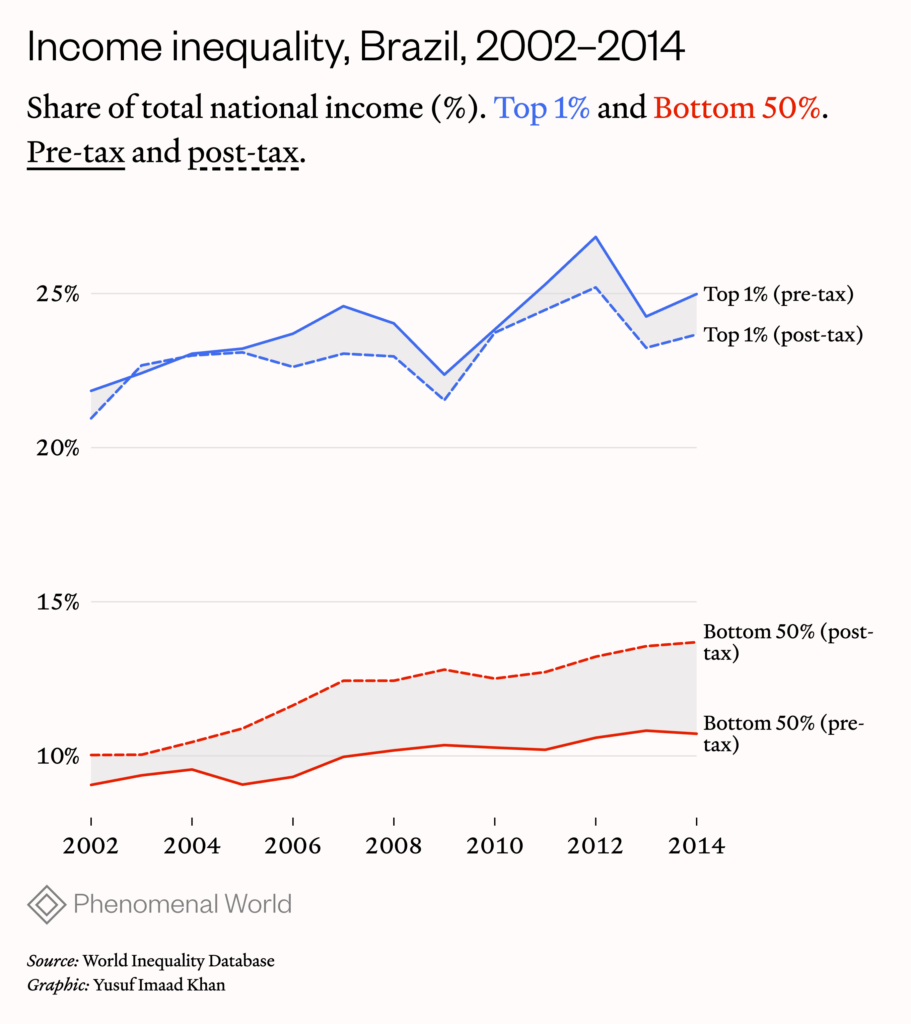
This supports the standard left-wing critique of the first PT administrations: social progress was made, but the economic oligarchy as a whole was left unchallenged. Public spending directed to the poorest reduced inequality at the bottom of the distribution, reinforcing distributional gains and progress in combating poverty. But by preserving the regressive Brazilian tax system—marked by dividend exemptions and very low effective tax rates at the top of the distribution—the PT did little to alter inequality among the wealthiest strata.
The graph also reflects the phenomenon of the “squeezed middle.” The increase in the post-transfer income share of the poorest 50 percent and the richest 1 percent necessarily implied a reduction in the share appropriated by the remaining 49 percent. As the Brazilian economy grew significantly over these years, each stratum saw an increase in its average incomes—yet the middle group grew less. Its share of national income decrease relative to both the bottom and the top. This distributional shift had important political consequences. The middle classes, benefitting neither from the social policies targeting the poor nor from the generous tax exemptions enjoyed by the rich, became increasingly dissatisfied with the first PT governments.
The PT’s agenda in the 2000s reflected the fact that, ever since redemocratization, public spending—cash transfers, healthcare, education—had been the state’s main means of income redistribution: the primary counterweight to the regressive tax collection system. By consolidating these distributive instruments to the benefit of the poor, Lula and the PT secured the firm support of the country’s working classes. Yet the government also ran up against the inevitable limits to transforming income distribution through public expenditure alone. Ultimately, the extreme concentration of income at the top cannot be reversed without a profound change in the tax structure. And the expansion of redistributive capacity through public spending was always constrained by a tax system that placed a significant burden on the middle class while practically exempting the wealthiest. Historically, the average Brazilian paid 40 percent of their income in taxes (combining various direct and indirect taxes), while the wealthiest 0.01 percent paid less than half that figure.
The Poor in the Budget
One of Lula’s promises in his 2022 presidential campaign was therefore to “put the poor in the budget, and the rich in income tax” (o pobre no orçamento e o rico no Imposto de Renda). The first goal required the administration to repeal the fiscal rule adopted under the Michel Temer government in 2017 that froze real growth in spending, which imposed a hard limit on social policy and public investment. The second meant pursuing hugely ambitious tax reforms which had not been attempted even at the height of Lula’s popularity during his second term. Having returned to the presidency with a narrow margin, lacking a majority in Congress and facing a resurgent far right, the task seemed nearly impossible.
As a first step towards putting the poor in the budget in the aftermath of Bolsonaro’s disastrous handling of the Covid-19 pandemic, the incoming PT administration negotiated the Constitutional Amendment Proposal (or PEC), in which Congress agreed to raise the spending cap, allowing social spending to increase by R$145 billion. Without this increase, it would not have been possible to maintain state benefits. Yet this pushed primary spending to close to 20 percent of GDP and opened up a significant budgetary deficit. In return for the PEC, the new government pledged to draw up a new fiscal rule to replace the one from 2017.
Dubbed the Sustainable Fiscal Regime (RFS), the new framework stipulates that spending can continue to grow as long as tax revenue is also growing, with state expenditure limited to 70 percent of the gains in public revenue. Though this still creates fiscal constraints for the government, it represents an improvement on the previous spending cap for two main reasons. First, by repealing the spending freeze, it introduces a countercyclical component: now, even during economic slowdowns, public spending can continue to expand, through the disciplined expansion of public services and investments. Second, by linking expenditure growth to revenue performance, the new regime discourages the use of tax breaks as a political tool to win favor with certain constituencies. Under the RFS, revenue losses reduce fiscal space, while revenue increases allow for expanded spending. This, in turn, creates a clear incentive for the PT to carry out a structural overhaul of the tax system.
The New Tax Paradigm
The third Lula administration’s tax regime represents an unprecedented response to popular demands for a deeper transformation of the Brazilian economy. The reconfiguration currently underway has the potential to finally confront the country’s extreme concentration of wealth, which public spending alone cannot resolve. For the first time in the democratic era, we are seeing a comprehensive reorganization of indirect taxation, along with measures that call on the wealthiest to contribute more to financing the state.
This regime has three main pillars: the reform of consumption taxation; revenue restructuring; and the reform of income and wealth taxes, particularly the Individual Income Tax. In the area of consumption, the new tax architecture is the culmination of at least two decades of intense debate. Constitutional Amendment No. 132/2023 brought about a comprehensive restructuring of the Brazilian tax system by replacing the fragmented logic of indirect taxes with a dual Value-Added Tax (VAT), consisting of the Contribution on Goods and Services (CBS), under federal jurisdiction, and the Goods and Services Tax (IBS), shared by states and municipalities.
This has resulted in a number of significant changes. By distributing broad tax credits throughout production chains and reducing cumulative taxation, the reform seeks to eliminate distortions that led companies to artificially integrate different stages of production, use less efficient inputs and technologies, or organize their supply chains for tax reasons rather than economic ones. Incentives for predatory competition among states through tax benefits have been reduced, diminishing the “tax war” between federal entities and reorganizing the country’s productive geography around real economic fundamentals, rather than tax advantages.
Though it is designed to be neutral in terms of tax rates, the reform may increase structural tax revenue by promoting greater economic efficiency and productivity gains. Its allocative effects are accompanied by distributive measures, such as tax exemptions for the basic food basket and the introduction of a cashback mechanism, which returns a portion of the indirect tax revenue to lower-income consumers. Thus, the reform helps correct a long-running historical distortion in Brazilian taxation: the proportionally greater burden of indirect taxes on the base of the social pyramid, stemming from the fact that lower-income families allocate a larger share of their income to consumption.
The effort to restructure revenues followed the same logic of combining greater economic efficiency with the promotion of tax justice. This includes measures such as the reintroduction of fuel taxes and the reinstatement of the casting vote in the Administrative Council of Tax Appeals (CARF), which reestablishes the primacy of the public interest in cases of ties in tax litigation and reduces incentives to use administrative disputes as a means of deferring tax payments. The government has similarly sought to limit tax offsets by restricting automatic mechanisms and the excessive use of credits, particularly those arising from judicial decisions.
This comes alongside the gradual reversal of payroll tax exemptions and the review of sectoral programs with high fiscal costs, such as the Emergency Program for the Recovery of the Events Sector (Perse), adopted in 2021 to mitigate the negative impacts of the pandemic. In addition, Complementary Law 224/2025 sought to address the rapid growth of tax expenditures by establishing a 10 percent across-the-board cut and creating guidelines for a new governance framework for these benefits, with requirements for targets, time limits, and monitoring mechanisms.
Other measures have tried to combine the correction of economic distortions with increased tax intake. Decree No. 12,499, for example, adjusts the rates of the Tax on Financial Transactions (IOF) for various transactions, in an attempt to reduce tax asymmetries among institutions offering similar products while improving tax collection. By eliminating the IOF on the repatriation of capital associated with direct investment, the measure standardized the treatment of such returns relative to transactions in the financial and capital markets, strengthening incentives for foreign investment. In December 2025, a similar increase in taxation on fintech was approved, reinforcing competitive parity with other institutions offering similar financial services. The rules governing the taxation of gambling have also been revised, with the introduction of joint liability mechanisms aimed at curbing irregular operations in the sector and mitigating their social costs.
Finally, under Lula 3.0, several measures aimed at expanding taxation on capital gains and large estates have been implemented. Among them are the taxation of offshore accounts and exclusive funds, the increase in the withholding tax rate on interest on equity, the establishment of a minimum tax on multinationals through an additional Social Contribution on Net Income, the setting of a minimum tax rate for dividend remittances to non-residents, and the fight against tax avoidance strategies in pension fund investments. As a result, the share of income tax in total primary revenues has increased by 1.4 percentage points over the course of the administration. Taken together, the effort to rebuild tax collection capacity is expected to generate more than R$480 billion in additional revenue for the public coffers by the end of 2026.
These initiatives signal an effort to radically transform the country’s tax system, combating privileges and distortions while making it more efficient and fair. In November last year, they culminated in the passage of a landmark bill: the Individual Income Tax (IRPF) reform. As early as 2018, Lula and Haddad argued for a more equitable, solidarity-based tax reform, placing the issue at the center of its political agenda during its time in opposition. Now it has come to fruition. The revenue-neutral IRPF reform is notable for its simplicity. As of January 2026, those earning less than R$5,000 per month are exempt from income tax. For those above this threshold, taxation increases progressively until reaching the full level for monthly incomes of R$7,300 or more.
To offset these exemptions and deductions, individuals with taxable income exceeding R$ 600,000 per year now pay a minimum tax rate, which can reach 10 percent for those earning over R$1.2 million. In practice, a minimum tax levied on approximately 140,000 taxpayers will reduce the tax paid by more than 15 million people. For those earning up to R$5,000 per month, the cumulative annual benefit will be equivalent to nearly an extra month’s salary. The effect is not only to create a more rational system but also to rebuild the connection between the PT and the middle classes. By increasing the tax burden on the top of the pyramid and beginning to tackle the roots of Brazilian inequality, Haddad may have found a way to incorporate the squeezed middle into the PT’s project.
The passage of the proposal was eased by certain aspects of its design. First, by linking the expansion of the low-income exemption—a highly popular policy—to offsetting mechanisms within the income tax system itself, the reform preempted its opposition. Rather than increasing taxation on dividends or establishing differentiated rates for different types of income, the choice of a minimum rate simplified the implementation and made it easy to explain the measure to the public. Finally, the reform’s parametric logic—both regarding the minimum rate and the income brackets at which it applies—means the debate over greater tax justice will now continue within the framework established by the IRPF.
This victory was also due in large part to the administration’s deft political maneuvering, particularly its ability to use congressional vetoes as an opportunity to start a public conversation about the anti-democratic nature of the legislature. Coordination between economists, political parties, and social movements succeeded in overturning the common assumption that the Brazilian people would oppose higher taxation. The slogan “Congress is the enemy of the people,” propagated by the PT’s base and the left more broadly, became a rallying cry on the streets and social media. Intensifying social pressure allowed the government to overcome its minority in Congress and pass an agenda that seemed impossible at the beginning of its term.
Can the strategy be extended? A PT-led campaign is now underway to reduce the working week while preserving wages. By placing this policy at the center of the public debate in an election year, the government is signalling its intention to continue on the course set by the tax reform, turning distributive conflict into a new site of political mobilization.
Democratization
Opponents on both the right and left accused previous PT governments of failing to enact real structural reforms. The right argued that the PT had effected an artificial redistribution of income which, because it was not accompanied by productivity gains, relied entirely on the commodities boom, and could only be maintained after its exhaustion through a major fiscal imbalance. The left meanwhile claimed that the external boom allowed the government to distribute income to those at the bottom without confronting those at the top, in what amounted to a timid policy of class conciliation. Yet while some of the PT’s measures were less ambitious than others, many of its reforms did in fact have a structural character: by redirecting state policy to benefit historically neglected constituencies, it contributed to the democratization of the state.
On the social front, the combination of cash transfer policies and a labor-market boom allowed Brazil to conquer the scourge of hunger. Programs such as Luz para Todos (Light for All), Mais Médicos (More Doctors), and Cisternas (Water Cisterns) expanded access to essential public services and helped reduce geographic and social inequalities. The expansion of access to higher education, notably through the university quota system—and its extension to the federal civil service—increased the presence of Afro-Brazilians in positions of power. Macroeconomically, the repayment of foreign debt and the accumulation of over $300 billion in foreign exchange reserves substantially reduced the country’s vulnerability to international shocks. While these gains were enabled by a favorable international context, economic policymaking was also decisive for developing a virtuous cycle of economic growth with income redistribution and increased public investment.
To recognize the merits of the first PT administrations is not, however, to deny that, until recently, the oligarchic structure of Brazilian political economy—with its high concentration of income and power—was left largely intact. It is only Lula’s third administration that made a serious effort to challenge it. From this perspective, it is clearly the most radical of the PT administrations.
During the period of negotiations on the Sustainable Fiscal Regime, there was significant fear among the left that the new fiscal rule would not break with the logic of the previous spending cap. Yet the pre-inauguration approval of the PEC Proposal—which ensured that the new fiscal rule would start from an already high level of public spending—plus the guarantee of real expenditure growth and the linking of expenditure growth to revenue turned out to be fundamentally distinct features, which distinguish the current fiscal regime from what came before. In light of the economic results achieved by the current administration, it is obvious that the government has proven its ability to navigate the constraints of the new spending framework.
The results for the period show a simultaneous expansion of employment, social spending, and public investment, accompanied by a reduction in inequality as measured by household surveys. The Continuous Cash Benefit rose from R$84.6 billion in 2022 (in 2025 values) to R$127 billion. Bolsa Família, which served approximately 18 million families in July 2022, reached 21 million at the start of the current administration and has recently seen a decline due to improvements in the labor market. Overall, social spending saw its highest real growth in ten years, at 6.16 percent.
Public investment has also resumed growth and is expected to end 2026 at the highest level of the decade: R$529 billion. A significant portion consisted of infrastructure investments, which in 2024 broke the record for the last three presidential terms, totaling R$261 billion. The average monthly number of homes financed through the FGTS was 47,000 units, the highest volume on record. At the same time, economic performance exceeded the expectations of many analysts, who had predicted a slowdown under the new fiscal framework: GDP advanced and, over the past three years, grew at an annual average of 3 percent, the highest rate in over fifteen years.
Finally, even with the expansion of social spending and investment, the fiscal results showed a significant improvement. The primary deficit fell from 2.09 percent of GDP in 2023 to 0.48 percent in 2025, and the average for the term is expected to be the lowest since 2014.
This performance was made possible by an approach that reorganized fiscal policy based on a clear principle: reconciling social justice, growth, and political credibility. The RFS was necessary to address fiscal constraints that reflect the current political balance of distributive power, as well as the economy’s installed capacity, public debt management, and the dynamics of exchange rate policy, as well as the lower tolerance for inflation both in Brazil and on the international stage.
This demonstrates that, while the scale of public spending is undeniably important, the question of who finances it and who benefits from it is equally consequential. Advocating for fiscal expansion is not the same as advocating for tax justice. The former ignores the intricacies of distributional conflict and shifts the debate to the absolute size of spending—which includes a significant portion of regressive expenditures that favor the wealthiest—rather than the sources of financing and its ultimate orientation.
As the data on income distribution in Brazil illustrate, the ability of public spending to influence income concentration at the top is practically nil unless it is accompanied by more profound tax reforms. The country’s history, from the coffee crisis to tax relief programs, is replete with episodes in which fiscal expansion proved little more than a way to socialize the elites’ losses during economic slowdowns, deepening the country’s inequalities in the name of sustaining economic activity. Now, in an unprecedented move, the Lula government has achieved a fiscal reorganization based on higher taxation of the wealthiest, a review of regressive tax expenditures, and an expansion of cash transfers to the poorest.
Progressive criticism of the PT’s early governance experiences, combined with political work to educate and mobilize the popular sectors, has contributed to the maturation of the party’s program, producing a more ambitious agenda. In contrast to the previous model, based solely on improving conditions at the bottom without challenging the privileges at the top, the wealthiest are now being forced to pay more while the poorest are reaping the benefits of an expanding social state. As the election approaches, any assessment of Lula–Haddad economic policy must take into account not only the improvements in employment, inflation, and inequality, but also the transformation of Brazilian fiscal policy framework. The ongoing restructuring represents an extension of democratic sovereignty: by reforming fiscal and tax rules, the government seeks to incorporate its working-class base into the state itself.
Further Reading

A Class Coup
Workers, unions, and dictatorship in Brazil (1964–85)
The struggle for rights of Brazilian workers, and its fierce public presence since the end of the Second World War, reached its apogee early in...

The G20 in the South
The Brazilian Presidency in 2024
In December 2023, Brazil began presiding over the G20. The one-year presidency, which will culminate in the annual summit being hosted in Rio de Janeiro...

What Future for the Global South?
Brazil’s leading diplomat on navigating global instability
Lula’s Chief Advisor discusses the assault on Iran, the concept of multipolarity, and how Brazil can defend its sovereignty in an age of imperial conflict.