Analysis
E-Commerce in the “Second Cold War”
False narratives in the global race for e-commerce markets
Many political commentators and scholars have found it useful to frame China’s challenge to US hegemony in the terms of a “second Cold War”—second, of course, to the first between the US and the USSR. In addition to a fight for political influence in various geographic blocs of countries, the second Cold War is also a form of “network-based competition,” in which the US and China compete for dominance over “interrelated transactional networks.” If the dollar’s role was one important element in the history of the first Cold War, another particularly important transaction network today is e-commerce, which spans infrastructural, logistical, and digital domains. Both countries have domestic e-commerce giants—Amazon and Alibaba—which, in the opinion of some observers, “Washington and Beijing have sought to instrumentalize… in pursuit of geoeconomic and geopolitical objectives.”1Schindler, S., Alami, I., DiCarlo, J., Jepson, N., Rolf, S., Bayırbağ, M. K., … Zhao, Y. (2024). “(<)a href='https://doi.org/10.1080/14650045.2023.2253432'(>)The Second Cold War: US-China Competition for Centrality in Infrastructure, Digital, Production, and Finance Networks(<)/a(>).” (<)em(>)Geopolitics(<)/em(>), (<)em(>)29(<)/em(>)(4), 1083–1120.
If indeed e-commerce is a battlefield in a new Cold War, then China has thus far put up a weak fight. While there are certain places—like Brazil—where Amazon, the Chinese e-commerce companies, and regional or homegrown alternatives are all vying for logistical supremacy, Amazon is by far the most dominant e-commerce company globally. Moreover, there are major obstacles to Chinese e-commerce growth internationally; indeed, it is difficult to imagine the key Chinese companies as a whole catching up with Amazon any time soon, let alone as individual companies.
But rather than affirming US dominance in a second Cold War, the analysis here can just as easily be employed to question the applicability of this framework to the case of e-commerce. China is unquestionably “behind” the US when it comes to global e-commerce penetration, but it’s not clear that winning this particular race is its goal.
Categorizing global e-commerce
When it comes to global e-commerce, both in terms of companies and markets, it’s China and the United States, and then everyone else. China is by far the largest market in terms of revenue generated from e-commerce ($2.04 trillion in 2025), with the US a distant second at $1.08 trillion, per the global e-commerce database ECDB.2Not to be confused with the Extremist Crime Database published by the University of Maryland and funded by the Department of Homeland Security. The e-commerce revenue in 2025 of the next eighteen countries after the US totals $1.39 trillion, just 68 percent of China’s revenue.
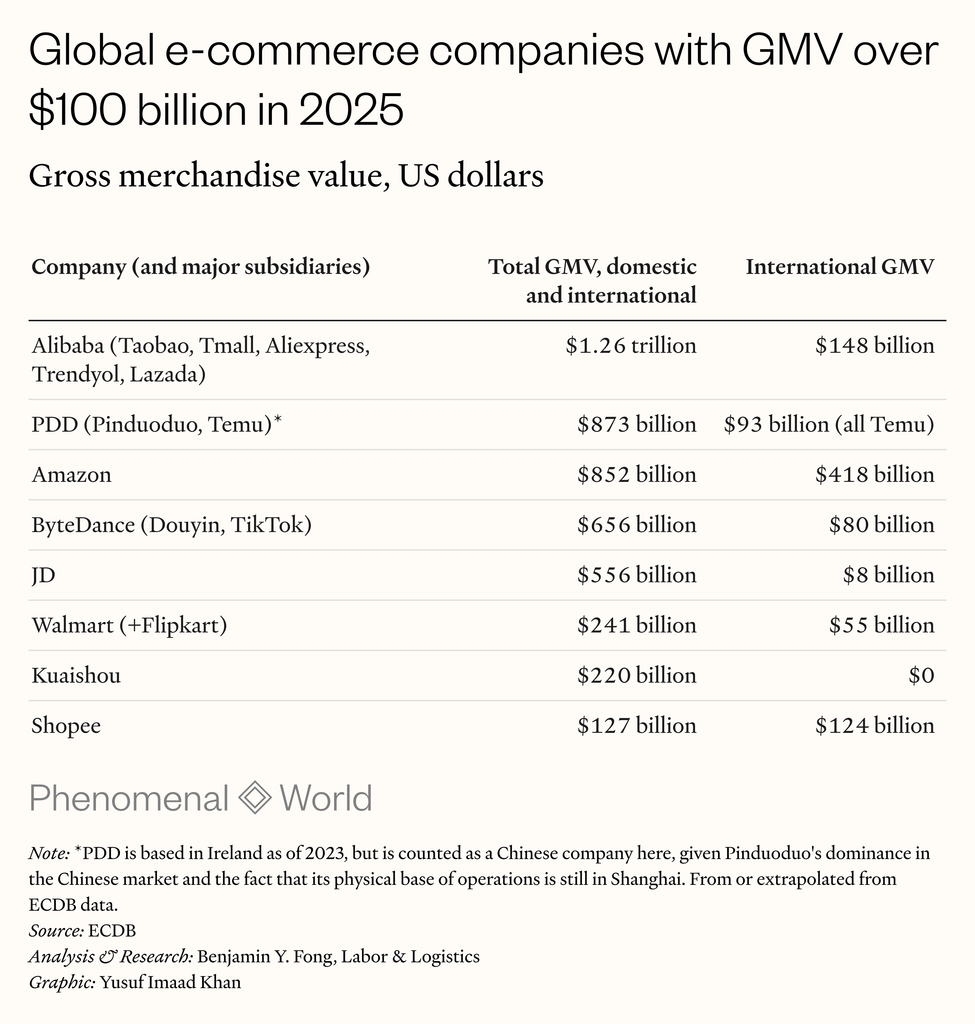
At the company level, ECDB ranks e-commerce dominance by gross merchandise value (GMV), i.e., the total cost of both first- and third-party goods sold on their websites—typically a greater number than revenue as companies only capture fees on third-party sales. According to this metric, the largest e-commerce company in the world is a Chinese one: Alibaba, provided one tallies together the GMV of its various subsidiaries (Taobao, Tmall, Aliexpress, Trendyol, and Lazada), which amounted to $1.26 trillion in 2025. Alibaba is followed by PDD (which owns Pinduoduo and Temu), Amazon (the largest company under a single brand), ByteDance (the developer of Douyin and TikTok), JD.com, Walmart (and its subsidiary Flipkart), Kuaishou, and Shopee (based in Singapore—the only company here that is neither Chinese nor American).
While this list speaks to the size and power of Chinese e-commerce companies, the vast majority of their GMV is derived from domestic sales. Pinduoduo and Kuaishou operate exclusively in China, though the former’s sister company Temu is internationally focused. Taobao and Tmall’s GMV is more than 97 percent–focused domestically; Alibaba’s primary international play is Aliexpress, and it also has controlling stakes in Trendyol and Lazada. If you total the 2025 GMV derived outside of China for all five of the largest Chinese e-commerce giants (see Table 1), it only amounts to $329 billion, or 79 percent of Amazon’s international GMV.
That said, Douyin, Temu, and Aliexpress’s year-over-year GMV growth were all over 20 percent in 2025, as opposed to Amazon’s 9.7 percent. These growth rates might seem to paint a picture of a true global platform struggle, but a closer look at the prominent markets reveals that Amazon maintains a significant lead over its Chinese competitors.
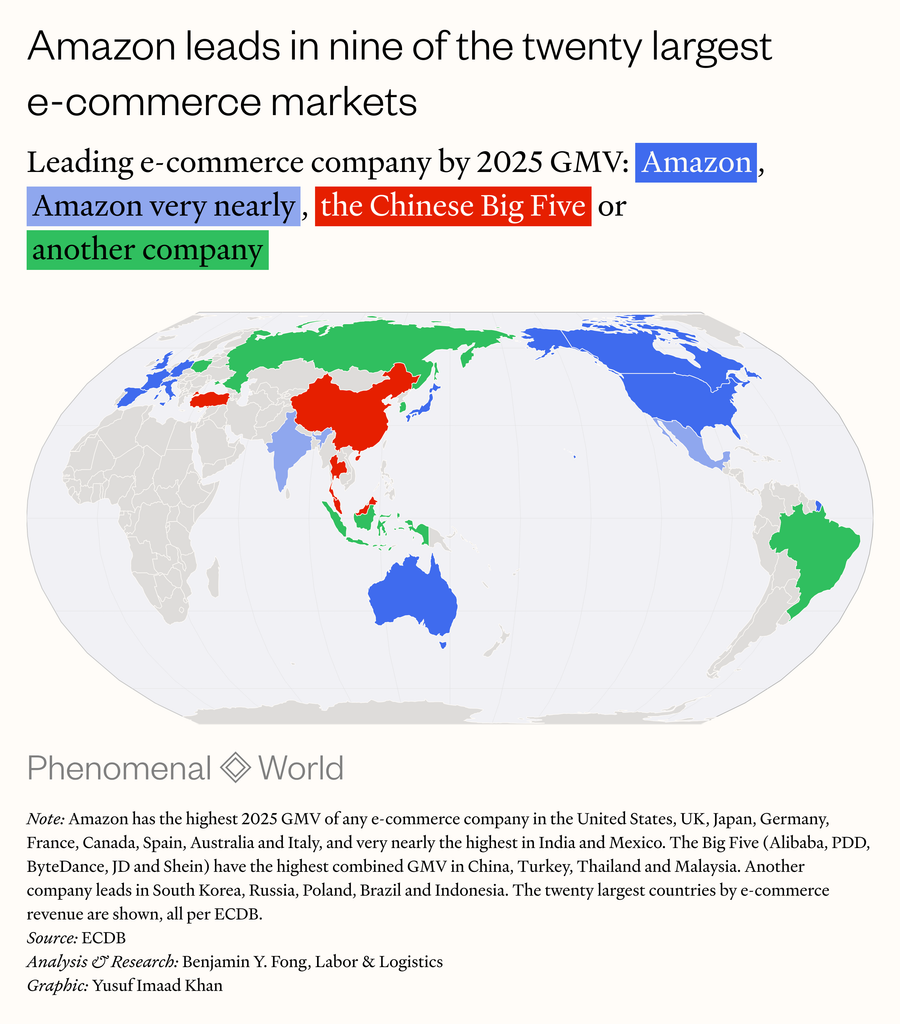
After China and the United States, the eighteen largest national e-commerce markets by revenue can be broken into three categories that are useful for the present analysis (see Table 2). The first consists of the established markets where Amazon dominates, including the UK, Japan, Germany, France, Canada, Spain, Australia, and Italy. These are countries with high internet use where the online share of retail is expected to grow less than 25 percent in the next five years, according to ECDB. In all of these countries, Amazon is not only the largest e-commerce player but its 2025 GMV was also larger than that of Alibaba, PDD, ByteDance, JD, and Shein combined, which I group together here as the “Big Five” international Chinese e-commerce players (this is my own categorization, not ECDB’s).3Shein, which has disturbed many US retailers and lawmakers, is not in the list of largest e-commerce companies in the world. But it is a major Chinese international player with a GMV of $71 billion in 2025.
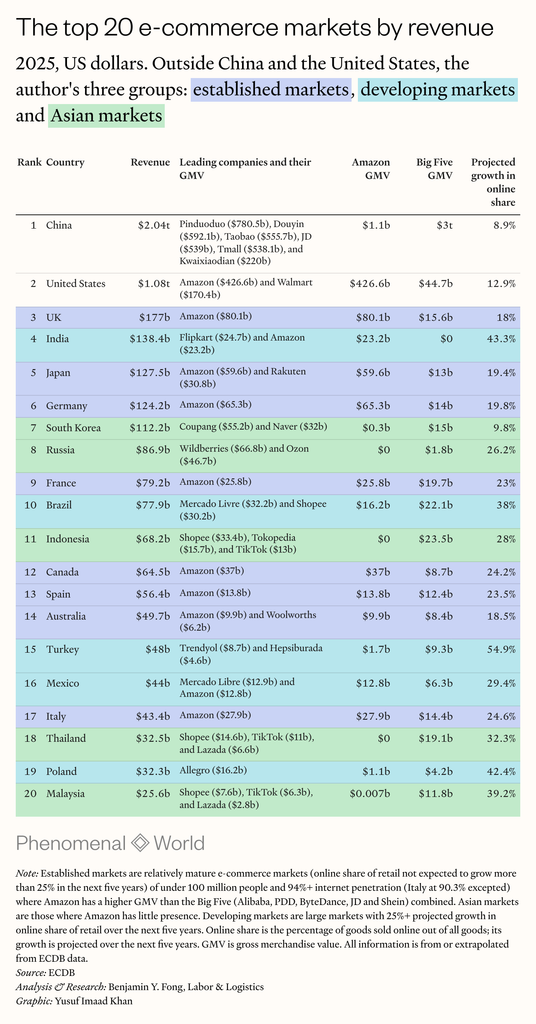
The second category consists of the big developing markets, which are large markets with above 25 percent projected online share of retail growth in the next five years, and could all be considered “battleground” markets for Amazon and the Big Five. These include India, Brazil, Turkey, Mexico, and Poland. Surely the sorest point here for the Chinese companies is a total lack of penetration into the massive market of India, which banned many Chinese apps after a border dispute between the two countries in 2020. India is not only the most populous country in the world, but ECDB projects its online share of retail to grow a whopping 43.3 percent in the next five years. Unsurprisingly, Amazon is very committed to surpassing Flipkart (Walmart) as the dominant e-commerce company in India, recently promising to invest $48 million there through 2030. Meanwhile, despite some easing of Chinese–Indian tension, the Chinese app ban remains in place.
Of all the countries with the top twenty largest e-commerce markets, Brazil might be the place where there is the clearest jockeying for position between Amazon, the Big Five, and homegrown alternatives, most notably Mercado Livre, so it’s no surprise that the “second Cold War” framing has been applied there. In Mexico too, this is evident, though Amazon is pretty close to being the dominant player in the country. Turkey and Poland both have homegrown alternatives in Trendyol and Allegro, respectively, though Alibaba took a controlling stake of the former in 2018.
The final category consists of the Asian markets where Amazon currently has little presence. In South Korea ($112 billion in e-commerce revenue in 2025, about $25 billion more than Russia), the dominant company is Coupang, which chose to IPO on the New York Stock Exchange in 2021 and moved its headquarters to the US in 2022, despite conducting over 90 percent of its business in South Korea. After a massive data breach that affected more than 30 million of its customers, Coupang was fined earlier this year by the South Korean government for $400 million. In response, a House Judiciary Committee accused South Korea of discriminatory practices toward Coupang and other “US” companies, despite Coupang having less than 1,000 employees in the US and doing little business in the country. In Russia, meanwhile, the dominant company is the homegrown Wildberries, which has grown increasingly close to the Kremlin and recently had its warehouses targeted and struck by Ukrainian drones in a war effort backed by the United States. Neither Chinese nor American e-commerce companies currently have much of a foothold there, and I can’t see this changing any time soon. Indonesia, Thailand, and Malaysia are each dominated by Singapore-based Shopee, though both ByteDance (through TikTok) and Alibaba (through Lazada) have significant market share. What’s immediately notable about these countries is that despite little to no competition from Amazon, not one of the Big Five companies controls the leading marketshare.
In brief, among the top twenty largest national e-commerce markets, Amazon is unlikely to lose much ground where it has already achieved a dominant market share: the US and the eight established markets. In the developing markets, there are some examples (like Brazil) where true competition seems evident, but China is iced out of India, and Amazon is nearly dominant in Mexico. And even in the Asian markets, where the Big Five face little to no competition from Amazon, they have not yet established their dominance. Again, all of this paints the picture of a pretty lopsided contest in the supposed “second Cold War.”
Will China catch up?
Chinese e-commerce companies are pretty far behind Amazon when it comes to international market penetration, and while it might seem like it’s only a matter of time before one of them really scales internationally, the Big Five face a steep uphill climb to catch up with Amazon.
Temu and Shein achieved their remarkable growth in the US thanks to the de minimis loophole, which has since been closed. Under this exemption, no import levies were placed on shipments worth $800 in value or less to the US. Rather than send inventory in bulk to US distribution centers, as most retailers do, Temu and Shein would simply send individual orders already packaged from China duty-free. After this exemption was eliminated in May 2025, both companies’ daily active users in the US plummeted, as did their US ad spend. Both companies have had to pivot to utilizing local warehousing and transportation services, now forced to compete on Amazon’s turf. Shein reported a loss of $99 million in Q1 2026, as opposed to a profit of $395 million in Q1 2025, a dip attributed mostly to the cratering of their US market. Both companies shifted focus to the European market, but the EU too recently closed their own de minimis exemption.
While PDD Holdings does not break out numbers for its Temu segment in its reporting, one can be certain that Temu is also struggling to navigate the new tariff reality. PDD moved its headquarters to Dublin in 2023, partly for the country’s friendly corporate environment, partly to better grow Temu for a western audience, but also to escape from a Chinese regulatory crackdown. China’s State Administration for Market Regulation has been investigating reports of fraudulent deliveries, and in December 2025 it raided Temu’s Shanghai office. The next month, Temu’s new Dublin headquarters were raided by the European Union, which was investigating illegal Chinese subsidies provided to the company.
AliExpress, too, has had to pivot away from the direct-from-China model, and by turning increasingly to local sourcing and warehousing, it just posted its first quarter of profitability this year (though on declining revenue). It has also quietly started a membership program, “Elite,” similar to Amazon Prime, and it looks like the company’s harrowing strategy from here on out is to try and out Amazon Amazon. The same goes for JD, which is still barely an international player at this point but recently launched its Joybuy platform in many European countries. Known for its logistical prowess and first-party, higher-end goods (as opposed to the deals found on Temu and Shein), JD might be better positioned to take on Amazon head-on, as its brand has not previously been known as a discount alternative. This is a daunting task regardless, but the strategy is perhaps more clear-eyed than thinking an import loophole could be exploited forever.
Of all the Chinese e-commerce companies, however, ByteDance’s TikTok is the real player to watch. In July of this year, TikTok Shop’s online GMV in the US was greater than that of Target, Costco, and Home Depot. This is somewhat ambivalent news for ByteDance, which was forced to take a minority stake in TikTok USDS Joint Venture, which operates TikTok in the US, after the Trump administration threatened an app ban. But it is nonetheless clear evidence of the general success and promise of ByteDance’s “social commerce” model, i.e., buying and selling directly within a social media app, which has long been successful with Douyin in China and is now taking off in many other parts of the world. TikTok’s overall GMV grew by 93.9 percent in 2025, and it is projected to grow 86.5 percent in 2026, according to ECDB. While the other Chinese e-commerce companies are increasingly being forced to play Amazon’s game, ByteDance has a novel and attractive retail channel, the ceiling for which has not yet been glimpsed.
The meaning of Chinese competition in e-commerce
With the resources available to an Alibaba or a PDD, the global e-commerce landscape could change quickly if they went on an acquisition spree. But for the moment, Amazon is far and away the dominant player, and there are significant hurdles to the viability of Chinese e-commerce abroad (TikTok aside). But this raises a simple question: how much does that really matter?
Chinese e-commerce really took off in the mid-2000s: Alibaba’s Taobao was launched in 2003, and it overtook eBay China just two years later to become the largest e-commerce platform in the country. From that point on e-commerce sales boomed, and the Chinese state was, for the most part, hands off as the new platform giants grew. As Lizhi Liu, author of From Click to Boom: The Political Economy of E-Commerce in China, explained to me,
The Chinese economy used to be driven largely by state-led investment and exports. But by the mid-2000s, those two engines of growth were beginning to lose steam. The Chinese government therefore started looking for ways to stimulate domestic consumption, and e-commerce became one important part of that effort. When I spoke with local government officials, they sometimes described e-commerce as a “抓手”—a policy lever they could use to achieve broader economic goals. They saw e-commerce as a way to build a more integrated national market and lower the cost of doing business. This helps explain why the government supported it [through lax regulation] for such a long time, even though the rapid growth of online commerce considerably disrupted traditional offline retail.
McKinsey issued a study in 2013 claiming that while 61 percent of Chinese e-commerce spending was a substitute for offline spending, 39 percent was new expenditure that would not otherwise have been made—a number that climbed to 57 percent in smaller cities outside the major metropolises. This domestic retail market growth, an explicit goal of the state in the mid-2000s and eventually a central objective of the 12th Five-Year Plan in 2011, came through the forging of a new mode of impersonal exchange that tied together distant regions of China. As small producers found a vast new audience, Chinese attitudes toward entrepreneurship began to change. “Before the mid-2010s, it was still relatively unusual for young people in China to become entrepreneurs,” Liu continued. “‘Entrepreneur’ was not necessarily a positive label; it could simply mean that you did not have a regular job. Many parents would have strongly preferred that their children take a stable job rather than start a business. E-commerce helped change this by dramatically lowering the barriers to entrepreneurship, a development that aligned closely with the Chinese government’s policy priorities—for example, the idea of “mass entrepreneurship and mass innovation” (大众创业、万众创新) proposed by then-Premier Li Keqiang in 2014.”
Still, despite the phenomenal success of e-commerce, it was an open secret that state regulation would eventually come. Many analysts attribute the beginning of the state’s crackdown on the tech sector to Jack Ma’s inflammatory political comments in October 2020. While that might have been the proximate cause of a multiyear regulatory effort, there were a number of other factors: Chinese banks had long lobbied the state to regulate e-commerce, there were well-known privacy and security issues with the e-commerce companies’ data collection practices, and there was even pervasive tax evasion. Regulation obviously stifled e-commerce growth, but it curbed many of the excesses of the tech moguls—something Americans can only dream about.
Today, e-commerce growth in China is tame compared to what it was between 2008 and 2020. That is partly due to regulation, but the market is also quite saturated. Five-year projected growth in the online share of retail in China is a measly 8.9 percent, much lower than even the established markets in western Europe. ECDB puts its existing online share of retail at 28.1 percent, but other estimates have it between 32 and 47 percent. As Ma himself said once, “In the US, e-commerce is the dessert, but in China, it is the main course.”
Still, China’s size means that even a lower growth rate represents massive revenues. ECDB projects China’s e-commerce revenue to grow by more than $900 billion over the next five years, over $200 billion more than in all eighteen of the top twenty e-commerce markets after the US combined. The state’s aim with e-commerce was always the growth of domestic consumption; it has been fabulously successful in this regard, and it will continue to be for the foreseeable future. Of course, international growth is desired: “The state ultimately cares a great deal about growth. In China, 2023 was widely described as e-commerce’s “出海元年”—literally, the ‘first year of going global,’” Liu explained.
Cross-border e-commerce had existed well before then, of course, but 2023 marked a broader pivot as many Chinese e-commerce firms and consumer brands began placing much greater emphasis on overseas expansion. The Chinese government certainly supports this international push, but I am not sure it is primarily about challenging the United States or Amazon. Much of it is more pragmatic: China’s domestic e-commerce market is already highly saturated; with domestic economic slowdown, Chinese companies increasingly need to look abroad for new sources of demand. For many of them, going abroad is more about continued growth—and sometimes even survival.
Given the difficulty of penetrating the established markets, I imagine the short-term focus for China’s e-commerce companies will involve seeking regional dominance (and in particular knocking Shopee down a peg) and growing their share in the developing markets to which they have access—particularly, Brazil, Turkey, and Mexico. In any event, given the projected growth of the Chinese market, despite its significant slowdown relative to the 2010s, international expansion is not quite a make-or-break proposition.
All of this puts into question the basics of the “second Cold War” framing: for Beijing, e-commerce in its period of rapid growth was about opening up the domestic market. Though there is now an explicit injunction to go global, this is more about maintaining the health of Chinese businesses. Regardless, there is still enough road ahead domestically for the Chinese e-commerce companies to do well without marked international success. No doubt the Big Five want, like any set of capitalist firms, to find growth markets, but it takes some degree of imagination to understand their constrained strategies for doing so as the moves of a geopolitical combatant.
Filed Under
Further Reading
Overexpectations in e-commerce?
A story told through the clash of the world's two largest corporations by revenue
Is brick-and-mortar retail bound to lose ground to the new portals of infinite choice and doorstep delivery? The picture is more complex than it might...

The Anti-Amazon
Costco's model and the future of retail
We are in a new age of logistical prowess, led by the dynamism of Amazon as it strives to carry out dizzyingly complex forms of...

Three Frontiers of Global China
Prospects for South–South development without dependency
What defines Global China today? China’s global power extends beyond infrastructural investments in the global South to entail normative and epistemic shifts as well, with...