July 27, 2026
Analysis
Defense Dividends
Private finance bets on the defense industry
In June 2025, BlackRock announced the creation of an Exchange Traded Fund (ETF) focused on the European defense sector in response to what Jane Sloan, the company’s Head of Global Product Solutions, described as “consistently expressed interest” among European clients in defense investment. The new fund, she claimed, would not just “offer investors targeted exposure to the European defense sector” but also serve in “channeling capital into Europe to support local industry and the strategic goals of the region’s countries.”
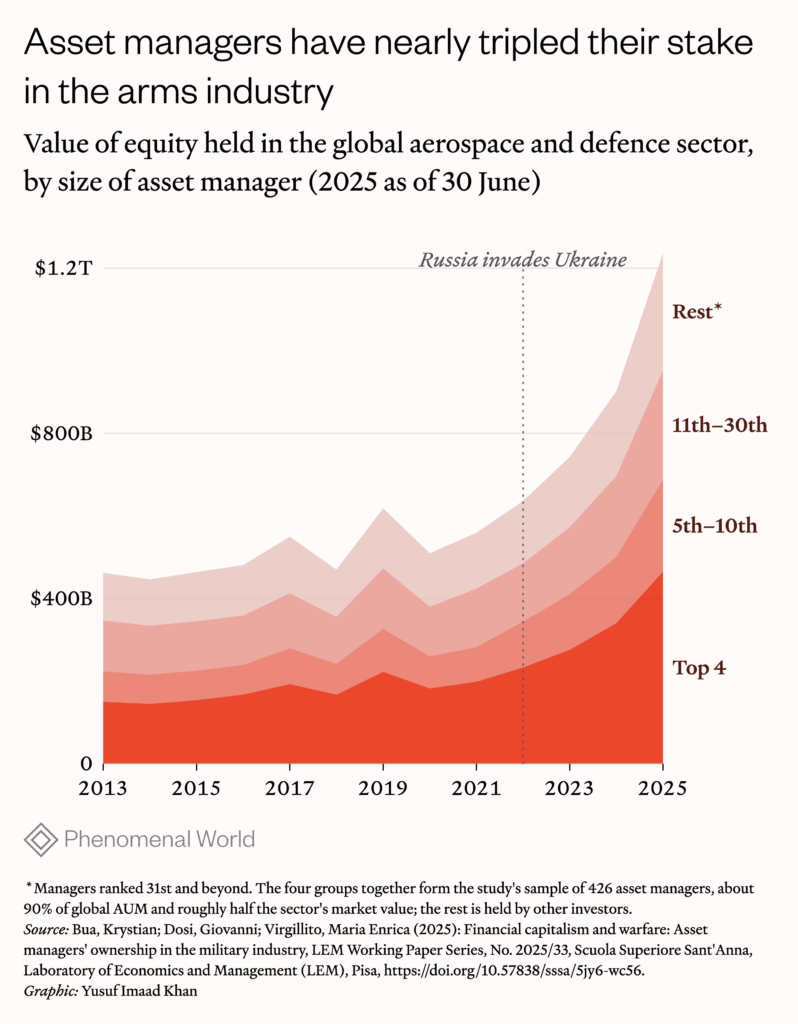
BlackRock’s new ETF is emblematic of the staggering acceleration of private sector interest and investment in the global military and defense sector. Over the past decade, the value of asset managers’ holdings in the global arms industry has nearly tripled, with a dramatic acceleration since 2022. In Europe, defense has become the fastest-growing recipient of venture capital, with investment surging by around 130 percent in 2025 alone amid increasing ambitions around economic growth, competitiveness, and “strategic autonomy.” Tech firms are also turning towards lucrative defense contracts with the Pentagon in order to address the AI “profitability problem,” competing directly with established contractors like Lockheed and Boeing.
The relationship between finance, technology, and war is of course not new. Bond markets first emerged in Britain in the seventeenth century to finance war with France. After World War II, venture capital firms such as the American Research and Development Corporation (ARD) were created to profit from new military technologies. Financial capital has thus long had a hand both in enabling and profiting from warfare.
What differentiates today’s military investment rush is the sheer extent to which private finance has become predominant at both national and international levels: asset managers, private equity, and speculative capital increasingly shape military industries. This unprecedented hybridization of the military-financial apparatus is driven by two shifts. First, intensifying geopolitical tensions between major powers—namely, the US, China, Russia, and the EU—as well as recent conflicts in Ukraine, Palestine, and Iran have generated strident demands for military investment and rearmament. Second, Western investors are on the search for reliable returns amid persistent economic stagnation.
The outcome is what we call “financialized militarization”; that is, an important avenue for accumulation and both a response to, and a driver of, intensifying imperial rivalry. This is particularly evident in the “artificial intelligence arms race,” a competition among the major powers for dominance over autonomous weapons systems, which shores up the strategic importance of frontier AI model development and attracts speculative finance. The autonomous weapons industry has thus become heavily dependent on private investment to underwrite the industrial build-out and capital-intensive infrastructure necessary for further AI advances.
The increasing role of private finance alongside changing patterns of ownership in the defense industry has resulted in a visible change in national procurement strategies to accommodate smaller venture-capital funded technology companies and private finance, which are both oriented toward experimentation and short-term performance measures. Additionally, the same pool of private capital is now financing competing geopolitical projects in the US, Europe, and China: asset managers such as BlackRock and Vanguard have simultaneous investments across European rearmament, US primes, and Chinese military firms that the Pentagon has blacklisted. As financialized militarization progresses, a stable global geopolitical order becomes increasingly at odds with the logic of investor returns. Rather than promoting peace, integration, and internationalism, as liberal thinkers predicted, financialization is fanning nationalistic tensions and increasing the risk of warfare.
Funding the AI arms race
The contemporary financialization of the defense sector is driven largely by the imperative to develop and scale AI capacity. In seeking to develop and scale indigenous “dual purpose” AI capacity for civilian and military ends, states are redesigning procurement practices, investment frameworks, and innovation incentives to entice venture capital, start-ups, and technology firms into defense production.
This transformation is most explicit in the United States. Between 2022 and 2023, the value of federal AI contracts increased from $355 million to $4.6 billion. This dramatic increase was driven almost entirely by the Department of Defense. In 2025, the Trump administration’s National Security Strategy affirmed the US’s ambition to “remain the world’s most scientifically and technologically advanced and innovative country,” recognizing technological preeminence as central to military deterrence. With the aim of developing an “AI-first” military, the US government has awarded contracts worth up to $200 million to so-called “frontier AI companies” to develop agentic workflows for national security missions. More recently, Elon Musk’s AI platform Grok has been slated for integration across Pentagon networks, with Secretary of Defense Pete Hegseth confirming that the country will soon “have the world’s leading AI models on every unclassified and classified network throughout our department.” The Department of Defense’s “AI Acceleration Strategy” is similarly oriented towards reducing barriers to experimentation and investment, including embedding private technology firms more deeply within defense planning and delivery.
Across the Atlantic, European states are deploying industrial policy and strategic investment mechanisms specifically designed to cultivate domestic AI ecosystems. In the UK, the Defence Artificial Intelligence Strategy emphasizes the importance of using the National Security Strategic Investment Fund (NSSIF) to develop a venture capital ecosystem to support dual-use AI and quantum technologies. The NSSIF is slated to receive a £330 million uplift between 2025 and 2029 to finance firms deemed capable of addressing the UK’s national security and defense capacity. Its co-investment partners—including AlbionVC, Evolution Equity, and Atlantic Bridge—are indicative of a broader effort to crowd in equity investment and venture capital, align private capital with defense priorities, and boost economic growth in an otherwise stagnant economy.
Amid concerns over Europe’s laggard status in AI development and its technological dependence on both Washington and Beijing, the European Defense Fund has committed €800 million towards AI, digital, and cyber defense projects. Defence and Space Commissioner Andrius Kubilius recently noted that “without AI for our defence in the European Union, there will be no European defence readiness.” Alongside projections that EU member states will spend €3.4 trillion on defense proper by 2035, the European Commission has encouraged governments to allocate at least 10 percent of defense expenditure towards EU-based AI and quantum computing firms.
A €1 billion “fund of funds” enabled by the European Investment Bank has also been established to scale defense start-ups across the bloc. These investments are—inter alia—oriented towards enhancing the continent’s “drone defense” capacities, a priority deriving from the conflict in Ukraine. Institutionally, they embed venture-backed technology firms within defense procurement and delivery systems, aiming to realize strategic autonomy from US data storage and tech infrastructures.
Ownership and governance
Tightening links between AI and military tech have also altered investor attitudes toward defense. In the post-Cold War context, institutional investors and mainstream venture capital voiced ethical objections to military-related investment and engagement. For example, Environmental, Social and Governance (ESG) frameworks in the 2010s often regarded defense as incompatible with principles of responsible investment, with arms manufacturing sitting alongside gambling and tobacco on exclusion lists. In the early twenty-first century, longstanding tech firms such as IBM likewise prioritized consumer-based applications and sought to foreground their progressive credentials over their Cold War alliances with the Pentagon, while some of the newer tech firms widely advertised their anti-war stance.
These attitudes have dramatically changed in recent years. Within the European investment community, for instance, the Russian invasion of Ukraine has normalized the sentiment expressed by the Global Advisory Alliance that “defending democracy may be the most responsible investment of all” and that this warrants expanding private investment in European military readiness. Tech firms have likewise, in the words of Google, cohered around the view that “democracies should lead in AI development.”
The pivot is as much driven by a shifting investment landscape as it is by a changing geopolitical landscape. Faced with competitive pressures, market saturation, chronically low rates of GDP growth and productivity, structural limitations on the profitability of AI, and the availability of vast pots of public money, Big Tech has embraced extensive partnerships with the US and European military-industrial complexes. An MIT study published in 2025, for instance, revealed that “despite $30–40 billion in enterprise investment into GenAI . . . 95 percent of organizations are getting zero return.” For AI firms, the offer of military-related subsidies, patronage, and broader government support both in terms of further contracts and diplomatic support for expansion abroad provides a vital hedge against dismal profits, volatility, and prospective economic woes at home.
Financial markets and actors have recognized the investment opportunities generated by government efforts to cultivate complex and expensive AI-enabled defense ecosystems. PricewaterhouseCoopers lauds “AI as an exponential driver of military capabilities” and “a key enabler of next-generation defense capabilities.” AI technologies, the company argues, will “revolutionize military operations” by 2030. Likewise, Morgan Stanley contends that “geopolitical conflicts are catalyzing investment and modernization efforts across the globe,” noting that “scenarios reminiscent of the Cold War era could see global defense spending rise to 3.5–4 percent of GDP, potentially unlocking hundreds of billions of dollars in more spending.” It identifies significant opportunities both within AI-related investment in the defense and aerospace sectors and also across downstream areas such as manufacturing, supply chains, logistics, cybersecurity, and energy.
As a result, industry reporting suggests that global AI sales within military markets alone are set to increase nearly five-fold between 2025 and 2034, from $22 billion to $101 billion. Key areas of investment include collaborative autonomous systems, predictive decision-making algorithms, and dynamic resource management.
Unsurprisingly, both the valuations of defense tech firms and the scale of investment directed towards them have increased markedly: 2025 was proclaimed the “best-ever year” of funding for defense tech. Venture capital deals in defense technology nearly doubled between 2024 and 2025, from $27 billion to $50 billion, while equity funding for defense-oriented start-ups likewise doubled in the same period. While the lion’s share of finance raised in the West has been directed towards US-based start-ups, Europe has seen a near 40 percent year-on-year increase.
This surge in financing and valuations follows the “unprecedented” rise in global military spending, not least in Europe. In particular, the widespread deployment of drones and AI software in Ukraine has served as a testing ground, and both governments and private investors are banking on these technologies’ scalability across the European security complex.
The outcome has been a profound change in the ownership structure and internal governance of global aerospace and defense firms. Over the past decade, asset management firms have seen the value of their equity nearly triple in the global aerospace and military sector (Table 1). Beyond aggregate growth across this sector, driven by rising valuations and new capital inflows, this trend reflects a deepening interpenetration between the management and governance structures of security and financial firms. Even prior to the post-2022 militarization and associated rapid expansion of AI-related investment, the Middle East scholar Shana Marshall had noted that “most private equity firms combine the marquee names and government contacts of high-ranking military and national security retirees with veteran investment bankers who use their rolodexes of rich clients to invest in security enterprises.”
Private equity and procurement
The great irony behind the ongoing return to industrial policy is that it is driving, and being driven by, further financialization. While states deploy security-driven industrial policies and tools to nurture indigenous technological capacity, venture capital firms, asset managers and private equity increasingly shape the priorities and production strategies of defense firms. Thus, rather than simply hollowing out state capacity, financialized militarization has seen states deploy and direct expanded public resources in ways that bring substantial returns for finance.
One consequence of this shift is that national processes of procurement and acquisition increasingly fold speculation, portfolio management, and short-term performance into procurement cycles, R&D timelines, and corporate governance structures. Consider, for instance, the changes to the UK defense procurement process, underpinned by the Strategic Defence Review (SDR) and the Procurement Act that came into force in 2025. In pursuit of “warfighting readiness,” the SDR commits the UK to a radical overhaul of procurement that is to be “measured in months, not years,” alongside the elimination of “barriers to entry” and barriers “between the military and the private sector,” with 10 percent of its Ministry of Defence equipment and procurement processes dedicated to novel technologies annually. Its new, segmented approach is explicitly geared towards exploiting technological advances by venture-backed start-ups, offering targeted contracting within time horizons ranging from three months to two years. In effect, these serve as a portfolio of procurement commitments calibrated across distinct risk profiles and time periods.
Towards an “innovation-led” and “industry-backed” transformation of UK defense capacities, the SDR also commits to creating a new “Defence Investors Advisory Group.” This includes members from venture capital and private equity, and the group will directly inform government priorities and strategies for crowding in additional investment. This partnership is pitched as a way to spur technical advances in the UK and as a vehicle for a so-called “defense dividend,” driving national economic growth.
Parallel developments are visible across the EU and US. In EU member states, European defense procurement is being revised to embrace “innovative start-ups and small firms,” such as in the case of Germany’s Bundeswehr Cyber Innovation Hub (CIHBw), which collaborates directly with venture capitalists to foster defense capabilities. At the level of the EU, the European Commission ReArm strategy is likewise oriented towards leveraging public finance to unlock private investment and venture capital in critical defense technology—effectively subsidizing private profits in tech and defense with public funds.
The US is also overhauling its procurement and acquisition practices in ways that mirror the speed, risk tolerance, and commercial scaling models of venture and financial capital: a shift away from multi-decade development cycles, an emphasis on “speed to capability delivery,” a commitment to “commercial first” contracting, and the elimination of bureaucratic hurdles. The US thus seeks to leverage its ties to both Wall Street and Silicon Valley to push forward the development of its military capacity and innovation systems, while also seeking a US$150 billion infrastructure “refresh” funded by private equity. Its major procurement and acquisition reform is ultimately oriented towards augmenting the US defense industrial base and, in the words of Secretary Pete Hegseth, enabling “America’s innovative companies to focus their talents and their technologies on our toughest national security problems.”
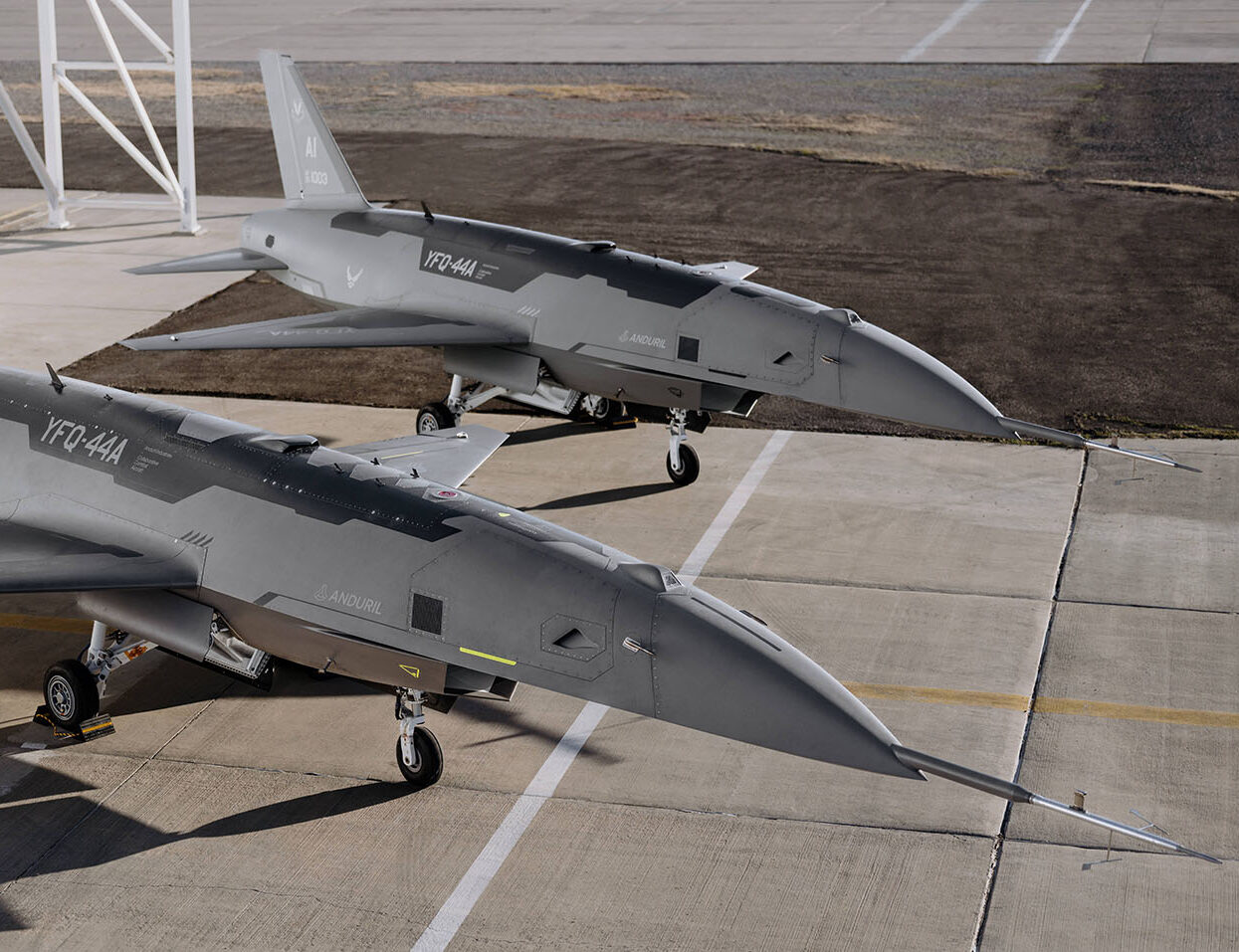
The US is thus expanding trusted capital networks and extensive partnerships between its Department of Defense and venture-backed tech firms, systematically absorbing private finance into the US defense innovation base and the wider military-industrial complex. The latter has been traditionally dominated by a relatively small set of prime contractors—Lockheed Martin, Boeing, Northrop Grumman, RTX (previously Raytheon) and General Dynamics—and financed mainly by direct government contracts. In the current setup, however, a new generation of “neo-primes” like Anduril, Skydio, and Shield AI now play significant roles.
Borderless capital meets territorialization
Rather than integrating global markets, mobile private finance is routed through jealously guarded national procurement and innovation systems. Military innovation is absorbed into territorially-bounded markets and supply chains shielded by protectionist barriers. The resulting security architectures are compartmentalized and each bound to a distinct geopolitical project.
This is most visible within the now-fraught Atlanticist alliance. The EU’s ReArm Europe strategy relies on mobile capital via large institutional investors, private equity, and venture capital to pour billions into European defense-tech firms. Yet this strategy is directed towards building the European Defense Technological Industrial Base (EDTIB), and is hedged by strict “Buy European” provisions requiring that at least 65 percent of components and munitions originate within the EU or associated states, alongside capability targets for air and missile defense systems, AI, drones, and long-range strike capacity. The Pentagon’s response has been scathing. It has “strongly opposed” what it terms “protectionist and exclusionary policies that strong-arm American companies out of the market” and has threatened retaliation against European firms.
The investors themselves, however, face no such barriers, traversing the divide they are helping to harden. BlackRock, for instance, ranks among the largest institutional shareholders of Airbus and Rheinmetall, the champions of European rearmament (holding roughly 6–7 percent of shares), and has set up funds to cash in on this process, but is also a major shareholder of US primes such as Lockheed Martin and Northrop Grumman. Hence European defense “sovereignty,” though financed by the same mobile capital, augurs a parallel techno-security infrastructure set at odds with that of the US.
A similar pattern is visible across the militaries of the US and China. China’s Military-Civil Fusion (MCF) strategy treats dual-use sectors such as AI, aerospace, and quantum computing as central to the modernization of the People’s Liberation Army (PLA) and seeks to dismantle the barriers between civilian technological development and defense production. The MCF strategy is itself a territorializing mechanism: it takes in mobile (and often foreign) dual-use investment and binds it to a nationally-embedded military-industrial base kept behind strict export controls on security grounds. Yet despite US attempts to constrain Chinese access to finance, advanced semiconductors, and other components, capital keeps flowing in. US-based investors like Goldman Sachs and Intel Capital have invested in Chinese dual-use AI firms, prompting claims that “the imperatives of capital supersede the grandest geopolitical rivalries.”
This pattern persists even against the US government’s own security designations. In 2024, the House Select Committee on the CCP found that US index providers and asset managers facilitated $6.5 billion of investment in sixty-three Chinese companies that the US had blacklisted, of which $5.3 billion went specifically to PRC military companies. Moreover, the same two US asset managers that underpin European rearmament—BlackRock and Vanguard—are also the largest investors in blacklisted Chinese military firms, providing roughly $1.9 billion each. More recently, a 2026 report from the same House Select Committee alleged that JPMorgan and Bank of America helped Chinese battery giant CATL raise billions of dollars, despite the firm’s designation as a “Chinese military company” by the Pentagon. While such transactions were not prohibited by US law, the report claims that “each bank made the choice to essentially disregard the US government’s Chinese military company designation to make millions of dollars.”
Once routed through China’s MCF framework, mobile financial capital contributes towards a rival innovation structure to that of the US and Europe. Consider the Aviation Industry Corporation of China (AVIC). AVIC is the principal producer of military aircraft for the PLA, and designer of China’s sixth-generation fighter; the firm has received $178 million via US passive index flows even as it is “locked in a race with the US over who can field the technology first.” As recognized by former U.S. Deputy National Security Adviser Matt Pottinger at the House Foreign Affairs Committee: “US companies, financial institutions, and investment funds have . . . helped underwrite and expedite the modernization of the PLA and China’s high-tech surveillance police state.” He subsequently lamented that “our [US] ingenuity and money are supplying so-called dual-use technologies,” including “advanced semiconductors and cutting-edge AI applications to unmanned aerial vehicles . . . all of which have been integrated into Chinese military and intelligence programs.” Mobile financial capital is channeled into parallel, compartmentalized and potentially rival techno-security apparatuses, each actively fostering alternative geopolitical projects.
Coalitional limits
The deepening financialization of the national military and defense sectors is the result of two crises. The first is a structural crisis in neoliberal economies: the loss of dynamism in highly financialized, advanced Western economies has prompted a search for state-backed returns. The second is rising geopolitical instability, itself driven in part by a wide range of contemporary maladies: growing concentrations of wealth, worsening conditions of work, the accumulation of unpayable debts, escalating housing costs, the withdrawal of public services and universal entitlements and, not least, climate change and the scramble for energy, minerals, and other resources.
The convergence of military, finance, and tech is a powerful way to address these overlapping crises, allowing each sector to consolidate power and generate financial returns. Perversely, the entire structure relies on injections of taxpayer-funded resources (which often lead states to subtract resources from social spending to gesture towards balancing their books), and on the investment of pension funds. Working people thus bear the consequences of financialized militarization while their pension funds finance it.
Though powerful, the coalition between Big Tech, private finance, and domestic military industries has its limitations. There are, first, prospective constraints on the degree to which military production can be territorialized. Defense tech (and Silicon Valley more generally) is heavily reliant on rare earths and critical minerals, whether for missile guidance systems, satellite communications, or fighter jets. The 2026 crisis around Greenland’s sovereignty, alongside the aggressive US pursuit of critical minerals in the Democratic Republic of Congo (DRC), can be read as attempts to shore up American supply given Chinese dominance of the sector. The imperative is acute given new procurement rules that will prohibit the use of Chinese-origin rare earth magnets and metals in US defense technology starting in January 2027. Absent alternative supply chains, and given US structural constraints in midstream rare earth processing, US–China interdependence is likely to persist both in terms of finance and access to critical materials.
AI-enabled military technologies also expose the defense sector to the speculative dynamics that have characterized previous waves of financialized and technology investment, not least the prospect of an AI crash. The emerging structure of the defense sector renders it a comparatively low-risk domain for private finance, since state guarantees effectively underwrite demand, large-scale investment, and the ensuing profits. In this sense, defense procurement already functions as a preemptive subsidy for the AI sector that has yet to fully demonstrate its commercial viability. But that same structure also raises the prospect that any future contraction in broader AI-related valuations will be managed through public bailout mechanisms on national security grounds, displacing fiscal pressures—and austerity measures—onto other areas of public expenditure. This would mirror the salvaging of the financial industry after the North Atlantic Financial Crisis of 2007–09, but without the option of compensatory cuts in defense spending. Either way, financialized militarization is set to continue: a process that both feeds on geopolitical instability and deepens it.
Further Reading

Orbital Enclosure
How the US's long push to deregulate outer space led to SpaceX's dominance of the skies
In mid-June, SpaceX went public. The company’s initial public offering share price of $150 quickly crowned Elon Musk the world’s first dollar trillionaire. As the...

Arms Markets
A look at the world’s largest military industries
The US is far and away the world’s largest military spender, military producer, and arms exporter, accounting for more than a third of global military...

Rearming Europe
Political legitimacy through war
The main justification for the EU’s recent dramatic reorientation toward defense is the proliferation of threats to European security emerging from Russia’s invasion of Ukraine....