July 22, 2026
Analysis
Orbital Enclosure
How the US's long push to deregulate outer space led to SpaceX's dominance of the skies

In mid-June, SpaceX went public. The company’s initial public offering share price of $150 quickly crowned Elon Musk the world’s first dollar trillionaire. As the company’s executives rang the Nasdaq bell, Musk announced far-fetched plans to launch 100,000 satellites and new data centers beyond the stratosphere. The technical challenges of this growth projection—including the absence of a global space traffic management regime—is counterbalanced by the company’s political power.
Orbital domains and celestial objects have long been defined in international law as “the province of all mankind,” meant to serve collective and future interests. Decades before the rise of new “techvangelicals” with their eyes set on colonizing Mars, the Outer Space Treaty of 1967 served as the principal legal framework anchoring spectrum and orbital coordination. The signatories of this treaty recognized that exploring and using extra-terrestrial domains “shall be carried out for the benefit and in the interest of all countries.”
But over the past fifteen years, outer space has emerged as a frontier of intense commercial activity and private investment, and the regulation of the orbital environment—from satellite licensing to debris mitigation rules—has become increasingly influenced by corporate interests. Questions once treated as public policy (how to manage orbital slots, radio spectrum, launch safety, or space data) are predominantly settled by way of closed-door consultations. How has this regulatory framework moved so far away from protecting the province of all mankind?
Since the 1970s, American reforms have gradually granted private US-based companies a competitive advantage in accessing communications satellites, particularly in the Low-Earth Orbit (LEO). Satellites in the LEO fly below an altitude of 2,000 kilometers, which allows them to transmit signal rapidly, but a large network of them is required to maintain consistent coverage, whereas a single satellite in the much higher Geostationary Orbit (GEO) can provide signal to nearly a third of the globe. Spectrum rights in the GEO are granted on a first-come, first-served basis by the International Telecommunications Union (ITU), a specialized body of the UN, while LEO rights are granted through state sponsorship and a rigorous filing process meant to avoid the harmful interference that can arise from the high number of satellites.1Mia M. Bennett, and Zachary Cudney. “(<)a href='https://doi.org/10.1080/21622671.2025.2594491'(>)Holding up the skies: is Starlink occupying low Earth orbit?(<)/a(>)” (<)em(>)Territory, Politics, Governance(<)/em(>) (2026): 1-19.
However, this process has been weakened by private companies in search of monopoly power. Under the Federal Communications Commission (FCC), licenses for LEO operators have become longer, faster to obtain, and easier to transfer.2In 2002 FCC extended space-station and earth-station license terms from 10 years to 15 years. See (<)a href='https://docs.fcc.gov/public/attachments/FCC-02-45A1.pdf'(>)FCC, Space Station Licensing Rules and Policies, FCC 02-45, B Docket Nos. 02-34 and 00-248, Feb 28, 2002(<)/a(>). In 2003 it adopted new satellite licensing procedures to issue licenses more quickly, created queues based on filing date and time, moved geostationary orbit-like systems to first-come, first-served processing, and eliminated the anti-trafficking rule that had prohibited selling bare satellite licenses for profit (See (<)a href='https://www.govinfo.gov/content/pkg/FR-2003-08-27/pdf/03-21649.pdf'(>)Federal Register, FCC Satellite Licensing Regulations, Vol. 68, No. 166, (<)/a(>) Wednesday, August 27, 2003, Rules and Regulations, 51499-51508). In 2016 the FCC reaffirmed that change, explaining that the point was not to prevent licenses from being transferred to entities that would put them to their highest-valued use in the shortest amount of time ((<)a href='https://docs.fcc.gov/public/attachments/FCC-16-108A1.pdf'(>)See FCC, 47 CFR Part 25, [IB Docket No. 02-34; FCC 16-108], August 16, 2016).(<)/a(>) Just last year, the FCC launched a fresh review of spectrum-sharing rules, under pressure from SpaceX to expedite Starlink’s sprawling LEO constellation. The company’s persistent engagement with the agency reveals how a dominant actor can, over time, influence the very standards and processes of space governance.
Because orbital positions and radio frequencies are scarce and path-dependent, early occupation creates consolidated advantages that are difficult to reverse. The result is a new form of enclosure, where control over critical space-based infrastructures complements economic, political, and military power on Earth, while excluding most states from any influential participation in decisions that affect climate monitoring, communications, security, and knowledge production.
Cold War Legacies
The origins of contemporary privatization lie in the institutional and technological choices made during the Cold War, when early US dominance in satellite deployment and space governance paved the way for durable advantages for private actors. Long before companies like SpaceX dominated the LEO, orbital and spectrum access for communications satellites was governed through a state-coordinated system in which governments controlled international filings, competing systems were either barred or tightly constrained and private launch approvals were rare.
This changed with the passing of the 1962 Communications Satellite Act, which created the first commercial communications satellite system—“the vigor of our competitive free enterprise system will be effectively used in a challenging new activity on the frontier of space,” remarked President John F. Kennedy upon signing it. Two years later, the International Telecommunications Satellite Organization (later known as Intelsat) was founded under the act. This intergovernmental consortium, which owns and manages a range of communications satellites, was run by a quasi-private American corporation (COMSAT) and headquartered in Washington, D.C. Management of the company transformed the US into the largest investor and agenda-setter in commercial satellite regulation.3For the origins of Intelsat, see Communications Satellite Act of 1962, PUBLIC LAW 87-624-AUG. 31, 1962, and (<)em(>)Interim Arrangements for a Global Commercial Communications Satellite System(<)/em(>), signed in Washington, D.C. on 20 August 1964 and published in the United Nations Treaty Series (No. 7441).
Although framed as a global, nondiscriminatory communications system from its earliest years, Intelsat was inseparable from American political priorities in orbital positioning, and helped the American regulatory state become a key actor in translating orbital claims into legitimate, internationally recognized access. Because GEO slots are finite and longitudes are scarce, Intelsat’s efforts to secure priority rights through ITU coordination turned into an exercise in enclosure—most commonly via registrations, filings, and paper satellites that convert anticipatory claims into use rights.4Paper satellites refer to filings registered on paper with the ITU for a geostationary orbit slot and associated frequencies, without any real intention or capability to deploy an operational satellite. Through this practice administrations and affiliated firms can hoard strategically valuable orbital positions and associated spectrum, and prevent potential competitors from accessing scarce GEO slots. In some cases, these filings also function as speculative assets: once coordination rights are secured, they can be sold, leased, or used as bargaining chips in negotiations with operators that possess the technical and financial capacity to launch satellites but lack priority rights. At the same time, administrations may use paper satellite registrations to preserve national options for future satellite programs. They did so in coordination with the FCC, the US agency tasked with licensing satellite systems, managing spectrum claims, and coordinating orbital-slot and frequency assignments with the ITU system.5While the Outer Space Treaty prevents national appropriation and private ownership of outer space, it simultaneously delegates responsibility for authorization and continuing supervision of non-governmental actors to individual states, which then operationalize that delegated authority through specialized agencies.
Rival projects emerged largely to compete with this US-led order: the USSR’s Intersputnik was constituted as an explicit counterweight to an American-dominated regime. Similarly, Europe’s Eutelsat was created to address regional needs neglected by Intelsat. But these alternatives ultimately proved incapable of challenging US dominance. Intersputnik, often relying on state subsidy and leased capacity rather than building a comparable market-driven system, lagged technologically, while Eutelsat converged towards the US market model. Thus the US had, by the 1980s, the political capacity to present itself as the legitimate organizer of orbital access—embedding its preferences in the practical governance of slots, spectrum, and market entry.
As privatization and deepening financialization reshaped the US economy in the subsequent decades, its regulatory architecture was repurposed to further open the orbital environment to private actors. During the 1980s President Ronald Reagan’s executive order 12465 and the Commercial Space Launch Act of 1984 created a legal environment conducive to the privatization of rocket and satellite launches. Outer space governance became increasingly oriented toward the collection of data and the promotion of interconnectivity, and a deregulated rush to occupy and monetize orbital positions predictably favored US or US-allied firms.
A further push was made in 2000, when Washington’s ORBIT Act further shifted away from the treaty-led consortium model, dismantling intergovernmental monopolies and endorsing privatization.6For ORBIT act, see Open-Market Reorganization for the Betterment of International Telecommunications (Orbit) Act, Public Law 106–180, March 17, 2000. On how the ORBIT act enabled the privatization of INTELSAT, see US Government Accountability Office. Telecommunications: Intelsat Privatization and the Implementation of the ORBIT Act. GAO-04-891. Washington, DC: Government Accountability Office, September 2004. The Act solidified the FCC’s institutional role, granting it de facto authority over orbital resources and allowing it greater power to institute technical standards, licensing thresholds, and administrative procedures that respond to US geopolitical motives and corporate demand in privileging rapid private deployment over collective deliberation. US government-backed institutions thus forged the market in outer space—organizing orbital slots and spectrum, allocating rights, and converting those rights into private assets.
Private Finance and “New Space”
The latest wave of outer space commercialization began gathering in the wake of the 2008 global financial crisis. After the meltdown, investors began seeking new outlets for excess capital. The domain of space infrastructure—with its high barriers to entry, government-backed demand and promise of stable service revenues such as broadband connectivity, earth imaging, GPS applications—emerged as a compelling option. This was facilitated by the Commercial Space Launch Competitiveness Act, which President Barack Obama signed in 2015, and explicitly allowed US citizens and industries to engage in the commercial exploration and exploitation of space resources, creating stronger legal and economic incentives for private investment in space ventures.7US Commercial Space Launch Competitiveness Act. PUBLIC LAW 114–90—NOV. 25, 2015. As a result, between 2015 and 2023, private investment in space enterprises worldwide exceeded $300 billion, spread across roughly 2,000 companies.8For comparison, the global space economy (public and private) reached an estimated $500 billion in annual value by 2022 and is projected to top $1 trillion by 2030. See Raswant, Arpit, Bo Bernhard Nielsen, and Peter J. Buckley. “(<)a href='https://doi.org/10.1057/s41267-025-00783-1.'(>)Space: a new frontier for international business(<)/a(>).” (<)em(>)Journal of International Business Studies(<)/em(>) (2025): 1-22. The US captured the dominant share of this investment boom, with American companies consistently attracting the majority of global space venture funding.
This surge of private investment in outer space coincided with the rise of asset manager capitalism—a regime that formed in the wake of the financial crisis in which a handful of investment fund complexes wield outsized influence across multiple sectors.9For more on asset manager capitalism, see Braun, Benjamin. “Exit, control, and politics: Structural power and corporate governance under asset manager capitalism.” (<)em(>)Politics & Society(<)/em(>) 50, no. 4 (2022): 630-654. This mode of investment promises capital abundance by centralizing and standardizing the deployment of savings through passive, benchmark-driven vehicles. These vehicles transform heterogeneous savings into permanent, liquid market demand, sustained by monetary accommodation and institutional credibility. The result is a system characterized by continuous capital inflows and higher asset valuations, but limited capacity for long-horizon, illiquid, and uncertain investment. By the mid-2020s, BlackRock and Vanguard appeared among the largest shareholders in nearly all S&P 500 firms with a level of ownership concentration that would have been inconceivable a generation earlier.10Fichtner, Jan, Eelke M. Heemskerk, and Javier Garcia-Bernardo. “Hidden power of the Big Three? Passive index funds, re-concentration of corporate ownership, and new financial risk.” Business and Politics 19, no. 2 (2017): 298-326. This included all publicly traded major space industry players, which were seen as a source of stable returns.
But during the 2010s, asset managers also became a transmission belt for activist investors, who were willing to fund “New Space” startups. This was possible thanks to quantitative easing that inflated public asset values and compressed yields, inducing institutional investors to rebalance toward higher-risk and illiquid assets. While index funds became the dominant vehicle for public-equity exposure, the same asset-management complexes expanded private-market platforms and portfolio-engineering tools that facilitated shifts into venture capital, private equity, and growth finance. 11Specifically, large asset-management complexes built the critical platforms for data, benchmarks, risk analytics and workflow systems such as BlackRock’s Aladdin/eFront and Preqin architecture which made private-market allocations more legible and scalable. The expansion of private-market capital and growth of secondary liquidity mechanisms like tender offers and private share trading have gone hand-in-hand with critical regulatory changes. Most notable was the 2012 JOBS Act’s softening of reporting requirements for private capital investment, which made it attractive for high-growth firms to remain private longer, reducing reliance on IPOs and the disclosure and governance demands of public markets.
As a result, the median age of tech companies at IPO has stretched to over twelve years, and indeed some high-profile space firms indefinitely postpone their IPO plans. In prior cycles, a successful aerospace company might go public within a few years of growth to access public markets. Companies like SpaceX and Blue Origin, however, have stayed private for a decade or more, raising billions in venture capital and private equity, and thereby insulating their governance from public scrutiny. There have been no quarterly earnings calls or SEC filings for them to fulfill. Firms like SpaceX could attract large volumes of investment while remaining outside public market discipline.
The result is that as of early this month, SpaceX’s Starlink alone comprised about 65% of all active satellites in low-Earth orbit—over 10,700 out of around 16,200 operational satellites—giving a single firm a near-monopoly presence beyond the stratosphere.12See (<)a href='https://planet4589.org/space/stats/active.html'(>)https://planet4589.org/space/stats/active.html(<)/a(>) for most recent estimates. According to launch tallies compiled by industry analysts, SpaceX completed approximately 134 commercial orbital launches in 2024, accounting for an estimated 84% of the global commercial launch market. In 2025, the company further extended its market share with roughly 161–165 orbital launches and an estimated 82% share of global commercial launch activity.
Bifurcated Regulation
The incentives and regulatory preferences of large passive asset managers differ from those of entrepreneurial or activist investors: whereas the latter push for radical regulatory changes, the former seek regulations that ensure overall market stability and risk mitigation to firm-specific competition. One implication of this is that regulatory agencies embedded in safety and liability regimes, like the Federal Aviation Administration (FAA), are more likely to work with firms that share a similar stability orientation, while market-making regulators like the FCC are more likely to work with private and activist investors seeking to “move fast and break things.” This bifurcated regime prevents meaningful public deliberation over orbital governance.
Today, passive asset managers that include index fund complexes are major owners across the more established aerospace and telecommunications sectors, meaning that even when space companies enter the public markets, control rights through votes and board influence remain concentrated in the hands of a few massive asset managers. Most recently available institutional ownership data derived from SEC 13F filings show that in aerospace, Vanguard holds roughly 9.2 percent of Lockheed Martin’s outstanding shares and BlackRock approximately 7.3 percent, while State Street controls an even larger stake at nearly 15 percent as of September 2025. A similar pattern holds at Boeing, where Vanguard owns about 8.9 percent of shares and BlackRock close to 6.8 percent. In telecommunications, there is a similar pattern: Vanguard is AT&T’s largest shareholder at approximately 9.3 percent, followed closely by BlackRock at 8.1 percent.
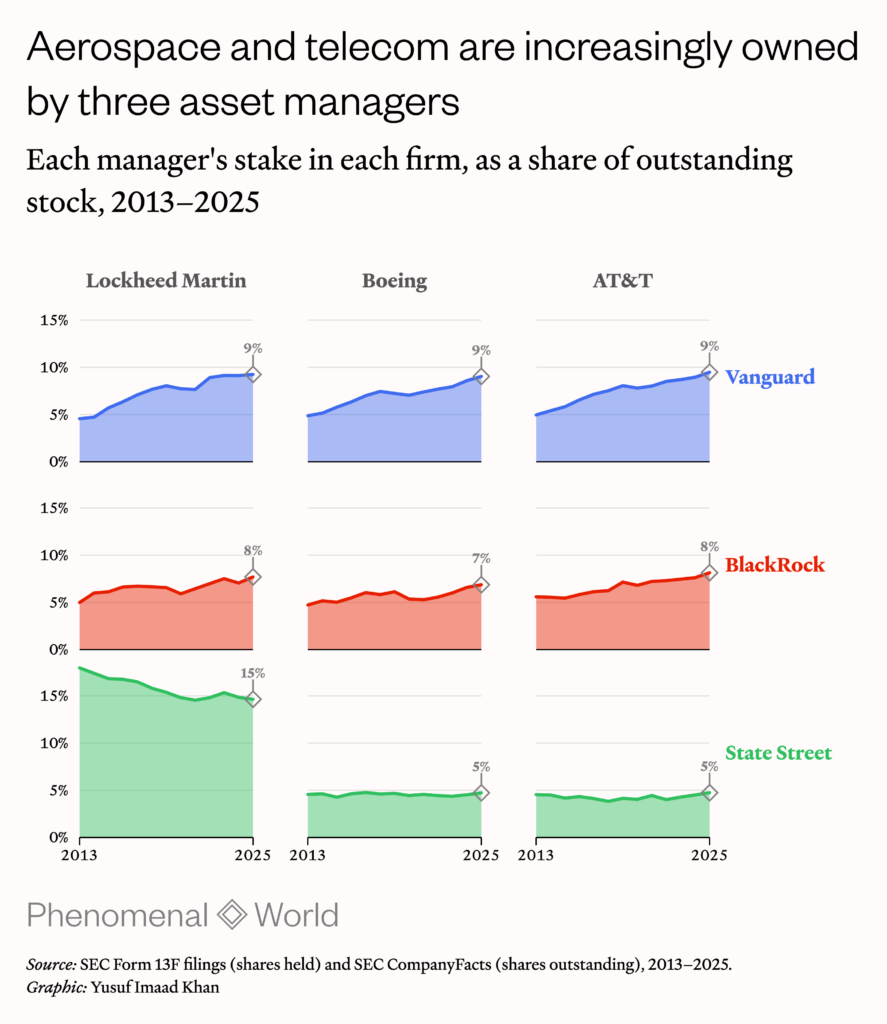
These investors cannot readily exit their positions—they manage index funds that must hold stocks in proportion to their index weights.13Bebchuk, Lucian A., and Scott Hirst. (<)em(>)Index funds and the future of corporate governance: Theory, evidence, and policy(<)/em(>). No. w26543. National Bureau of Economic Research, 2019. With trillions under management—BlackRock alone manages around $10 trillion—their stakes in companies are so large that selling off shares via Wall Street’s usual threat of exit would disrupt their related investments and therefore expected profit projections. Instead, proxy voting and communications with management have become central channels through which these large funds exert influence over governance outcomes, with greater scrutiny focused on major firms where they hold concentrated stakes.
When it comes to regulatory decisions that involve companies involved in rocket launches such as Lockheed Martin or Boeing, asset managers rarely lobby the FAA directly. Instead, they affect FAA-related regulation indirectly through their power to shape incentives around compliance, safety oversight, and lobbying transparency at major firms that work closely with the FAA. Unlike classical regulatory capture via bribes or appointing industry cronies, this shaping of new standards occurs when well-staffed companies are allowed to use their technical expertise to heavily input into the rulemaking, de facto coauthoring regulations in a way that is invisible to public stakeholders. What looks like neutral safety or technical regulation can actually serve as a mechanism of market structuring in favor of private interest.
FAA’s commercial space launch regulations have been shaped via industry advisory processes such as the FAA Aviation Rulemaking Committee, which Boeing, Lockheed Martin, and United Launch Alliance (ULA) participate in.14Congressional Research Service. (<)a href='https://www.congress.gov/crs-product/R48582'(>)(<)em(>)Commercial Space Launch and Reentry Regulations: Overview and Select Issues(<)/em(>)(<)/a(>), CRS Report No. R48582 (Washington, DC: Library of Congress, June 23, 2025). The recent streamlining of launch regulations in a new FAA framework known as Part 450 was coproduced through iterative interaction between FAA and these firms, who lobbied for regulatory architectures that internalize compliance work within their own companies while preserving FAA oversight through procedural and discretionary mechanisms. While both SpaceX and ULA supported streamlining, SpaceX pushed more strongly for broad, operator-defined performance standards, whereas ULA, which is jointly owned by Lockheed Martin and Boeing, emphasized regulatory clarity and predictable discretionary oversight.15US Department of Transportation, Federal Aviation Administration. “(<)a href='https://www.govinfo.gov/content/pkg/FR-2020-12-10/pdf/2020-22042.pdf'(>)Streamlined Launch and Reentry Licensing Requirements(<)/a(>).” (<)em(>)Federal Register(<)/em(>) 85, no. 238 (December 10, 2020): 79566-79740.
A different form of regulatory capture?
Because asset managers concentrate the interests of multiple companies, their preferences have thus tended towards corporate strategies that prioritize risk control within the space industry. (This also explains why the S&P 500 has recently rejected SpaceX’s application for an accelerated inclusion in the index, refusing to bend the rules to allow the company entry before hitting the necessary profit benchmarks.) Private and activist investors, on the other hand, expect more substantial regulatory change because profits in riskier sectors depend on reconfiguring market access, licensing, and technical standards. Regulatory activism is thus a core feature of private capital both on the investor and entrepreneur side. The expectation from the main investors of SpaceX, which include the Founders Fund and Valor Equity Capital, has been quicker returns on their investments. Under this pressure, the company has constantly sought to cut down costs and get around lengthy and costly regulations by moving first in haste, and considering any damage their operations may incur later.
As a result, the relationship between the FAA and SpaceX has been conflict-ridden. SpaceX’s business model—characterized by rapid iteration, high-frequency testing and failure—systematically collides with the FAA’s mandate to manage public safety, airspace integrity, and downstream liability. This has produced repeated and highly visible clashes: formal enforcement actions and proposed civil penalties for alleged licensing noncompliance, prolonged launch approval processes tied to mishap investigations requiring dozens of corrective actions, and temporary closures of civilian airspace following vehicle breakups and debris risks.
Meanwhile, given its near-monopoly power in LEO-based satellite communication, SpaceX has entrenched itself within regulatory processes of the FCC even more aggressively than traditional firms, exerting continuous pressure on technocrats and policymakers in order to reshape standards in line with their commercial priorities. A case in point is FCC’s 2021 decision to allow SpaceX to modify its first-generation Starlink constellation by lowering the orbits of around 2,800 satellites from 1100–1300 km to approximately 550 km. Competing operators objected that this could increase collision risks and interfere with their future systems, and they urged the FCC to at least delay until further environmental review. The FCC went ahead and approved SpaceX’s request with some conditions anyway. The written order mirrored many of SpaceX’s assurances—such as the promise that lower altitude would actually reduce debris risk and that interference would be manageable. In a related case, when Dish Network and an astronomer group challenged a similar approval of a SpaceX request by the FCC in court, the court upheld the decision, deferring to the agency’s technical judgment. In those adjudications, SpaceX’s technical claims were preferred over the challengers’ because the company’s scale and expertise allowed it to frame the FCC’s risk assessments.
Another recent dispute took place over SpaceX’s request to operate satellites at nine times the FCC’s authorized power limits, which further illustrates how one company’s scale and market dominance allow it to shape regulations according to its will. Despite strong objections from competitors like AT&T and Verizon, who warned of severe spectrum interference, the FCC granted SpaceX a waiver in March 2025 without fully resolving the technical concerns. Rather than enforcing its earlier, more precautionary public interest standard, the FCC accepted SpaceX’s assurances and shifted the burden to monitoring of interference after the fact.16Neal, Sarah. “One Giant Leap for Monopolies: Spectrum, SpaceX, and the FCC’s Public Interest Paradox.” Administrative Law Review Accord 10, no. 2 (2025): 109-142 SpaceX engineers and lawyers routinely engage in these type of ex parte meetings with FCC officials to discuss pending rules, in which they are often able to guide the conversation given that they possess much of the needed data on what is considered safe or technically feasible. The outcome is regulation with general rules that just so happen to align with the architecture of the dominant firm.
The Future of the Orbit
In today’s de facto privatized system of outer space governance, decisions ranging from spectrum assignments, debris rules, and licensing conditions are increasingly made through opaque bureaucratic processes. These decisions, however, are critical for determining who can afford to operate in, and who profits from outer space. Technical jargon and the niche nature of these proceedings act as a barrier to entry for public interest voices. While other countries including Russia, China, Japan, the EU and India also seek to consolidate their presence in extraterrestrial domains, given the divergence of national political priorities, there is hardly a shared consensus among them regarding the future of collective outer space governance. In fact, there is an emerging polarization between the US-led Artemis Accord signatories—a coalition of seventy nations that have agreed to a non-binding set of principles around space exploration—on the one hand, and the smaller number of countries brought together by China’s alternative proposal, the International Lunar Research Station.
The result is that most decisions with important collective impact go unnoticed. When the FCC updated its orbital debris rules, the loudest commenters were industry players. During this process, the FCC actually invoked a categorical exclusion from environmental review for Starlink and other large constellations. The FCC has long neglected the environmental impact of satellite licenses, an increasingly problematic oversight given the sheer magnitude of satellites and reentries that can now impact astronomy and the atmosphere. In 2022, the Government Accountability Office (GAO) recommended that the FCC reexamine its categorical exclusion for large constellations and, at minimum, articulate why it thinks they are environmentally benign. But absent intervention from public interest organizations, the FCC did not comply. Though scientific organizations highlighted research that has found that aluminum oxide particles released as satellite debris combust on atmospheric reentry has the potential to damage the ozone layer, regulators chose to brush these findings aside in favor of industry arguments.17Ferreira, José P., Ziyu Huang, Ken‐ichi Nomura, and Joseph Wang. “Potential ozone depletion from satellite demise during atmospheric reentry in the era of mega‐constellations.” (<)em(>)Geophysical Research Letters(<)/em(>) 51, no. 11 (2024): e2024GL109280.
Security classification further blurs transparent decision-making. Many military uses of commercial systems such as that of Starlink in Ukraine or US Air Force are discussed in closed forums, and not in open legislature. But these discussions pose questions of high social and political significance: should a private company, or its CEO, be able to unilaterally decide to provide or withdraw internet service to a country in conflict, as Elon Musk did in parts of Ukraine that the country was trying to retake from Russian forces in 2022? How should we determine the acceptable amount of debris risk? And should any portion of the spectrum be preserved for public use?
Though public institutions ostensibly set the rules of space governance, emerging regulatory practices are notably influenced by the ownership, scale, and financial structure of space firms. The current trends in the space sector signal a broader transformation in which the lines between public and private blur as the state acts increasingly as a partner to a handful of companies, and prioritizing US dominance in commercial and military domains becomes the shared goal of private investors and regulatory agencies.
An alternative path would begin from an understanding that governance of the orbit is of collective interest. Astronomers raising alarms about mega-constellations ruining the night sky, environmentalists pointing to reentry pollution, and antitrust scholars concerned about corporate concentration all suggest a rising interest and investment in the political economy of outer space. Governance of the orbit ought to be oriented toward collective knowledge, public coordination, and long-term stewardship. Rather than treating commercial access as the default and public interest as a constraint, a more equitable regime would reverse that hierarchy: access to orbital positions and spectrum would be granted primarily for scientific research, Earth observation, climate monitoring, and other globally beneficial public missions, with strict limits on for-profit use.
This would require strengthening multilateral authority beyond coordination toward collective governance, including the power to set binding caps on satellite density, prioritize non-commercial missions, and reclaim orbital slots from speculative or profit-driven deployments. National regulators would no longer function as gatekeepers translating corporate applications into ITU filings, but as custodians accountable to international public mandates.
Crucially, such a regime would treat satellites not as proprietary assets but as elements of a public knowledge infrastructure, requiring open data standards, shared access to observations, and collective management of orbital debris and congestion. Reasserting public control over celestial space would thus mark a refusal of the idea that global coordination must be delivered through markets, and instead position outer space as a domain where international cooperation, scientific inquiry, and intergenerational responsibility take precedence over profit and private power.
Further Reading

America’s Braudelian Autumn
Factions of capital in the second Trump administration
In its efforts to revive the American Empire, the Trump administration will have to delicately balance the interests of both manufacturing-oriented nativists and capital factions...

Nvidia in the Gulf
The Arab monarchies turn to Silicon Valley
In May 2025, Donald Trump, accompanied by many of Silicon Valley’s luminaries, traveled to Saudi Arabia, Doha, and Abu Dhabi for the first overseas venture...

Titans
Tracing the rise and the politics of asset manager capitalism
In mid October 2021, when BlackRock revealed its third quarter results, the asset management behemoth announced it was just shy of $10 trillion in assets...