Analysis
A National Champion?
The meteoric rise of the meat processing multinational JBS and the politics of development in Brazil
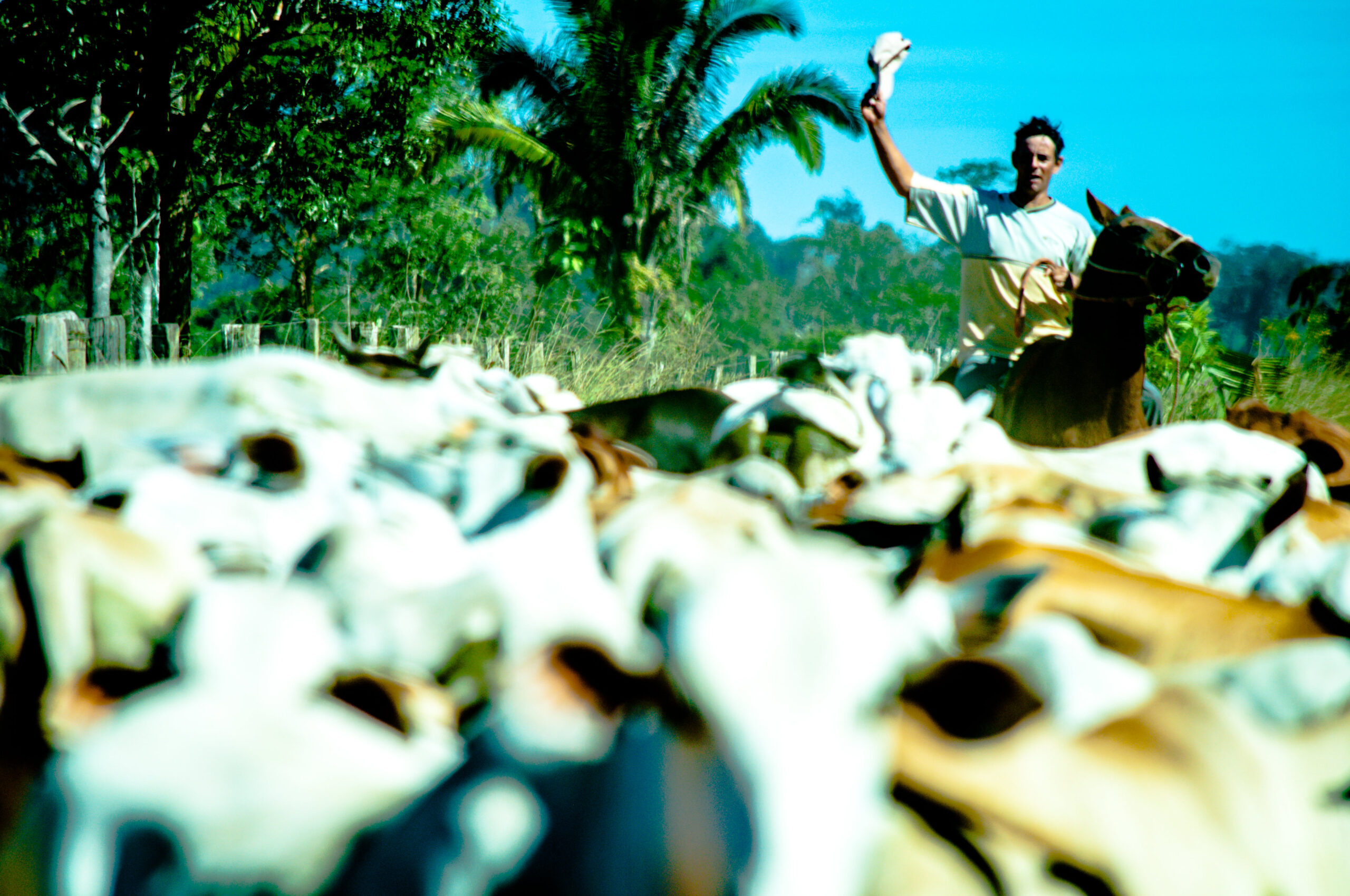
After Trump’s inauguration last year, debate focused on the attendance of Big Tech executives and what it implied about the relationship between capital and the MAGA project. Yet, as Senator Elizabeth Warren noticed, the single largest donor to the inaugural committee was Pilgrim’s Pride, a US firm owned by JBS, a giant food corporation that originated in Brazil. Pilgrim’s Pride’s donation of US$5 million was not only the largest one, but amounted “to more than the contributions from Apple’s CEO plus Amazon, Meta, and Google, combined.”
There is suspicion that the payback for this donation was authorization for JBS to list its shares on the New York Stock Exchange (NYSE), an old aspiration of the Batista brothers—Joesley and Wesley, who hold controlling shares of the firm. As Warren put it, the Securities and Exchange Commission approval of JBS’ application, “made just months after the donation from Pilgrim’s Pride, raises questions regarding undue influence.” Besides, according to an article in The New York Times, a company owned by the Batistas received the “blessing of the new Trump-backed [Venezuelan] government” in July of this year to buy a major stake in the country’s oil production. Multiple columns could be written about JBS, covering a myriad of cases of corporate greed, corruption and abuse. For those who understand Portuguese, the new podcast series O berro do boi provides an excellent examination of the history of the firm, building on many years of investigative journalism undertaken by Consuelo Dieguez for Revista Piauí. But here the aim will be a different one: to examine the difficult questions that the case of JBS poses for development thinking.
Given the close relationship between JBS and the Brazilian Development Bank (BNDES)—which owns about a fifth of the company—a common reaction to JBS’s controversies is to claim that they are the necessary consequence of government intervention in the economy. The implication seems to be one that is welcomed by free market advocates: the only way to prevent corruption is to reduce the role of the state and thus impose market discipline on economic agents. This is, at best, naïve, as unregulated markets are often ripe for abuse and tend towards corporate concentration, ending up very far from the idealized image of fair competition between a multitude of innocent price takers. Besides, it is hard to find in the historical record examples of peripheral countries that caught up with high income levels without resorting to state intervention in markets—in other words, without getting the relative prices “wrong,” as the political economist Alice Amsden famously put it.
But it is useful to take seriously the challenge posed by the story of JBS to development practice, and the risks to state intervention it implies. This case pushes us to go beyond the economics of development policy, focusing also on its political dimensions. The support given by BNDES to JBS not only created a corporate behemoth with very dubious contributions to Brazilian development, but also helped weaken the social and political bases for an inclusive development project, being a key factor in the emergence of agri-bolsonarism—the electoral force that may be decisive in returning the far right to power in Brazil in the coming election. If this is avoided and Luiz Inácio Lula da Silva remains in office for another four years, it will be crucial to channel the institutional capacity represented by BNDES in more fruitful directions, as well as to conceive of ways to constrain the immense power accumulated by the Batista brothers.
The rise, fall, and rise again of JBS
The firm that would become JBS was founded many decades ago, when a butcher’s shop in the Brazilian hinterland owned by Joesley and Wesley’s father acquired a small meatpacker, and took advantage of the market created by the establishment of Brasília—the new capital of the country, built in the 1950s. By the late 1990s, when JBS (at the time called Friboi) moved its headquarters to the state of São Paulo, it had acquired a series of other meatpackers, taking part in the corporate consolidation of the sector that followed trade liberalization and the end of hyperinflation. The turning point in its history, however, would be in 2005, when it bought Swift-Armour in Argentina with a loan from BNDES that covered 85 percent of the price paid. In the early years of the commodities boom, when primary exports from South America surged thanks to China’s reordering of the international division of labor, JBS started diversifying its operations beyond Brazil.
Two years later, the firm started selling shares on the São Paulo stock exchange, transformed its relationship with BNDES, and marched towards global dominance. In 2007, BNDESPar—the branch of BNDES that finances companies through the purchase of their shares rather than the extension of credit—injected 1.1 billion Brazilian reais into the company to allow it to purchase the US operations of Swift and become the largest beef producer in the world. In the following two years, once more with the support of BNDES—this time alongside Petros and Funcef, the pension funds of the Brazilian oil company and one of its largest public banks—JBS bought more US and Brazilian firms (Smithfield, National Beef, Five Rivers, Pilgrim’s Pride, Bertin), expanded into poultry and became the largest animal protein producer in the world.
In the 2010s, it would go on expanding, acquiring subsidiaries of large transnational corporations like Cargill and Tyson to strengthen its position in the European and Asian markets. Simultaneously, in Brazil, it diversified its operations beyond animal protein, becoming involved in pulp and paper, construction and finance. In the decade that followed its first foreign acquisition, that of Swift-Armour in Argentina, JBS’s net revenue increased forty-fold. Then, in the mid-2010s it stabilised, before growing again, doubling in size between 2015 and 2021. In Brazil, it wasn’t among the four hundred largest firms in 2002, but rose to the position of fifth-largest by 2010. Globally, it entered the list of Fortune Global 500 firms in 2010, ranking 496th. Three years later, it moved up to the 275th position.
It wasn’t, however, an uncontested ascent. In 2017, under pressure from the Brazilian authorities on several fronts (from charges of tax evasion, deforestation, and bribery of sanitary inspectors), the Batista brothers decided to reach a deal with the country’s public prosecutors, offering compromising recordings they had made of a series of politicians, including the then-president, Michel Temer. This bold move was spurred by contemporary political developments: Brazil had been rocked by mass protests in 2013 that led the government to approve new anti-corruption legislation empowering public prosecutors to offer plea bargains and leniency agreements to people and firms under investigation as a way to obtain information on criminal activities. The new powers were used extensively in a series of corruption scandals that engulfed the state-controlled oil company and major construction companies. (Later it was revealed that the anti-corruption campaign resulted from a politically-biased collaboration between a federal judge and a group of public prosecutors who aimed to bring Lula down. Lula was indeed arrested in 2018, opening the way for the electoral victory of the far-right candidate Jair Bolsonaro, who appointed the federal judge in question as his Minister of Justice. Lula’s convictions were annulled in 2021.)
Concerned that the corruption investigations would reach them, the Batista brothers decided to move, recording authorities and offering a far-reaching plea deal that promised to implicate a series of top politicians. Detailing significant bribery schemes, it led to the largest settlement in Brazilian history: JBS’s holding company committed to paying 3.2 billion dollars in compensation in exchange for the brothers being exempted from criminal prosecution. The deal was later partially reversed, and both were sent to jail for almost a year. The day that the recordings they made with the president were released—known as Joesley Day—was marked by a massive selling of shares in the Brazilian stock market that led to the suspension of trading. Always in search of a way to become richer, the Batistas allegedly used their privileged information that the recordings were going to be made public to make money in the stock market.
One of the main puzzles that O berro do boi, the recent podcast series on JBS, leaves unresolved is how they managed to return to the top after their imprisonment. Reinstated at the helm of JBS, the Batista brothers resumed their buying spree, were welcomed back by the Brazilian political establishment and garnered influence in Trump’s White House. Since 2023, they have resumed their central position in Brazilian official missions abroad. Joesley apparently acted as a key mediator between Lula and Trump when the US unleashed its tariff attacks on Brazil. The listing of JBS’s shares at the NYSE last year culminates this rebirth. This year, JBS bought a Brazilian defense company in an operation that fueled copious speculation about its potential geopolitical drivers.
Such a resurgence does not mean that the Batistas’ legal troubles are over—far from it. In cases alleging environmental, labor, and antitrust violations, the evidence of their wrongdoing keeps accumulating. They have been linked again and again to cattle laundering operations that aim to bypass the company’s anti-deforestation commitments, as well as to cattle ranchers accused of labor abuses, land grabbing of indigenous territories and other illegal activities. And this is not restricted to Brazil. In 2021, for instance, Pilgrim’s Pride pleaded guilty to criminal charges related to fixing prices in the US. Three years later, JBS agreed to pay an approximately US$140 million settlement in a class action lawsuit that alleged they were suppressing workers’ wages in US meatpacking plants.
National champions
Remarkable as it is, the rise of JBS to global dominance can be seen as part of a broader trend of transnational corporations that originated in the Global South taking on increasing importance. The boom in international trade that took place in the 1990s and 2000s, driven by the consolidation of global supply chains with operations spread across national borders, allowed for the rise of global corporations from peripheral countries, challenging the dominance of the incumbents from the capitalist core. In the 2000s, some saw this as a redrawing of the global corporate map: as the economist and investor Javier Santiso wrote, “multinational groups are arising in China, India, the Republic of Korea, Turkey and South Africa and, one after the other, staking out important positions not only in domestic but also in foreign markets.”
The prominence of Latin American corporations in this period led Santiso to name the 2000s the “decade of the multilatinas,” that is, of transnational firms from Latin America. Seen from a different angle, as peripheral economies became more deeply integrated into the global economy, local capitalists could operate at a larger scale and the process of centralisation of capital picked up speed—a process that has been referred to as “decentred centralisation,” that is, centralisation of capital without a single geographical centre. Brazil’s deepening specialization as a supplier of primary commodities to the world economy allowed some of its companies (not only JBS, but also Amaggi, Vale, and Petrobras, among others) to find their place on the global stage.
Brazilian developmentalist economists saw this as an opportunity. Strengthening so-called “national champions,” that is, transnational firms controlled by Brazilian capitalists, was considered a key policy to stimulate exports and, in this way, attenuate the country’s foreign vulnerability. Current account surpluses were regarded as a “strategic macroeconomic goal,” as they expanded the policy space and allowed for lower interest rates. (Since 1999, when Brazil turned to its current macroeconomic framework—combining inflation targeting with floating exchange rates—it has struggled with extraordinarily high interest rates, which some consider to be driven by its subordinated position.)
The economist Luciano Coutinho argued in 2002 that supporting “competitive national champions” could lead to the concentration in the country of “high value-added activities in management, finance, organizational innovation and brand and technological development,” which would help keep “the best jobs and the best opportunities for professional development” in Brazil. In a context of trade liberalization, the internationalization of domestic firms was a condition for their survival. Without them, Coutinho warned, the domestic market would be dominated by foreign firms, “which tend to concentrate innovation and noble activities in their countries’ of origin,” preventing the establishment in the country of “endogenous centres of technical progress.”
BNDES, which Coutinho presided over between 2007 and 2016, was the main institution tasked with fostering national champions. In 2002, its statute was amended to allow for financing the investments of Brazilian firms abroad—a practice previously prohibited, as it was seen as stimulating the exports of jobs and the using scarce foreign currency without clear benefits. A year later, with the Workers’ Party in power for the first time and developmentalist economists occupying a more prominent place in the state apparatus, a working group was created within BNDES to assess the possibility of supporting the internationalization of Brazilian firms. The first operation of this kind, two years later, was the purchase of Swift-Armour in Argentina by JBS. It paved the way for a much broader effort: between 2005 and 2013, the value of BNDES’ net outstanding loans almost tripled in real terms, making its portfolio similar in size to that of the World Bank. The twenty Brazilian firms that were ranked as the most internationalized (in terms of assets, revenues and employment) in 2018 had all received support from BNDES. A significant part of this support was given through the buying of shares: fourteen of 2014’s top twenty Brazilian transnational firms were owned partially by the state.
Reinforcing productive subordination
Thus, was the strategy of creating national champions a success? Many Brazilian firms became substantially more internationalized and a few of them—JBS above all—occupy powerful positions in their sectors. But what was the impact of the strategy for the rest of the Brazilian economy? If one focuses on the issue of foreign vulnerability, it would be hard to claim that the strategy had unambiguously positive results. It is true that, since 2005, the Brazilian government has managed to accumulate foreign reserves at an unprecedent scale, building defences against foreign shocks. By 2013, it had multiplied its reserves around seven times and it has kept them at a level around US$360 billion since then. The internationalization of Brazilian firms may have contributed to the conditions that made possible this policy of reserve accumulation, taking advantage of the extraordinary commodity and liquidity booms of the 2000s. Yet, if the federal government became less vulnerable to currency fluctuations, the same cannot be said about subnational entities and the private sector. The problem of an extraordinarily volatile exchange rate still haunts Brazil, as its economy remains tightly connected to the global financial cycle.
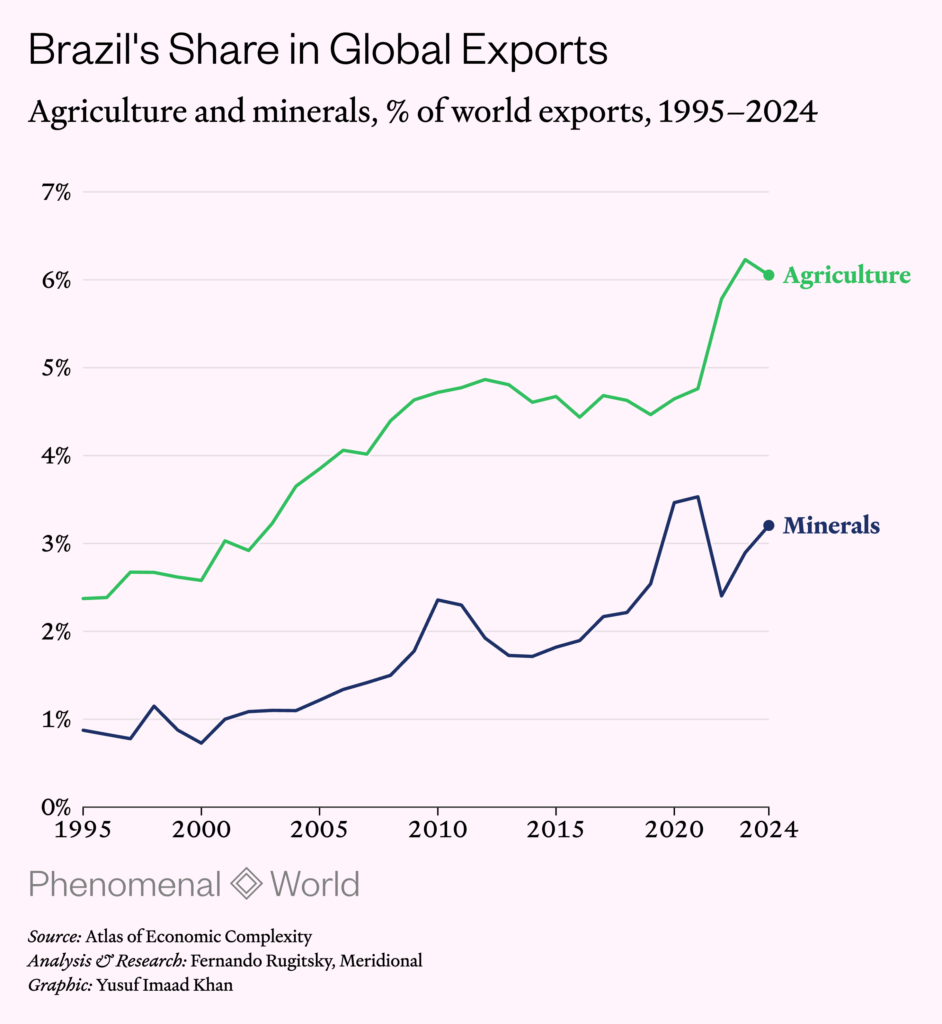
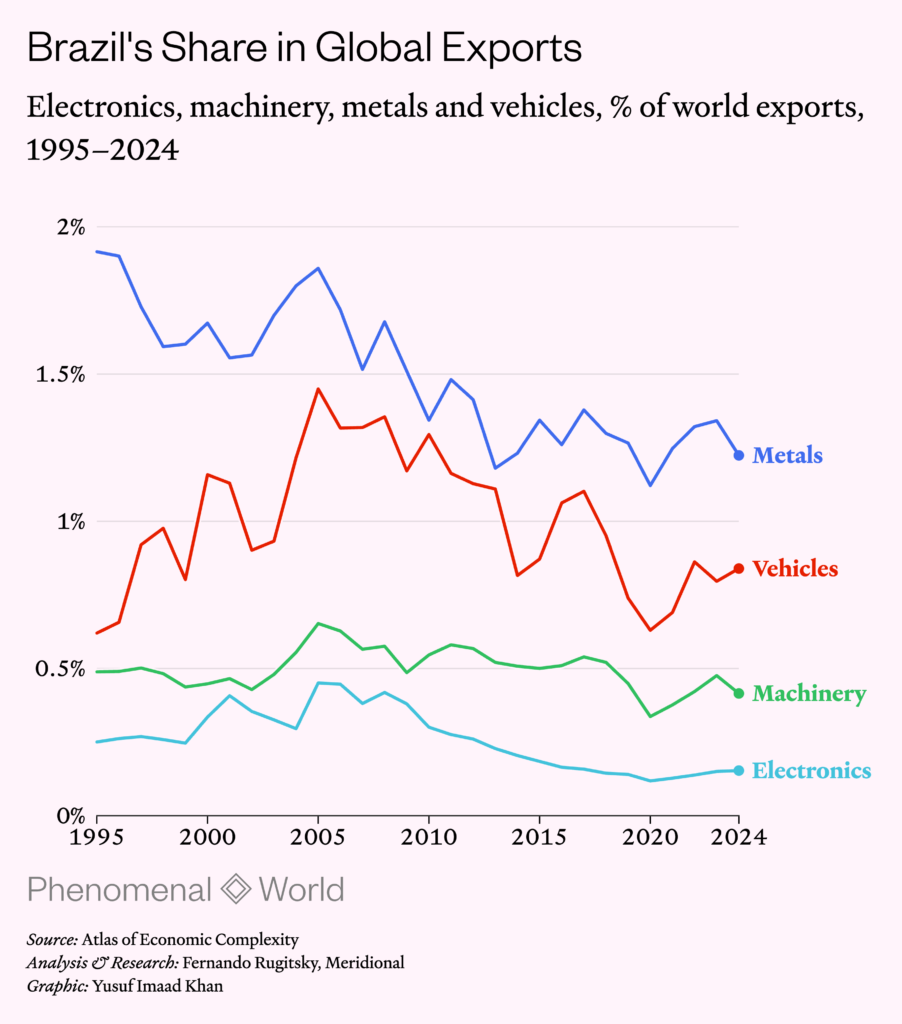
A supporter of the strategy could make the fair point that such a persistent vulnerability was the failure of macroeconomic policy rather than of the national champions strategy. But failures are evident, too, even when focusing on the economy’s export performance, the direct target of the strategy. As the two figures below show, in terms of Brazil’s share of global exports, the situation clearly worsened. Since 2005, the Brazilian economy only increased its share of the global market in agriculture and minerals, seeing decreases in the sectors that tend to be either more technology-intensive or have more linkages with other sectors (chemicals, electronics, machinery, vehicles). The increases in the share of agriculture and minerals should not dismissed, but it is hard to conceive of an inclusive development strategy built almost entirely on these two strengths.
The growing reliance of the Brazilian economy on these primary commodities is also reflected in terms of the activities of internationalized Brazilian firms. As Judit Ricz and Michael Schedelik noted, “Looking at the breakdown of the foreign assets of the top twenty BMNEs [Brazilian multinational enterprises] by main industries in 2016, oil and gas, mining, food processing, metallurgy, and pulp and paper accounted for more than 90 percent.” It is hard to disagree with the conclusion they drew from this: “new industrial policies in general and the national champions strategy in particular failed to promote any reasonable structural change in Brazil.”
In a way, this was to be expected. BNDES deliberately focused on the economy’s existing strengths to promote the internationalization of Brazilian firms. It reinforced, thus, the existing structural characteristics of the economy, instead of transforming them. It has been argued that the pressures of electoral politics further pushed the government in this direction, as the need to stimulate growth and show some success in the short run stimulated the bank to focus on sectors that were already competitive. It requires a longer-term strategy—politically challenging to sustain—to defy comparative advantage rather than conform to it, overcoming rather than deepening productive subordination.
The politics of development
The case of JBS is not an outlier, but representative of a strategy that empowered primary-exporting sectors. And the political dynamics it unleashed are particularly revealing of the risks of this strategy. Considering that BNDES has owned, since 2007, at least 20 percent of JBS’s shares, one could expect it would aim to exert influence over the company’s trajectory. It had, however, little success in this regard. In 2016, with the Workers’ Party ousted from the federal government and BNDES weakened by the incoming administration, JBS announced a plan to transfer its headquarters from Brazil to Ireland. The development bank vetoed the proposal, which would have effectively denationalized a national champion. Yet an agreement between the Batista brothers and BNDES led to practically the same result: the firm was divided in two, with a Brazilian one left in charge of its beef business in the country while one in the Netherlands took charge of all of JBS’s foreign activities as well as its Brazilian poultry business. As a result, 85 percent of JBS’s total sales were transferred abroad. BNDES also tried—again without success—to use its shareholding power to change the company’s policy regarding executive pay, as top salaries were considered to be excessive compared to market standards. It formally registered its disapproval in 2018, with no noticeable impact on the trajectory of executive compensation.
Renato Gaspi and Pedro Perfeito da Silva suggested that these failures are inherent to the public-private arrangement, as the shares owned by BNDES limited its interest in disciplining the company because it feared financial losses. Discussing the cases of both JBS and Marfrig, another animal protein national champion, they argued that “any bolder moves in this respect could trigger a reaction of financial markets . . . which in turn could lead to losses for the Bank and taxpayers. As government involvement grew, so did the [animal protein] sector’s power to push for benefits with weak conditionalities.” This was a particularly acute problem in this sector, due to the weakness of sectoral forces, like unions or social movements, that could have pushed the government in alternative directions. The result, they say, was a disembedded neoliberal regime.
But at stake was not only the government’s failure to discipline capital. The political shifts brought forth by the consolidation of JBS and other national champions in the animal protein sector were felt beyond the industry, eventually engulfing the whole country. The consolidation of the meatpacking business, which preceded the national champions strategy but was intensified by it, resulted in an oligopsonistic meat supply chain that put pressure on the multitude of cattle ranchers who supplied the downstream firms that control meat processing. Between 2011 and 2023 (the period for which data is available), JBS alone controlled more than a third of all beef exports. If one adds the shares of the two next-largest firms (Marfrig and Minerva), the total share goes over two-thirds. A similar oligopsonistic structure can also be observed in the soy supply chain. Politically, these sectoral reorganizations fostered the formation of a social bloc united in opposition to these oligopsonies, led by small and medium cattle ranchers and soy farmers, which became one of the main electoral bases of the far right in Brazil. The anthropologist Caio Pompeia has called it agri-bolsonarism.
The origins of this bloc can be found in 2012, years before Bolsonaro rose to the main stage, when agrarian organizations took part in a “National Movement against the Meatpackers Monopoly.” Leaders of this movement, such as Luiz Nabhan Garcia from UDR (União Democrática Ruralista), would gradually gain influence in local and regional organizations by welding together numerous groups with a shared antagonism not only towards the “national champions” but also the Workers’ Party—partly for its support for the large corporations. Their antipathy towards the project headed by Lula was also driven by the latter’s environmental policies. Since 2018, they channelled this accumulated power in favor of Bolsonaro, decisively contributing to his electoral performance. The overlaps between the regions in which the soy and cattle booms took place and areas that voted for the far right in both 2018 and 2022 is clear. In 2023, these ranchers and farmers formed most of the ranks of the far-right’s attempted coup, storming the presidential palace and the Supreme Court.
The national champions strategy was part of a broader project that was able, for a time, to accelerate economic growth and reduce wage inequalities in Brazil, building loyal support for the Workers’ Party amongst the bottom half of the population, especially in the Northeast, the poorest region in the country. This support has buttressed the party’s electoral power—the Workers’ Party won five of the six presidential elections that took place since 2002. Since 2018, however, its electoral supremacy has been challenged by the far right.
Agri-bolsonarism gave the far right a territorial base that resembles lulismo’s Northeast one. In this way, the national champions strategy contributed to the formation of a political force that risks bringing about its own undoing and threatens Brazilian democratic institutions. When the federal government turned to the right, first with Temer and then with Bolsonaro, the development bank itself was subject to profound changes that reduced its funding and constrained its actions. It is a particular irony that the move that brought this new order about—the impeachment of Dilma Rousseff, Lula’s successor—came with the support of the Batista brothers. One of the confessions of Joesley, in his plea bargain, was that he paid members of Congress to vote in favour of the impeachment.
This should not be read as an indictment of BNDES. Quite the contrary: the bank and its technical staff represent a key achievement of the country in terms of building state capacity, and are critical to the implementation of any future development plan. Besides, BNDES’ record over the last two decades is not restricted to the national champions strategy, involving a series of policies and lines of credit that should have pride of place in an inclusive development strategy. Rather, the lesson to be taken from critical engagement with the story of JBS is that any development program needs to carefully consider its political implications, as one of its main challenges is to maintain its political support so that it can be sustained for the time needed for its policies to bear fruit. Especially during processes of structural transformation, which come with deep changes in economic and social structures, political coalition-building in support of development strategies is particularly challenging. With hindsight, fostering national champions in industrial agriculture caused much more harm than good, contributing to the entrenchment of a productive structure dependent on primary exports at the same time that it fed growing antagonism to democracy.
Further Reading

The World’s Stockyard
Agribusiness and the green transition in Brazil
In the age of climate emergency, the developmental drawbacks of being a primary goods exporter may intensify. Besides barriers to climbing the value chain on...

Controlling Capital
Inflation targeting and external vulnerabilities in the Brazilian economy
Central banks are back in the spotlight. After more than three decades of low inflation in rich countries, the rise in prices observed between 2021...
Battlefield Amazonia?
The political economy of the Brazilian rainforest
How the PT's environmental crackdown undermined its own ambitions for the biome.