June 19, 2026
Analysis
A Legacy in Dispute
A referendum on Petro and the consolidation of post-Uribism in Colombia's presidential election
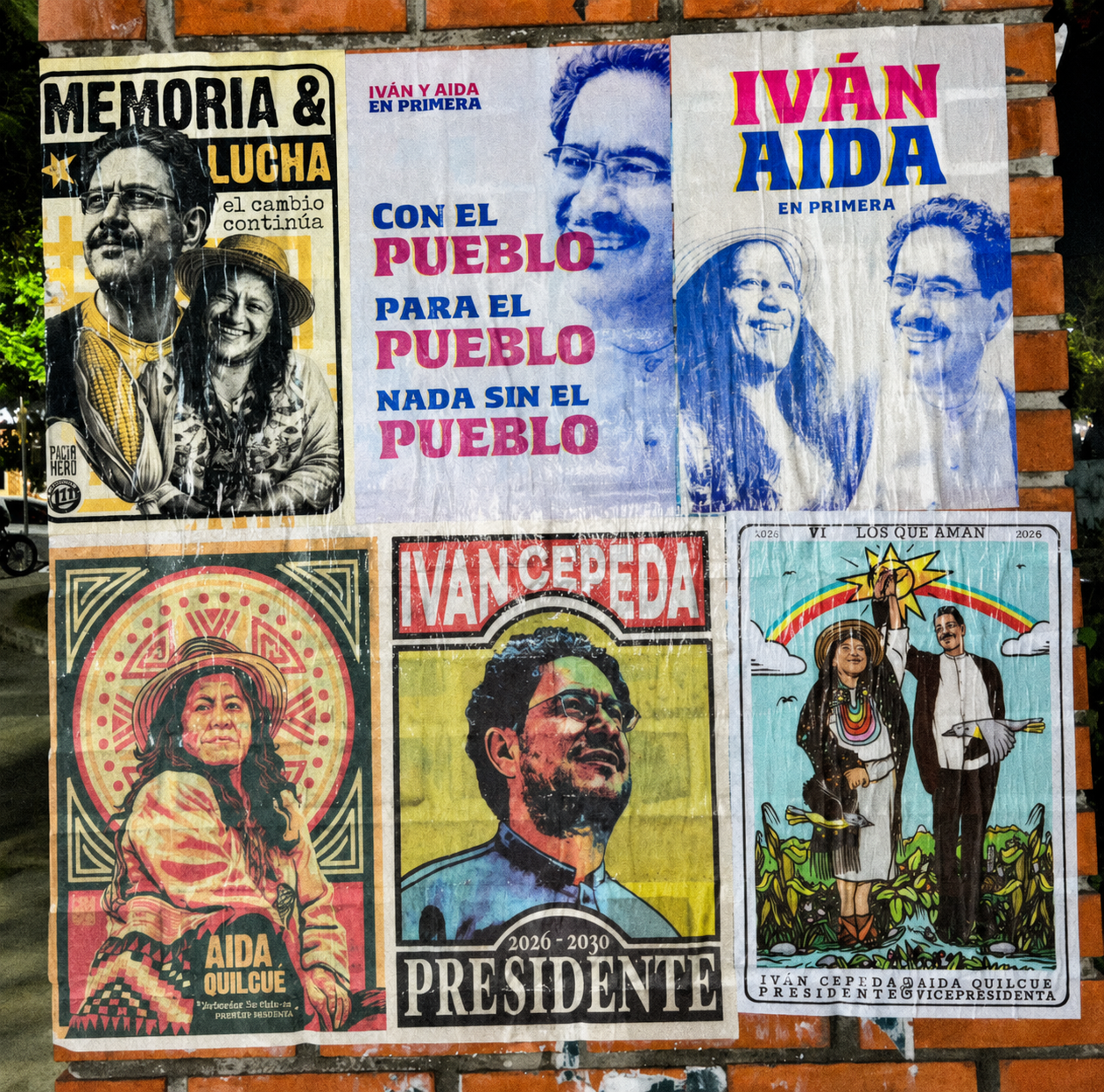
In the second round of Colombia’s presidential election this Sunday, the far-right candidate Abelardo de la Espriella will face off against the ruling party’s left-wing candidate, Iván Cepeda, following a campaign marked by aggressive rhetoric. De la Espriella received the most votes in the first round, a surprise in an election in which Cepeda led for much of the race.
Unknown until recently in traditional circles of power, De la Espriella is a lawyer who turned his legal and media defense of controversial figures into political capital. (Notably, he provided legal representation to Alex Saab, the businessman who for years was identified by investigative journalists and authorities in several countries as one of the main financial operators of the Maduro regime.) Throughout his career, he has served as a sort of devil’s advocate, representing politicians linked to parapolitics, the alliance between politicians and right-wing paramilitaries that took place during former President Álvaro Uribe’s administration.
De la Espriella’s family has maintained political ties to Uribe’s inner circle since the early 2000s. His father was one of the first to campaign for Uribe in the department of Córdoba, and was later appointed as a notary in Bogotá and Cartagena. Now, many years later, Abelardo has managed to win more votes than the official Uribista candidate, previously the most visible face of the right wing in the twenty-first century.
De la Espriella projects an image of luxury and entrepreneurial success inspired by Trump, capitalizing on his business career as a supposed indication of his ability to unleash prosperity in Colombia. He structured his campaign around the promise to take a tough stance against crime, similar to that of El Salvador’s President Nayib Bukele. He has also played the anti-politics card in hopes of snatching the presidency from the left.
In the lead-up to the election, Abelardo has primarily challenged the Petro administration’s social reforms and “total peace” policy toward armed groups. He has spoken of “gutting the left,” using openly violent rhetoric reminiscent of that of other regional leaders such as Javier Milei. He has promised to implement much of his agenda through executive decrees, which, should he take office, foreshadows major tensions with Congress and the courts as well as an expansion of executive power. Given his promise to take a heavy-handed approach toward street crime while also reducing the size of the state, there is concern that his government will bring new violations of fundamental rights, judicial guarantees, and the economic stability of the hundreds of thousands of people currently employed by the government.
This Sunday’s election can be interpreted as a referendum on President Gustavo Petro, who, while barred from running for another term by the Constitution, has remained at the center of the political debate. An electoral analysis of the first-round results shows that the left-wing vote has shifted over the past four years. Although the left has tended to gain ground in rural areas, including regions where they have traditionally had little presence, largely thanks to land redistribution and subsidy policies, it has lost ground in the four largest cities (particularly in the capital), especially among the upper classes.
These data will be key to understanding Sunday’s result. The continuity of the Petrismo political project is at stake. The public will have to decide whether to continue electing the left to power, as in Mexico, or to join the growing ranks of the countries across the continent that are choosing anti-establishment right-wing presidents.
The legacy at stake
Gustavo Petro came to power with an ambitious agenda of social reforms and high expectations from his base, following the heavily-criticized administration of his Uribist predecessor, Iván Duque—an administration marked by the pandemic and large-scale popular protests that were violently suppressed. However, the country’s first left-wing government faced resistance from a significant portion of the Colombian population, which continued to associate the left with armed groups and their abuses, or with the disastrous experiment in neighboring Venezuela. Thus, Gustavo Petro’s election in 2022 was won by a narrow margin (50.4 percent in the runoff), while the Pacto Histórico, his movement, secured only 17.3 percent of the vote in the legislative elections held at that time. This was an unprecedented result for the left, but far from sufficient to allow it to govern alone.
In this context, the challenge for Petro was to demonstrate that he could carry out major structural reforms within an institutional framework that he did not fully control and that imposed serious limits on him. During the first months of his administration, the president sought to build a broad coalition that included the traditional Liberal and Conservative parties, and opened his government to figures recognized for their experience and results who had no prior affiliation with the left. This allowed him to push through a first wave of reforms, which included fiscal measures such as a wealth tax and increased taxes on high incomes, and a national governance plan. It was also during this phase that consensus was reached on the main points of pension reform, the first of the major social reforms Petro had envisioned.
But the experiment was short-lived. As early as the first half of 2023, the president decided to change his strategy after increasingly intense disagreements within his government came to light, particularly regarding healthcare reform. He ultimately chose to break with his governing coalition by reorganizing his cabinet into a more cohesive team characterized by left-wing activism, and by assuming a minority position in Congress. According to Petro, this change was justified by the resistance—if not outright sabotage—that his own ministers were mounting against the reforms.
Following this shift, Petro embarked on a constant power struggle with Congress and the judiciary, which changed the rules of the country’s political life. From his X account, he ramped up his rhetoric against the opposition, the mainstream media, and at times his own administration. He also called on his supporters to take to the streets to pressure the other branches of government, which he accused of obstructing his agenda, and in the end managed to secure congressional approval for the pension reform, which merged two previous parallel systems into a single “pillar” system. The second major reform he managed to pass was a labor reform that expanded various protections for workers. The passage of both pieces of legislation showed that dialogue with Congress, despite the tensions, never completely broke down.
Other flagship government reforms, however, were rejected, such as the controversial healthcare reform, even though the sector has been suffering from increasingly alarming problems and accumulated deficits since the pandemic. Alongside the bumpy and hard-fought progress of the government’s reform agenda, Petro began promoting the idea of convening a Constituent Assembly to address all institutional obstacles. This new approach contrasted with a Colombian political landscape that traditionally relied on institutions operating through negotiations and deals.
It is precisely this approach, which allowed Petro to achieve certain political results, that was put to the test at the polls, where he remains competitive in supporting the campaign of Iván Cepeda, his successor. Cepeda’s campaign was built on Petro’s acceptable level of popularity, which improved during the final year of his term. His clashes with the Israeli government over the war in Gaza, or with Donald Trump over the treatment of migrants in the United States, allowed him to garner support beyond his own base, and he skillfully pursued a policy of appeasement after his visit to Washington in February 2026 following US intervention in Venezuela.
The shift to a confrontational minority-government strategy succeeded in destabilizing the opposition, which never managed to find the right tone in the face of Petro’s rhetoric. The right entered the 2026 elections deeply divided, lacking strong leadership, and unable to move past Uribe, whose overbearing shadow continues to loom over it. (The former president reentered the race by registering on the list of Senate candidates for his party, the Centro Democrático, several years after retirement from active political life.) Meanwhile, several outsider figures emerged, such as the journalist Vicky Dávila, who briefly appeared to be a strong contender before being displaced by De la Espriella as he sought a new path for the right, modeled after Argentina’s Javier Milei or El Salvador’s Nayib Bukele.
By contrast, Petro managed to unite the left early on and prevent any dissent within his own camp, thanks to a successful primary in October 2025 that gave the winner, Iván Cepeda, front-runner status in the polls, which placed him at between 35 and 40 percent of the vote throughout the campaign. Cepeda, the son of a congressman and longtime leader of the Colombian Communist Party who was assassinated in the 1990s, has a well-established track record within the Colombian left, having fought many battles alongside Petro, although he has a much more traditional style and is less inclined toward public grandstanding and social media controversies.
On the social front, Petro succeeded in forging a strong connection and sense of identification between segments of the working class and his political project, and Cepeda has inherited that fervor. Petro nearly doubled the minimum wage during his administration, which, with thanks to the strong performance of the labor market, led to a decline in the percentage of the population living below the poverty line, from 36 percent in 2022 to 31 percent in 2024, according to a recent study by Colombia’s central bank. These results carry weight in the electoral context—and it likely true that Petro would not have had the leeway to achieve them had he continued with the coalition strategy he pursued in the early months.
But his minority government strategy also had electoral consequences. Petro’s decisions and style alienated a segment of the population—one that extends beyond the elites—from the left. He lost the support of allies such as Vice President Francia Márquez, and was criticized by the feminist movement for affording protection to some of his loyalists who were accused of harassment. Even so, Márquez and the bulk of the feminist movements announced their support for Cepeda, in opposition to De la Espriella’s traditional patriarchal rhetoric.
In addition, numerous corruption scandals have plagued Petro’s administration, partly due to the president’s distrust of traditional political and administrative staff, which led him to appoint loyalists to many key positions without paying much attention to their ethical standards. Tensions with Congress also created the temptation to buy the support of its members. This was the case with a high-profile scandal involving the National Unit for Risk and Disaster Management, in which the agency’s executives confessed to having diverted public funds to pay bribes to members of Congress with the apparent aim of securing congressional approval for Petro’s reforms.
The results of this electoral cycle are contradictory for the left. They show signs of progress and consolidation, but are also insufficient to secure the future of its reforms. The March 8 legislative elections, held almost two months before the first round of the presidential election, were once again won by the ruling Pacto Histórico, which increased its share of the vote from 17.3 percent to 22.7 percent. However, vote share of the Centro Democrático, its main rival on the right, also rose from 11.4 percent to 15.6 percent.
The left thus ended Petro’s term as the country’s most-voted-for party, more unified and organized than ever before in its history as a political force. A new generation of leaders has emerged from the government and Congress that will allow it to gain influence within institutions even if it does not win the presidency. However, the left’s initial momentum was put on hold after the results of the first round of voting on May 31, when despite the predictions of the polls, it was surpassed by the far-right.
The first round for the left
Once the vote count on May 31 was complete, turnout for the first round stood at 57.9 percent—a figure not seen since the end of the National Front era for the first round of a presidential election—which shows that Colombians are deeply interested in the race and turned out en masse to vote.
The result left the country split down the middle: Abelardo de la Espriella and Iván Cepeda accounted for more than 85 percent of the votes, with Paloma Valencia, the Uribist Centro Democrático candidate, falling far short of the right’s historical high. De la Espriella took first place with more than 43 percent of the votes, while Cepeda followed closely behind with 40.99 percent.
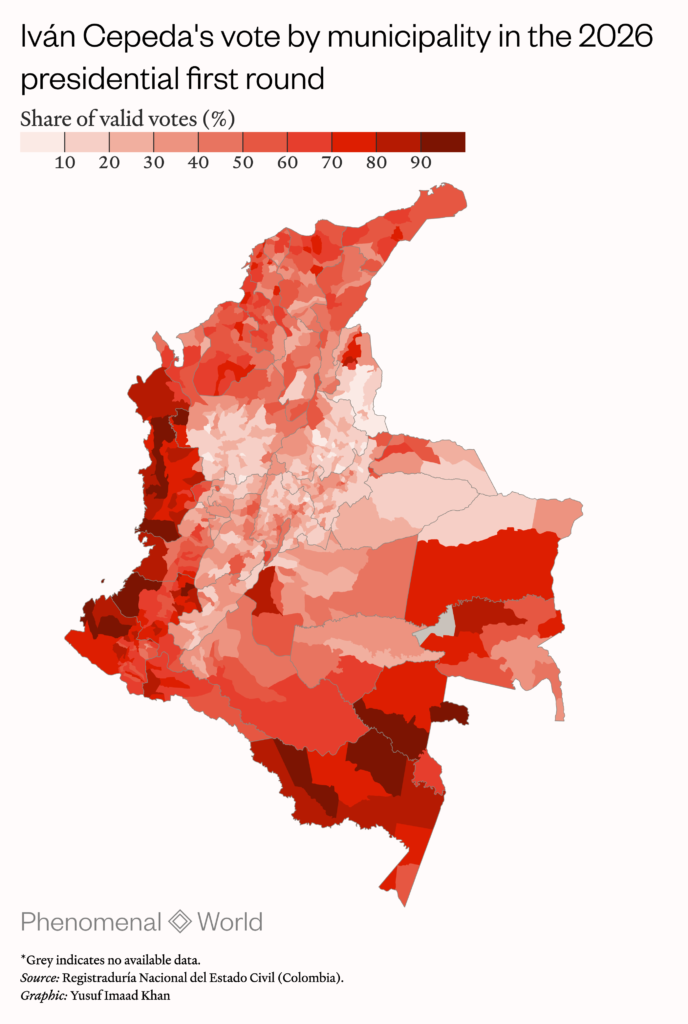
Iván Cepeda’s result was closely comparable to that of Gustavo Petro four years ago, to the point of obtaining very similar percentages. Not only did Cepeda achieve a level of support similar to Petro’s four years ago, but he also followed a very similar geographic pattern, with higher vote shares in the country’s most remote departments—those most affected by the armed conflict.
Many of the municipalities where Petro achieved his best results in 2022, and where the progressive movement remains competitive under Cepeda’s leadership, are areas where people have lived for decades with limited state presence but the strong influence of armed groups. In regions of the Pacific, the Amazon, parts of rural Caribbean Colombia, and border areas, the promise of taking these communities seriously and increasing social investment as well as making progress on agrarian reform found a receptive audience by addressing historical problems related to infrastructure, health, education, and security.
However, there are some differences between the performance of Cepeda and Petro to be found when examining the details of the gap between the percentage of the vote obtained by the left in the first round of elections in 2022 and 2026, as shown in the following map.
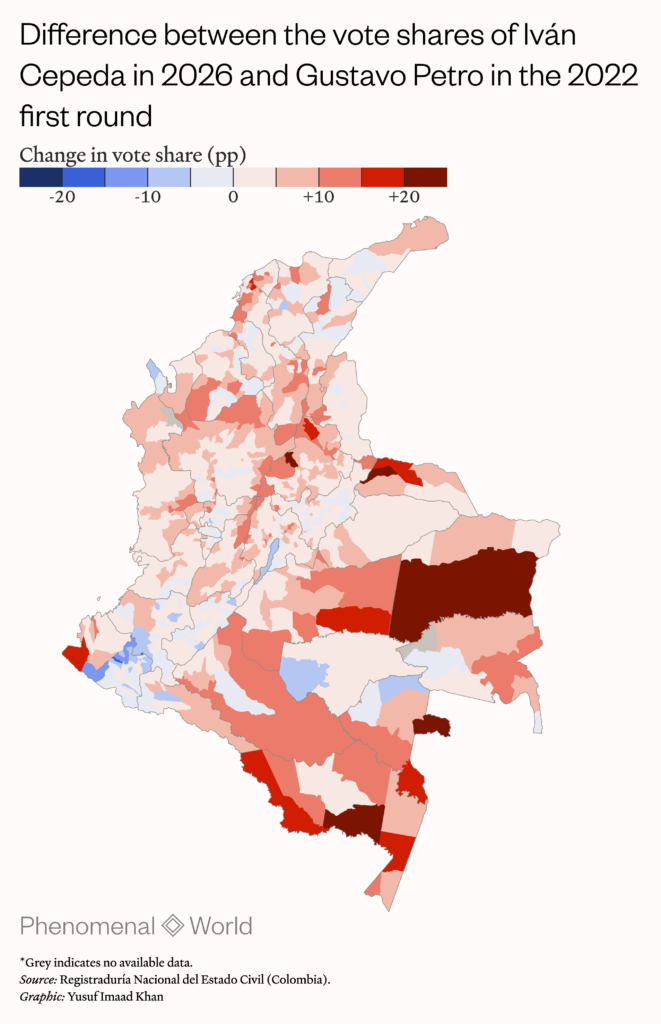
Despite the impression of an identical pattern, the left-wing vote has shifted over these four years. The left has tended to gain ground in rural areas, including in regions where it has previously had minor influence. This is the case in much of the departments of Antioquia, Tolima, and Meta. The entire department of Santander deserves special mention: four years ago, it was a stronghold of right-wing candidate Rodolfo Hernández, and De la Espriella has not managed to regain all the support that Petro’s opponent once had there.
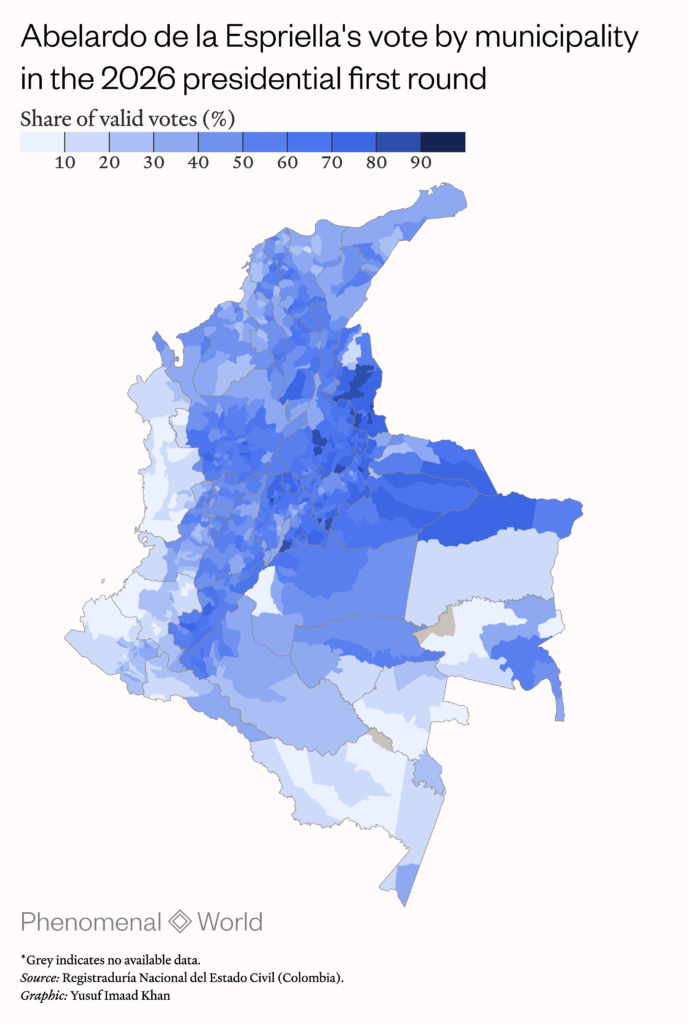
However, in the cities the left has lost ground—particularly in the four largest cities, and especially in the capital. We can also mention the cities in the Coffee Region, as well as the smaller cities of Boyacá, Valledupar, Neiva, Popayán, and Pasto. Although they may hope to make a comeback in left-aligned areas where voter turnout dropped—such as Putumayo, Catatumbo, and Buenaventura, among others—the number of votes to be gained in those departments is limited. In contrast, the number of votes to be regained in Bogotá, Cali, and other major cities is considerable, and these are votes that the left once won.
Part of this shift can be explained by the fact that in 2022, Gustavo Petro succeeded in building a very broad urban coalition that included traditional left-wing voters, young people, professionals, part of the middle class, and many centrist voters who wanted change following Iván Duque’s administration. Four years later, some of those people are no longer voting based on the promise of change, but rather on the perceived results of the Petro administration, which is impacting Cepeda’s candidacy.
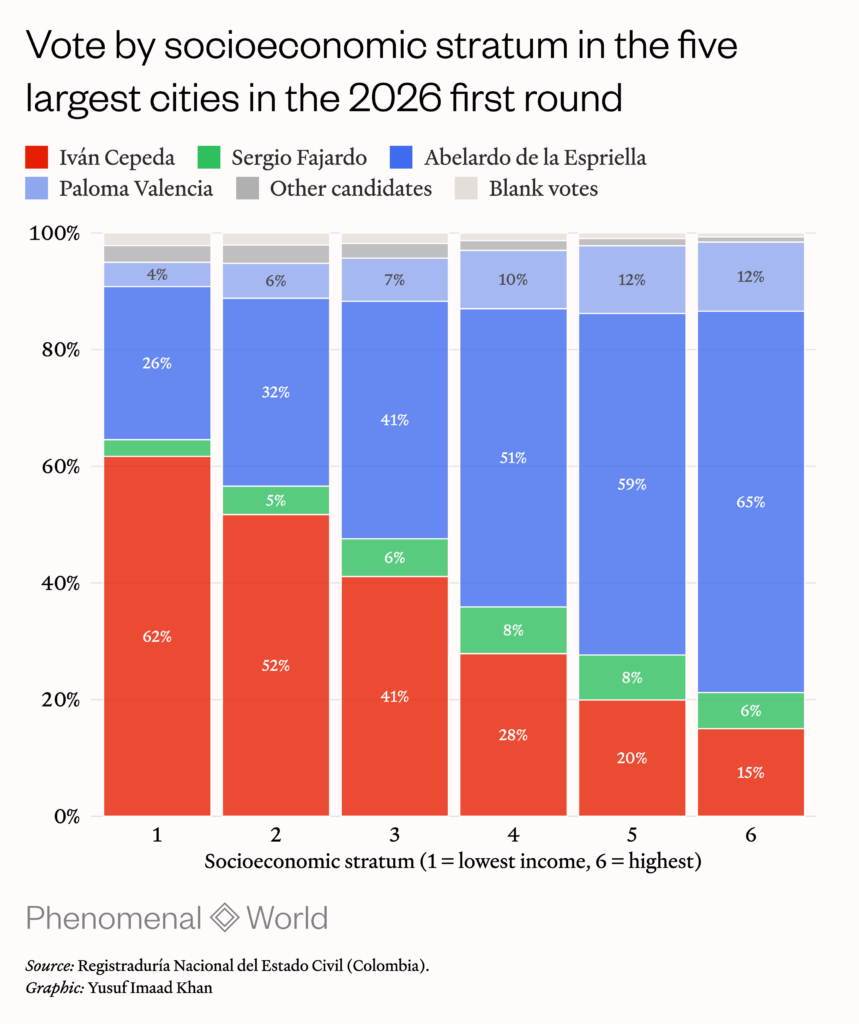
In these major cities, the vote is highly “stratified” by the socioeconomic levels, or estratos, that the government uses to categorize the population. Cepeda wins an absolute majority in estrato 1 and 2 (which comprise the poorest people), while De la Espriella does the same in estrato 4, 5, and 6 (the wealthiest). In estrato 3, which is considered middle class, Cepeda lost nearly 5 percentage points compared to Petro in 2022: about 60,000 fewer votes in raw numbers. De la Espriella, for his part, has a percentage similar to Cepeda’s in stratum 3, with the difference between the two at just about 10,000 votes. These figures confirm that the middle classes in major cities have become a key battleground for the runoff and that any potential comeback by Iván Cepeda depends on winning over that segment of the electorate.
The electoral landscape revealed in the first round explains the strategy of moderation and distancing from Petro that has been taking shape over the past few weeks in Cepeda’s campaign, as Cepeda has stepped away from Petro’s proposal for a constituent assembly. The goal is certainly to attract the political center, but above all, the urban middle-class electorate that voted for the left four years ago. Cepeda managed to maintain the percentage Petro achieved in stratum 1 four years ago, but lost ground in the higher strata—and especially in the very important stratum 3, as the graph shows.
The Consolidation of “Post-Uribism”
On the right, De la Espriella’s victory in the first round ushers in the era of “post-Uribism” that has been on the horizon since 2022. Even back then, the waning influence of Uribe was evident; he had previously been the right’s unavoidable figurehead since leaving office in 2010. The Centro Democrático had emerged severely weakened from Iván Duque’s presidency, and its designated successor candidate never managed to gain traction.
Instead, the party rallied behind the aligned candidacy of Federico “Fico” Gutiérrez, former mayor of Medellín, who failed to advance to the second round against Petro and was displaced by Rodolfo Hernández, an outsider businessman with an anti-political populist platform. This anti-political rhetoric is the same one now being espoused by De la Espriella, who champions “los nunca,” meaning those who have never received any assistance from the state and make a living through their own labor, against “los nadies,” a term Petro used to describe marginalized communities but who De la Espriella disparages for depending on subsidies, or “los de siempre,” the political class.
It is highly effective rhetoric that is not particularly new. Uribe made it one of his key platforms at the time of his first election, when he criticized “political maneuvering and corruption.” But after his two terms in office, Uribism became “gentrified”; turning into a party of representatives who began to establish themselves in Congress and gradually became the voice of the interests of the wealthiest sectors, abandoning the populism of Uribismo’s early days. This left a void that De la Espriella knew how to exploit, finding in Paloma Valencia, the Centro Democrático candidate, an easy target given that she is the granddaughter of a former Conservative president.
Valencia was on the verge of overtaking De la Espriella in the polls during the month of April, capitalizing on the momentum created by her victory in the primaries, but a series of strategic errors caused her to miss her chance. She began seeking support from the center with a premature second-round strategy, when she should still have been focused on winning over right-wing voters. In the end, it was De la Espriella who reaped the tactical votes from an electorate willing to support any well-positioned right-wing candidate able to prevent the left from remaining in power.
The anti-Uribe stance embodied by De la Espriella has yet to be better defined. He draws on more contemporary references than Uribe, such as the figures of Javier Milei, Nayib Bukele, or Donald Trump. In terms of his electoral base, De la Espriella draws particularly on the support of those who see him as the most direct and confrontational alternative to Petrismo. He has also managed to attract right-wing sectors dissatisfied with the traditional parties, who believe that the Centro Democrático has become too moderate and a more disruptive figure is needed. His base also includes retired military personnel, who advocate for the role of the Armed Forces in the fight against guerrilla groups. Finally, like far-right leaders in other countries, he has garnered significant support among evangelical churches and conservative Catholic sectors, where he has presented himself as a defender of the traditional family and an opponent of abortion.
The support received from the US president between the two rounds, in and of itself, does not have a very clear electoral impact. The position of both candidates regarding the United States has been quite clear from the outset: total alignment for De la Espriella, more critical cooperation for Cepeda. Trump’s endorsement simply confirms this.
But in a context in which international issues are not particularly relevant to the electorate, De la Espriella’s success in the first round must be understood within the specifically Colombian dynamics of the transition away from post-Urbismo and as a reaction to the Petro administration. De la Espriella draws heavily on the concept of the “anti-politician” candidate embodied by Rodolfo Hernández, Petro’s rival in 2022 who died in 2024. He has adopted a style that is more focused on the working classes than the Centro Democrático, is more critical of the elites, and claims a broader focus, whereas Uribism almost exclusively campaigned on criticizing the peace agreement with the FARC guerrillas and negotiations with armed groups. Among these new preoccupations, one that stands out is a rhetorical celebration of hard work in contrast to those who live “off the state’s teat”—both the political class and those who live off public benefits. On security matters, a more aggressive emphasis is placed on the fight against urban crime, and not just against armed groups active in rural areas.
Uribe himself, who expressed his support for De la Espriella in the runoff, will undoubtedly continue to play a role. His party remains the best-organized and strongest on the right. However, he will no longer be the undisputed figure he once was. De la Espriella now has the opportunity to assume a new leadership role that will go unchallenged if he wins—and that will carry significant weight regardless of whether he loses.
Although De la Espriella reached the runoff by harshly attacking his opponents and the media—a strategy that helped him defeat Valencia in the first round—it remains to be seen whether that approach has weakened his standing in the runoff, during which appealing to the center, moderates, and undecided voters becomes essential. All the more so, it will become an obstacle to governing if he ultimately becomes the next president. De la Espriella has no party or organized layer of support in civil society. He will therefore have to come to terms with this political class that he criticized so heavily, yet now relies on in the second round. For now, De la Espriella poses a direct threat to civil liberties, a free press, and the rights of minorities with his platform promising law and order, carried out through the concentration of power in the executive branch. It remains to be seen whether that rhetoric will prevail.
Further Reading
Total Peace?
Gustavo Petro’s government negotiates with the ELN
Four Years of Petro
At the end of his term, has Colombia's first leftist president managed to reverse the gains of technocratic neoliberalism?
Tierra, guerra y política
Orígenes de la guerra civil y la desigualdad agraria en Colombia en los años 60s-80s
Further Reading

Total Peace?
Gustavo Petro’s government negotiates with the ELN
Gustavo Petro’s presidency marks a turning point in Colombia’s democratic history. Not only is Petro the first leftist in government, but he has also made...
Four Years of Petro
At the end of his term, has Colombia's first leftist president managed to reverse the gains of technocratic neoliberalism?
This August, Colombian President Gustavo Petro’s four-year term will come to an end. Petro’s 2022 victory marked a dramatic rupture in the history of Colombian...
Tierra, guerra y política
Orígenes de la guerra civil y la desigualdad agraria en Colombia en los años 60s-80s
El ciclo de violencia que comenzó en algún momento entre mediados de la década de 1970 y comienzos de 1980 en Colombia estuvo estrechamente relacionado...