June 16, 2026
Analysis
Four Years of Petro
At the end of his term, has Colombia's first leftist president managed to reverse the gains of technocratic neoliberalism?
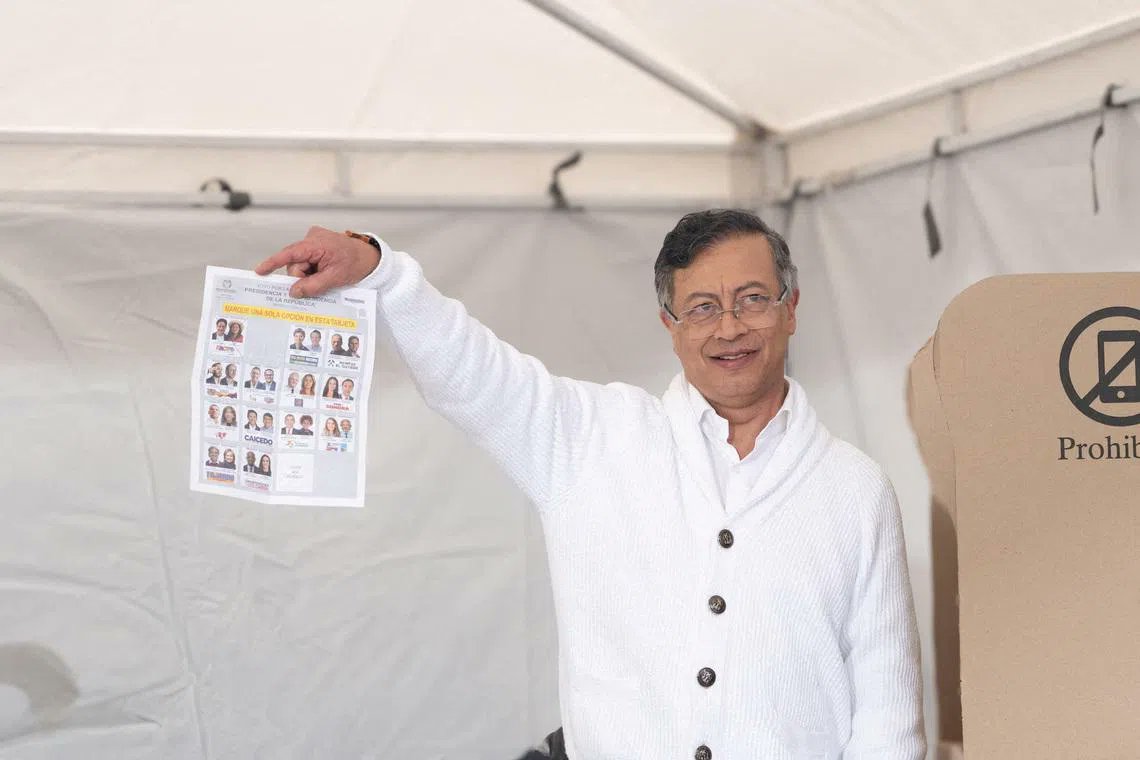
This August, Colombian President Gustavo Petro’s four-year term will come to an end. Petro’s 2022 victory marked a dramatic rupture in the history of Colombian politics, which has long been dominated by a conservative elite and shaped by counterinsurgency, extractivism, and the country’s close partnership with the United States. A former M-19 guerrilla, Petro promised a break with what he frequently denounced as the country’s “neoliberal model,” a four-decade-old system which he described as having “led to great inequality, the destruction of the social fabric, and more violence.” His agenda included ambitious plans to overhaul Colombia’s pension and healthcare systems, as well as land and labor reforms, but it amounted to more than a sum of its parts. Petro built his political career denouncing the links between politicians, landed elites, paramilitary squads, drug traffickers, and foreign multinationals that underpin Colombia’s extractivism—what he calls the “economy of death”—and his project while in office has been an attempt to fundamentally reorient the country’s developmental model away from fossil fuel dependence, the illicit economy, and land dispossession, towards “an economy of life.”
While Petro’s platform represented a radical departure from decades of Colombian politics, his proposed policies were not revolutionary. Rather than a leap into twenty-first-century socialism, he aimed to reduce inequality, further political inclusion, and guarantee the civil rights promised in the 1991 Constitution. On election night, Petro told his supporters that achieving these goals would require “develop[ing] capitalism” in the country. Informed by a reading of Colombian history that echoed the dependency theory and mode of production debates of the mid-twentieth century, Petro argued the country had been stuck in a “pre-modern, feudal” state that had to first be overcome.
The challenges Petro faced in office revealed the difficulty of governing through institutions that were forged during a neoliberal period, which is a conundrum not unique to Colombia. Distinct to the Colombian context is the long-running insulation of economic issues from political debate—the product of La Violencia and the uniquely technocratic political formation it birthed—which includes the enshrining of pillars of neoliberal governance in a constitution that enjoys massive popular legitimacy.
Petro’s project emerged in a country whose transition to neoliberalism was gradual, producing a more muted backlash than in other parts of the region, where more dramatic reforms sparked anti-neoliberal movements that helped bring the Pink Tide governments to power. In addition, Colombia’s left has had to deal with an economic restructuring that was deeply intertwined with armed conflict and the rise of paramilitarism, which together have violently stamped out popular opposition. Thus, Petro’s presidency is best understood not simply as a symbolic breakthrough, but as a test of what a progressive government can achieve in four years in a country characterized by institutions shaped by decades of neoliberal reform, an extremely violent opposition to popular social movements, and no history of left-wing rule.
If the country’s presidential elections are to be treated as the only barometer of Petro’s success, it is clear that his project was not popular enough to withstand a well-funded right-wing onslaught. Indeed, the second-place finish of Iván Cepeda, his chosen successor, to far-right populist and narcolawyer Abelardo De La Espriella in the first round has led critics to discount Petro’s time in office. Nevertheless, even if the far right returns to power—an outcome predicted, but not guaranteed, by early polling—the left’s time in power will leave an impact on the country, and region, far beyond these four years. Colombia’s turn towards an explicitly redistributive, anti-extractive agenda strikes such fear in its critics because of its success—Petro is leaving office with relatively high approval ratings for a departing president and the economy is stable. He has done so by focusing on the popular classes, whose lives have dramatically improved as a result of a slew of massive reforms to the labor and pension systems, a boost to the minimum wage, unprecedented land redistribution and targeted spending in peripheral regions. But beyond these material advances lies a more potent challenge to the status quo: he has successfully called into question elites’ technocratic control over policies that have long benefitted them, bringing class squarely back to the center of the discussion and ushering in new forms of popular politics.
The gradual shift from ISI to liberalization
Colombia’s regionally unique history of armed conflict is intimately tied to another distinct feature of the country’s history—the technocratic nature of economic decision-making that was crystallized in the “pacted democracy” of the National Front. The National Front, a coalition government that agreed to alternate between liberal and conservative leadership, came to power in the aftermath of La Violencia, a brutal civil war that lasted between 1948–1958 and claimed at least 200,000 lives. This pact allowed Colombian elites to sidestep the structural challenges of the country’s economic model, which at the time was characterized by a low-productivity agricultural sector and locked into an unfavorable position within the global economy as an exporter of raw materials and importer of manufactured goods, producing chronic trade imbalances and constraining industrial development. The stakes of Colombian economic development were high. Growing the economy, integrating the periphery, and addressing entrenched regional and ethnic inequalities were not just ways to bolster the capitalist model of development—a shared Cold War goal across the region in the face of rising leftist tides—but also were explicitly framed as a means to stop the country’s bloodshed.
In this period, Colombia had a trajectory that differed from the more ambitious “big push” industrialization pursued by countries like Brazil and Argentina. Its approach to import substitution industrialization (ISI)—a broad attempt to correct the deteriorating terms of trade by shielding domestic industry—was more flexible. It involved a lesser degree of state intervention, and continued to depend on revenues from coffee exports to fuel development. While this program achieved steady economic growth, it did not lead to structural change. Key distributive questions were considered too destabilizing so soon after La Violencia, which was itself rooted in disputes over land as much as partisan animosities. By the mid-1960s, however, this model was reaching its limits, facing a small domestic market and continued dependency. When coffee prices—which then accounted for roughly 80 percent of export earnings—tumbled in 1966, Colombia faced a balance-of-payments crisis. President Carlos Lleras Restrepo rejected the IMF’s demand for a massive devaluation of the peso as a condition for a stabilization loan, which he deemed to be politically impossible and a violation of Colombia’s sovereignty. He instead introduced a more controlled adjustment through Decree 444 of 1967, establishing a crawling-peg exchange rate that allowed small, regular devaluations of the peso. The result was not liberalization, but an eclectic strategy that acknowledged the limits of ISI as a motor of development, while still maintaining protection for key industries. 1Carlos E. Juárez, “Trade and Development Policies in Colombia: Export Promotion and Outward Orientation, 1967-1992,” (<)em(>)Studies in Comparative International Development (<)/em(>)(Fall 1993, Vol. 28, No. 3), 80.
The episode is significant for what it reveals about Colombia’s emerging political economy. Lleras successfully resisted the IMF’s most politically costly demand while preserving access to international financing, which he saw as a necessary ingredient for development. This outcome was enabled by Colombia’s strategic importance during the Cold War—maintaining the stability of the National Front government was a key priority for the US government. Lleras’s balancing act reflected the consensus that was forged in the aftermath of La Violencia, which prioritized moderation and stability over confrontation with the structural inequality present at both the national and international level. Thus, the maintenance of macroeconomic stability became a fundamental political strategy. The task of controlling inflation, avoiding future balance-of-payments crises, and reassuring foreign creditors was entrusted to an elite that treated economic management as a technical matter rather than a set of policies that should be subject to democratic control. Macroeconomic stability coexisted alongside growing social tensions rooted in unequal land distribution and the resulting large-scale migration to urban centers.
By the late 1970s, as inflation approached 30 percent, sharp fluctuations in global coffee prices produced a temporary export bonanza that flooded the domestic economy with foreign exchange. Rather than catalyzing the development of the industrial sector, this influx of money fueled inflation and further undermined manufacturing competitiveness by driving up the value of the peso. The expansion of the illegal economy during this period—first marijuana, then later cocaine—exacerbated these distortions, channeling illicit capital into land and urban real estate and deepening speculative dynamics. 2Forrest Hylton, (<)em(>)Evil Hour in Colombia(<)/em(>) (London: Verso, 2006). The state responded by introducing what came to be called the la ventanilla siniestra—a window through which dollars could be exchanged for pesos without an explanation of their origin—in order to absorb illicit dollars into the formal economy, which helped stabilize the currency and bolster reserves, contributing to Colombia’s ability to avoid the debt crises that engulfed much of the region after 1982. Moreover, Colombia was able to maintain its trademark image among investors as a macroeconomically stable and fiscally responsible country even amidst the skyrocketing narco-fueled violence of the 1980s.
It was in this context that neoliberalism took shape in Colombia—not as a sudden imposition, but as a decades-long reorientation of the country’s development strategy which was shaped by technocratic management and the economy’s insulation from politics, supported by an elite bipartisan consensus that endured even after the National Front formally ended in 1974. While Colombia did not experience the hyperinflation or debt crises that generally characterized Latin American economies, by the mid-1980s the peso was overvalued, exports were less competitive, the domestic market was saturated, and external financing had dried up as investors withdrew from emerging markets during the regional debt crisis. By the end of the decade, the government of Virgilio Barco began to pursue a more explicit program of economic “modernization,” which aimed to gradually expose the national economy to global competition by reducing protectionist barriers. Notably, this early round of liberalization did not follow the trajectory of classic “shock doctrine” IMF-backed bailouts of crisis-ridden economies, but rather took its own course, presented as a pragmatic adaptation to global change.
Accelerated liberalization and the crises of the 1990s
After decades of gradual liberalization under a hybrid-ISI development model, Colombia entered a new phase under President César Gaviria, who accelerated market reforms though la apertura económica, or “economic opening.” This turn did not emerge in response to hyperinflation or a debt crisis, but rather a political crisis. By the late 1980s, the failure to institutionalize broader political participation, tension between the regional and national governments, and the Congress’s inability to pass meaningful legislation—combined with escalating violence from both the cartels and guerrillas—led to a sense of institutional decay and a broader crisis of legitimacy.
In response, there was a moment of political opening marked by the demobilization of guerrilla groups such as the M-19, and a Constituent Assembly was formed to draft the 1991 Constitution. The Constitution is widely celebrated for expanding civil and cultural rights—notably its recognition of Afro-Colombian and Indigenous collective land rights and the principle of prior consultation—along with social and environmental protections. Yet for much of the left—including Petro, who was elected to Congress following his release from prison as a part of the peace process with M-19—the 1991 Constitution represents a democratic project whose promises remain only partially realized. The popular spirit of the constitution generated political buy-in that would grant a degree of legitimacy to its far-reaching economic changes.
The 1991 Constitution institutionalized neoliberalism by embedding market-oriented economic governance in the country’s legal architecture. The Constitution firmly enshrined private property and competition as organizing principles of economic life—for example, placing strict limits on the state’s ability to expropriate land and requiring compensation at market value, even for idle land. Economic questions were pushed into the legal realm to be adjudicated by a Constitutional Court, which narrowed the scope of democratic deliberation and insulated key policy decisions from popular pressure. One of the most consequential constitutional reforms was central bank independence. Article 371 formalized the autonomy of the Banco de la República and defined price stability as its primary mandate, which aligned Colombia with a prevailing orthodoxy that treated inflation as a technical problem best managed by experts rather than elected officials, and helped signal credibility to international investors and financial institutions.
Economic restructuring proceeded alongside these institutional changes. Labor markets were liberalized through reforms that increased flexibility and normalized short-term contracts. The pension system and education were further privatized, social security restructured, and key sectors such as healthcare and telecommunications were deregulated, sparking widespread protests. The social consequences in Colombia were in large part similar to that of the rest of the region: pension privatization failed to meaningfully expand access even as public spending continued to balloon; union density declined as violence against trade unionists surged; budget cuts forced many public universities to close and cut back on services; healthcare reform expanded access but triggered funding cuts and expanded the role of private intermediaries, which led to worsening care for patients and workers.
The centerpiece of the apertura económica was trade liberalization, through which the vestiges of ISI were dismantled. Average tariffs were reduced sharply, from 38.3 percent to 11.7 percent and import licences went from being required for 50 percent of products to 3 percent. In the wake of this opening, exports grew modestly while imports surged, increasing the balance-of-payments deficit. Simultaneously, the deregulation of capital markets and the removal of exchange controls in January 1991 triggered a rapid influx of foreign capital, which went from a modest outflow in 1990 to an inflow of $2.7 billion by 1992. Rather than moving into productive sectors, this surge in liquidity, combined with relaxed credit standards, fueled a credit and real estate boom, pushing inflation upward and driving interest rates from 4 percent to nearly 20 percent between 1992 and 1995. 3Carlos Eduardo Hernandez and Edwin López, “Colombia during the Financial Crisis of the Late 1990s,” in (<)em(>)Encyclopedia of Financial Crises(<)/em(>), ed. Sara Hsu, (Elgar, 2023).
As a result of la apertura, Colombia became more deeply embedded in global financial circuits—and more exposed to their volatility. That vulnerability became clear in 1999, when the country experienced its worst economic crisis since the 1930s. Liberalization also served to fuel the armed conflict as social dislocations and a rise in informal employment contributed to the growth of a precarious proletariat that supplied recruits to guerrilla and paramilitary organizations, both of which were funded by the expanding drug trade. 4Nazih Richani,“The Political Economy of Violence: The War-System in Colombia,” (<)em(>)Journal of Interamerican Studies and World Affairs (<)/em(>)39 (2): 37–81 (1997). Against this backdrop, President Andrés Pastrana (1998–2002) opened peace talks with the FARC. The FARC denounced neoliberalism as a betrayal of Colombia’s sovereignty and a cause of immiseration, and called for income redistribution, agricultural reform, increased social spending, state control over strategic sectors, and an end to foreign debt repayments.
Engagement with this alternative economic vision was, however, short-lived. As Pastrana looked abroad for aid to strengthen state capacity and social investment, Colombia’s development became increasingly subordinate to US security priorities. What began as a development-oriented proposal to address the social roots of the conflict and of coca production—originally dubbed by Pastrana a “Marshall Plan” for Colombia—evolved into “Plan Colombia,” a military aid package and security strategy focused on counterinsurgency and counternarcotics. The aid from the United States—which in the end totaled $10 billion—was contingent upon market-oriented reforms and privatization, reinforcing the connection between economic liberalization and security policy. As the fight against narcotraffickers and guerrillas in Colombia was folded into the Global War on Terror, the idea that insecurity was a phenomenon with social roots disappeared from the political mainstream, eclipsed by the rhetoric of security and investment, which would reach its apogee under the administration of Alvaro Uribe.
Neoliberalism in war, neoliberalism in peace
As Petro describes it, Colombia’s “economy of death”—driven by “petroleum, carbon, and cocaine”—was consolidated during the presidency of Álvaro Uribe. Colombia’s trajectory during this period stood in sharp contrast to much of Latin America. While progressive Pink Tide governments—in Bolivia, Ecuador, Venezuela, Brazil, Argentina, and elsewhere—used commodity windfalls to expand social spending, Uribe combined a program pursuing macroeconomic stability with militarization and market reform, resulting in growth without redistribution.
Uribe’s election in 2002, which broke the traditional Liberal–Conservative duopoly, strengthened the connection between security and economic liberalization through his populist political project, Uribismo. Drug traffickers and “retired” paramilitary fighters, often with ties to the government, dispossessed campesinos of lands that would then be used for the expansion of agribusiness—a process facilitated by a series of pro-landowner laws that violated the constitutional rights of local communities. 5Cristina Rojas, “Colombia’s Neoliberal Regime of Governance: Securitization by Dispossession,” in Laura MacDonald and Arne Ruckert, eds., (<)em(>)Post-Neoliberalism in the Americas.(<)/em(>) The demobilized paramilitaries also furthered the extraction of resources like oil, bananas, and coal by foreign multinationals by protecting key infrastructure from guerrilla attacks, and murdering community activists fighting displacement and environmental degradation. Organized labor, already weakened by decades of violence, was further marginalized: union density collapsed, thousands of union activists were assassinated between the 1990s and mid-2000s—often, here too, by paramilitaries at the behest of large multinationals—and laws passed by the Uribe administration increased the flexibilization of labor. 6See Jasmin Hristov, Paramilitarism and Neoliberalism (London: Pluto Press, 2017).
For all its violence, Uribe’s militarized, export-oriented growth strategy guaranteed him reelection and produced an economic boom. Between 2003 and 2013 the country’s per capita GDP quadrupled and foreign investment poured into mining, energy, and agribusiness sectors, which were guaranteed “security” and reduced royalties under Uribismo. Meanwhile, privatization accelerated across banking, telecommunications, energy, healthcare, and pensions, leading to a contraction in public sector employment. Free trade agreements signed with the United States and Canada in 2006 and 2008 entrenched investor protections and arbitration mechanisms while reinforcing Colombia’s traditional position in the international division of labor as a raw material exporter.
Domestic elites and international observers viewed Colombia as a “success story” during the Uribe era, though the economic growth came at the expense of large swaths of the population, including Afro-Colombians, Indigenous groups, peasants, and trade unionists, who were deemed a threat and excluded from the body politic. Rather than addressing the structural roots of the conflict, Uribe’s developmental model entrenched them, narrowing the space for alternative visions.
The neoliberal economic project moved into new territory under Uribe’s successor Juan Manuel Santos, who took office in 2010. Breaking with Uribe, Santos reopened negotiations with the FARC, a process that culminated in the Peace Accords signed in Havana in 2016. As monumental as the achievement was, the Peace Accords cannot be separated from the extractivist ends they served. The talks emerged at a moment when the limits of the extractivist economy were made apparent by a devastating fall in oil prices, and the Santos government framed the negotiations as a means of restoring investor confidence and integrating conflict-affected territories into the global economy. As Santos himself argued, peace would allow Colombia to become a “normal” country for capitalist development. In this sense, the Peace Accords extended the neoliberal order consolidated under Uribe into the post-conflict countryside, opening new spaces for extraction and accumulation while leaving intact the institutional and distributive structures that had sustained violence for decades. 7Hylton, Forrest, and Aaron Tauss. 2016. “Peace in Colombia: A New Growth Strategy: Colombia’s Peace Deal Is a Remarkable Achievement, but Its Economic Implications Are Troubling.” (<)em(>)NACLA Report on the Americas(<)/em(>) 48 (3).
These unresolved tensions between security, neoliberalism, and social reform reached a breaking point during the presidency of Iván Duque (2018–2022). In 2019, his administration introduced a slate of proposed labor, tax, and pension reforms—known as the “paquetazo”—that collectively sought to cut the minimum wage, privatize public pensions, and cut taxes for multinationals while raising them for the working and middle-classes. The opposition to this agenda coalesced in November 2019 in a nationwide strike of nearly 1.5 million people that brought together indigenous and peasant movements—the groups historically most affected by state repression and neoliberalism—with students and labor movements to challenge the prevailing economic model.
The estallido social (”social explosion”) served to repoliticize the neoliberal model, putting economic questions back into the sphere of public debate. Beyond the crisis of the pandemic, the protesters linked their grievances to decades of liberalization, free trade, and extractive development. Gustavo Petro’s election in 2022 can be understood as the institutional expression of a longer cycle of political mobilization. This, however, raised a question that would define the new administration: whether a government emerging from a climate of mass mobilization could meaningfully challenge an economic order that had survived an economic crisis, war, and peace—and that was embedded in Colombia’s institutional architecture.
Building the Economía de la Vida
Petro laid out his ambitious agenda in the National Development Plan, the document each administration submits to Congress to define and fund its priorities. It rejected Colombia’s prevailing economic model in favor of a vision of the country as a “Global Powerhouse of Life.” Rooted in an unprecedented level of citizen participation, the plan sought to shift the economy away from extractive and illicit exports—seen as drivers of the armed conflict, environmental harm, and the dominance of multinationals—towards one centered on small-scale agriculture, tourism, expanded education, and higher wages and pensions. Central to Petro’s plan was a series of proposals to reform the country’s health and pension systems, along with labor and land reform, which would be financed through an overhaul of the country’s tax system. The administration argued that greater public investment would reduce dependence on the illicit economy, strengthen domestic demand and promote more equitable growth, and address the root causes of the armed conflict.
During the first several months of his administration, Petro was able to pursue his agenda with the backing of broad coalitions in both Congress and in his cabinet. His appointment of moderate technocrats signaled an effort to channel reform through institutions, and to compromise rather than pursue rupture, reassuring investors that Colombia’s trademark fiscal prudence would remain intact. Backed by a fragile congressional majority, his administration passed two key pieces of legislation in its first year: a law authorizing negotiation with armed groups, which paved the way for Petro’s “Total Peace” strategy, and a November 2022 tax reform aimed at raising $5 billion to finance the administration’s ambitious social agenda through a wealth tax, along with measures that targeted the profits of oil and gas companies.
Still operating through the institutional framework he initially embraced, Petro introduced labor, healthcare, and pension reform bills to Congress in spring 2023. These bills aimed to reverse decades of privatization and the erosion of worker protections that began in the early 1990s under Gaviria, paradoxically around the same time that these very rights were guaranteed in the 1991 Constitution. Of the three, healthcare reform became the administration’s central political battle and by April 2023, the fight had shattered Petro’s governing coalition and prompted a cabinet reshuffling that marked the end of his initial strategy of negotiated reform.
In addition to these political challenges, the government was also facing fiscal constraints. When Petro took office, Colombia’s economy had rebounded from its pandemic-era contraction, but inflation remained high at 13.1% and the budget deficit stood at 5.3%—down from its 2020 peak, largely due to higher oil prices. These conditions complicated efforts to expand public spending, especially as the government anticipated declining revenues from fossil fuel extraction as part of its green transition. Its room to maneuver was also limited by the fact that roughly 85% of the national budget is “inflexible,” meaning it is already committed to pensions, debt servicing, or legally mandated programs. Matters worsened in spring 2023, when the Constitutional Court struck down a key provision of the government’s tax reform, deepening the challenge of closing the revenue gap.
These setbacks pushed Petro towards a more confrontational political strategy. He increasingly appealed directly to his supporters, addressing crowds from the balcony at the Casa de Nariño and calling for referendums on reforms that had stalled in Congress. Critics accused Petro of shifting towards populism, long stigmatized in Colombian politics, and circumventing democratic processes in his attempt to bypass Congress. The departure of the moderates from his cabinet, particularly Finance Minister José Antonio Ocampo, raised concerns that fiscal discipline, and thus Colombia’s credibility and the stability of the peso, might be on their way out too.
Even after the loss of the coalition, the administration was able to pass a compromise bill for pension reform that extended benefits to 2.5 million elderly Colombians who would have previously received nothing. The bill strengthened contributions to Colpensiones, the public pension system; enabled women with children to retire earlier; and provided new benefits to the parents of children with disabilities. Despite these gains, political compromises meant that the retirement age was not lowered. Moreover, constitutional protections for private pension rights made outright nationalization impossible, which severely limited the bill’s scope.
It was the passage of labor reform, however, that best illustrates the administration’s evolving strategy after losing its congressional coalition. Originally proposed in 2022 but rejected by Congress twice, the bill was revived through sustained popular pressure—encouraged by the government, which went as far as calling for a referendum on the bill—and ultimately approved in June 2025. The legislation made the Colombian labor code more progressive, mandating an eight-hour workday, pay bonuses for work on Sundays and holidays, a ban on indefinite short-term contracts, formal rights and benefits for delivery workers, and groundbreaking provisions for community caregivers. Though Petro was forced to make concessions, the labor reform provided greater stability to the country’s overwhelmingly informal workforce.
Land reform—one of Petro’s central campaign promises—has come up against some of the deepest structural constraints. Colombia’s strong constitutional protections for private property have significantly limited much of the government’s attempt to redistribute land to the peasantry, a measure that it sees as key to addressing rural instability. As a result, the Petro administration has largely relied on buying land from large landowners, a strategy that critics argue risks legitimizing patterns of violent land dispossession tied to the country’s armed conflict.
The land issue is so deeply tied to the country’s armed conflict that “Comprehensive Rural Reform” (Reforma Rural Integral, RRI) was the first point of the 2016 peace deal with the FARC—an agreement that Petro vowed to implement after years of inaction on the part of the state. His diagnosis of how the situation in the countryside relates to Colombia’s economic model and the armed conflict that sustains it overlaps well with the RRI, which called for the transformation of the countryside, poverty reduction, support for the campesino economy through public investment, alternative approaches to illicit crops, and the formalization of land tenure. The administration has made meaningful progress, including expanding legal protection for campesinos, establishing a rural court system, prioritizing food production and sustainable land use, and distributing over a million hectares of land to victims of the armed conflict. Nevertheless, the government has fallen far short of the goals established in the RRI and its own National Development Plan, underscoring the difficulty of transforming the countryside through existing institutional channels.
Changing the rules of the game
Beyond his domestic reform agenda, Petro has become an increasingly prominent voice on the world stage, linking Colombia’s development model to a broader critique of the international order. From his 2022 speech at the UN General Assembly in which he warned that coal and oil would “extinguish all humanity,” to his ban on new extractive projects in the Amazon, Petro has framed climate change as inseparable from questions of development, sovereignty and global inequality. He was also an early leader in the global movement to end the genocide in Gaza as he denounced Israeli terrorism, ended arms purchases, and cut diplomatic ties with Israel. For Petro, both Gaza and the climate crisis are symptoms of the same broken international order that has kept countries like Colombia stuck in their dependent position and reliant on extractivism.
Petro has confronted not only domestic financial institutions, but also the rules of the international economic system. Efforts to limit his June 2024 ban on coal exports to Israel demonstrated how Colombia’s sovereignty was limited by the interconnected power of free trade agreements (FTAs), multinational corporate power, and international arbitration courts. Since then, he has argued that humanitarian and environmental concerns supersede the obligations of commercial treaties, which he used as grounds to cancel the Colombian-Israeli FTA and to attempt to modify Columbia’s FTA with the United States to include tariff on carbon-emitting vehicles. In late March, Petro announced that the country would pull out of the Investor-State Dispute Settlement (ISDS), a system that enables foreign corporations to sue governments in international tribunals for domestic policies that affect their profits, in a move to defend both Colombia’s sovereignty and the global energy transition.
Far from simply operating in the rhetorical realm, these moves have demonstrated Petro’s willingness to break from Colombia’s most important military and economic ally and longtime benefactor—the United States. Petro’s head-on collision with the rules that govern the international order—on human rights, free trade, and the contradictions between them—marked a stark departure in a country where leaders have long privileged maintaining access to these systems, rather than restructuring them on more equitable terms—as the case of Lleras Restrepo’s brief feud with the IMF in 1966 revealed.
The centrality of the green transition to Petro’s new economic model heightens the stakes of the experiment. Indeed, his time in office demonstrates that a move away from fossil fuels within the current international order may be exceedingly difficult. In his quest to see if a middle-income, commodity-dependent country can pursue climate transition and redistribution within the current order, Petro has found that though success is far from guaranteed, it is impossible without challenging these larger structures domestically and internationally. This has been an unprecedented experiment in a region where progressive governments have historically financed their serious redistributive agendas through extractive projects.
“Petronomics”
Petro’s clash with the standard rules of the international order has only been half the battle. In an attempt to truly reorient the country’s development model, his administration has challenged the macroeconomic orthodoxies that have long governed economic questions in Colombia. This was the case with his historic 23 percent minimum wage increase, which he introduced by decree at the end of 2025. After the Constitutional Court suspended the measure for lacking sufficient technical justification, Petro responded by calling for mobilizations in plazas across the country. The government framed the policy not in strictly technocratic or legal terms, but as a “vital wage” that would have a positive impact on the Colombian working class. Petro signed a decree on February 19, 2026, that reaffirmed the wage, which remains in effect. Initial concerns about skyrocketing inflation, unemployment, and damage to small businesses have thus far not materialized. There has not been a wage-price spiral, and Central Bank board member Cesar Giraldo even stated that the wage increase was not a driver of inflation.
This episode casts doubt on the presumed trade-off between wages and prices. This stance brought Petro into direct confrontation with the Central Bank over interest rate hikes that the administration argues will dampen consumption and investment, particularly given external drivers of inflation such as rising energy costs. The Bank, for its part, has defended its inflation-targeting mandate and warned that Petro risks undermining its independence, which has long been a pillar of Colombia’s economic credibility. That credibility has been strained by the administration’s suspension of fiscal rule in June 2025, which caps the debt-to-GDP ratio, in order to expand public spending. The move prompted rating agencies to downgrade Colombia from investment grade to speculative status. The government’s willingness to risk a credit downgrade outside of an economic crisis is a particularly striking departure from a decades-long consensus that treated the maintenance of investor confidence as nearly sacrosanct.
While media coverage has often focused on Petro’s drama and unpredictability, the macroeconomic landscape remains remarkably stable. A March 2026 report published by the left-wing heterodox think tank Vida—and presented by Petro—argues that Colombia is gradually shifting away from fossil fuel extraction and traditional exports and towards a “new model” of an economía para la vida that reflects many of the ideas outlined in Petro’s National Development Plan. Although such structural transformations take time, the report emphasized encouraging recent indicators: GDP and inflation have returned to their pre-pandemic levels, unemployment has fallen to a record low 9 percent, and 2.1 million people rose out of poverty between 2022-2024. Beyond the report’s findings, however, longer-term concerns remain about the fiscal impact of declining oil revenues, a widening trade imbalance, and foreign debt servicing—issues that will likely shape the next administration’s economic agenda.
More than any single reform, what has emerged under Petro is an alternative macroeconomic vision, one that departs from decades of orthodoxy by prioritizing employment, wages, and public investment over the imperatives of inflation targeting, fiscal restraint, and investor confidence. While this has been called “polarizing” by many critics, many saw it as a necessary corrective to decades in which the technocratic management of the economy—which benefited a narrow ruling class and kept international financial institutions and investors satisfied at the expense of the living standards of the vast majority of Colombians—was conflated with common sense. Petro has made it clear that institutions including the Central Bank, the Constitutional Court, and the fiscal rule are not neutral, they are political, a reality implicitly recognized by De La Espriella, who has argued that wage policy has escaped its institutional constraints and must be protected from “populism” by the Banco de la República.
Petro’s Legacy
While Petro was not able to fully overcome the limits of neoliberal governance and orthodoxy during his four year term, he has markedly improved the lives of the country’s popular classes. He instituted key reforms to the education, pension and labor systems, working to reverse their privatization, which has been underway since the early 1990s; massively raised wages; and presided over a period of economic stability without relying heavily on extractivism—a novelty in the pantheon of recent left-wing governments. Even more important, he has successfully stripped away the facade of “apolitical” technocracy.
Doing so has been uniquely challenging in Colombia, a country in which decades of technocratic rule, constitutional reforms, and the security imperatives generated by armed conflict have combined to obscure the political nature of economic management. Even still, Petro’s tenure offers lessons for other leaders in the global South, namely that he was only able to do so by relying on popular mobilization, challenging macroeconomic orthodoxy by insisting that growth follows redistribution, and resorting to (or at least threatening to implement) drastic institutional reforms, including the drafting of a new constitution. While this has led critics to accuse Petro of antidemocratic behavior—the threat of a new constitution, specifically, has hung like a weight around the neck of Cepeda as a candidate—these actions were a response to the institutional limits on reform imposed by the Janus-faced 1991 Constitution. Nevertheless, his suggestion to iron out these contradictions with a referendum on a new constitution was seen not as a move to fulfill the social rights guaranteed to its citizens, but as a power grab by an executive frustrated by an intractable legislature, which has recently led Cepeda to abandon the project.
Even if Cepeda loses and the left does not retain power, Petro’s tenure reveals that governing on behalf of the popular classes, even through decrees, can be a popular project—once he began to more stridently test the institutional constraints on the power of the executive in pursuit of redistributive policies, his popularity began to rebound. It also reveals that reversing neoliberalism’s gains is a complicated project that requires the formulation of new macroeconomic principles, the challenging of institutional constraints at the domestic and international level, and the privileging of humanitarian and environmental concerns over those of profit-seeking. Petro’s framing of his political project as the construction of an “economía para la vida” powerfully weaves these anti-neoliberal threads together and encapsulates the high stakes of its potential success.
Colombia remains a country plagued by armed conflict, inequality, and poverty. Nevertheless, Petro’s government has gone further than any recent Colombian leader in diagnosing and rectifying an economic order that has waged war on large swaths of the population and environment for decades. In doing so, Petro has sharpened the contradictions of Colombian society, for the better—no matter who comes into office in August, they will be now playing on a different terrain in which the political nature of economic decision-making has been made explicit. Whichever candidate wins the election will face the task of maintaining or advancing social gains within the same structural constraints faced by Petro, or attempting to roll back the reforms—a move that would represent an explicit return to the “economy of death” and risk widespread social backlash.
Further Reading

Underdevelopment and War
Dependency, neocolonialism, and the agrarian problem in Colombia
In the 1960s and 70s, the Colombian national government embarked on an ambitious agrarian reform program to address poverty in the increasingly violent countryside. Under...
Closing the Extractive Frontier
An interview with Andrés Camacho, Colombia’s former Minister of Mines and Energy
With more than half of Colombia’s export revenues coming from coal and fossil fuels, Colombian President Gustavo Petro’s plan to end domestic fossil fuel production...

Total Peace?
Gustavo Petro’s government negotiates with the ELN
Gustavo Petro’s presidency marks a turning point in Colombia’s democratic history. Not only is Petro the first leftist in government, but he has also made...