Analysis
Scorched Earth
Climate adaptation on a boiling planet

Programming Note: In addition to this monthly newsletter, Kate and Tim are regularly publishing dispatches and putting out podcasts, which you can find at thepolycrisis.org.
This summer’s heat waves have brought new levels of suffering. Across Europe, several countries—Germany, Hungary, France, the UK, Poland, Spain, Denmark—recorded their hottest-ever June days. As temperatures climbed toward 40°C, motorways were closed, train services suspended, nuclear plants put offline. Scorching temperatures and dry ground have given rise to wildfires across Southern Europe, with more expected as the summer continues. In Switzerland, the “Glacier Loss Day” threshold, when annual snowfall has all been melted and the glaciers start being eaten by the heat, was reached on June 29, months ahead of the typical end-of-summer timing—the second-earliest time ever on record.
In North America, too, temperatures soared, and the US National Weather Service placed 130 million people under an extreme heat warning earlier this month. As the power grid began to buckle, wholesale spot electricity prices rose more than 50 percent in the Midwest, doubled in New York City, and leapt by 240 percent in New England.
Heat waves tend to attract less attention than the charismatic megafauna of climate disasters—the floods, storms and wildfires—in part because they cause less property damage and are thus less obviously financially costly. But they are increasingly deadly, even if the number of deaths can be difficult to ascertain. It usually takes a person some days to expire from heat exposure, so the cause of death is more commonly attributed to organ or respiratory failure rather than heat. The best ways to assess heat-related deaths—as with other extreme events like pandemics—involve inspecting “excess mortality” during hotter days. These estimates typically yield heat-related death numbers that are several hundred times higher than recorded cases.
Taking into account excess mortality, scientists estimate that the heat wave in the last week of June caused 5,000 deaths in Germany and 2,700 in France. Another early estimate for the entire continent put the number at 20,000, just for that single week. More deaths are expected as the summer continues. By now, summertime is recognized as a deadly season. The 2023 heatwaves are thought to have caused almost 48,000 deaths between May and September, while the previous year’s are estimated to have caused more than 60,000 deaths.
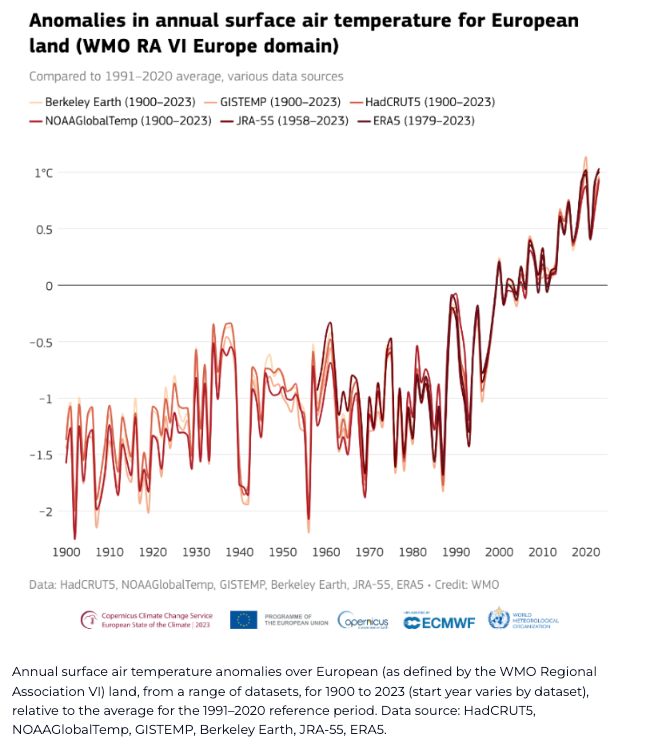
(Source: Copernicus)
The implications of a warming climate can be difficult to fully comprehend. How can an apparently tiny change in the annual average global temperature be so determining? When that change is averaged across the entire globe and across an entire year, it’s more like a change in the human core body temperature: fractions of a degree can be catastrophic. Infrastructure functions up to a point, but there are thresholds beyond which train lines buckle and roads melt.
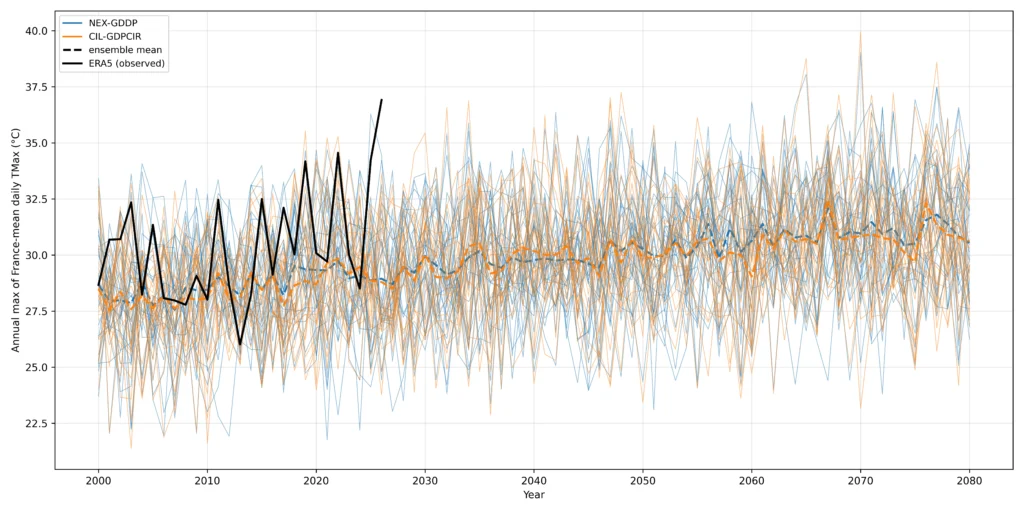
(Source: Carbon Brief)
Heat can kill through subtle means, such as higher nighttime minimum temperatures. If temperatures don’t drop enough at night, the inability to cool down after a hot day can become fatal. Infants and older people are most vulnerable. Heat’s effects on health can be cumulative, so a heatwave’s duration matters. Scientists at Kings College London estimated that 2 degrees centigrade of warming would make one-third of the earth’s landmass effectively uninhabitable for people over sixty. A recent ILO report estimated that extreme heat causes over 20 million injuries each year.
Heat waves are, of course, not the only climate disasters threatening the globe. Floods in West African countries like Cote d’Ivoire, Togo, Benin, Ghana, and Nigeria have caused dozens of deaths in the last month. A weak, late monsoon season in India caused planting delays and water shortages. The weather effects of human-induced climate change will be compounded by a “super El Niño” pattern that is forecast to develop over the coming months. El Niño exacerbates not just heat, but also flood and drought. The previous super El Niño, which occurred just over a decade ago, drove tens of millions of people in Eastern and Southern Africa into food insecurity. The threat of its return this year has led the Food and Agricultural Organization and the World Food Programme to create their first joint anticipatory program to provide resilient crops and irrigation.
Mitigation and adaptation
How is the world responding to these emergencies as the effects of climate change intensify—in many cases, more quickly than scientific models had foreseen? Emissions reduction—ceasing the burning of fossil fuels and halting the clearing of land—is the cornerstone of mitigation.
There has been some progress in this respect, as the old approach of pricing carbon has been replaced, or at least supplemented, by more comprehensive measures like green industrial policy, as well as improved and cheaper access to clean energy and storage, in large part thanks to Chinese green manufacturing. The latest UN emissions gap report estimated that we might now be on a path toward 2.3 to 2.5 degrees of warming, compared to last year’s estimate of 2.6 to 2.8 degrees—an improvement, though one that hardly meets the challenge.
Separately, adaptation seeks to build resilience to the earth’s changing climate and weather patterns. After the devastating heatwaves of 2003 that killed more than 70,000 people, France introduced a slew of adaptive measures, including early warning systems and welfare checks, which helped to radically reduce fatalities. There are estimates that mortality would have been 80 percent higher without such policies during that scorching summer.
Elsewhere, the small island of Dominica, which is hyper-exposed to temperature changes, has set out to be a leader in resilience to both hurricanes and earthquakes, improving its meteorological monitoring, water infrastructure, and forest conservation. Following the catastrophic Bhola cyclone of 1970 in which 300,000 people died, Bangladesh built cyclone shelters, which radically reduced the death toll in subsequent storms.
These basic adaptive measures are obviously essential, but since the early days of international climate negotiations, there have been fears that an emphasis on adaptation would draw attention and energy away from the urgent work of reducing emissions. Scientists are at pains to point out that adaptation can’t take precedence over mitigation, otherwise there will be no point of stabilization around which we can adapt.
The fears of instrumentalizing adaptation are not unfounded. Germany’s far-right AfD party has opposed renewable energy for years but has recently made air conditioning a key focus of its campaign, with a spokesman declaring that his party wanted to stop people “being sacrificed on the altar” of energy ratings. Similarly, Marine Le Pen’s National Rally, which has sought to block wind turbines and solar panels, has become an avid proponent for air conditioning.
Adaptive measures are urgent but they can be difficult to roll out at scale. There are not just rising temperatures to deal with, but also floods, wildfires, rising sea levels, drought, and so on. Preparedness for one or some of these hazards doesn’t prepare one for others; in fact, it can increase vulnerability. Well-insulated homes can be good on energy efficiency, potentially good for bushfire smoke—but deadly in a heatwave.
The privilege of protection
Mitigation tends to be debated and implemented at the national or international level. Adaptation, by contrast, is distributed and diffuse. That’s in part because the effects of climate change are often intensely local. Take, for example, the politics of shade: leafier neighborhoods are often cooler than asphalted poorer neighborhoods. Adjacent suburbs and even buildings can be more or less susceptible to flooding than their neighbors; variations in topography can make certain areas more or less conducive to trapping heat or allowing breezes. There is the question of which schools get air conditioning, of which towns get support to build flood management or over-batten roofs against cyclones, or whose roads get prioritized for repairs. In vulnerable areas, who will have access to home insurance, and who will be left to fend for themselves?
Adaptation, to the extent that it’s formally defined, tends to be the preserve of municipal governments, planners and civil engineers. In a 110-page report, the European Union recently estimated its adaptation investment needs at €70 billion per year, mostly for infrastructure such as transport and water (€30 billion), managing coastal erosion and wildfires (€21 billion), and improving food security (€12 billion).
Identifying how much is currently being invested in dealing with the effects of climate change was, the report said, almost impossible: public investment is either embedded in other projects such as infrastructure improvements, or not categorized in a consistent way. Other measures are even harder to track. A seawall is the classic piece of adaptive infrastructure, but what about improving insulation in schools, or supporting volunteer firefighters?
Adaptation is largely a public good. Unlike electricity generation or selling EVs, it doesn’t align with the goals of private finance, and so it is entirely beholden to fiscal constraints, especially those of the international financial system. Getting access to funds to help deal with the consequences of climate change will continue to be shot through with the inequalities of the global system.
This means that many of the most vulnerable people in the world will continue to be the most exposed to the effects of climate change. At the global level, the correlation between financial subordination and susceptibility to climate change impacts is well-documented, and international financial support for adaptation is one of the most contentious issues in global climate negotiations. Within countries, too, there are already marked discrepancies between those who can afford to shield themselves from heat, floods, and cyclones, at least to some degree, and those who cannot. Going forward, we can expect that decisions about who and what to protect will strain governance structures and challenge democratic decision-making, in large part because it will be hard to predict precisely what’s required. As the urgent work of decarbonization continues, maximizing the capacity to adapt to this global boiling—and not just for those in the North Atlantic—will be a site of urgent struggle.
Further Reading
Global Boiling
Stocks and flows, action and inaction in the planetary impasse
COP30 Without the USA
Climate cooperation, forest funds, and the tentative move toward green industrialization
Plastic Planet
Stalled negotiations and accelerating accumulation in the global petrochemicals industry
Further Reading

Global Boiling
Stocks and flows, action and inaction in the planetary impasse
This July has been the hottest in our recorded history and, most likely, over the last 120,000 years. Four “Heat Domes” across the northern hemisphere—over...
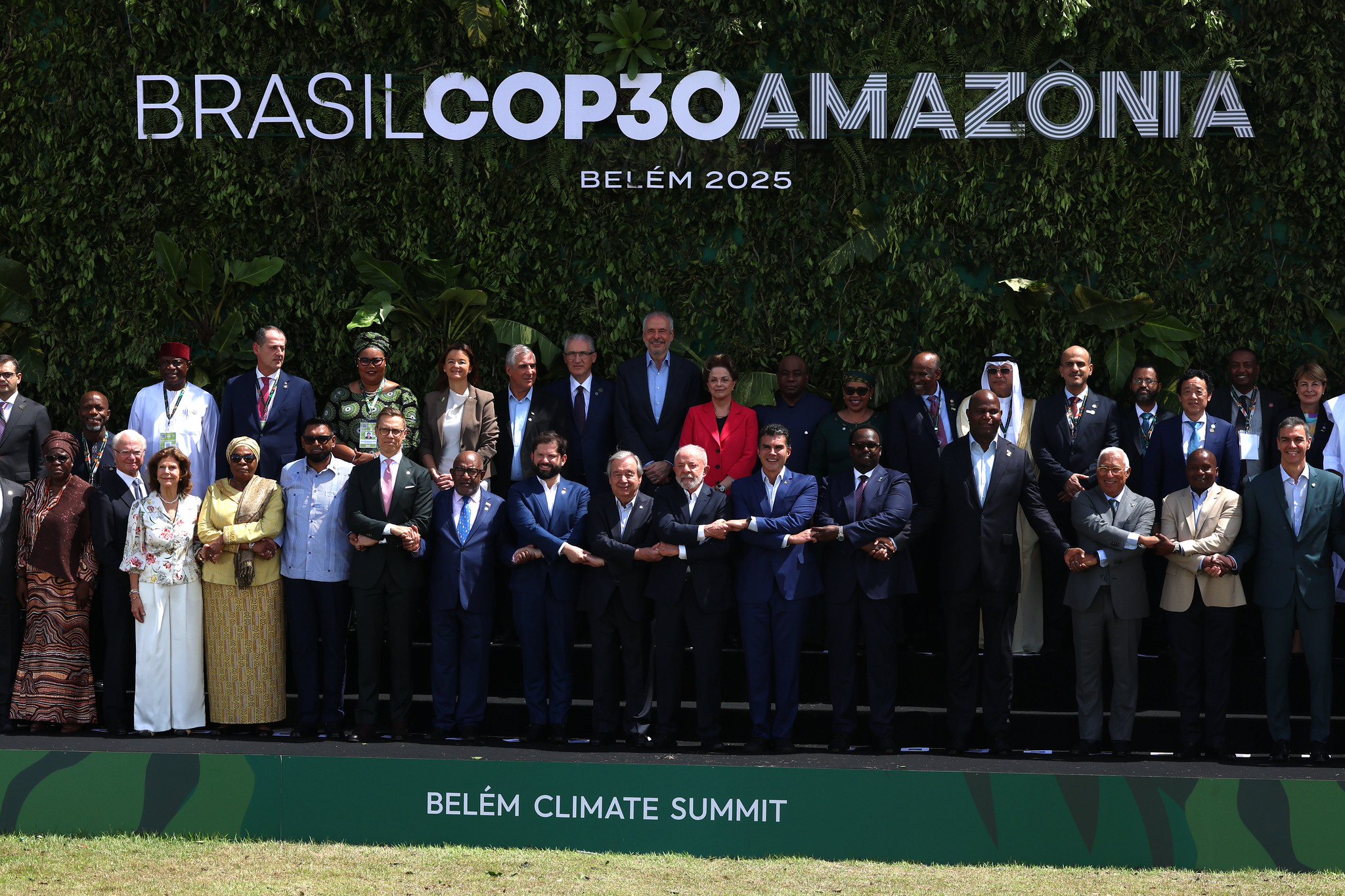
COP30 Without the USA
Climate cooperation, forest funds, and the tentative move toward green industrialization
Climate cooperation, forest funds, and the tentative move toward green industries
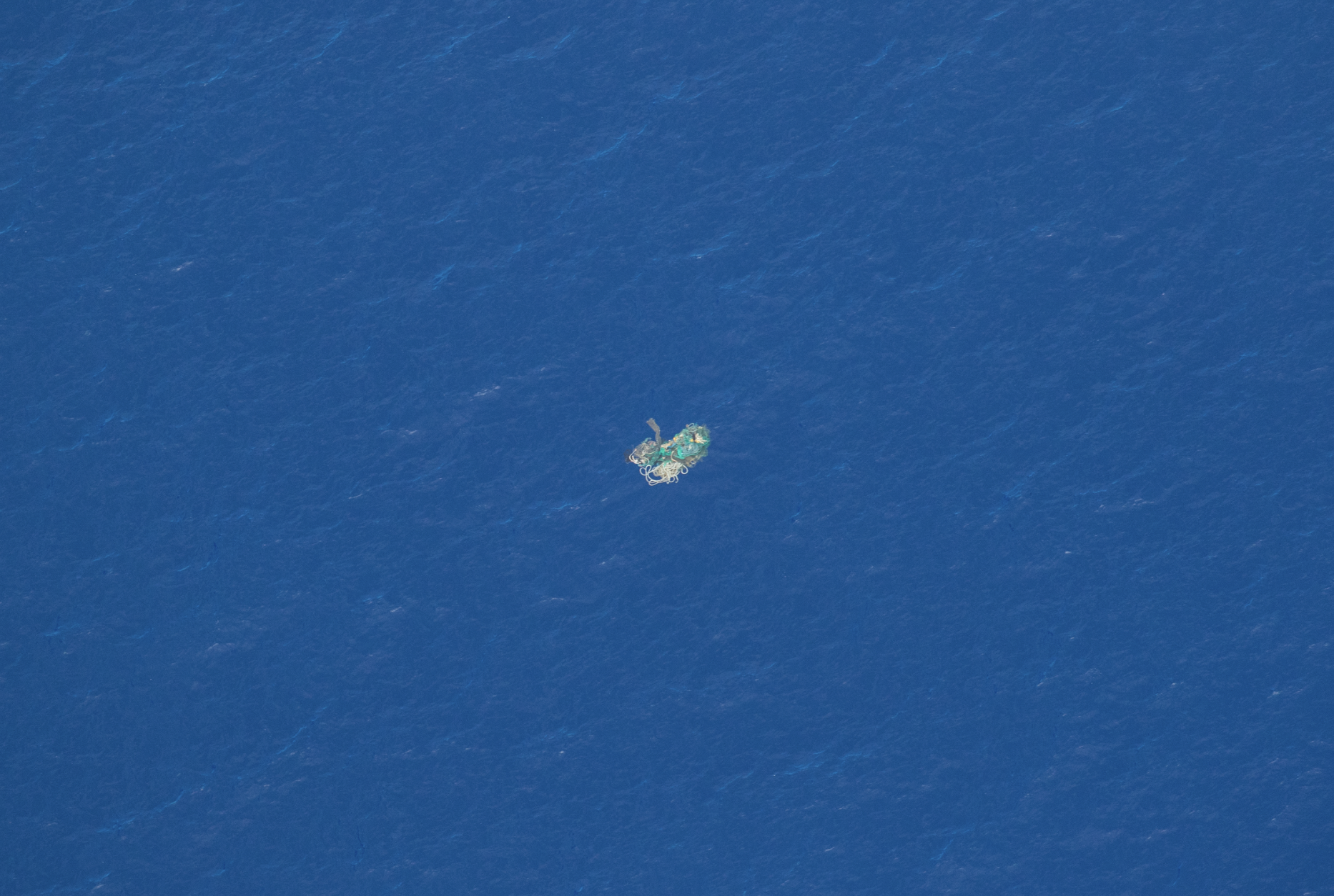
Plastic Planet
Stalled negotiations and accelerating accumulation in the global petrochemicals industry
The Polycrisis has always taken an interest in fossil fuels. We have written about how the industry has shaped international climate diplomacy and liberal politics. We’ve looked at the dynamics of...