September 17, 2026
Analysis
Control Board Colonialism
Ten years of PROMESA in Puerto Rico
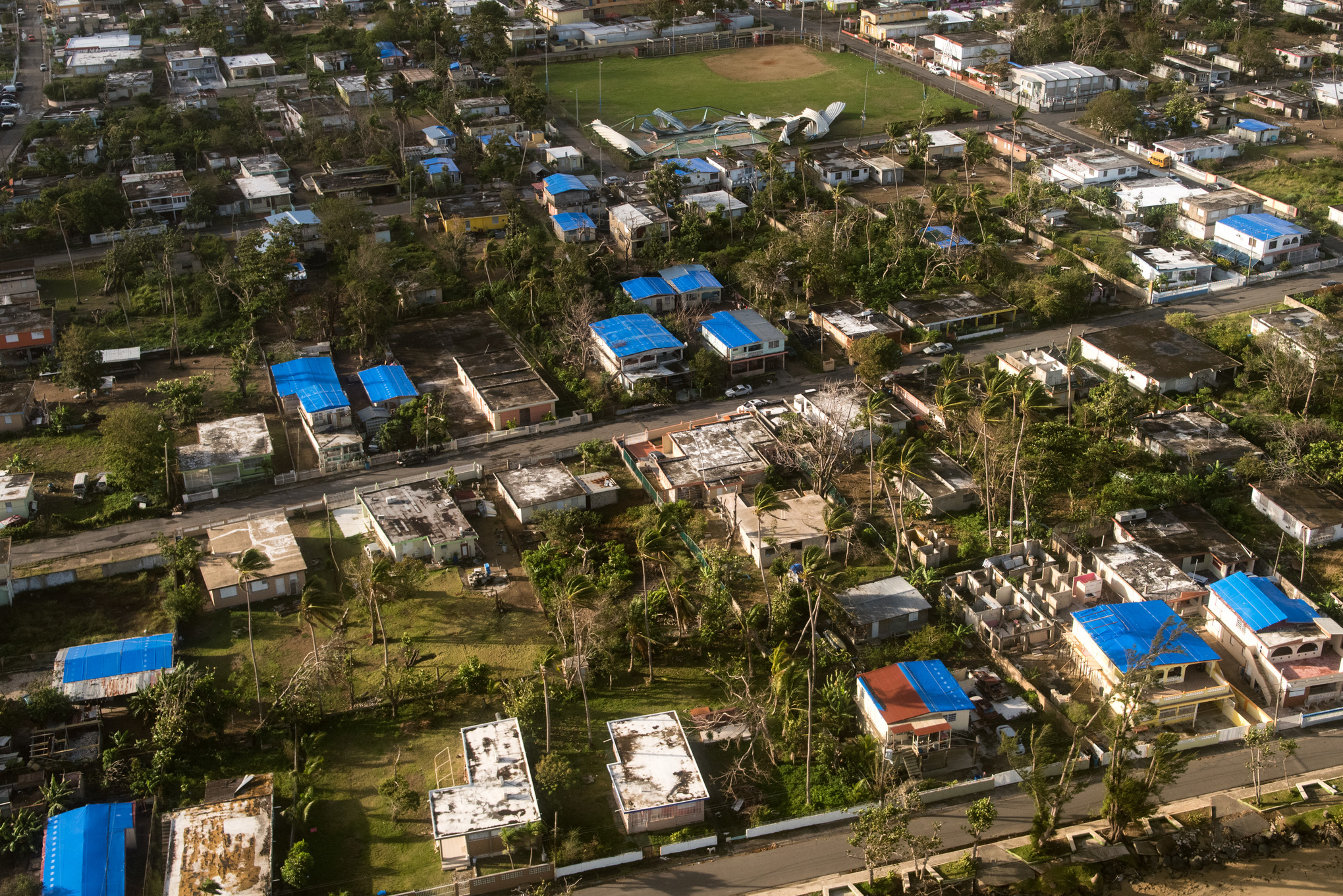
When Hurricane María made landfall in Puerto Rico in September 2017, its thrashing winds knocked out the territory’s electric power grid, wiped out 80 percent of its agricultural crops, and wrecked 95 percent of its cell networks, along with 85 percent of its aboveground telephone and internet cables. Roads, bridges, and a major dam were severely damaged, and thousands of people were made homeless. The economic damage was colossal, estimated to be in the range of a hundred billion dollars. Rebuilding and repair in the aftermath of the storm was beset by obstacles and is still ongoing. The hurricane triggered the longest blackout in US history—lasting almost a year in some areas—and Puerto Rico’s power grid remains in a state of disrepair, prone to regular outages across cities and towns. Of the billions of dollars in funds allocated by Washington for reconstruction, including $20 billion for the energy grid, very little arrived to Puerto Rico—the result, in large part, of the botched federal response under the first Trump administration.
The spectacular catastrophe of Hurricane María drew media attention, but Puerto Rico was already in the midst of a profound crisis, which was only compounded by the storm’s effects; blackouts, uneven access to potable water, soaring unemployment, and stagnation had long been features of life for its 3.2 million residents. Having endured a deep recession for ten years, Puerto Rico finally announced that it would be unable to repay close to $72 billion of debt in 2015, while owing a further $50 billion in unfunded pension obligations. In June of the following year, the US Congress passed, and President Obama signed into law, the Puerto Rico Oversight, Management, and Economic Stability Act, known by its optimistic acronym PROMESA.
The Act led to one of the largest bankruptcy-like restructurings in US history, overseen by an unelected control board—known locally as la junta—which concentrated economic authority in its own hands. This board, to which President Barack Obama appointed seven members, took complete control of Puerto Rico’s finances, working to preserve bondholders’ assets while instructing the local government in San Juan to make sweeping cuts, gutting many social programs while abandoning major infrastructure projects. The results have been transformative: a success in the terms set out by the board insofar as the debt has been reduced by almost half; a calamity from the perspective of most inside Puerto Rico, where social spending has been gutted and economic decision-making has been completely subordinated to an unelected coterie in Washington.
Ten years after the enactment of PROMESA, the control board remains in place. According to the legislation, the condition for the board’s departure is Puerto Rico’s fiscal and economic recovery. How to determine when that has been achieved remains an open question, but it is clear that neither the residents nor the elected representatives of Puerto Rico will be consulted on the matter. Unless the structural conditions that led to PROMESA’s enactment—a colonial financial architecture that encourages predatory behavior and a constitution that radically limits the archipelago’s sovereign powers—are addressed, conditions in Puerto Rico will continue to deteriorate.
The making of a fiscal emergency
Puerto Rico’s contemporary political economy has its roots in the territory’s colonial history, which began with the arrival of the Spanish in the late fifteenth century. The archipelago—Puerto Rico is not just an island, but is composed of Vieques, Culebra and another 140 small islands, islets, and cays—was incorporated into an imperial economy, which was based first on mining and subsequently on plantation agriculture, foremost the cultivation of sugar and coffee, worked by enslaved Africans. Following the Spanish–American War, Spain ceded Puerto Rico to the US under the 1898 Treaty of Paris. This entailed a reorganization of the archipelago’s political institutions, landholding, trade relations, and economy, increasingly integrating Puerto Rico into US markets. It was in this context that the US Congress enacted the Foraker Act of 1900, establishing the archipelago’s civil government and economic institutions while exempting the territory from federal income tax (establishing federal income tax would have meant recognizing Puerto Rico as part of the Union) and other financial regulations. Beginning in 1901, the US Supreme Court’s Insular Cases established Puerto Rico as an “unincorporated territory”—meaning a jurisdiction belonging to, but not fully part of the US and therefore subject to Congress’s extensive authority under the Territorial Clause. US monetary policies devalued local currency and real estate, accelerating land dispossession and facilitating large-scale land acquisitions by US sugar corporations.
In 1917, Congress enacted the Jones-Shafroth Act, which imposed US citizenship on Puerto Ricans while further strengthening congressional authority over the archipelago’s political and economic affairs. Another important effect of the Jones Act was the “triple tax exemption,” which exempted Puerto Rican government bonds from taxation at the municipal, state, and federal levels, making them particularly appealing to US investors. Several years later, the Merchant Marine Act of 1920 further limited Puerto Rican autonomy by requiring all maritime commerce between the archipelago and the US to be conducted on qualifying US vessels, greatly increasing the cost of living on the archipelago. In the years following World War II, the federal government sought to transform Puerto Rico into an export-oriented manufacturing hub. The aptly named Operation Bootstrap combined cheap labor, local tax exemptions, federal incentives, and unrestricted access to US markets for the benefit of US corporations.
In 1952, Congress approved the Puerto Rican constitution, which established the Commonwealth of Puerto Rico (a liberal translation of Estado Libre Asociado). The product of bitter conflict amid Puerto Ricans, many of whom preferred either independence or outright statehood, the constitution allowed them to elect their own local government while remaining subordinate to the United States. It also prioritized debt repayment over any other spending. Rapid industrialization brought economic growth during the 1950s and 60s, but by the 1970s it was showing signs of exhaustion. Rising labor costs, increased international competition, and the global oil crisis hit an economy highly dependent on imported petroleum, while unemployment remained persistently high. As growth slowed, the government began to rely on federal transfers and public borrowing to sustain infrastructure, employment, and public expenditures.
Section 936 of the US Internal Revenue Code, introduced in 1976, sought to revitalize development by encouraging US corporations to establish themselves in Puerto Rico. To do this, it allowed qualifying firms to repatriate profits generated in Puerto Rico without paying federal corporate income taxes, making the archipelago all the more attractive to US capital—particularly knowledge-intensive industries such as pharmaceuticals, medical-device manufacturing, electronics, and financial services. To some extent, the tax exemption worked, and by 1995, manufacturing accounted for approximately 42 percent of GDP. This generated more than 30 percent of deposits in Puerto Rico’s banking system and accounted for approximately 17 percent of total employment. The gains were, however, limited. Profits generated by Section 936 corporations were largely controlled by US firms and, most significantly, Puerto Rico’s economy had become increasingly dependent on a federal tax provision over which the Puerto Rican government exercised no control.
Puerto Rican governments had used borrowing since at least the mid-twentieth century to finance infrastructure and public corporations, but from the 1980s, a growing public debt had come to bear the burden of compensating for declining fiscal capacity and persistent budgetary deficits. In the 1990s, Pedro Rosselló’s New Progressive Party government attempted to stimulate the economy and finance public projects by borrowing large sums—approximately $10.5 billion during Rosselló’s first term and another $13.7 billion during his second—but public indebtedness grew faster than the economy.
By the millennium, Puerto Rico’s developmental model was becoming untenable. Trade liberalization—including free-trade agreements like NAFTA—and increased international competition weakened some of the advantages on which Puerto Rico’s industrialization strategy had depended. In 1996 Congress had initiated a ten-year phaseout of Section 936, which American critics had long argued facilitating excessive erosion of the federal tax base, and while the final end to the provision in 2006 did not by itself cause Puerto Rico’s economic crisis, it removed one of the central pillars around which the economy had been organized, at a time when domestic industry was already under mounting pressure from globalization. That year, Puerto Rico entered a recession.
Rather than developing a tax system capable of generating sufficient revenues to replace the declining benefits associated with the existing development model, access to financial markets increasingly substituted for fiscal capacity and economic development, and bonds were issued more and more often to cover operating deficits, refinance existing obligations, and service previous debts. The Puerto Rican Sales Tax Financing Corporation, COFINA, which was developed in the wake of the recession to issue “extraconstitutional” bonds, epitomized this transformation by securitizing future sales-tax revenues, effectively converting future streams of public revenue into financial assets that could be sold to investors in exchange for immediate financing. Puerto Rico’s triple-tax-exempt status further facilitated this process by sustaining strong demand for its bonds among US investors. Financial institutions, bond underwriters, credit-rating agencies, insurers, and eventually hedge funds consequently assumed an increasingly important role in Puerto Rico’s fiscal governance. As Puerto Rico’s creditworthiness deteriorated, borrowing became increasingly expensive and a growing share of public resources was devoted to servicing existing obligations.
Because Puerto Ricans are US citizens and can move freely between the archipelago and the states, migration quickly presented itself as a response to rising unemployment and austerity. The resulting population decline was both a consequence of the crisis and exacerbated it. The departure of working-age residents and professionals reduced the tax base, weakened domestic consumption, and put additional pressure on public finances, generating a feedback loop between economic contraction, migration, declining revenues, and indebtedness.
By the time Alejandro García Padilla took office in 2013, Puerto Rico’s debt stood at about $67 billion. As conventional municipal investors became increasingly unwilling to lend to the government, Puerto Rico came to rely more on high-risk investors like hedge funds. As the crisis deepened, revenues continued to decline and the government increasingly struggled to meet its basic obligations. The response of credit-rating agencies was to downgrade Puerto Rico’s debt, with Moody’s, Fitch Ratings, and Standard & Poor’s eventually pushing its bonds deep into speculative, or “junk,” territory. These downgrades further constrained Puerto Rico’s access to credit, increasing its financing costs and intensifying fiscal pressures. As investments slowed to a halt, corporate tax incentives and exemptions increased in an attempt to stop the bleeding: in 2004, there were approximately forty tax exemption laws for the private sector; by 2020, more than a decade into the crisis, there were more than ninety tax exemption laws, limiting a substantial flow of income to the government.
The scale of the crisis was finally made public when, on June 29, 2015, Governor García Padilla declared that the archipelago’s debt was “not payable.” The debt, roughly $72 billion at the time, was distributed across four categories: general obligation bonds backed by the Commonwealth of Puerto Rico; sales-tax-backed bonds issued by the COFINA; obligations of public corporations, such as the Puerto Rico Electric Power Authority (PREPA); and debts associated with municipalities and other entities. It would still take some months before the defaults began. On May 1, Puerto Rico defaulted on a $442 million bond payment. A second major default followed on June 1, when the government was unable to repay a $2 billion loan.
The structure of the public debt
Puerto Rico’s debt had, from the beginning, been structured in such a way as to make the odds of repayment slim: much of it was generated by complex, often predatory financial instruments. As the Action Center on Race and the Economy has shown, approximately $36 billion of the more than $70 billion in debt did not correspond to original borrowing, but to accumulated interest on just $4.3 billion in capital appreciation bonds underwritten by Wall Street banks. Capital appreciation bonds, much like payday loans, defer paying any interest—at rates exceeding 700 percent in the Puerto Rican case—until reaching final maturity. Other predatory financial practices included scoop-and-toss refinancing schemes, variable-rate debt or adjustable-rate mortgages, interest rate swaps, and auction-rate securities, all of which allowed interest obligations to be rolled into new principal over time. These mechanisms extended repayment horizons beyond what the Puerto Rican constitution allowed, while significantly increasing total liabilities, embedding long-term fiscal instability into the structure of the debt.
Wall Street banks, financial entities, hedge funds, and law firms all played a decisive role in shaping the scale and structure of Puerto Rico’s indebtedness, and profited from its expansion. Banks charged substantial fees and repeatedly refinanced obligations in ways that generated immediate gains for financial firms while deepening Puerto Rico’s long-term exposure. ReFund America estimates that UBS, Citigroup, Goldman Sachs, and Barclays have made $1.6 billion in fees on Puerto Rico’s scoop-and-toss deals since 2000. Hedge funds later acquired distressed bonds at substantial discounts and positioned themselves to extract favorable settlements through litigation. As the research and campaigning organization Hedge Clippers has documented, even after the devastation caused by Hurricane María, hedge funds pressured the Puerto Rican government to prioritize debt repayment, arguing that federal disaster relief funds could be used for that purpose. Public debt became a mechanism of extraction, transferring wealth outward while leaving the archipelago to absorb the social and economic consequences of the structural adjustments imposed to repay it.
Puerto Rico lacked many of the political and legal powers available to sovereign states in attempting to respond to economic crises. In 1984, Congress had amended the Bankruptcy Code to explicitly exclude Puerto Rico and its public corporations from Chapter 9 municipal bankruptcy protections. Without access to Chapter 9, Puerto Rico’s heavily indebted public corporations could not seek a court-supervised restructuring of their obligations or obtain the protections from creditor enforcement available through municipal bankruptcy. This exclusion became increasingly consequential as the fiscal crisis deepened after 2006. The government in San Juan enacted its own restructuring law in 2014, but it was quickly struck down by the US Supreme Court in 2016, holding that the Federal Bankruptcy Code preempted local legislation. The Court reasoned that Puerto Rico could not legislate in an area reserved to Congress, even though it was excluded from the protections of that same federal framework.
This decision exposed a central contradiction in Puerto Rico’s legal status. The territory is not a state and therefore lacks sovereign authority and key protections, yet it is treated as a state for certain federal purposes. The contrast with Detroit illustrates the practical consequences of this colonial relation. Facing approximately $18 billion in liabilities, Detroit was authorized by the state of Michigan to file for municipal bankruptcy under Chapter 9 in 2013, allowing it to restructure its obligations through an established federal judicial process. Puerto Rico and its public corporations, by contrast, had been expressly excluded from that same mechanism and, as the Supreme Court case established, could not create an alternative restructuring process of their own. Only Congress could resolve this impasse, either by extending existing bankruptcy protections or by creating a new legal framework. With the creation of PROMESA, it chose the latter.
La Junta begins
PROMESA did more than create a mechanism for restructuring Puerto Rico’s debt—it installed a new center of political authority that sat above the institutions of Puerto Rico’s own elected government. The seven-member board was given broad powers to certify fiscal plans and budgets, review legislation and government contracts, demand information from public agencies, and, crucially, to compel the Puerto Rican government to comply with PROMESA’s requirements. Section 108 of PROMESA explicitly prohibits Puerto Rico’s governor and legislature from exercising “control, supervision, oversight, or review” over the board. Carefully insulated from the ordinary mechanisms of democratic accountability and local supervision, PROMESA thus established the institutional foundations of a parallel, federally authorized government capable of overriding key fiscal and budgetary decisions made by Puerto Rico’s elected institutions.
The geography of the board’s emergence captured something of this relationship. The board did not begin its work in San Juan. On September 30, 2016, its seven members assembled for their first public meeting in New York City, more than a thousand miles from the territory they had been empowered to oversee. During the meeting, which was interrupted by protesters, the board instructed Governor García Padilla to submit a new fiscal plan—within weeks—that would comply with the board’s directives. The colonial resonances were difficult to miss: an unelected body created by Congress, meeting in Manhattan, was determining the fiscal parameters within which Puerto Rico’s elected government would have to operate. The board would eventually establish a physical presence in Puerto Rico, but its authority derived from Washington D.C. rather than from Puerto Rican law, Puerto Rican voters, or the consent of Puerto Rico’s legislature.
Title III of PROMESA provided the other major pillar of this new governing architecture by establishing the legal mechanism for restructuring Puerto Rico’s debt within the US federal court system. Drawing on elements of Chapters 9 and 11 of the US Bankruptcy Code, it created a distinct territorial bankruptcy regime in which only the oversight board has the authority to initiate proceedings and approve restructuring terms. In May 2017, Chief Justice John Roberts appointed Judge Laura Taylor Swain to oversee the Title III proceedings, which the board initiated later that month, acting on behalf of Puerto Rico and several of its instrumentalities. It swiftly became the largest and most expensive public sector restructuring in US history.
On February 4, 2019, Judge Taylor Swain approved the COFINA settlement and confirmed its restructuring plan, making it one of the largest municipal bond restructurings in US history. Several days later, old COFINA debt with a value of $17.6 billion was exchanged for $12.02 billion in new COFINA bonds, which were divided into several current-interest-bearing bonds and capital appreciation bonds, for which balloon payments would be due in future decades, the last ones ending in 2058. The COFINA plan of adjustment will result in payments of $32.3 billion in forty years, and will require the extension of Puerto Rico’s elevated sales and use tax—higher than in any US state—until then.
Nearly five years later, in January 2022, Judge Taylor Swain confirmed the Plan of Adjustment for the Commonwealth of Puerto Rico to restructure $33 billion of liabilities against itself, the Public Buildings Authority, and the Employee Retirement System; and reduced more than $55 billion in pension liabilities to $7 billion. The Public Accountability Initiative estimated that, in the restructuring, hedge funds made $1.1 billion in profit. The plan of adjustment includes cash payments of $7 billion for hedge funds, which came from the savings generated by the austerity measures imposed by the board in the previous years. These austerity measures include pension cuts of 8.5 percent to all retirees whose monthly pension exceeds $1,500. Combined with cuts to benefits for current employees, the adjustment plan amounts to a total reduction in pension spending of 19.3 percent.
Hundreds of lawyers, consultants, advisors, and financial analysts from more than thirty firms participated in the proceedings, with their fees paid by Puerto Rican taxpayers. Each party involved retained its own teams of legal and financial experts. Advising firms such as McKinsey played a central role in analyzing budgets, producing fiscal plans, negotiating with creditors, coordinating proceedings, shaping legislation, and designing policy interventions that extended far beyond debt restructuring. Since 2017, well over $1.5 billion has been spent on these professionals (estimates by Espacios Abiertos place the total above $2 billion). The overwhelming share of these funds has flowed to US-based firms.
It’s important to emphasize that all of this occurred against the express wishes of local politicians, government actors, and civil society organizations, who repeatedly challenged the board’s authority in court—to no avail. Indeed, each court case, whether brought in US District courts or the Supreme Court, only worked to further expand the board’s power, allowing it to consolidate its control over fiscal policy while further insulating it from demands from civil society and government. Taken together, these decisions did more than resolve discrete legal disputes; they entrenched a new distribution of power.
Austerity’s social costs
Mainstream accounts of PROMESA, including those of the former board members, present the federal intervention as a difficult but necessary belt tightening in the service of restoring growth after decades of stagnation and fiscal mismanagement. The good work of the control board, the story goes, has meant that pensions have been protected, fiscal discipline has been restored, and Puerto Rico’s economy is close to stable once more. What these sanguine narratives tend to omit, however, is any recognition of the social costs inflicted by the ongoing process of PROMESA. Between 2019 and 2023, the board vetoed or sought to annul thirteen laws enacted by the Puerto Rican government that it deems contrary to its fiscal goals, including measures related to health insurance, public sector wages and benefits, pandemic relief for healthcare workers, pensions, and labor reform. The consequences have been far-reaching. Since 2006, 673 public schools have closed and the University of Puerto Rico has suffered deep cuts; by 2022, the university’s budget had been slashed by 56 percent of its pre-PROMESA figure. Tuition rates have nearly tripled.
In 2019, the board called for healthcare reforms that would reduce projected spending by $638 million annually by fiscal year 2024. These targets implied approximately $1.8 billion in cumulative savings between fiscal years 2020 and 2024. The cuts were never implemented at that scale, and with the COVID-19 pandemic and an influx of federal Medicaid funding, the board substantially scaled back its austerity targets. Yet Puerto Rico’s healthcare system continues to face considerable fiscal uncertainty. The enhanced federal Medicaid funding that has sustained the system in recent years is scheduled to expire in September 2027, potentially producing a multibillion-dollar funding shortfall and renewed pressure for reductions in benefits, eligibility, and other public expenditures. Municipal governments, too, faced $900 million in cuts between 2016 and 2026, which have pushed forty-three of them into bankruptcy. Some local governments have lost up to 60 percent of their budgets, all while leading disaster responses to ongoing storms, hurricanes, and earthquakes, as well as the Covid-19 pandemic.
Puerto Rico’s Electric Power Authority (PREPA), the now notorious source of blackouts across the archipelago, has been a major target of la junta. The control board had, from its inception, made clear its intention to privatize the public utility. “Only privatization will enable PREPA to attract the investments it needs to lower costs and provide more reliable power,” wrote four board members in an editorial for the Wall Street Journal in June 2017. The control board hired McKinsey to prepare detailed plans for privatization “supported by financial models and market engagement.” Since privatization began in 2021, electricity bills have increased by 40 percent while water rates have risen by 30 percent. At the same time, $1.5 billion has been allocated to payments to PREPA bondholders. The transformation of the public utility has been marked by controversy, conflicts of interest, persistent service failures, and rolling blackouts and water shortages, leaving Puerto Ricans to pay more for increasingly unreliable electrical and water systems.
As public services have been reduced, Puerto Rico has been promoted as an offshore financial center. Under Act 60 of 2019, the local government has offered extraordinary tax advantages to individuals and firms willing to relocate to or structure business activities through the archipelago. International banks, private equity firms, wealth managers, alternative investment funds, international captive insurance, crypto-investors, and more than five thousand wealthy individuals have taken advantage of these incentives. The financial services sector has celebrated this shift as evidence that Puerto Rico is “open for business.”
After PROMESA?
PROMESA provides no fixed date for the control board’s departure, but Section 209 of the Act stipulates that the board will terminate once Puerto Rico demonstrates adequate access to short- and long-term credit markets at reasonable rates. The government is also required to complete at least four consecutive fiscal years with balanced budgets. In the meantime, ten years after its arrival to San Juan, the board continues to certify budgets, oversee fiscal plans, review legislation, and authorize the privatization of public utilities.
When it does eventually depart, as it one day must, to what extent will Puerto Ricans regain control of their own economy, and their own political and juridical processes? Some areas of fiscal decision-making will inevitably be returned to the Puerto Rican government, but will this amount to the restoration of political and economic sovereignty? In the absence of structural change, Puerto Rico would remain, as it has long been, subject to Congress’s plenary powers and without sovereign control over many of the legal and economic arrangements that helped produce the economic crisis in the first place. Many of the effects of PROMESA—school closures, tuition rises, deteriorating public services, persistent blackouts, municipal disinvestment, and the redirection of public resources toward consultants and creditors—are likely to outlive the control board itself. This is in part due to the fact that debt-service obligations will continue for decades as the government continues to relinquish substantial revenues through the tax incentives and exemptions that have always been central to its economic development strategy, but with a new emphasis on financial services and the relocation of wealthy investors to the archipelago. The extraordinary out-migration to the US since 2006 poses a further challenge. While the intensity of the out-migration has slowed down, the population continues to decline, sparking new problems for growth.
The question of Puerto Rico’s future socioeconomic health is not just a question of whether or not it will be able to increase its public spending after the control board departs, but whether it will be able to construct a fiscal and developmental model capable of generating funding that can be directed toward public need, rather than continuing a combination of fiscal austerity for residents and incentives for mobile capital. PROMESA laid bare the contemporary forms of US colonial governance, but also generated a decade of resistance from Puerto Ricans who have refused to accept that this arrangement is normal, necessary, or just. Whether they can regain the capacity to decide collectively how public resources are raised, distributed, and invested will determine what comes after la junta.
Further Reading
Brady’s Lessons
An ambitious debt-restructuring program helped nations recover from the Lost Decade—can it help again today?
Miami Syndrome
Competing factions debate Cuba's future amid unfolding catastrophe
Another Lost Decade?
The systemic character of the global periphery debt crisis.
Further Reading
Brady’s Lessons
An ambitious debt-restructuring program helped nations recover from the Lost Decade—can it help again today?
As ever, the 1970s loom large. The economic and political trauma of those years has cast a long shadow over economic policymakers and commentators, and...
Miami Syndrome
Competing factions debate Cuba's future amid unfolding catastrophe
Anticipation defines Miami. The city was developed in the early twentieth century on previously uninhabitable ground, built on islands dredged from the ocean and financed...

Another Lost Decade?
The systemic character of the global periphery debt crisis.
Contrary to common beliefs on fiscal fundamentals, the current debt crisis in the global periphery demonstrates that the solvency of sovereign states is determined by...