Analysis
Two Paths for Rideshare Organizing
Can rideshare drivers be successfully organized without being classified as employees?
One of the greatest impediments to unionization in the neoliberal period has been what economist David Weil calls “workplace fissuring”—a business model that, whether through subcontracting, franchising, or offshoring, is designed to distance labor from capital. Think of McDonald’s, which operates a system of over 13,700 restaurants in the US, run by over a million workers, but which admits employer responsibility for only 105,000 of them.
As part of an effort to organize this labor market, the Service Employees International Union (SEIU) and its allies launched a legislative campaign in 2021 to establish a framework in California for sectoral bargaining—i.e., bargaining on an industry or sector level, rather than the enterprise-level bargaining enshrined in American labor law—for fast food workers. Initially, SEIU’s legislation included the aim of holding “fast food franchisors jointly liable for labor violations at their franchisees’ establishments.” The industry fought hard to kill this language, understanding well that it was a key component of SEIU’s strategy. It was thus willing to concede on a number of fronts—the creation of a Fast Food Council to bring representatives of labor and management together, and even an increase in the industry’s minimum wage to $20 per hour—provided joint liability was taken off the table. What eventually became AB 1228, passed in late 2023, formally established the Fast Food Council as a vestige of the union’s sectoral bargaining goals for the industry. But without a chairperson—Governor Gavin Newsom has delayed appointing one—it has not met in over a year.
Though platform-networked gig work is often framed by platform owners as offering workers autonomy and an opportunity for self-management, it is best understood as a more recent instance of workplace fissuring, part of this broader restructuring of American labor markets towards wage competition and individual bargaining. Gig workers, like all independent contractors, do not share the wage-and-hour protections of the Fair Labor Standards Act (FLSA), the organizing protections of the National Labor Relations Act (NLRA), or the safety protections of the Occupational Safety and Health Act (OSHA), and are kept at a distance, both personally and legally, from their de facto employers. While SEIU’s attempt to push against employee misclassification in the fast food industry failed, gig worker advocates have made progress on this question elsewhere. British Columbia, for instance, changed its provincial law in 2023 to reclassify online platform workers as employees rather than independent contractors. This legislative change made possible the unionization of 1,000 Uber drivers in Victoria, BC. Just this April, these drivers won a contract, a first of its kind in North America.
For many gig worker advocates, this path—reclassify rideshare drivers as employees, and then unionize them—represents the best way forward for organizing. Others, however, have been pursuing a competing strategy in the United States for the past few years. In November 2024, Massachusetts voters passed Question 3, a ballot initiative that extended a unique kind of collective bargaining right to rideshare drivers without first granting them rights as employees. Similar laws have been recently passed, in California in October 2025 and Illinois in August of this year, and legislation has been introduced in Minnesota. In theory, these new laws offer the possibility of collective representation to enormous numbers of workers: the campaigns claim 70,000 rideshare drivers in Massachusetts, 800,000 in California, and 100,000 in Illinois.
Champions of sectoral bargaining see in these state-level experiments a promising new approach for unions in the twenty-first century. But without closing the hole in minimum wage coverage ripped open by rideshare companies’ exploitation of independent contracting, do these new frameworks in the US suggest organized labor is simply legitimizing the business models of Uber and Lyft?
The case for reclassifying
According to the Gig Economy Data Hub, between 25 and 43 percent of the American workforce participates in the gig economy, with 10 percent (roughly 17 million people) reliant upon gig work for their primary income. If you take the ratio of rideshare drivers in Illinois (100,000) to the state’s total population (12.7 million) to be roughly equivalent nationally, there are approximately 2.7 million rideshare drivers in the US. Other estimates find that there are roughly 2 million drivers working between Uber and Lyft (though Lyft claimed in 2019 to have 2 million drivers in North America, the vast majority of which are in the US). My educated guess is that there are about 2.5 million rideshare drivers in the US today, and extrapolating from one study of Uber drivers, roughly a fifth of them work more than 35 hours per week.
Take-home pay is the most pressing issue rideshare drivers face. Gridwise, a privately held “intelligence platform for gig workers” backed by Silicon Valley venture capital, claims that median gross pay for rideshare drivers is $21.92 per hour, and the top 10 percent of earners clear $29.28 per hour. This is gross pay per hour spent driving, however, and so does not include time spent waiting for fares or expenses like fuel, maintenance, and depreciation. Rideshare Drivers Union (RDU), a union of California drivers founded in Los Angeles in 2019 that claims over 20,000 members today, estimates that drivers take home about $6.20 per hour on average. RDU President Nicole Moore said that take-home pay is typically about a quarter of gross pay. Using Gridwise’s numbers, this would mean the median rideshare driver would be taking home roughly $5.48 per hour after accounting for hours on the clock and driver expenses. “I’ve seen so many drivers drive themselves into homelessness with a bad week,” Moore told me. “You have a transmission that goes out, and there’s no slack. You’re just barely paying the bills, with a kind of addiction to this app that is doing no good for your life.”
There is a good case to be made that these conditions follow from the basic misclassification of rideshare drivers as independent contractors rather than employees. Indeed, Uber seems to admit as much in their 10-K:
If, as a result of legislation or judicial decisions, we are required to classify Drivers as employees (or as workers or quasi-employees where those statuses exist), we would incur significant additional expenses for compensating Drivers, including expenses associated with the application of wage and hour laws (including minimum wage, overtime, and meal and rest period requirements), employee benefits, social security contributions, taxes (direct and indirect), and potential penalties.
In other words, legal reclassification would effectively translate to higher wages and benefits expenses for the company. “We want drivers to stand on a floor set by states and the federal government, and to be able to move up off that floor,” Moore told me. “Instead, we’re in the dungeon, and we’re hoping to get to the floor.”
In British Columbia, reclassification not only brought drivers up to the floor that the rest of the labor market stands on, but led United Food and Commercial Workers Local 1518 to organize the drivers. They recently won a contract with “signing and quarterly bonuses based on the number of rides completed, a five per cent yearly increase on some fees, $500 for health benefits and a formal dispute resolution process.” The International Brotherhood of Teamsters (IBT), too, believes that reclassification is a necessary prerequisite for organizing. When the idea of collective bargaining for independently contracted drivers appeared in Massachusetts, first in the legislature and then on the ballot, the IBT consistently opposed it. “Workers are either employed by a company or they aren’t,” IBT president Sean O’Brien declared. “There is no ‘third way.’ We should not be changing our laws in support of greedy corporations that want to deny full employment rights to workers.” O’Brien gets to the heart of the issue here: if workers are employed by the company, they should not only have the labor rights granted by the NLRA, FLSA, OSHA, and other worker protection laws, but their employers should also take responsibility for the direct employment relationship.
The simple fact that Uber and Lyft have either not opposed or in fact supported the new sectoral bargaining frameworks in California, Massachusetts, and Illinois could be seen as Evidence A that these changes will in fact preserve the status quo. In California, company support for AB 1340, the legislation passed last October, was traded for additional favors, such as the condition that their minimum insurance liability requirement would be lowered. These are not the typical signs of progressive labor legislation.
The case for moving beyond the classification fight
There are a few minor differences between the new state rideshare driver organizing frameworks, but there are also basic commonalities. First, a union may petition the state to be certified as a bargaining representative of all rideshare drivers by submitting signed cards indicating a desire for union representation from a certain percentage of workers (see table). Second, the rideshare companies that dominate market share (Uber and Lyft, primarily) must bargain with this representative, but they may choose either to negotiate individually or to form a bargaining association. And finally, the negotiated agreement between the two parties is submitted to the state for ratification, a legal procedure devised to circumvent possible antitrust suits.
| State | Enabling Legislation | Status | Support/Opposition | Description |
| MA | Question 3: Unionization for Transportation Network Drivers | Ballot initiative passed November 2024; App Drivers Union certified May 2026 | Supported by SEIU Local 32BJ/IAM, opposed by IBT; Uber/Lyft did not oppose | 5 percent for lists, 25 percent for certification;* potential 70,000 driver unit |
| CA | AB 1340: Transportation Network Company Drivers Labor Relations Act | AB1340 passed October 2025; California Gig Workers Union reached 10 percent threshold in June 2026 | Supported by SEIU, Uber, Lyft | 10 percent for lists, 30 percent for certification; potential 800,000 driver unit |
| IL | HB 5090: Transportation Network Driver Labor Relations Act | HB 5090 passed both houses June 2026, awaiting Governor Pritzker’s signature | Supported by Illinois Drivers Alliance (SEIU Local 1/IAM) and Uber, opposed by AFSCME Council 31 | 10 percent for list, 30 percent for certification; potential 100,000 driver unit; a 4-cent-per-ride implementation fee, which also supports the creation of a Rideshare Workers Support Fund |
*Unions seeking to be the sectoral bargaining representative for rideshare drivers receive full lists of drivers’ contact information, provided by the companies to the state, after they submit petitions from a certain percentage of workers who indicate they wish to be represented by that union; they are certified as a bargaining representative when they submit petitions from a higher percentage of workers.
All three efforts could be seen as having essentially ceded to the companies the issue of worker misclassification. The Illinois law, for example, notes that the drivers the legislation refers to “does not include any individual who [is] . . . determined by a final order of a court of competent jurisdiction to be an employee within the meaning of Section 2(3) of the National Labor Relations Act”—and the California and Massachusetts laws have similar language. But at the same time, none of the laws codify rideshare drivers’ status as independent contractors. In the case of California, the new statute only affirms Proposition 22, the Silicon Valley-backed initiative passed in 2020 that solidified rideshare drivers’ non-employee status. In 2023, the California Supreme Court decided that Prop 22 forbid collective bargaining for these workers, but AB 1340 simply reinstated their collective bargaining rights rather than trading anything away in exchange. Nonetheless, rideshare drivers remain non-employees, without rights to minimum wage or other employee protections.
“I totally agree these workers are employees legally by most legal definitions,” said David Madland, senior fellow at the Center for American Progress and prominent advocate for sectoral bargaining. But “the political power that these companies have” means that “even though most people agree with that, they are still independent contractors under basically every law.” Silicon Valley companies, Madland continues, have
changed the law in most states. You’re dealing with a really tough opponent. You can still fight them [at the federal level], which would require the Trump administration to totally change course and say these are employees . . . which seems to me an almost impossible course of events. . . . So then you’re left with the question, “What do you do with these drivers now? What can improve their conditions now?
Ronnie Gonzalez, Special Representative of the International Association of Machinists and Aerospace Workers (IAM) and a member of the leadership team of the Illinois Drivers Alliance, agreed with Madland: “There’s already been millions of dollars spent on the independent contractor question. We believe it’s answered. We’ve been down that road, and we’ve lost that fight.”
Gonzalez also opposes employee status on grounds beyond feasibility. Many drivers, he argues, do not wish to be reclassified as W2 employees. “In our years of representing drivers, we understand that they enjoy the independent contractor status because it provides the freedom and flexibility that is the attractive part of the job in the first place. Taking that away from them wouldn’t be properly representing the desires of the drivers we’re looking to represent.” Opinions on this question are, of course, mixed. Unsurprisingly, survey results tend to differ considerably depending on how employee benefits are framed.
But, most often, supporters of the new framework are motivated by pragmatic calculations of what their existing power can achieve. “What is the most promising way to improve these workers’ conditions?” Madland asked. “You can have that fight, or you can have an ideological fight about what should be happening in a purely ideal world. And in the pure ideal world, yes, these should be employees with bargaining rights. But we have a more limited set of paths forward.” Moore, for her part, has criticized the new laws for “trading labor rights for collective bargaining,” but nonetheless is participating in the new framework: she and the RDU are now competing with the SEIU-backed California Gig Workers Union to become the state’s bargaining representative under AB 1340.
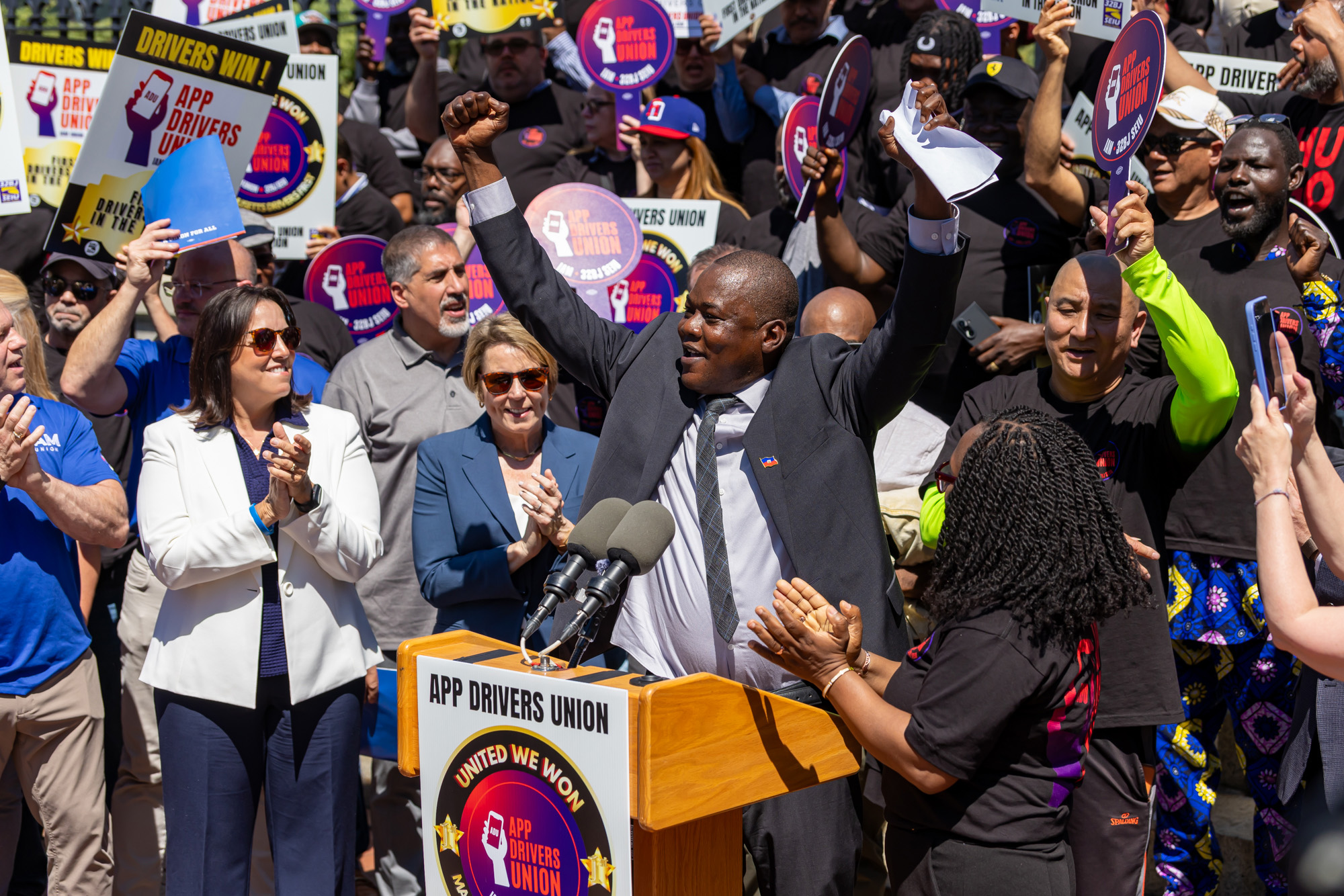
Autumn Weintraub, the executive director of the App Drivers Union, believes that rideshare drivers having some form of institutional power at the present moment is particularly important. The App Drivers Union recently became the certified bargaining representative of 70,000 rideshare drivers in Massachusetts, under the framework established by Question 3. As Waymo is pushing to expand their automated taxi services around the country, Massachusetts had been considering an industry-backed bill that would have established a regulatory framework for autonomous vehicles, overseeing their expansion in the state. But the legislative session recently ended without its passage, and Weintraub argues the App Drivers Union played a key role in the bill’s defeat. “If we weren’t organized here, this would have gone through this year,” she says.
Best and worst case scenarios
The new framework for rideshare driver organizing in the United States is still very new, and so judgment of it should be stayed at least until the dust settles on the new process in one of these states. But it is clear, even at this early stage, what the best and worst case scenarios for the framework would be.
The worst is that this new framework essentially codifies a sub-minimum wage for an entire segment of gig workers. Moore outlined a scenario in which drivers in a particular state would get a 20–30 percent wage bump out of a first contract, and all sides would tout the bump as a huge victory. But a 20–30 percent bump on $6.20 per hour in California would put workers’ take home pay between $7.44 per hour and $8.06 per hour—still well below California’s minimum wage of $16.90 per hour. “This [kind of] collective bargaining, it’s not going to solve our pay problem,” she said.
However, the determination of hourly pay relies on the broader question of how much collective power the workers will have in bargaining, and their ability to enforce any agreement. CAP’s Madland understands the framework to involve true sectoral bargaining: “This is collective bargaining, the workers and the employers negotiating agreements. The state does have a certification role, but that is to to review and approve, not to actually be involved in the contract negotiation. So I really view it as actual bargaining. . . . The hope is that both in Massachusetts and California, they might be able to achieve a contract this year.”
The IAM’s Gonzalez has a somewhat different view. What the Illinois Drivers Alliance is pursuing, he says, is not what is traditionally understood as collective bargaining: “It’s essentially being in a union, but not completely. We call it a union, but for all intents and purposes, it’s an organization that’s going to recommend standards to the state, and the state will approve them. There will not be a contract between the company and the unions. This will be a set of state standards that are recommended to the state, and then the state will create policy.” There are major substantive differences between these two views; even with a hard squint, it’s difficult to portray the latter as a robust form of sectoral bargaining.
Finally, the fact that SEIU and IAM are major supporters of the framework is troubling to many: in 2019, it was revealed that the California council of SEIU may have supported Uber and Lyft’s attempt then to classify drivers as independent contractors, in a shady move that would have indeed straightforwardly traded labor rights for collective bargaining. The IAM, meanwhile, was behind the creation in 2016 of the Independent Drivers Guild based in New York City, which many in the rideshare driver organizing space think of as a company union, i.e., a “union” that is essentially controlled by Uber.
In sum, this could be a process without teeth, geared toward Pyrrhic victories that paper over worker misclassification puzzlingly condoned by unions, and resulting in a state codified minimum wage for rideshare drivers worth half of the legal minimum for all other employees.
The best case scenario, by contrast, has a clear precedent: SEIU’s home care organizing campaign in the 1990s and early 2000s. Briefly, under the leadership of Andy Stern, SEIU pursued a number of regulatory changes that allowed home care workers in various states, on the West Coast in particular, to form unions and collectively bargain with public authorities. Importantly, many home care workers who gained collective bargaining rights remained independent contractors throughout this process—they were not converted into true civil servants, even though they were technically working for newly established public authorities. According to David Rolf, a leader in home care worker organizing in California and later president of SEIU 775, Washington state’s home care union, the home care strategy yielded 750,000 new members for SEIU, a high proportion of the roughly 1.2 million new members the union claimed in the fourteen years it was led by Stern. (Rolf is also a co-founder of the Workers Lab, which published the Gig Economy Data Hub.)
SEIU’s home care unions are not simply paper organizations legitimizing low wages. Before organizing, home care workers on the West Coast were for the most part making minimum wage (the minimum wage in California in 1990 was $3.35 per hour) with no benefits and the expectation of long hours with no overtime. Today, the West Coast home care unions have either won or are pressing for $25 per hour with affordable health insurance, paid time off, retirement benefits, and travel pay. SEIU 775 has also built formidable political clout in Washington and was a key player in the Fight for $15 in the state, and the home care union model was in many ways the basis of the Biden administration’s proposed care work expansion, which was stymied in the Build Back Better legislation.
Of course, there are a number of differences between the home care and rideshare organizing frameworks: new state agencies were created to act as the employers of record for home care workers, while rideshare drivers must sit across the table from more formidable adversaries in Uber and Lyft. Crucially, since Medicaid reimbursements make up a sizable chunk of home care workers’ pay, SEIU can lean on its lobbying arms to improve workers’ pay when bargaining home care contracts. No such option is available for the new rideshare driver unions, while the rideshare companies will be free to raise prices if they can.
My point in drawing this comparison is simply to say that the basics of the framework that have drawn so much criticism—passing regulatory changes that make a particular sector of poorly remunerated independent contractors organizable without fighting the classification battle on the front end, and then using these imperfect changes to build strong workers’ organizations—have been tried before, and to some success. It could be that the small differences between the pieces of the enabling legislation in these various states end up mattering quite a bit here: Question 3 in Massachusetts, for instance, is stronger on a number of fronts than HB 5090 in Illinois, and those legislative details might grant the App Drivers Union a success that the Illinois Drivers Alliance will not see.
Extending the framework
Thus far, none of the new laws cover other app-based delivery workers, and there doesn’t seem to have been any attempt to include them in the framework. Moore told me that there is more division in their interests than one might think: for instance, while rideshare drivers bemoaned the passage of Prop 22 in California, many app-based delivery drivers celebrated it for including wait time in statutory pay considerations, given that delivery drivers are often waiting for pickups longer than rideshare drivers. Amazon Flex drivers, for instance, will often wait in a long queue at the company’s Sub-Same Day centers before even being able to get into the facility to pick up their packages.
But this is not to say that a similar model could not be applied to delivery drivers. In New York City, pressure is ramping up to pass the proposed Delivery Protection Act, an ordinance which would reclassify subcontracted delivery drivers (including gig workers) as direct employees of parent companies. One wonders, if such municipal threats of stronger wage-and-hour coverage or outright reclassification proliferate, whether other large corporations may turn to the independent contractor sectoral bargaining idea as a relief valve.
Nonetheless, both in theory and practice, sectoral bargaining has more than proven its worth: by bargaining at the level of an industry instead of an enterprise, it takes wages out of competition, and so defuses one source of employer animosity towards unions. And in various European cases, it has borne some staying power in guaranteeing workers their rights and a strong voice.
But it should always be remembered that European sectoral arrangements were won by an ascendant labor movement in the early and mid-twentieth century, the fruit of a short-lived and reluctant post-war compromise between capital and labor. So, too, with the US minimum wage, which was not codified in federal statute until 1938 and did not expand to large retail employers until 1961. Today, by contrast, organized labor imagines its future from a place of weakness, and it’s possible that sectoral bargaining is just one more mirage in the desert.
It’s also possible, however, that an imperfect structure will make collective organization possible in a way that transcends the imperfections of its genesis, as in the case of SEIU’s home care organizing. As Weintraub noted, the Massachusetts law occasioned “the first time in the United States that Uber and Lyft have actually been forced to sit at the table with drivers.” However much the rideshare companies think they can control this process, they’re ultimately in untested waters; facing off with the hundred-plus worker bargaining committee that the App Drivers Union is forming, they may realize they’ve bitten off more than they can chew.
Further Reading
Walmart Concedes to the Union
North America's largest employer grants a first for its workers: an adversarially-bargained union contract
Unstitching America
No private company is logistically capable of delivering the mail. So what does privatization of the US Postal Service mean?
The State and Software Capital
Digital public infrastructure and the promise of India’s online consumer market
Further Reading
Walmart Concedes to the Union
North America's largest employer grants a first for its workers: an adversarially-bargained union contract
In our hyperpolitical age, when mass protests come and go without much clear sense of what was won or lost, the strategies of social movements...
Unstitching America
No private company is logistically capable of delivering the mail. So what does privatization of the US Postal Service mean?
No private company is logistically capable of delivering the mail. So what does privatization of the US Postal Service mean?
The State and Software Capital
Digital public infrastructure and the promise of India’s online consumer market
The Aadhaar digital identification project was launched in 2009 with the promise of eradicating corruption. Over 1.3 billion Indians today hold Aadhaar numbers, making it...