March 11, 2026
Analysis
Crisis of Plausibility
On Chile’s new President, José Antonio Kast, and the left’s decline
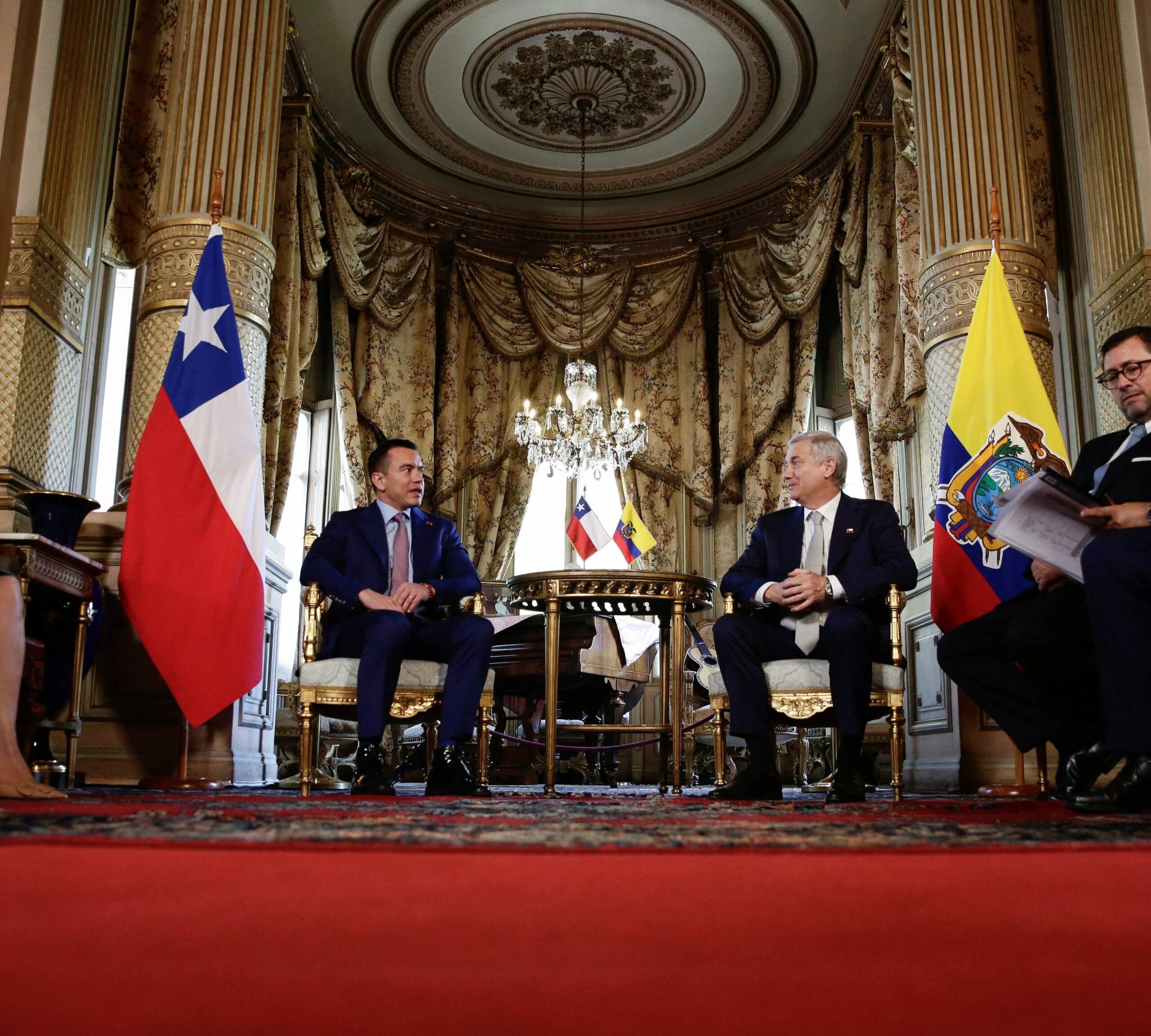
Chile took a dark turn in the 2025 general election. The far-right candidate José Antonio Kast won the presidency with 58 percent of the vote, beating his Communist rival Jeannete Jara in a runoff by a significant margin, while his electoral alliance Cambio Por Chile increased its representation in the chamber of deputies. With one of the highest turnout rates in decades, thanks to a new mandatory voting system, more than 7 million people cast their ballots for Kast’s bullish “law-and-order” program, calling for a crackdown on crime, unions, and migration, a return to free market principles, and the repeal of progressive social policies. His inauguration marks the end of a brief political opening for the country’s left, which propelled Gabriel Boric to power in 2022 following a wave of widespread protests that challenged Chile’s constitutional order. Hopes of dismantling the neoliberal structures inherited from the Pinochet dictatorship now appear to have been buried for the foreseeable future.
Various explanations have been offered for this reversal of fortunes. The election result has been described as a reassertion of the Chilean people’s innate conservatism, an expression of anti-incumbency sentiment, a symptom of rising concern over crime, or a reflection of broader regional trends. These interpretations, however, often miss what is distinctive about the Chilean conjuncture. There has not been a sudden mass conversion to the right. Rather, the country’s existing economic model, founded in the wake of the dictatorship, has been beset by what might be termed a “crisis of plausibility.”
This model was based not only on the promise of growth but of greater national integration. Macroeconomic stability was supposed to translate into improved living conditions for a majority. Chile combined rapid expansion with a significant reduction in poverty and an increase in real wages. The model delivered enough, for long enough, to create a shared common sense about how progress would look.
Yet even in its most successful phase, the post-1990 bargain of integration contained a displacement. The promise of mobility rested on a combination of targeted social spending, macroeconomic discipline, and expanding access to privately and semi-privately organized services. This access-based integration became a substitute for rights, financed through household balance sheets, credit markets, and a mixed public private provision system. Distributive conflict became a long horizon project. Governments can ask for patience, because the payoff is expected to arrive later.
While this notion may have held water in the 1990s, it has come to seem increasingly far-fetched since the turn of the millennium. The education system, as a tool of social mobility, failed to live up to its promises. Constitutional processes to redraft the 1991 Constitution temporarily functioned to make gradual reforms intelligible as steps toward a larger settlement. But once that horizon closed through the plebiscite defeats of 2022 and 2023, slow reform began to look less like progress and more like drift.
The decisive shift is not that redistribution ceased to matter, but that politics appeared unable to produce a future. Against that background, the governing experience of Gabriel Boric becomes legible as a problem of timing under constraint. Amid stagnation, indebtedness, and institutional fatigue, a right-wing politics of “security” managed to gain ground. To understand how this process played out, and how the left might reorient itself under the incoming Kast government, we must look back at Chile’s post-Pinochet trajectory.
The bargain
Chile exited the dictatorship era in 1990 with a highly liberalized economy that owed much to the Chicago School. The country’s democratic transition combined continued macroeconomic discipline with expanded social spending. This gave rise to a peculiar developmental bargain. In lieu of a return to import substitution or state-led industrial strategy, elites sought “stability” through the preservation of key parts of Pinochet’s economic order, plus greater social inclusion through targeted redistribution and social programs.
As indicators began to improve over the next decade, this bargain was accepted by large sections of the population. Between 1990 and 1998, Chile’s real GDP growth averaged 7.3 percent annually, while real GDP per capita increased by an average of 5.6 percent per year, and real wages grew by close to 4 percent per year across the decade. Poverty declined sharply, from 38.6 percent to 21.7 percent, while extreme poverty fell from 12.9 percent to 5.6 percent. Though such gains did not eliminate inequality nor create a high-wage economy for most Chileans, they nonetheless made the goal of integration seem within reach. It appeared that growth, stability, and gradual redistribution could all happen simultaneously. The political implications were significant, as the country’s institutions began to command real authority, and ordinary households saw the hardship they were experiencing as a temporary state rather than a structural condition.
Yet the post-1990 bargain displaced the promise of mobility into a specific institutional channel. As increased productivity and wage convergence remained uneven, households increasingly came to see mobility not as a labor market certainty but as an educational project. Credentials were needed to realize the prospect of progress. The “massification” of higher education thus accelerated rapidly during this period. Official analyses show that net enrollment among people aged eighteen to twenty-four rose from 13 percent in 1990 to 27.5 percent in 2006, and then 30.8 percent in 2009.
This increase had a dual function. Symbolically, it represented inclusion, dignity, and the promise of a professional identity for the new generation of Chileans. Institutionally, it operated as a substitute integration mechanism, in a society where universal rights in health, pensions, housing, and care were still limited or segmented. There was a growing sense that educational effort could compensate for structural inequalities. The entire political settlement thus came to rest on educational returns.
This was a point of major vulnerability. When social mobility relies on educational credentials, the latter naturally becomes a source of intense scrutiny. If the quality of provision turns out to be unequal, if labor market absorption is segmented, or if paying for education means taking on excessive debt, then the situation can become politically combustible. Education, in other words, can only play a stabilizing role if its costs are not seen as punitive.
It was Chile’s student credit regime that ignited this tinderbox. Created in 2005, the State Guaranteed Loan (Crédito con Aval del Estado, CAE) institutionalized debt-financed access as a major pillar of expansion. It integrated higher education expansion into financial circuits and redefined the social meaning of access, which was now no longer merely a matter of admission and tuition, but a long-term obligation. A direct link was established between macroeconomic conditions, household balance sheets, and political legitimacy. By the end of 2021, an official characterization of the CAE debtor population reported that over a million students had taken up the credit scheme, and that delinquency had risen persistently since 2015, reaching 48 percent at the close of 2021. The same report shows that delinquency was about 77 percent among those who did not complete their studies.
The opening up of Chilean higher education, then, was not a simple story of expanded opportunity, but rather a complex web of marketized provision and financial architecture that shifted risk onto households. This created the conditions for a politics of disappointment, with unmet expectations giving rise to popular resentment. Though the latter was staved off as long as the economy continued to grow, it eventually came to the fore when the expansionary cycle slowed down, and the dream of integration began to unravel.
Students in revolt
This slowdown produced a series of political upheavals, in 2006, 2011, and 2019, each of which expressed the same underlying tension: access to education was expanding faster than the capacity to guarantee decent quality and secure the desired outcomes. In a society still organized around privatized provision and credit, the system proved unable to deliver on its promises. With the lived experience of social mobility now mediated by the problems of tuition and student debt, distributive conflict came to center on the education sector.
In 2006, secondary school students launched the so-called “Penguin Revolution.” What began as a series of concrete demands on issues such as the cost of transportation and examination fees soon escalated into a comprehensive critique of educational inequality. The movement pushed the education debate back onto the national agenda and exposed the disparities of the system. In 2011, the focus shifted onto higher education. Over the next two years, university federations and broader social actors engaged in mobilizations that directly targeted market interests in education, such as for-profit provision and debt financing. The movement succeeded in linking household balance sheets to wider questions of political legitimacy.
Those two waves changed the political baseline for the next decade, legitimizing a vocabulary of social rights and raising expectations about the pace at which institutional politics should translate into material improvements. This newly assertive outlook fed into the social uprising of 2019, which was initially triggered by a public transport fare increase and soon transformed into a mass struggle against inequality, debt, and the high cost of living. As protesters called for an overhaul of education, healthcare, and pensions, demanding that they serve the public as opposed to profiteers, the state was plunged into crisis.
The only way to defuse the situation was to open a constitutional process that had been negotiated in Congress. The political trigger was the Agreement for Social Peace and a New Constitution of November 15, 2019, in which parties committed to an institutional exit through a plebiscite with two questions. Voters would be asked whether they wanted a new constitution and which body should draft it. In December 2019, that roadmap was formalized through a constitutional amendment, Law 21.200. It set out operating rules for the constituent body and established the sequence of stages. The plebiscite, postponed because of the pandemic, was finally held on October 25, 2020. Turnout was high by the standards of the voluntary voting era, at 50.9 percent. That day, the Approve option won 78.27 percent. The Constitutional Convention mechanism also prevailed decisively, with 78.99 percent of the vote.
Politically, the result functioned as a replacement mandate with overwhelming quantitative legitimacy. It was not simply about changing a text. It opened a channel to reorder the social contract under democratic conditions, with an explicit horizon of greater equality. That expectation was reinforced by the institutional design of the body itself. In the election of convention members on May 15 and 16, 2021, 155 representatives were chosen. Gender parity applied. Seventeen reserved seats were included for Indigenous peoples. There was also an unusually strong showing by independent lists. The message of the mechanism had two sides. On one hand, it aimed to broaden the sociopolitical base of the process. On the other hand, it signaled that the new pact would not be an elite arrangement, but an institutional production that could absorb pressures and demands from below.
The Convention was installed on July 4, 2021, and it opened an intense phase of organization and drafting. A leadership board was chosen, committees were defined, procedural rules were approved, working methods were set, and a deliberation calendar was established. From the outset, its architecture combined participatory aspirations with demanding procedural constraints.1 Some of the notable features include Law 21.200, which established that Constitutional provisions and the voting rules had to be approved by a two thirds quorum of members in office. The Convention also could not alter those quorums or the procedures for adopting agreements. This high threshold was designed as a guarantee of cross partisan breadth. It also introduced a persistent tension between transformation and the practical capacity to close deals. At the same time, the process sought to sustain legitimacy through participation mechanisms intended to make citizen input consequential. The public participation rules, approved by the Plenary in October 2021, created an internal structure with a political commission and a technical secretariat. A digital platform and a public registry were also implemented to channel submissions. One of the most visible instruments was the Popular Initiative of Norm. Any person or group could propose constitutional level provisions. If a proposal reached 15,000 signatures from at least four regions, it acquired a status comparable to a proposal introduced by convention members and had to be discussed and voted on. Self convened meetings were also contemplated, which were deliberative spaces organized from within society. The idea of a diriment plebiscite was included as well, as a way to unlock provisions that did not reach two thirds but did reach three fifths on a second vote, although its feasibility depended on additional institutional adjustments.The promise was to combine electoral representation with effective participation, traceable inputs, and territorial reach. In that way, the final text could be presented as the synthesis of an expanded public deliberation.
Chilean politics reorganized around the constituent moment and made room for a new generation of leadership. Gabriel Boric reached La Moneda after the 2021 presidential election, which recorded the highest voter turnout in national history. The wager was to channel unrest through institutions, reconnect democracy with social protection, and give political direction to the promised cycle of transformations. For much of Boric’s coalition and electorate, the government and the Convention looked like two pieces of the same wave. The hope was that protest could become institutional architecture to create sustainable material change.
Boric and the binding nature of stabilization
Boric faced difficult path from the start. His administration took office while the constitutional cycle was still open, and with the hope that the process could deliver a renewed floor of legitimacy. That expectation was quickly shattered. On September 4, 2022, in the mandatory exit plebiscite, the Constitutional Convention’s draft was rejected by a wide margin.2Rechazo won 61.86 percent against 38.14 percent for Apruebo. Turnout was also exceptional, above 85 percent of the electorate, which changed the profile of the effective electorate relative to the voluntary voting era.
The 2022 defeat removed the institutional vehicle that could have expanded the space for reform. That closure deepened after the second attempt also failed. A new, more tightly controlled process was launched with pre-defined bases, an Expert Commission, and technical admissibility review, and it culminated in another plebiscite. On December 17, 2023, the second proposed text was again rejected. En contra won 55.76 percent against 44.24 percent for A favor. Two consecutive defeats consolidated a fatigue effect and reinforced a lesson that alternatives perceived as too far from the median voter were likely to be punished. The practical result was a stronger binding logic of sequence, caution, and governability. The space for ambitious redistribution narrowed further, not only because of macro constraints, but because the symbolic mandate for rapid refoundation had been denied twice at the ballot box.
That political closure unfolded on top of macroeconomic constraints. The pandemic cycle had created an unusually high baseline of state capacity in the eyes of households, while also leaving macro conditions that required stabilization. In the government’s own fiscal planning, the strategy was organized around convergence toward tighter structural balances, with the aim of reducing a structural deficit that had widened during the emergency period. In 2022, fiscal consolidation was dramatic. Official budget accounts and summaries report that the year closed with an effective surplus around 1.1 percent of GDP and a real decline in public spending of roughly 23.1 percent relative to 2021, an exceptional contraction in recent decades.
Reduced uncertainty and lower inflation expectations are valuable, but they do not show up as visible improvement in everyday life at the speed reformist coalitions need. Constraint also did not disappear after the initial adjustment. By 2024, official fiscal reports documented an effective deficit of about 2.9 percent of GDP and a structural deficit of about 3.2 percent of GDP, confirming that fiscal tension was reconfigured rather than solved.
Inflation added a second, more corrosive channel. Annual inflation closed 2022 at 12.8 percent, and it reached a peak of 14.1 percent in August of that year. Monetary policy became contractionary. Chile’s policy rate peaked at 11.25 percent before gradually declining, reaching 5.0 percent by December 2024. Disinflation protects real wages in the medium term, but it does so through instruments that cool credit and investment, with uneven effects on employment and precariousness. That is especially damaging when households carry high levels of consumer and educational debt and compare current restraint to the memory of massive pandemic transfers.
Social policy therefore operated within a paradox. The state was expected to act at scale because it had recently done so. The best single illustration is the Ingreso Familiar de Emergencia (IFE). The IFE was created as an extraordinary transfer during the pandemic and expanded over time, culminating in the IFE Universal phase. In July 2021, official government communication stated that the IFE Universal reached 15,805,563 people and 7,676,627 households. The official July 2021 summary report also noted that 95.8 percent of those registered in the social household registry were receiving IFE at that time. On the fiscal side, an official Dipres account reported that the IFE cost $24.6 billion between 2020 and 2021.
Returning to targeted instruments thus represented a collapse of expectations. Boric’s government did deploy important measures. Copago Cero was activated in September 2022 for Fonasa users in the public network, eliminating copayments in institutional care. Official health ministry reporting stated that between September 2022 and May 2024, 1,510,227 people benefited and total savings were estimated at 202 billion pesos. By September 2025, the government reported 1,919,190 people as direct beneficiaries since implementation. Wage policy also changed, so that the monthly minimum wage rose to 539,000 pesos for workers aged over 18 and up to 65.
These policies addressed out of pocket health costs, supported formal wages, and protected specific groups. But in the context of recent inflation, a fragile labor market, widespread indebtedness, and a post-constitutional closure environment, many households experienced these measures as containment rather than as a credible promise of sustained improvement. In other words, the policies could not rebuild integration for majorities fast enough under the constraints of stabilization, and under the political conditions created by two constitutional defeats.
The failure of the administration’s tax reform effort in March 2023 further hindered its ability to finance a broader universal agenda. Without new permanent revenues, redistributive ambition is forced into narrow corridors. While the pension agenda did pass in January 2025, its effects were not always perceived as immediate. A policy that phases in over years can be fiscally responsible and socially meaningful while still failing to deliver immediate relief in the period that matters electorally.
Why Kast won
José Antonio Kast’s victory in December 2025 marked the crystallization of a long political sequence in which the promise of integration became implausible, while the everyday experience of insecurity and loss of control became the most legible political fact. In the presidential runoff, Kast obtained 58.16 percent of the vote against Jeanette Jara with 41.84 percent, with 11,367,113 ballots cast. The magnitude of the margin matters, but the deeper point is what that margin condensed. Kast did not win because Chile suddenly became ideologically homogeneous. He won because a large part of the electorate came to treat order, discipline, and enforceability as the only promises that still looked executable within a constrained economy and a fatigued institutional landscape.
Kast is not a newcomer who appeared at the end of the cycle. He is a longstanding figure of the Chilean right who professionalized his candidacy through repetition, party building, and agenda discipline. Trained as a lawyer, he built an early local career and later served as a deputy for multiple terms. He first ran for the presidency in 2017 as an outsider relative to the mainstream right coalitions, then returned in 2021, and again in 2025. That trajectory created a political brand that could survive defeats, absorb grievances, and normalize a tougher right wing vocabulary inside democratic competition. By 2021, Kast was already capable of leading the first round and forcing a runoff, where he obtained 44.13 percent of the vote. Even in defeat, that result established him as more than a protest candidate. It signaled that a hard right offer could become a stable pole of representation, especially when the center right appeared fragmented and when the governing left was forced into a politics of restraint.
The organizational vehicle for that offer is the Partido Republicano de Chile (Republican Party of Chile). Kast founded and led the party after breaking with the older conservative right, building a party that positions itself as more uncompromising on public order, migration control, and cultural conservatism than the traditional right that emerged from the transition period. The mainstream right in Chile historically balanced business friendliness and macro orthodoxy with a pragmatic willingness to govern within the post 1990 consensus. Kast’s party was designed to exploit the perception that this pragmatism became indistinguishable from managerial inertia. Its comparative advantage was to promise clarity, hierarchy, and speed, and to treat the language of rights not as a horizon but as a source of disorder and fiscal indiscipline.
Kast should also be read as a product of a transnational right-wing infrastructure that now functions as a geopolitical shorthand inside domestic competition. Long before the 2025 runoff, he had embedded himself in networks that connect CPAC-adjacent conservative organizing with European and Latin American actors. His appearance at CPAC Brazil alongside Javier Milei and Jair Bolsonaro, and his post-victory meeting with Milei, made that alignment publicly legible. His subsequent European tour as president-elect staged a shared agenda with Santiago Abascal in Brussels, a meeting with Viktor Orbán in Budapest, and a stop in Rome with Giorgia Meloni, all organized around a familiar repertoire of security, migration, and order.
Kast’s victory relied on several mechanisms. The first is the exhaustion of the mobility promise. When educational expansion becomes a substitute for universal rights, it can stabilize a highly unequal society for a long time, but only if the returns remain credible. If improvements are slow, partial, or administratively complex, many voters interpret delay not as patience required by democracy but as evidence that the system cannot deliver.
The second mechanism is institutional fatigue after the constitutional cycle. The constitutional opening that began after the 2019 uprising created a period in which gradualism could be narrated as movement toward a collective destination. The failure of that process eroded the belief that politics can translate conflict into binding settlements. The relevant consequence is psychological and strategic rather than simply a rejection of the left.3Chile’s state migration authority has documented that irregular entries reached a peak in 2021 with 56,585 cases, then declined in subsequent years, including 44,235 in 2023, with further reductions reported for 2024. Voters become more willing to trade ambitious horizons for immediate instruments of control, rewarding what looks enforceable. Kast’s discourse is built precisely for that environment.
A third mechanism is the reordering of everyday fear around security and migration. It is not necessary for a country to have catastrophic homicide levels for insecurity to become dominant. Chile’s official homicide numbers are still low by regional standards, yet the public debate has been shaped by the perception of qualitative change, organized crime dynamics, and territorial control in specific neighborhoods, which amplifies fear even when national averages move slowly. In that setting, a law and order politics can convert disparate anxieties into a unified demand. Migration became fused with that demand. In Kast’s narrative, the problem is a loss of control, the solution is the reassertion of control.
A fourth element is the way political experience becomes an asset under conditions of disappointment. Kast’s repeated presidential bids alongside his party’s intermediate electoral victories signaled momentum and normalized his presence. In the 2023 election for the Constitutional Council, the Partido Republicano de Chile obtained 35.41 percent of the vote and twenty-three seats, becoming the largest single list in that contest. That result functioned as proof that the party was not a temporary reaction but a durable organization capable of winning.
Put together, these mechanisms help explain why Kast’s victory was simultaneously a rightward turn and a sanctioning event. It expressed a demand for order that grew out of stagnation, indebtedness, and institutional fatigue, and it rewarded an actor who had spent nearly a decade building a coherent organizational vehicle for that demand. Under an open economy with stabilization constraints, under a post-constitutional environment where collective horizons are weak, and under a social landscape where fear and control dominate everyday perception, the winning offer tends to be the one that converts diffuse frustration into a single executable promise. That is what Kast delivered, and it is why the victory should be understood as the culmination of a longer cycle rather than as a sudden conversion.
Left strategy in an open economy
What does a credible socialist economic program look like in a small open economy like Chile, where the exchange rate, external balance, and financial expectations constrain redistributive room, and where social reproduction has been organized for decades through privatized services, segmented rights, and cheap credit? A viable answer must be both macroeconomically compatible and materially legible.
Two political lessons follow. The first is that stability must be claimed as part of a class strategy rather than ceded to conservative technocracy. Inflation and currency depreciation punish lower and middle income groups first because they raise the cost of essentials and erode wages faster than contracts adjust. The 2022 inflation peak of 14.1 percent and the policy rate peak of 11.25 percent are not just macro facts. They are distributive events with political consequences.4Instituto Nacional de Estadísticas, 2023; Banco Central de Chile, 2024. A socialist strategy that treats macroeconomic stability as merely an external constraint will be perceived as resigned. A strategy that ignores stability will be punished through inflation and depreciation channels that quickly destroy popular legitimacy.
The second is that, for the Chilean left, the model of “economic integration” has a structural limit that becomes fatal under volatility and crisis. When inclusion is mediated by household budgets, credit conditions, and market prices, any macro shock is immediately translated into everyday stress, and legitimacy erodes faster than reforms can repair it. The problem is compounded when the expansion of social policy functions primarily as an indirect financing channel for private provision, because rising public spending can be experienced less as universal relief than as a transfer to large private capital that captures rents in essential sectors. In that setting, the integration promise loses credibility not only because it is crisis-vulnerable, but also because its distributive meaning becomes ambiguous.
Therefore, an agenda for the decommodification of social policy in Chile must be understood as a cost-of-living transformation rather than as doctrinal anti-market rhetoric. Citizens evaluate projects through concrete reductions in mandatory spending. Rent, transport, health copayments, energy, and care are the real battlegrounds. Copago Cero is analytically important because it signals the kind of universal platform that can reduce out-of-pocket costs directly at scale. The policy’s reported 202 billion pesos in savings for beneficiaries between September 2022 and May 2024 shows the magnitude of relief that universal design can generate when it is implemented through a dominant public network.5Ministerio de Salud, 2024. The same logic applies to housing and care. The state must expand universal platforms that function either as the default option or as a regulatory benchmark that disciplines private prices, so that public spending becomes verifiable relief rather than a mediated payment stream to providers with market power.
A credible left program in Chile is unlikely to look like a total replacement of the private sector. It should look like a gradual but irreversible reconfiguration of the public role. It means development banking, public procurement, and investment steering to change the supply structure behind the cost of living. It means public platforms in health, care, transport, and energy that reduce price volatility and out of pocket exposure. It means tightening regulation in captive markets and improving labor rules that strengthen predistribution. And it requires a tax base that can finance permanence. The failure of the 2023 tax reform illustrates the fragility of redistribution without a stable revenue architecture.
Finally, the left must rebuild an integration narrative beyond access, one which does not depend on exceptional moments. The pandemic transfers created a benchmark that cannot be replicated permanently. A sustainable project must therefore translate the memory of scale into a different kind of permanence. Not emergency checks, but permanent reductions in the cost of living and permanent improvements in security of provision.
That is the real meaning of the Chilean crisis for the left after Kast’s victory. The electorate did not only vote for the right. It voted against implausibility. Rebuilding credibility requires a program that produces visible improvements in material security while staying compatible with stability in an open economy. Without that, reformism will be punished again, and the demand for order will continue to displace the demand for rights.
.
Further Reading
Lithium Experiments
Chile’s mineral strategy and geopolitical realignment in the global energy transition
Gabriel Boric's government has revived industrial policy to upgrade Chile's role in the green transition. Yet serious obstacles remain.

After Boric
Assessing four years of Chile’s state-led development agenda
In his first year of government, Gabriel Boric positioned lithium, copper, and green hydrogen as catalysts for economic transformation. But the recent victory of right-wing...

Bittersweet Tides
Chile, Brazil, and the future of the Latin American Left
The recent victories of left parties across Latin America—most recently the election of President Luiz Inácio Lula da Silva in Brazil—have prompted comparisons with the...