Analysis
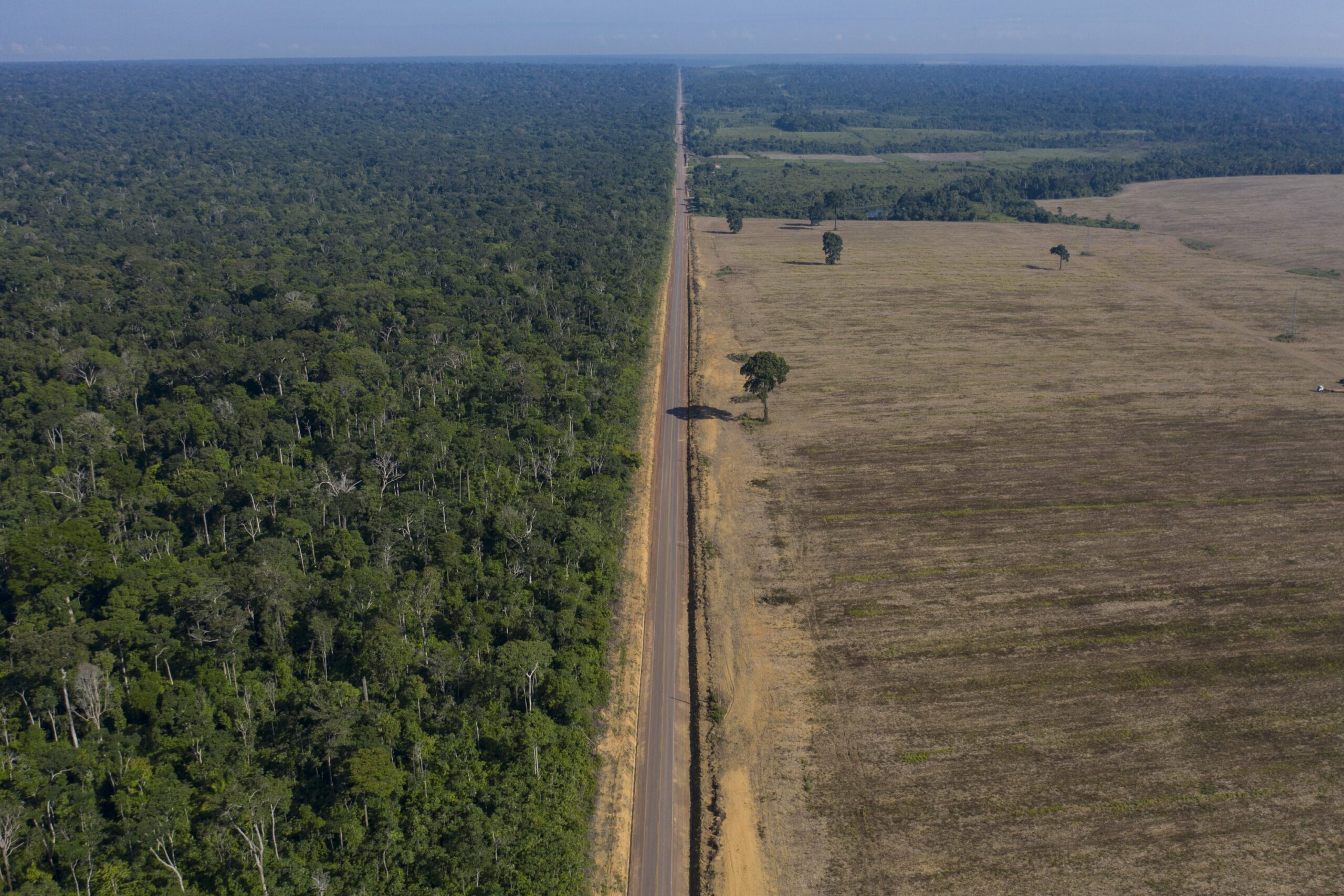
Last November marked the first COP summit to take place in the Amazon rainforest. Naturally, the question of how to preserve tropical rainforests was near the top of the agenda, with all manner of discussion about multilateral funding schemes and guarantees for indigenous peoples. Yet these high-level talks neglected many of the local policies and political formations that are equally critical to the future of the biome. To fill this gap, I thought it might be useful to explore the political economy of environmental policies in Brazil: the country that holds roughly a third of the world’s remaining tropical rainforests and around 60 percent of the Amazon. This is a story of two halves. On the one hand, the substantial—albeit temporary—decline of deforestation, which for a time made Brazil the largest individual contributor to global reductions of GHG emissions; on the other, the emergence of a far-right climate-denialist movement that has imperiled these fragile gains.
“This is a battlefield disguised as a wilderness.” The Guardian used this phrase last year to describe the brutal assassinations of Dom Phillips and Bruno Pereira, killed for helping to protect Amazon indigenous communities from illegal activities. Indeed, the Amazon is often viewed as a critical site of conflict—an active front in the struggle against climate breakdown—while the fight against organized crime, from drug trafficking to land grabbing to illegal mining, is framed as essential to stop the rainforest from reaching its tipping point. Environmental policies, we are told, must “lay down the law” for eco-criminals. The approach to the Amazon adopted by the Workers’ Party (PT) governments in the 2000s was labelled the “command-and-control crackdown.”
While this crackdown was undoubtedly successful in reducing deforestation on its own terms, it also generated a backlash that later reversed many of its achievements—especially under the presidency of Jair Bolsonaro—and which now threatens the very survival of the rainforest. Today, defenders of the original PT strategy are attempting to reinstate it under the third term of Luís Inácio Lula da Silva. Their narrative of the past two decades fits neatly with the “battlefield” framing: They made gains in the first decade of the new century, then lost ground in the 2010s, before mounting a counteroffensive in the 2020s, which they hope will lead to a decisive victory.
Such military metaphors, however, cannot always capture the realities on the ground. There is certainly an intense struggle between forest destroyers (organized crime, predatory agribusiness firms) and forest defenders (indigenous, quilombolas and riverine communities, alongside their allies in the state apparatus). Yet many of the 30 million people who live in the Brazilian Amazon cannot be easily placed in either category. By alienating a significant part of this population, the command-and-control crackdown sowed the seeds of its own undoing. It not only antagonized the agrarian elites; it also incited counter-mobilizations among a vast constituency of small and medium landowners. Such environmental policies may, in this sense, be partly to blame for the rise of a far-right politics backed by agribusiness capital, which in recent decades has evolved from merely a set of sectoral interests into an increasingly assertive movement vying for hegemony on the national stage.
To show how this historical process played out, I will briefly recap the rise and fall of the PT’s environmental strategy and how it committed the government to a flawed approach known as “land-sparing,” in which there was assumed to be a zero-sum trade-off between conservation and human occupation. Holding fast to an image of the Amazon as untouched wilderness, this orientation contributed to the country’s rightward turn while neglecting more promising models of conservation.
Theater of conflict
After decades of global concern about the rainforest, dramatic murders of forest defenders, and disastrous “colonization” plans by the Brazilian military government, the Amazon experienced a marked shift during the 2000s. The period spanning 2004 to 2012 is variously referred to, in the specialized literature, as that of “constructing climate institutions,” “the rise of the reformists,” or—as mentioned above—“the command-and-control crackdown.” The story usually begins with Lula’s ascent to the presidency in 2003 and the introduction of the PPCDAm (the “Action Plan for the Prevention and Control of Deforestation in the Amazon”) the following year. The first PT government, aligned with environmental and indigenous movements, engaged in an active process of institutional building, breaking with the timid policies of the preceding decade and—even more markedly—the deliberate state support for deforestation under the military dictatorship of 1964-1985.
The command-and-control crackdown cannot be understood without considering DETER, the government’s system of real-time deforestation data, obtained through satellite images, which was launched in 2004. Until then, enforcement efforts had been compromised by the fact that data was only available on an annual basis. With more frequent information now at hand, government agencies could begin targeting those involved in illegal deforestation for embargoes, fines, and confiscation of machinery.
Limits on legal deforestation in the Amazon had already been tightened at the turn of the millennium, when the government increased the minimum “legal reserve” in the region—that is, the share of a property that cannot be deforested—from 50 to 80 percent. Although this rule was watered-down with various exceptions, the strong pushback from landowners suggests that it was partially effective. In addition, the government established a series of federal conservation units and protected indigenous lands, amounting to a total increase in hectares of protected areas of about a quarter between 2004 and 2008. These areas became known as the “green barriers” to deforestation.
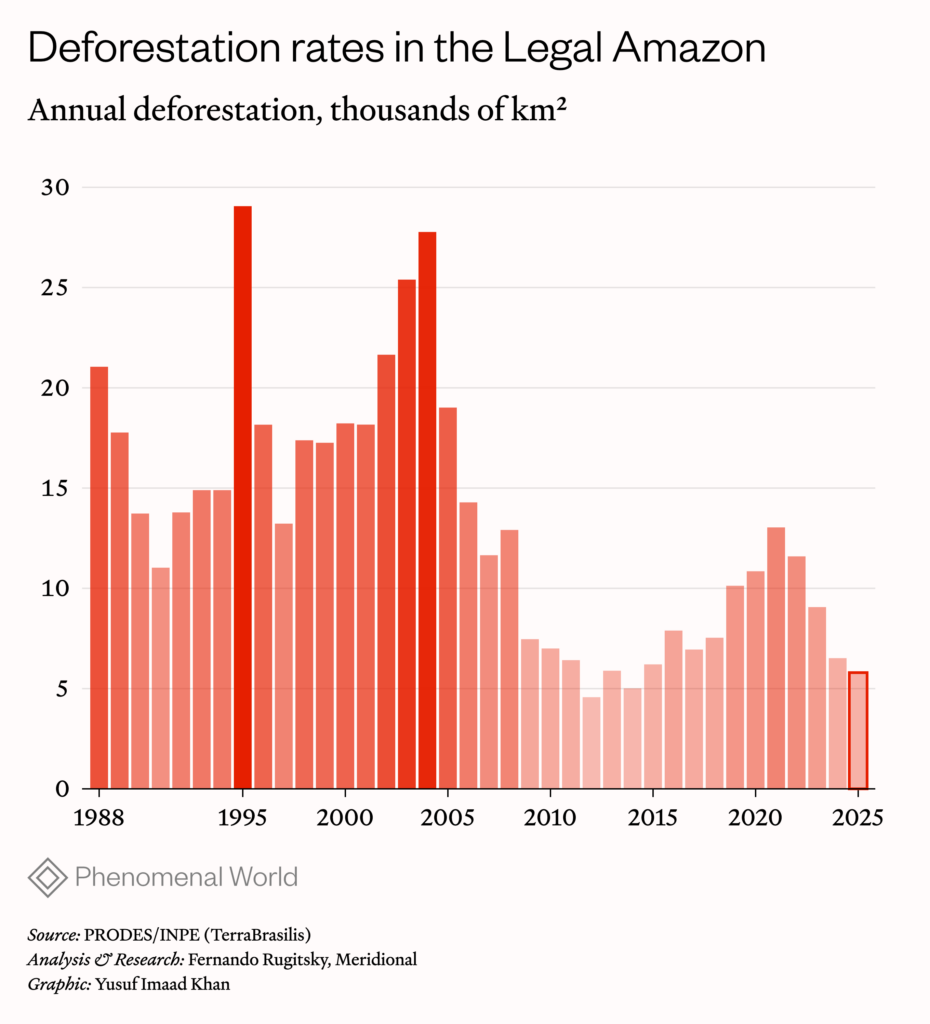
Struggling to adapt to this new context, and coming under intense pressure from environmental groups, the giant grain traders which had become dominant in the soy supply chain—ADM, Bunge, Cargill, Louis Dreyfus—agreed to a Soy moratorium in 2006. From then on, a ban was imposed on the purchase of soybeans from deforested land. Similar attempts at self-regulation were later adopted in the beef supply chain. Around the same time, the government began to test out additional tools to meet its environmental goals. In 2007 it began publishing an annual list of Amazon municipalities with worrying deforestation trends, giving the federal state enhanced power over them; and in 2008 a prohibition was introduced on extending credit to landowners who did not comply with environmental regulations. The results were impressive. From peak to trough, 2004 to 2012, deforestation in the Legal Amazon—meaning the Brazilian part of the rainforest and parts of the surrounding savanna—dropped from 27.8 to 4.6 thousand of km2 per year.
Backlash
As the 2000s rolled into the 2010s, through, an inflection in the trends slowly became visible. The number of infraction notices and seizures of equipment fell continuously between 2008 and 2012. Embargoes also declined between 2008 and 2009, before recovering from 2010 onwards. One might think that these tools were rendered less necessary as compliance with the regulations became more widespread—but that would only be true if deforestation rates were kept down, when in fact they began to increase in 2013, undoing more than a third of the PT’s gains by 2021 (see the figure below). Part of this was due to Congress yielding to agribusiness pressure and approving a new Forest Code in 2012, which among other regressive measures offered amnesty for a significant share of past illegal deforestation.
Yet these were only the first signs of a more thoroughgoing reversal. After the ousting of the PT from the presidency in 2016, in an impeachment pushed through with the crucial support of some agrarian interests, the new administration initiated a gradual process of dismantling the environmental institutions of the previous era. This then reached its apex under Bolsonaro’s far-right government. Enforcement agencies were weakened, protected areas were reduced, and advocates of deforestation were appointed to key government positions. In the middle of pandemic, Bolsonaro’s Minister for the Environment made the case, in a meeting that was later leaked to the press, that Covid offered a perfect distraction that would allow them to tear up environmental policies: a window of opportunity to passar a boiada.
The backlash did not abate after Lula’s return to power in 2023. The most significant recent example is Congress’s passing of legislation to eliminate mandatory environmental licensing and public consultation for a series of activities, including most agricultural, cattle-ranching, and mining undertakings. What critics have branded the “Devastation Law” is the most significant act of institutional dismantling to date, which will likely expedite a series of projects prone to increase deforestation, including oil drilling in the mouth of the Amazon River and the building of railways and highways to transport soybeans to ports in the North of Brazil and Peru. While Lula initially vetoed the most damaging measures, the agribusiness caucus has since managed to reinstate them, overturning 56 out of 63 vetoes.
Legislation at the subnational level has also been pushing in a similar direction. Since 2024, a series of Brazilian states passed laws preventing firms complying with the Soy moratorium from accessing tax incentives. Even though these state incentives are highly limited compared to the federal ones, the laws gave the giant traders a convenient excuse to finally bring the moratorium to an end last month.
It is difficult to find detailed explanations for the strength of this anti-environmental countermovement. This may in part be because of predominant orientation of the literature on environmental policies in Brazil, which, as Gregory Thaler points out, focuses mostly on different policy tools and their interaction yet fails to provide a “political account that looks beyond proximate factors to the actors and interests that generate the policy environment.” As he puts it, “the political-economic character of Brazil’s Amazon transition has not been effectively theorized.”
Kathryn Hochstetler’s work is one of the few exceptions. The PT’s emphasis on repressive measures, she argues, failed to create a political constituency that could guarantee the survival of its environmental project. Instead, it fostered violent opposition: “command-and-control tools were critical for reducing the rates of deforestation, but their very success at limiting private economic behavior also spurred political strategies that then helped to undermine those very tools and the institutions that supported them.” As an example she cites the increase in size of the agribusiness caucus, which went from 120 seats in the 2007–2010 legislature to 160 after 2011: from 23 to 31 percent of the total.
But while the march of pro-deforestation forces into the halls of power was a crucial part of the story, the full picture only emerges when one examines the dilemmas of the command-and-control crackdown at the local level. Studies of specific municipalities, like those undertaken by Thaler and his co-authors, reveal the fault lines created by the 2000s environmental push and the extent to which the political empowerment of agribusiness since the 2010s was based on widespread disaffection with the crackdown.
Land-sparing and its discontents
The environmental policy mix of the 2000s included a series of tools with different lineages, designed to meet the demands of different groups: support for agroecological practices, policies focusing on food sovereignty, and historical reparations for indigenous populations inter alia. The overarching logic of the crackdown, however, was that of land-sparing: containing deforestation by protecting some areas from any human use, while permitting the “sustainable intensification” of capital-intensive agriculture in other areas. The idea of sustainable intensification has been circulating for quite some time as a technical fix to make large-scale capitalist agriculture compatible with environmental policies. Its most recent incarnation is dubbed “climate-smart agriculture.”
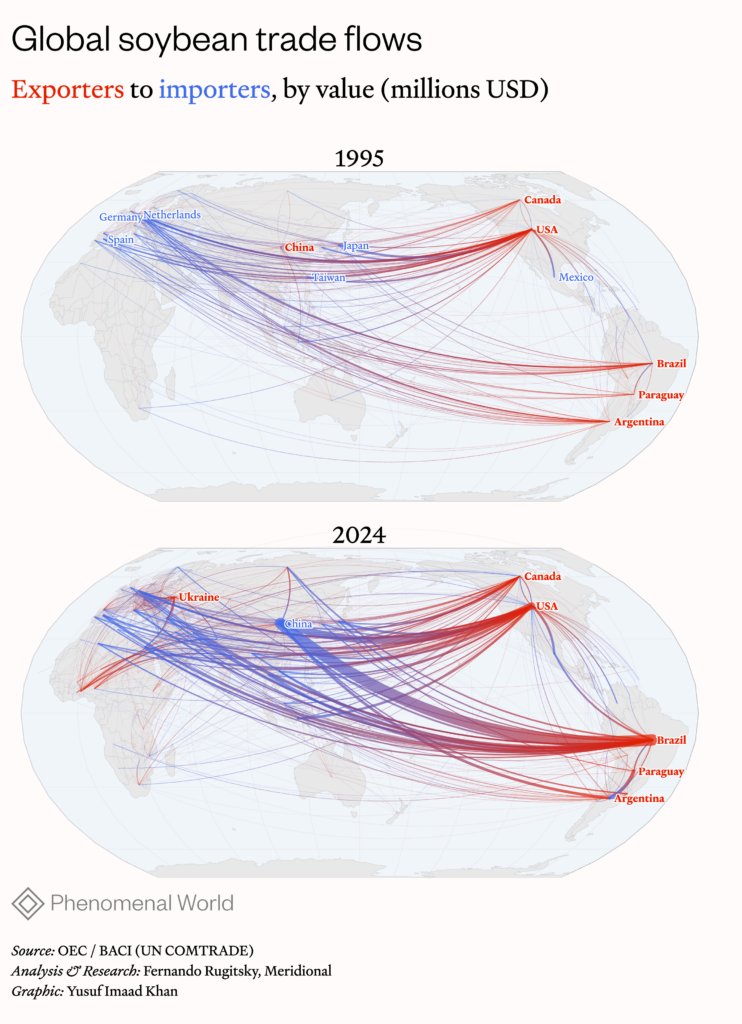
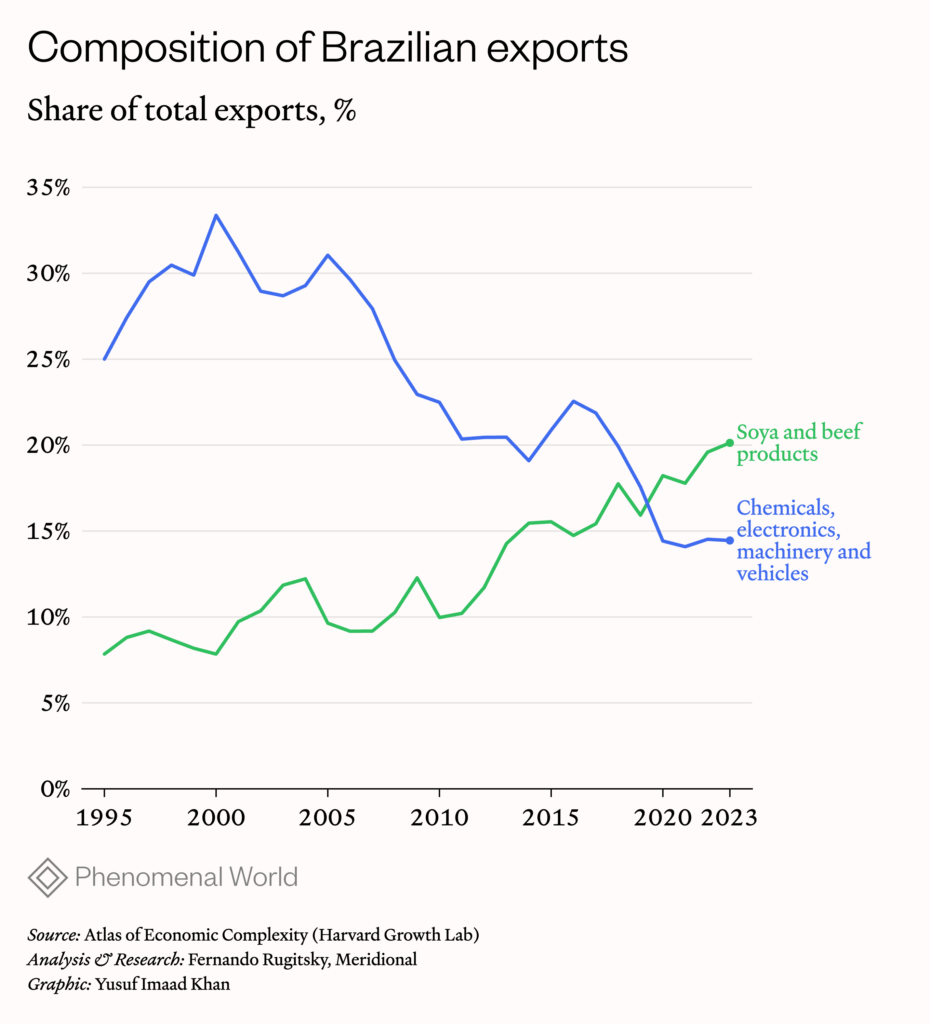
Land-sparing environmental policies came in handy for Lula’s governments in the 2000s, as it was engaged in the difficult task of meeting redistribution and environmental demands via a pattern of accumulation premised on agribusiness exports, dependent on a subordinated integration with the Chinese economy. The figures below show the scale of the shift for the case of soy, the most traded agricultural commodity globally in terms of value. The expansion of soy croplands and cattle ranches not only transformed the country’s geographical outlook but also provided access to foreign currency. Soy, beef, and related products accounted for about a fifth of Brazil’s exports in recent years, up from less than 10 percent two decades ago.
According to Thaler, the interests of agro-industrial corporations, government officials, and environmentalists thus converged in the Brazil of the 2000s to give rise to a “land-sparing complex.” Their project had no clear place for the massive population of small and medium landowners who populate the Brazilian agricultural heartlands. Given the costs involved in adapting to the new policies and the perceived difficulty of accessing government support, the land-sparing approach led to what Thaler describes as “smallholder dispossession:” “as smallholders struggle, large landowners consolidate their holdings.” Alongside this policy bias, so-called sustainable intensification had considerable health impacts for smallholders, causing what Fábio Zuker described as their expulsion by suffocation, via the chemical violence of glyphosate-intensive agriculture. (The land-sparing complex also had questionable effects on biodiversity, according to the vast literature on the rebound effects and other consequences of soy intensification.)
Measuring the fallout of PPCDAm measures in two Amazon municipalities, Thaler argues that “punitive measures without corresponding incentives disadvantage smallholders, who have fewer resources to deal with fines or invest in intensification.” Hochstetler concurs: “To the extent that the new agricultural and deforestation policies reach small farmers, it will be the punitive side of them.” Land-sparing policies thereby advanced the aims of large landowners and big agrarian capital by encroaching on the properties of less powerful groups, in an indirect form of green grabbing.
In his detailed ethnographic study of agribusiness politics in Brazil, Caio Pompeia showed how these “political and economically subordinated groups of agricultural employers” formed the basis of what he calls agri-bolsonarism: the unholy union of agricultural interests and far-right politics. Pompeia describes how these radicalized groups, disaffected with the command-and-control crackdown, captured one rural political organization after another, from state-level associations of soy producers to the agribusiness caucus in Congress. Initially, the large agro-industrial corporations resisted this movement, since they had learned to live with and could profit from the government’s policies. Yet, gradually, they began to see it as an opportunity to remove environmental constraints and exercise greater political influence. They therefore began to collaborate, behind the scenes at first, with the bottom-up far-right mobilization.
In the Brazilian social structure, these “subordinated groups of agricultural employers” sit atop a wider demographic whose livelihoods are more directly threatened by the land-hungry agribusiness surge: indigenous groups, riverine and quilombola communities, and agricultural workers—popular classes who feed the ranks of the forest defenders. It would be a mistake to assume that the PT crackdown represented a victory for their interests against those of agricultural elites. Here the “battlefield Amazonia” framing breaks down. In fact, the land-sparing policy was initially accepted by agro-industrial corporations and many of the largest landowners, to varying degrees, because they realized they could exploit it to accumulate more land. Rather than empowering the forest defenders against agro-industrial capital, the program ended up pitting the former against relatively subordinated agricultural employers: creating a political cleavage with profound historical consequences.
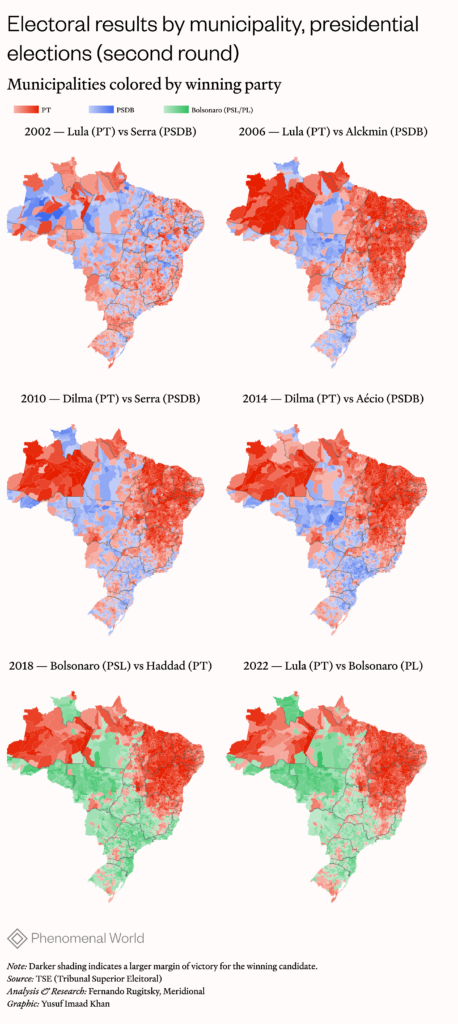
While agro-industrial corporations tightened their grip on the Brazilian state, capitalizing on increasing economic dependence on primary commodities, agri-bolsonarism provided a strong territorial base for a national anti-environmental politics. When the PT’s support declined in the mid-2010s, the far-right was able to seize the moment and mobilize the hinterlands, from the bosses to the smallholders. It achieved remarkable electoral success in the areas dominated by soy and cattle. Though many complex factors helped to shape the electoral dynamics, the geographical patterns in the maps below point to a striking conclusion: the rise of agri-bolsonarism led to the almost complete disappearance of municipalities leaning towards the PT in the agricultural belt that extends from the south of Brazil all the way to the Amazon rainforest.
Greenlash in the tropics
Today, a persistent paradox seems to be playing out in various realms of climate policy: the technological means of addressing climate challenges abound, yet the political conditions to deploy them are absent. This trend, which some have referred to as the greenlash, played out in the Amazon in the first decade of the century: sophisticated satellite identification and detailed legislation managed to curb deforestation, yet in it also unleashed political forces that have put the rainforest in an even more precarious position.
Needless to say, the alternative cannot be to throw the towel and abandon the goal of saving the rainforest. The aim must be to build a new alliance that will keep it standing. This should include subaltern groups ranging from the indigenous forest defenders to subordinated agricultural employers, united in their opposition to corporate agriculture. Concretely, this means engaging with alternatives to land-sparing which start from the multiple possibilities of harmonious human interaction with nature. Conservation biologists have coined the term “land-sharing” to describe this practice, involving “the difficult and messy process of agro-ecological harmonization through diversified working landscapes.”
Land-sharing is much more politically difficult than land-sparing, since it involves a direct challenge to agribusiness, but it is also much more promising. It opens up the prospect of reconciling the ecological and social dimensions of policymaking for the Amazon: not by starting from scratch, but by building on the existing social practices and traditions that have already been harnessed to resist the onslaught of big agrarian capital. “The agroecology implemented in settler projects,” writes Felipe Milanez, “as well as the collective management of Brazil-nut forests, the extractive reserves, and the demarcation of indigenous lands constitute spaces of common usage that materially confront the enclosures and the expansion of the latifúndios.” This would mean dropping the battlefield metaphor and reimagining a future for the Amazon that leaves room for both the rainforest and its peoples.
Further Reading
Meridional
A new monthly newsletter on Latin America’s political economy
A new monthly newsletter on Latin America’s political economy. In 2020, the late Bruno Latour remarked that “Brazil is today what Spain was in 1936,...

State and Development
Contemporary industrial policy and challenges for the Brazilian economy
The world economy has seen a resurgence of industrial policy in recent decades. National development programs are at the center of a variety of polarizing...

The G20 in the South
The Brazilian Presidency in 2024
In December 2023, Brazil began presiding over the G20. The one-year presidency, which will culminate in the annual summit being hosted in Rio de Janeiro...