November 20, 2026
Analysis
Spain’s House of Cards
Broken promises in the quintessential homeownership society
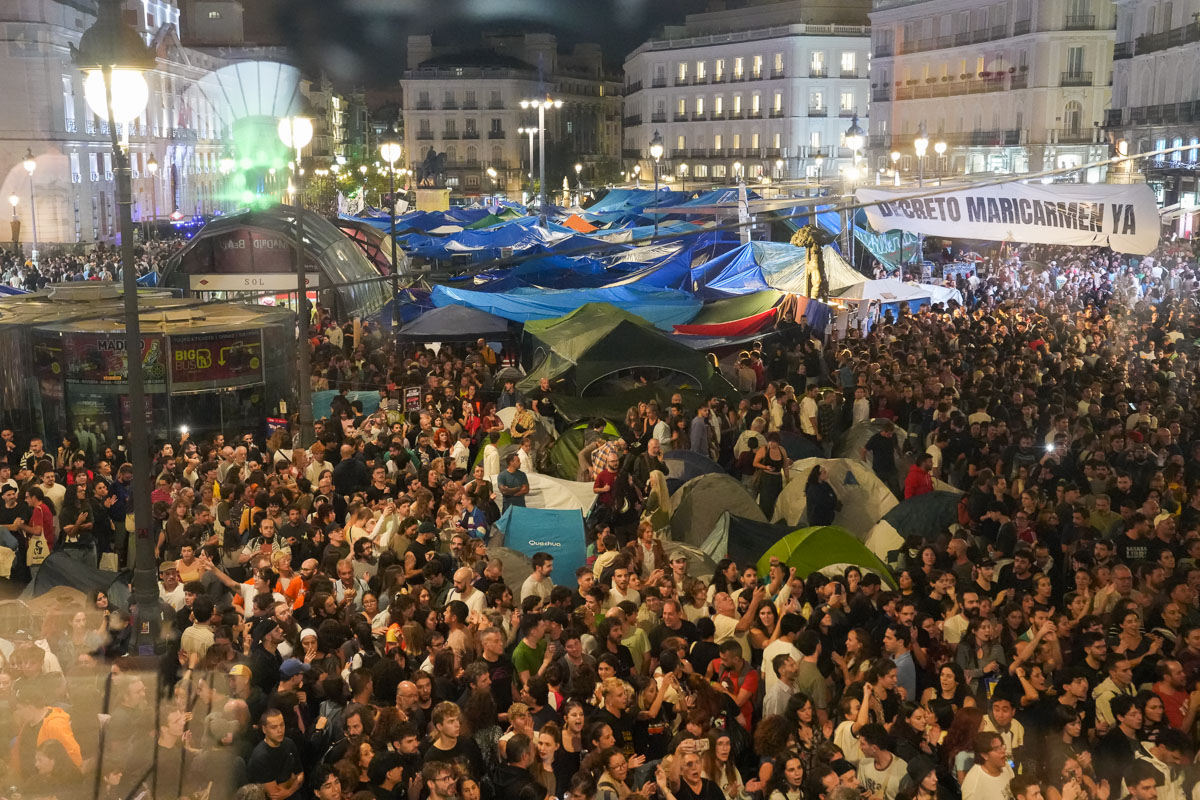
Spain’s snap election of 29 November 2026 is in large measure a housing election. In October, parliament voted on emergency decrees introduced by Prime Minister Pedro Sánchez, leader of a minority coalition government, to tackle the country’s housing crisis: an eviction moratorium, a crackdown on tourist rentals, curbs on corporate buyers, tighter controls on rent increases, and a strengthening of tenant security. But opposition parties blocked the measures. Sánchez’s response was to bring forward the country’s scheduled 2027 election, seeing an immediate vote as the only way to overcome legislative gridlock and secure a stronger mandate for progressive housing reform.
Commentary on the election and the housing crisis precipitating it has tended to focus on recent events. The main flashpoint concerned an eighty-seven-year-old pensioner named María del Carmen “Maricarmen” Abascal Martín, who had lived in her rental apartment in Madrid since the 1950s. In 2018, a real estate company called Urbagestión Desarrollo e Inversión S.L. bought the apartment and proceeded to demand a rent increase that Maricarmen couldn’t afford. In 2020, Urbagesa sued to evict her, and the courts ruled in its favor. There followed a multi-year tussle—supporters including tenants’ unions successfully halted three eviction attempts—before finally, on 23 September 2026, police evicted the infirm Maricarmen, removing her from her apartment on a stretcher while using tear gas and batons to clear crowds of protesters.
Three days later, a demonstration march through Madrid converged on Puerta del Sol, a square in the heart of the city, and culminated in hundreds of protesters pitching tents to establish an encampment and demanding emergency tenant protections. This, together with a flurry of outraged media headlines, prompted Sánchez’s government to hastily formulate its emergency decrees. The coverage also shamed Urbagesa into agreeing to let Maricarmen return home at her original, affordable rent. But it was too late: her health had declined, she was in hospital, and she died there on October 7.
If Maricarmen’s story was arresting, the underlying issues were neither new nor specific to Madrid and Urbagesa. Spain has been in a housing crisis, and has been vigorously protesting it, for nearly twenty years. Why is it that housing in the country is such a prominent lightning rod for popular discontent, when housing provision and affordability is a mess more or less everywhere? The answer has to do with the special, deeply rooted place of housing in the country’s social and economic dispensation.
Franco’s house society
The French anthropologist Claude Lévi-Strauss argued that housing provision is a primary foundation of social organization in all societies. By thinking and writing about “sociétés à maison”—house societies—Lévi-Strauss was inviting us to approach and understand societies through the ways in which they house themselves—or fail to. “Nothing,” the English journalist Vicky Spratt writes, “holds society together or tears it apart like housing.” So what type of house society is Spain’s?
The foundation of Spain’s contemporary house society was laid in the 1950s under Franco, whose dictatorship began in 1939. As late as mid-century, renting dominated Spain’s major cities, accounting for around 95 percent of households in both Madrid and Barcelona. But renting was anathema to Franco and his Falangist ideologues, who saw it as antithetical to the stable social order they sought to engineer. Only homeownership would do. “We do not want a Spain of proletarians,” José Luis de Arrese, Franco’s first minister of housing, declared in a famous speech in 1959, “but a Spain of proprietors.”
Franco’s housing policy was a complex web of inducements and indictments. Deeming landlords to be little more than worthless parasites, he maintained and reinforced wartime rent controls. This kept rents cheap. But it also disincentivized landlords to maintain their properties, which, combined with the regime’s anti-rental and pro-ownership rhetoric and the availability of subsidized mortgages, led households to strongly favor owner-occupation. Indeed during the 1950s and 1960s, facing these hostile ideological and economic conditions, landlords sold out en masse, typically to sitting tenants.
Meanwhile the administration also encouraged a massive wave of new residential construction through the provision of cheap land, tax exemptions and subsidized developer loans. Almost all of this construction, seeding huge new housing estates to absorb migrants leaving the countryside for Madrid, Barcelona and other cities, was for owner-occupation, partly because that was what households favored, and partly because rent controls meant nobody wanted to be a landlord. What the postwar Spanish state, unlike many northern European states of the era, did not do on any substantive scale was build public rental housing, which would have flatly contradicted its homeownership ethos, not to mention cost money it didn’t have—subsidizing private development was much cheaper than investing publicly. The upshot of all this was a massive, decades-long switch in urban areas from renting to ownership. By 1975, only around a quarter of households nationwide were still renting.
Franco died that year. But the political and cultural privileging of homeownership that the dictator had successfully contrived in postwar Spain did not die with him. With the transition to democracy in the late 1970s and early 1980s, Spain doubled down on ownership. The mechanisms shifted, however. In place of supply-side instruments, Spain’s democratic governments of the late 1970s onwards privileged demand-side measures. If, under Franco, household mortgage finance had been cheap, it had also been rationed. A range of liberalization reforms subsequently deregulated the sector, creating a deep, competitive mortgage market and thus making it much easier than it had been for a larger share of the population not only to borrow-to-buy, but to borrow more. At the same time, tax reform introduced deductions for investment in a main residence and gave a personal tax credit on payment of both mortgage principal and interest. These reliefs remained in place into the 2000s, by which time over 80 percent of Spanish households were owner-occupied. No other western European country now had a higher share. Spain was the quintessential homeownership society.
The new Spain
It has long been said that there are “two Spains”—las dos Españas, immortalized in the 1910s verse of the poet Antonio Machado—which are in perennial tension with one another, pitting, in journalist Tobias Buck’s words, “right against left, reaction against reform, religious against secular, tradition against modernity.” The death of Franco was supposed to have ended that. La Transición was widely lauded, both in Spain and beyond, for burying the country’s divided legacy. The “new” Spain represented, so the narrative went, a unification of the nation’s two erstwhile alter egos. It was a triumph of the national spirit in overcoming deep divides, a shared national project forged through compromise and consensus.
But not everyone bought it. Renegade figures including historian Josep Fontana and novelist Rafael Chirbes argued that Spain’s divisions had merely been papered over, not healed. Key power structures of the old regime—the military, the judiciary, the Church—remained intact, even as Spain was now “democratic.” Moreover, there was a direct lineage between leading figures in the dictatorship and many of those holding the most wealth and political influence in the new Spain. As the critics saw it, the transition effectively constituted a “pact” between Spaniards and their new leaders. Partly this entailed forgetting: a tacit agreement to focus not on the past, but on the future. To let bygones, up to and including the crimes of the dictatorship, be bygones. There was more to it than that, however. The pact was also understood as the price that ordinary Spaniards were expected to pay for prosperity. The new political elites would provide rising living standards if the population at large tolerated the maintenance of networks of privilege, patronage and corruption. Such, implicitly at least, was the deal. Parties distributed public jobs, contracts, and resources to build loyalty, with the creation of the Comunidades Autónomas at the end of the 1970s multiplying the number of regional governments with distributable budgets at their disposal.
Housing was crucial to all this. Rising homeownership rates and property values were elites’ central promise to the masses. Regional political appointees sat on the boards of the cajas, Spain’s savings banks. Alongside mortgage market liberalization and mortgage tax relief, the cajas were the main politically mediated channel through which the housing market was supported in the post-Franco decades. They expanded their branch networks and lent aggressively both to households and to developers and builders. The housing-based pact satisfied a sufficiently wide electoral base to ensure social and political stability.
However, housing became a bubble. “Attracted by the possibility of ‘flipping’ rapidly appreciating assets, speculative investors rushed to the real estate market,” writes historian Javier Moreno Zacarés. “But this rush of speculative demand inflated property prices in turn, forming a loop that grew increasingly decoupled from the underlying demand for housing.” Between 1995 and 2007, Spanish home prices increased by 125 percent in real terms, similar to other European countries with significant contemporaneous housing bubbles, such as Ireland. This wouldn’t have been possible without abundant, cheap and lightly regulated debt. The cajas and other Spanish lenders borrowed prodigiously from French and German banks to fund their lending spree. Thus, as house prices climbed, so too did the volume of household mortgage debt underpinning the whole house of cards, growing from just €100 billion in 1999 to some €600 billion in 2008.
Of course, Spaniards were far from the only ones in the early years of the new millennium to borrow extravagantly and bid up house prices to stratospheric levels, and Spanish lenders were far from the only ones to encourage such behavior. But Spain was distinctive. Proportionally, more of its people were homeowners than in any of the other countries with housing bubbles at that time, meaning society as a whole was much more exposed to a housing downturn. Even more important was how little else there was to the economy and to national patterns of wealth accumulation.
Franco’s had been a Spain largely of state-owned, uncompetitive industrial capitalism. With the country’s democratic turn, tourism and real estate came to the fore, although the industrial sector endured in parts of the north. In the mid-2000s, when Spain was building more homes (in absolute terms) than the US, 14 percent of workers (and a quarter of all male workers) were employed in construction, and that sector’s share of national economic output was 22 percent. But tourism and real estate were always decidedly fragile pillars on which to build a modern economy, both being inherently vulnerable to abrupt shifts in sentiment and in underlying economic conditions, not to mention deeply entwined with one another. What’s more, most ordinary Spaniards had little to fall back upon, family support aside, if and when the housing bubble burst. Few households held substantive savings or non-property investments. Household wealth essentially comprised housing and little besides.
As the 2000s went by, soaring house prices became more and more detached from average household incomes, which were modest at best. So wide did the gap become that by 2007, Spain’s national wealth-to-income ratio—effectively a measure of the extent to which a country’s accumulated wealth outpaces its generation of current income flow—was the highest recorded for any country in the world in over one hundred years: 700 percent. Moreno Zacarés has described it as an “asset-price economy.” But we can be more precise than that. It was a house-price economy.
The broken pact
Then came the crash. When financial markets in America froze in 2007–2008, Spain, more than anywhere else overseas, caught a cold. Interest rates spiked, causing indebted homeowners to default on mortgages across the country. Over the next decade, around three-quarters of a million mortgaged households would ultimately be foreclosed upon by their lenders. Meanwhile, with developers also now defaulting and demand for new housing collapsing, the construction industry was decimated, causing substantial collateral damage in adjacent sectors. Unemployment surged, briefly exceeding 25 percent in 2013. It was a terrible reckoning.
The collapse of Spain’s residential house of cards—nearly twenty years on, real house prices still haven’t recovered to their 2007 peak—proved that the homeownership promise had been false. The ensuing crisis scuppered Spaniards’ promised futures of upward social mobility. Homeownership had represented for many ordinary Spaniards their solitary substantive stake in the national project of the “new” Spain. By the turn of the decade, it represented merely a broken promise.
As Spaniards understood it, elites had reneged on the country’s unspoken moral and economic bargain: there had been a social contract in place, and it had been transgressed. Buck paraphrased the mood thus: “We trusted our leaders, but they failed us. We trusted our banks, but they betrayed us.” Spaniards thus turned against those who had let them down with unconcealed fury. When banks such as Bankia—the country’s largest real estate lender at the time of the crash—were denounced, it was not just for repossessing homes. It was for duplicity and perfidy.
In 2009, in Barcelona, a new grassroots organization was established, called the Plataforma de Afectados por la Hipoteca (PAH), the Platform for People Affected by Mortgages; it soon spawned local chapters across the country. PAH’s mission was evident in its name: it was there to help those on the wrong side of the housing market collapse. Public demonstrations against Spain’s banks became a common occurrence. Activists also physically blocked attempted evictions of foreclosed homeowners, forming human chains to stop repossessions from taking place. Other notable physical interventions included the squatting of bank-owned dwellings. Meanwhile, PAH sought political and legal redress, lobbying for re-regulation of Spanish mortgage law.
Foreclosures and repossessions peaked between 2009 and 2012 and eventually subsided. This, however, did not mean that Spain’s housing crisis was over; in some respects, it was just getting started. What began as a crisis of homeownership indelibly morphed, by the mid- to late 2010s, into a crisis of rent. When the financial crisis hit, Spain’s rental market was small, housing less than a fifth of Spanish households. But since the beginning of the 2010s it has grown substantially bigger and, as a result, significantly more important to Spanish society. On the supply side, there was now an understandable preference among both financial institutions holding foreclosed homes and developers holding newly built stock to put these properties into the rental sector rather than sell at a loss in a depressed ownership market. Meantime, rental demand was growing simply because people now couldn’t buy, even if they wanted to. Banks tightened mortgage lending criteria, and unemployment had risen steeply, especially among the young, which is where newcomers to homeownership principally are found.
The 2010s also saw sharply rising rents. Residential construction had gone into a deep freeze since the financial crisis, falling by fully 90 percent between 2006 and 2018. In 2013, the government changed rent regulations to make it easier for landlords to raise rents on existing tenancies. Between 2013 and 2020, rents nationwide increased by 50 percent. And so, by the mid- to late 2010s, instead of mortgage arrears, Spain’s signature social problem when it came to housing sustainability was fast becoming rent arrears and the eviction of delinquent renters. The government’s 2013 rent reforms also made it easier for landlords to evict.
PAH responded to these changing circumstances and challenges by changing itself. Having been formed in 2009 to help those “affected by mortgages,” it switched to supporting distressed, at-risk renters, including by helping form tenants’ unions, starting in Barcelona and Madrid in 2017. With the shift to the rental sector as the main site of housing contention came new aims, targets and protest tactics. Among the main demands leveled by Spain’s new tenants’ unions were fair rent increases, new legislation to curb rent gouging, and collective rent bargaining. And instead of targeting the institutional holders of soured home loans (mainly banks), as PAH in its original incarnation had done, the tenants’ unions now targeted landlords, especially those that were seen to be aggressive in hiking rents and evicting struggling tenants.
Hence, a new bête noire came into view. Petit landlordism was on the rise—between 2002 and 2017, the share of Spanish households owning two or more dwellings and receiving rent from tenants increased from 4 to 11 percent—but that’s not where tenants’ animus was directed. Spain’s aggrieved renters and the activists agitating on their behalf expressed their indignation most fulsomely against bigger, corporate landlords and especially against the US-based financial institutions that were increasingly active in the country’s rental sector. The primary target would be the US private equity firm Blackstone, whose acquisition of a controlling stake in the vast real estate portfolio of Banco Popular in 2017 made it Spain’s biggest private real estate owner.
The period since the financial crisis has been especially dismal for Spain’s young. Between 2007 and 2013, the unemployment rate among sixteen- to twenty-four-year-olds climbed from 18 to 57 percent, and it remained at 23 percent at the end of 2025, the highest in Europe. A report published in 2024 showed that the average monthly rent for young Spanish adults was €944, equating to a remarkable 94 percent of the average post-tax salary for the same cohort, of €1,005 per month. One consequence has been relentless growth in the proportion of young adult Spaniards living in their parents’ home, which reached around 85 percent for sixteen- to twenty-nine-year-olds in 2024. The average age of those leaving the parental home has risen to over thirty—unique in Europe.
New housing visions
Nearly two decades on from the global financial crisis, housing is indisputably still the leading social issue in Spain. And even before the horror of Maricarmen’s eviction and death, Spaniards were taking to the streets to protest. In April 2025, coordinated housing protests resounding to chants of “end the housing racket” were held in around forty cities nationwide, with up to 150,000 people protesting in Madrid alone.
As the trigger for the snap election, housing has dominated the current campaign, which was punctuated by a twenty-four hour general strike—the country’s first in fourteen years—organized by tenants’ unions in protest at the housing crisis, and in which more than three million people took part, resulting in blockaded roads and clashes with the police. The day after the strike, the country’s interim parliament passed a truncated package of the decrees voted down in October. To appeal to voters, the main parties have campaigned for strikingly different house societies. Sánchez’s Socialists want a society in which the state is much more interventionist in housing arrangements than it is now, specifically to help those on society’s vulnerable margins, which means stricter rental regulation—the full package of October’s decrees, essentially—plus more public housing; at present less than 2 percent of Spanish dwellings are publicly owned. Sánchez’s vision is of a more egalitarian house society. His fear, which he has been expressing for several years, is that Spain is heading in precisely the other direction and risks becoming, as he put it last year, “a society divided into two classes, the rich landlords and the poor tenants.”
Sánchez’s main rivals, the conservative People’s Party, have rallied behind the tired housing vision and policy instruments familiar from so many neoliberal polities around the world since the 1980s. Cutting red tape to enable building the new homes Spain needs. Help for first-time buyers in the form of tax cuts and mortgage guarantees. Recommitment to Spain’s broken homeowner-society model, in other words. For good measure, the PP has thrown in a sop to the country’s landlords: a mechanism to evict squatters within 48 hours by court order.
Finally, there is the far-right Vox, whose support, if polls are believed, could get the PP across the line on election day. Vox supports some of the same measures as the PP, particularly deregulation designed to boost construction. But its diagnosis of the country’s problems and suggested policy measures also depart from the PP’s in important ways. Like far-right parties in other parts of Europe, notably Germany and the Netherlands, Vox explicitly links housing affordability pressure to “mass illegal immigration”, and explicitly favors prioritization of the housing needs of Spanish nationals. Its proposals—again, mirroring those of other European far-right parties—represent a kind of welfare chauvinism. They include building more public housing, to which Spanish nationals would be given priority access. Vox would also give tax exemptions on a Spaniard’s first home purchase while introducing higher taxes on foreign buyers. Its house-society imagination is, in short, a much darker one than that of the PP or Socialists. It’s impossible to say with any certainty which way Spain will vote. The only thing that seems certain is that housing will continue to be nothing less than pivotal to how Spanish society understands and organizes itself for many years to come.
Further Reading
Growing Pains
Spain’s search for a new growth model
How can a Sánchez administration that enacts a successful progressive agenda—and a PSOE party that retains and even increases its share of voters while handling...

Transitions
Four voices on Spain's transition from the Franco dictatorship to parliamentary monarchy — and what didn't change.
It’s been some time since the term “transition” was fully incorporated into day-to-day usage in contemporary Spanish. It refers to the process of political change...

New System, New Society
An interview with former Prime Minister of Spain Felipe González.
Felipe González was Prime Minister of Spain from 1982-1996.