August 15, 2026
Analysis
Peru’s So-Called Paradox
The election of Keiko Fujimori empowers an extractive growth regime
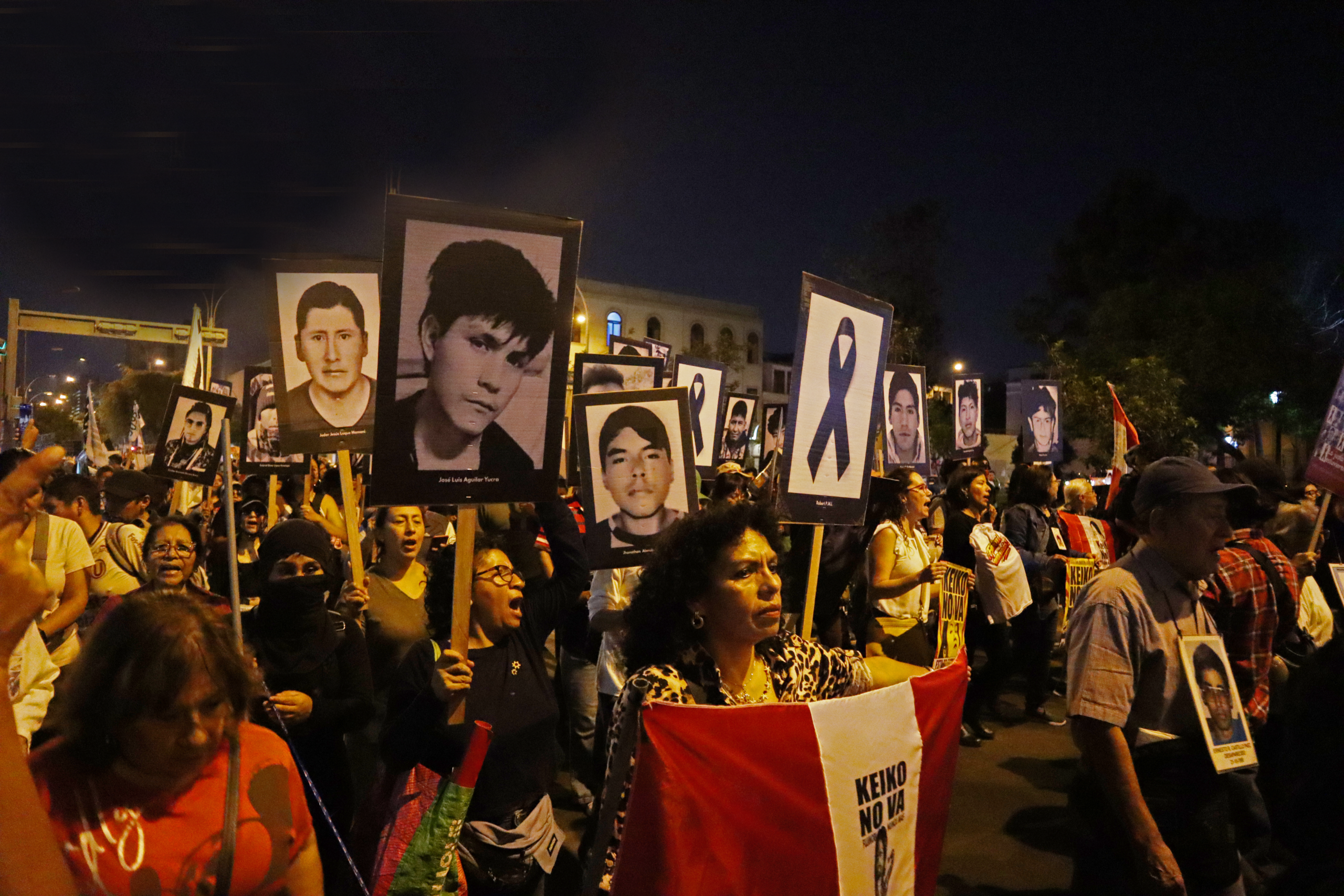
On July 28, Keiko Fujimori, daughter of Peru’s former dictator Alberto Fujimori, was inaugurated as the country’s incoming president. After three previous failed attempts at the office, Fujimori succeeded by promising to bring an end to a decade of intensifying crises in Peruvian politics: she will be the tenth president to serve in the past ten years in Peru due to a series of impeachments, resignations amid corruption scandals, and fragile party coalitions. She won the second-round election with 50.13 percent of valid votes—the slimmest-ever margin for a presidential election.
The country’s political instability has long coexisted with surprising macroeconomic stability: consistently low inflation and a sound currency. This contrast between politics and economics is widely referred to as the “paradox” of Peruvian political economy. It is attributed, both domestically and internationally, to the country’s efficient technocracy, particularly its longtime central bank president Julio Velarde and his fierce management of the country’s monetary policy. With vows to stabilize party politics and guarantee macroeconomic security by reelecting Velarde, Fujimori presented herself as uniquely able to bring the paradox decades to an end.
The hypocrisy of these claims is apparent. Since 2016, Fujimori and her party, the right-wing Fuerza Popular, have engineered a significant portion of this political chaos by consistently working to obstruct the government. In 2022, Fuerza Popular conspired with Congress to oust the leftist president Pedro Castillo in favor of Castillo’s vice president, Dina Boluarte, who murderously repressed the large protests that ensued in the wake of Castillo’s impeachment and imprisonment.1Pedro Castillo announced an in-constitutional dissolution of the Congress that led to his express impeachment and his immediate imprisonment, but Congress and elite actors had mounted a campaign against his government even before he assumed power, which included attempts to overturn the election, a general blockage to reforms, constant threats, and an impeachment process. In 2026, Fujimori’s right hand and vice-president elect, Miguel Torres, admitted that their objective was to (irregularly) end Castillo’s government by exerting constant pressure. Boluarte’s government, both illegitimate and unpopular, honored its alliance with Fuerza Popular by instituting three days of national mourning for the death of Alberto Fujimori, who was sentenced to twenty-five years in prison for human rights abuse and corruption but pardoned on humanitarian grounds in 2017.
Moreover, the framing of the Peruvian paradox itself misconstrues the relationship between the country’s political and economic spheres: Peru’s political and democratic decline is in fact intimately related to its macroeconomic status quo. Since the introduction of the country’s 1993 Constitution, a growth model centered on extractive commodity exports—particularly mineral exports—has consistently generated social and environmental conflict while doing little to reduce stark territorial and urban inequalities, overcome informality, or durably eliminate poverty. This model is predicated upon the need for constant foreign direct investment (FDI) and large foreign reserve accumulation, which further strengthens extractive industries and weakens alternative drivers of investment.
Peru’s twenty-first century economy has managed to persistently avoid the sort of economic crises that have plagued nearby countries like Venezuela, Bolivia, and Argentina, all of whom, for various reasons, suffered balance of payments adjustments that led to higher inflation and recessions. But stabilizing inflation is not equivalent to a strong developmental agenda. The insulation of the central bank, the Banco Central de Reserva del Peru (BCRP), from scrutiny, together with the reverence given to its leader, erodes opportunities for democratic debate on the prospects for more inclusive development. In its absence, the state turns to force to address escalating unrest.
An economic miracle?
Peru was a latecomer to industrialization. Until the 1960s, its longstanding and powerful landed oligarchy stood in the way of structural reform. Then in 1968, a military government led by Juan Velasco Alvarado took power and sought to redistribute land and advance industrialization. It carried out a series of agricultural reforms and sectoral nationalizations, such as the expropriation of the holdings of the International Petroleum Company, a subsidiary of Standard Oil of New Jersey. For a handful of years, Peruvian leaders attempted to refashion agriculture and industry such that power would be transferred to participatory cooperatives that incorporated the historically forgotten and abused rural indigenous populations.2See Carlos Aguirre and Paulo Drinot, eds., (<)em(>)The Peculiar Revolution: Rethinking the Peruvian Experiment Under Military Rule(<)/em(>) (Austin: University of Texas Press, 2017).
This peculiar form of state capitalism quickly reached its limits. The country’s industrialization push was not able to overcome entrenched forms of economic dependence, including reliance on the import of capital goods and demand for dollars. Furthermore, the Peruvian state lacked the capacity and political mandate to structurally alter accumulation dynamics. Strong political pressure from within the government and the military ultimately put an end to these developmental ambitions.
Beginning in the late 1970s, and especially after the Volcker Shock of 1979, Peru was buffeted by successive balance of payments crises, IMF interventions, and policy experimentation by democratic governments right and left. Orthodox and heterodox shock programs, as well as gradualist alternatives, failed to lead the country’s economy onto a path of sustainable growth and industrial development. The crises were compounded by the large internal rural-to-urban migration that was enlarging the underemployed informal workforce in cities. An onslaught of attacks by the Maoist guerilla group Shining Path and the dirty counter-war by the Peruvian state in the 1980s resulted in nearly seventy thousand deaths, largely in peasant communities. The “lost decade” of debt and hyperinflation took an especially brutal form in the Peruvian context.
Alberto Fujimori was elected in 1990 on a platform that rejected neoliberal policymaking, but he changed course even prior to his inauguration. The so-called “Fujishock”—a sudden revocation of subsidies and price controls as well as the institution of a floating exchange rate which caused everyday essentials to double or triple in price overnight—was followed by deep structural reforms, privatization, and the general dismantling of the development state apparatus, including the elimination of the developmental bank and planning offices. Under the pretext of combating hyperinflation, Fujimori dissolved Congress, dismissed the judiciary, and seized dictatorial power with military support. What followed was a brutal campaign of arrests and firings that replaced journalists, judges, and government officials with regime representatives.
In 1993, Fujimori proposed a new constitution that was passed by a public vote of 52 percent. Beyond concentrating executive political power, the constitution enshrined a Pinochet-style economic program that banned discriminatory policies against foreign investment and the imposition of exchange controls. The activities of Peru’s central bank were constrained to maintaining price stability, with monetary financing prohibited.
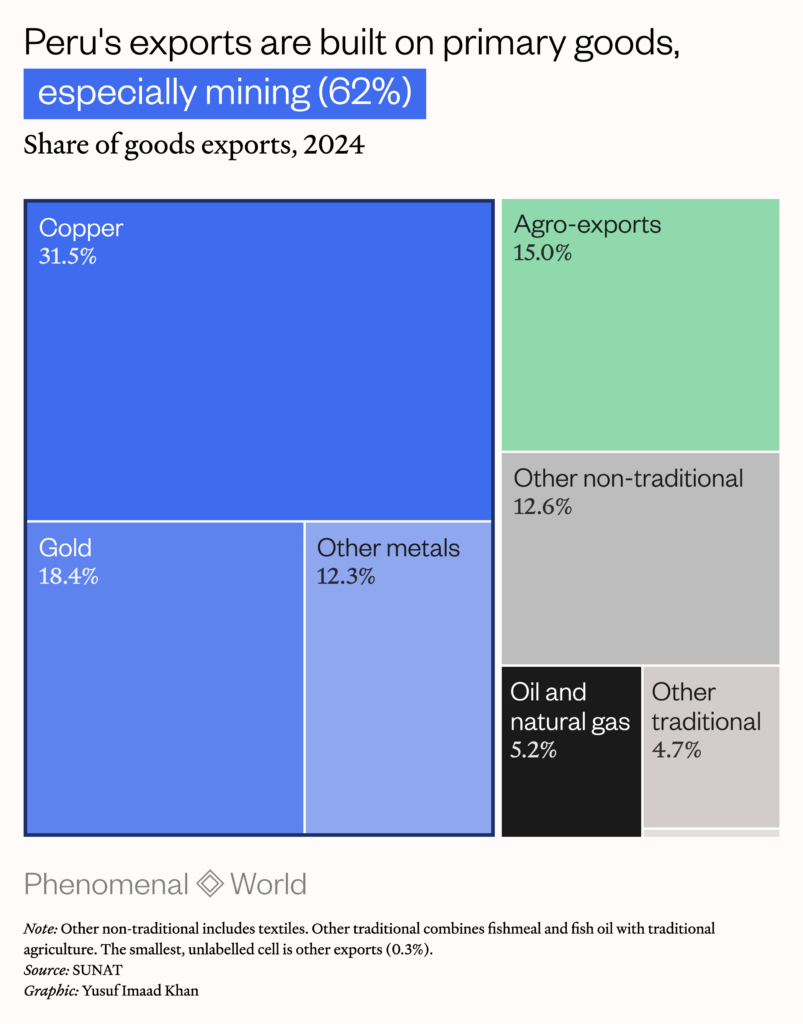
As a small and suddenly open economy in a globalized world, Peru’s position as a dependent commodity exporter, particularly of primary goods, became more deeply entrenched. A new mining code reinforced by the 1993 Constitution fully privatized the industry and granted foreign investors equal industry access to national ones.3See S. Gruber and J. C. Orihuela, “Deeply Rooted Grievance, Varying Meaning: The Institution of the Mining Canon,” in (<)em(>)Resource Booms and Institutional Pathways: The Case of the Extractive Industry in Peru(<)/em(>), ed. E. Dargent et al. (London: Palgrave Macmillan, 2017), 41–67. A large number of constitutionally protected concessions offered both foreign and domestic mining companies protection from taxation. Copper and other metals came to represent more than half of exports, with an emerging agricultural export market constituting around 15 percent.
Standard accounts of Peruvian political economy position the constitutional reforms as the reason for the subsequent economic miracle. Indeed, between 1990 and 1996, Peruvian inflation fell to single digits, and privatization earnings and tax reforms reconstituted the country’s fiscal position. Yet the country’s macroeconomic reality was complex. Growth improved modestly, but it was volatile and stood on average at 1 percent. The central bank faced a grave challenge in 1998 when Russia defaulted on its foreign debt. Peru had significant exposure as a result of its opening to foreign flows and the dollarization advanced by the 1990s reforms, and the central bank was unable to impede the onset of a banking crisis due to currency mismatches in Peruvian banks. The recessionary effects, compounded by natural disasters like El Niño and the political demise of fujimorismo, lasted until 2001.
Notably, the 1998 crisis was decisive in defining the operative mechanisms of Peru’s central bank for the following decades, tempering some of the most radical reforms of 1993. In its aftermath, the officials at the helm of the BCRP, including left-leaning economists, introduced a new regime organized around counter-cyclical policies to resist deflationary trends, the accumulation of foreign reserves, and tacit management of a floating exchange rate. Underpinning all of this was a sustained push for de-dollarization—an effort that extended well beyond the central bank, and, as former BCRP acting president Oscar Dancourt explained in an interview, one that first required defeating those advocating for adopting the dollar outright, as Ecuador did in 2000. None of these features, nor the cardinal idea of managing the exchange rate alongside price stability, were present in the central bank’s organic law or the 1993 constitution. Rather, they were part of a creative learning process undertaken by a plural group of officials who recognized the risks of subordinated financialization. But while this moderation of neoliberalism helped maintain stability, it did not fundamentally alter the country’s dependent position within the global economy.
The real growth “miracle” would come in the early twenty-first century, after Fujimori resigned in 2000 amid massive protests over a corruption scandal and an election widely considered to be fraudulent. Between 2002 and 2013, Peru’s GDP grew at an average of 6 percent. Inflation remained low and the domestic currency appreciated due to the capital inflows coming from the country’s export boom. Importantly, the period also saw notable declines in inequality and poverty rates—from 50 percent at the end of Fujimori’s government to 20 percent in 2018—due to targeted social policies as well as increased employment and access to credit.4The employment was not necessarily high quality, and high interest rates limited the benefits accrued to small borrowers, meaning that while many did move out of extreme poverty, they did not necessarily obtain reasonable living standards.
But above all, these positive trends were buoyed by the commodity boom of the 2000s, which was driven by demand in emerging markets (in particular, China) and aided economies across Latin America.5For a Latin American comparison see José Antonio Ocampo and Luis Bértola, (<)em(>)The Economic Development of Latin America since Independence(<)/em(>) (Oxford: Oxford University Press, 2013). As this super cycle ended, Peru’s growth rate diminished with rates across the continent, moving from the 6 percent average of the 2000s to 3.5 percent in 2014, then to a meager 1.8 percent in the years after Covid-19. There has also been a profound reversal of poverty rates in the post-pandemic years: Covid exposed the precarity of Peru’s economic progress given the speed with which economic security evaporated for millions of people in the informal economy. While improved terms of trade—superior even to those during the super cycle—are now resulting in a forecasted growth of 3.2 percent, the lasting consequences of the US–Israel war against Iran, as well as domestic turmoil and the threat of the worst-ever El Niño this year, threaten this recovery.
The risks of export success
The same macroeconomic policies that generate growth in Peru also generate inequality and precariousness. Economists including Germán Alarco Tosoni and Félix Jiménez argue that export success in primary goods has likely led to Dutch disease—financial flows from the mining industry that appreciate the currency, crowd out other value-added activities and slow internal motors for aggregate demand.6A version of this argument stressing the connection between monetary policy and industrial development was recently restated in Germán Alarco, Patricia del Hierro, and Luis Rodrigo Díaz, (<)em(>)Banca Central y Política Monetaria en Latinoamérica(<)/em(>) (Lima: Otra Mirada, 2026). Currency appreciation also increases the demand for imports as domestic substitutes fall prey to the re-primarization process, putting pressure on the trade balance. These effects are most apparent in manufacturing. The growth experienced during the 1990s actively reversed the incipient industrialization from earlier decades, prompting a turn to “premature de-industrialization,” as Jiménez has argued: manufacturing’s contribution to economic growth fell from 17.7 percent in 2003 to 6.4 percent by 2015.
There have also been severe effects in the traditional agriculture sector. The country’s open trade regime has made imported food increasingly competitive against domestically produced staples. This trend is reinforced by the restaurant and hospitality sectors’ preference for standardized, lower-cost inputs, such as imported potatoes (despite Peru being the historical birthplace of the cultivated potato and still maintaining significant potato production). Absent active public policy intervention, traditional agriculture is headed toward decline, threatening food security in the country and the livelihood of a significant fraction of the population.
Peru’s economic growth has made informal employment an essential feature of the country’s economy. Mining employs few workers: the sector currently represents around 9 percent of GDP, and more than 60 percent of exports, but gives direct employment to less than 2 percent of the active work force. The informal service sector amounts to around 70 percent of the active workforce but only amounts to 17 percent of GDP. Notably, informality is not confined to the informal sector: approximately one-fifth of informal workers are employed within formally registered firms, revealing that even the country’s formal sector relies on cheaper, unregulated labor. This model preserves regional hierarchies and inequalities, generating few productive non-extractive linkages between different economic activities throughout the territory.7Efrain Gonzalez de Olarte has offered views on the sectoral and spatial articulation of Peru’s economy in diverse works. One recent paper measures the productivity differentials in the formal and informal sector with the help of an input-output table: “Informalidad, productividades e ingresos en el Perú: Análisis sectorial,” Working Paper no. 546, Departamento de Economía, Pontificia Universidad Católica del Perú (PUCP), 2025.
Moreover, the commodity super cycle that powered the economy also strengthened informal and illegal actors who continue to contest the state’s regulatory power—from those carrying out informal mining to players in the drug trade who benefit from the money laundering potential of Lima’s sprawling service economy.8See Juan Pablo Luna, Andreas E. Feldmann, and Eduardo Dargent, “Greater State Capacity, Lesser Stateness: Lessons from the Peruvian Commodity Boom,” (<)em(>)Politics & Society(<)/em(>) 45, no. 1 (2017): 3–34; and Zaraí Toledo Orozco, “Informal Gold Miners, State Fragmentation, and Resource Governance in Bolivia and Peru,” (<)em(>)Latin American Politics and Society(<)/em(>) 64, no. 2 (2022): 45–66. A weak and constrained state governs these actors through “non-enforcement,” deliberate “forbearance,” or outright complicity, tolerating them due to their usefulness for producing employment, as scholars such as Alisha Holland have argued.9See Alisha C. Holland, (<)em(>)Forbearance as Redistribution: The Politics of Informal Welfare in Latin America(<)/em(>) (New York: Cambridge University Press, 2017); and Matías Dewey, Cornelia Woll, and Lucas Ronconi, “The Political Economy of Law Enforcement,” MaxPo Discussion Paper no. 21/1, Max Planck Sciences Po Center on Coping with Instability in Market Societies, Paris, 2021.
Peru’s open economic regime introduces external vulnerabilities as well, not just in the trade balance, but in the whole balance of payments. The country relies on FDI to stave off any balance of payments crises. However, these inflows come with sudden and systematic financial outflows, given that the favorable conditions for securing high returns to foreign investment, such as lower regulatory standards, international arbitration conditions and commitments to an easy capital exit guaranteed by large international reserves, facilitate the repatriation of profits. Short-term financial flows, in particular, are prone to sudden volatility. Longer-term FDI flows and export dependence generate risks to the country’s current account, which is plagued by a structural deficit in services and primary incomes. Exports of goods and FDI investment both depend on foreign professional services like freight, scientific expertise, and legal and financial consulting. Returns from FDI thus ultimately finance growing external indebtedness, both private and public.
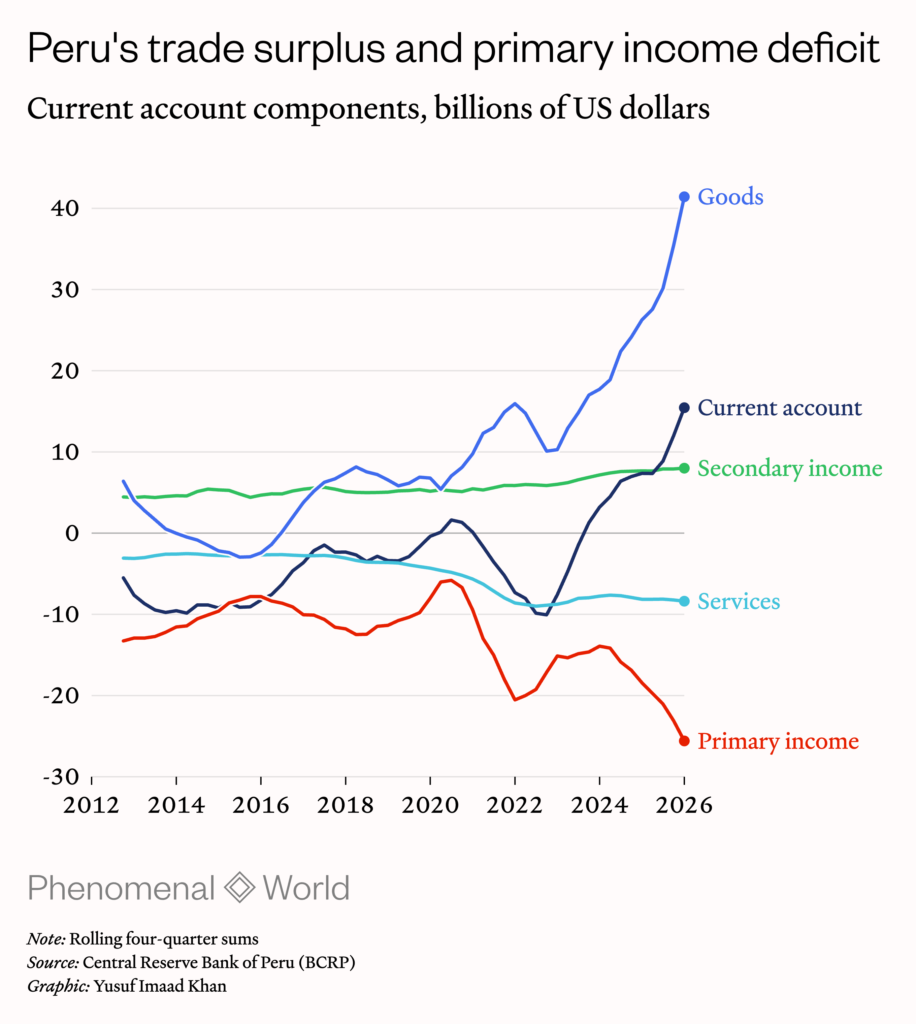
This circulation of capital would not be a problem if investment flows were oriented towards driving technical and structural change and scaling up the complexity of Peru’s production and exports.10For more on the importance of structural change in developing economies, see Gabriel Porcile and Giuliano Toshiro Yajima, “New Structuralism and the Balance-of-Payments Constraint,” (<)em(>)Review of Keynesian Economics(<)/em(>) 7, no. 4 (2019): 517–36. Instead, these flows are further entrenching re-primarization. As scholars Samuele Bibi and Sebastian Valdecantos put it in Minskyan terms, Peru’s external accounts profile, when the export winds are weak, has the form of an unsustainable Ponzi scheme.
This structural weakness is counterbalanced by the country’s low public spending, a large low-wage and informal workforce, large remittances flows from emigrated Peruvians and the favorable terms of trade of Peru’s export basket. Balance of payments crises are prevented through interest rates hikes that lure foreign capital, macroprudential (reserve) requirements to rein in hot foreign financial flows, and the accumulation and management of foreign reserves to both intervene in the open exchange market, and to dissuade—by signaling the capacity for further interventions—speculative attacks on Peru’s currency.11 See Renzo Rossini, “La política monetaria del Banco Central de Reserva del Perú,” in (<)em(>)Política y estabilidad monetaria en el Perú,(<)/em(>) ed. Gustavo Yamada and Diego Winkelried (Lima: Universidad del Pacífico, 2016).
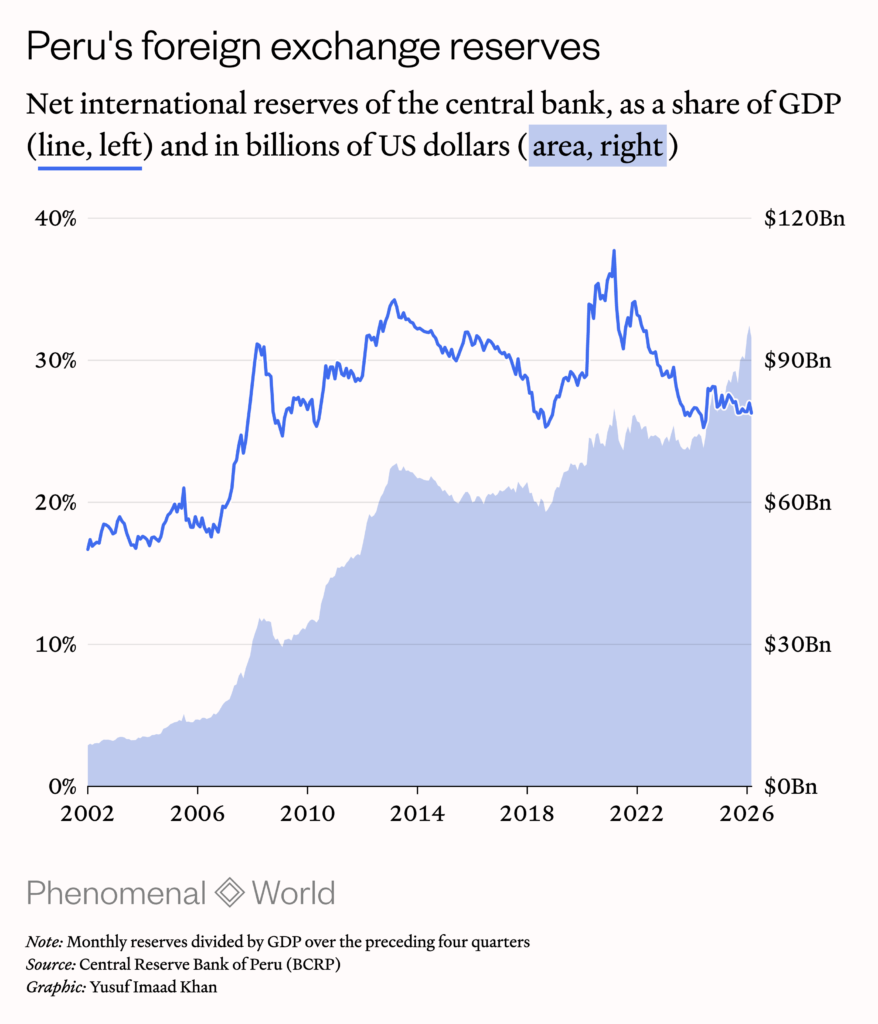
Indeed, BCRP’s large foreign exchange reserves have become a centerpiece of Peru’s macroeconomic stability. Foreign reserve accumulation works as insurance against a volatile financial market that can excessively punish economies with currency at lower levels in the monetary hierarchy, and is a strategy that has been used by numerous peripheral economies since the instabilities of the 1990s. However, even in comparison to other Latin American countries, Peru’s accumulation of reserves is particularly large. It not only leads in foreign reserves as a share of GDP in Latin America in the last decade, but boasts double the continent’s average amount of reserves.
Large foreign reserves give Peru some degree of monetary policy autonomy, despite open capital accounts, enabling the central bank to reduce the volatility of the exchange rate and signal to markets about the availability of liquid currencies, which pacify nervous investors. Their opportunity costs are far less discussed.12For instance, the accumulation of reserves entails sterilized interventions by the Central Bank to reduce the money supply and keep inflation at bay. There is an open debate, even in heterodox economics, about the advantages or disadvantages of such operations. For a critical view, Eduardo Torijo-Zane has argued that these sterilized FX purchases (not rare in peripheral countries but marked in Peru’s case), load bank balance sheets with risk-free, high-yield central bank papers. Primary dealer banks face a persistent incentive to hold BCRP instruments over extending productive private credit, compressing the risk appetite of precisely the institutions with the deepest intermediation capacity. See “Bancos Centrales ‘Periféricos’: El Caso de América Latina,” in (<)em(>)Estructura Productiva y Política Macroeconómica. Enfoques Heterodoxos Desde América Latina(<)/em(>). (CEPAL, 2015). By diverting capital away from productive domestic investments, reserve accumulation locks the country into dollar-dominated financial subordination. Instead of being channeled into local development projects, these funds are typically recycled into the global financial core: foreign reserves are predominantly held in highly liquid and perceived safe assets like US Treasury bills. A “fear of losing reserves” not only restricts policy autonomy, but prompts a cyclical expansion of reserve accumulation in order to continually secure market confidence.
Hollowed democracy
In a retreat from the democratic promise of social transformation that brought Alberto Fujimori’s downfall at the start of the millennium, Peru’s political economy has seen tightening links between governing elites, foreign investors, and domestic business interests that are mutually invested in the extractive sectors of mining, utilities and agrobusiness. In contrast to the widespread narrative that Peru’s political instability is the result of incompetence (which its macroeconomic policy is shielded from), these links suggest that, as the late Peruvian sociologist Francisco Durand has argued, the failure of Peru’s political institutions is directly related to their capture by business.13See Francisco Durand, “El problema del fortalecimiento institucional empresarial,” in (<)em(>)Construir instituciones: Democracia, desarrollo y desigualdad en el Perú desde 1980(<)/em(>), ed. John Crabtree (Lima: Instituto de Estudios Peruanos, 2006); and John Crabtree and Francisco Durand, (<)em(>)Perú: Élites del poder y captura política(<)/em(>) (Lima: Red para el Desarrollo de las Ciencias Sociales en el Perú, 2017).
The expansion of mining, utilities, and agribusiness has both triggered popular resistance and strengthened the repressive capacity of the state. In 2009, Peru’s government issued decrees allowing private companies to exploit natural resources on indigenous land in the Amazon. After Awajun and Wampis indigenous people blocked highways in the city of Bagua in protest, the government sent in the police, resulting in the deaths of at least ten indigenous people and twenty-three police officers, and more than 150 injuries (witnesses allege that civilian deaths were undercounted). Excessive government force, and the consolidation of political and economic power, risk further deteriorating the infrastructure for popular political engagement.
Overwhelmingly, the extractivist nature of Peru’s macroeconomy has generated what Roger Merino termed a cynical state—one that ostensibly aims to respond to the social and environmental concerns of the population while watering down regulations in pursuit of FDI. One prime example of this is the presidency of Ollanta Humala. Humala came to power in 2011 with a progressive agenda, promising to respond to indigenous grievances, but under constant pressure in elite corners and the media he appointed conservative figures to run the ministry of finance and the central bank. After six months, most of the left-leaning ministers were out of the cabinet, and the government betrayed its promises to not impose extractive industries on communities, violently repressing protests against an enormous gold mine in Cajamarca (protests which were ultimately successful).
It’s also become increasingly evident that the central bank has less technocratic autonomy than is commonly portrayed. In 2021, the election of Castillo, a leftist rural teacher, led to a massive short-term capital outflow that strained the exchange rate, reaching the level of four soles to the dollar—the highest since the currency was introduced in 1990. As critical observers argued at the time, the central bank had the ability to stabilize the exchange rate using their large reserves, but refrained from doing so. This revealed either—as some on the left argued—an attempt to pressure the incoming government to change political course, or limits to the policy autonomy created with accumulated reserves due to the pervasive fear of losing them. Either way, the turbulence destabilized the already fragile left coalition around Castillo.
Generally, leftist leaders struggle to make inroads against elite protection of central bank policies. When, this year, presidential hopeful and former central bank director Alfonso Lopez Chau proposed the creation of a sovereign wealth fund, the idea was dismissed as a sacrilegious violation of the central bank’s hard-earned foreign reserves.14 Ironically, a very similar proposal was articulated in 2025 by Jorge Baca-Campodonico, a former Alberto Fujimori minister, and current Keiko Fujimori advisor. The ensuing backlash forced Lopez Chau to commit to reinstating Velarde if he was elected president, and to seek Velarde’s approval for his economic policy.
The incoming Fujimori government is poised to deepen the forces behind Peru’s so-called paradox—its extractivist, FDI-led growth model, and the democratic weakening that it generates. Nonetheless, her strong grip on the levers of state power will bring significant changes. Her party has been advocating to increase the repressive powers of the state under the guise of tackling insecurity and criminality. Her followers have passed laws granting impunity to police and armed forces repressing dissent, which paves the way for further extractive projects. The human rights international system, which once worked as a check in the past, is now compromised given the extreme right-wing shift of the hemisphere led by the US.
Rejecting the separation of politics and economic policy is essential to undoing the pattern. It is only by opening up the space of economic deliberation that a new, democratic developmental agenda can be forged.
Further Reading

Bittersweet Tides
Chile, Brazil, and the future of the Latin American Left
The recent victories of left parties across Latin America—most recently the election of President Luiz Inácio Lula da Silva in Brazil—have prompted comparisons with the...

Brazil’s Neo-Extractivist Trap
Dependency patterns at the dusk of neoliberalism
The construction of a post-neoliberal order is underway. As with the rise of liberalism and neoliberalism, the solidification of a post-neoliberal international order will not...
Bolivarian Twilight
The recolonization of Venezuela
After the US invasion of Venezuela, acting President Delcy Rodríguez was named as a “friend” and ”partner” of the Trump administration. Why has Rodríguez managed...