Analysis
Agribusiness and the Compensatory State
The vicious cycle fueling ecological and democratic breakdown in Bolivia
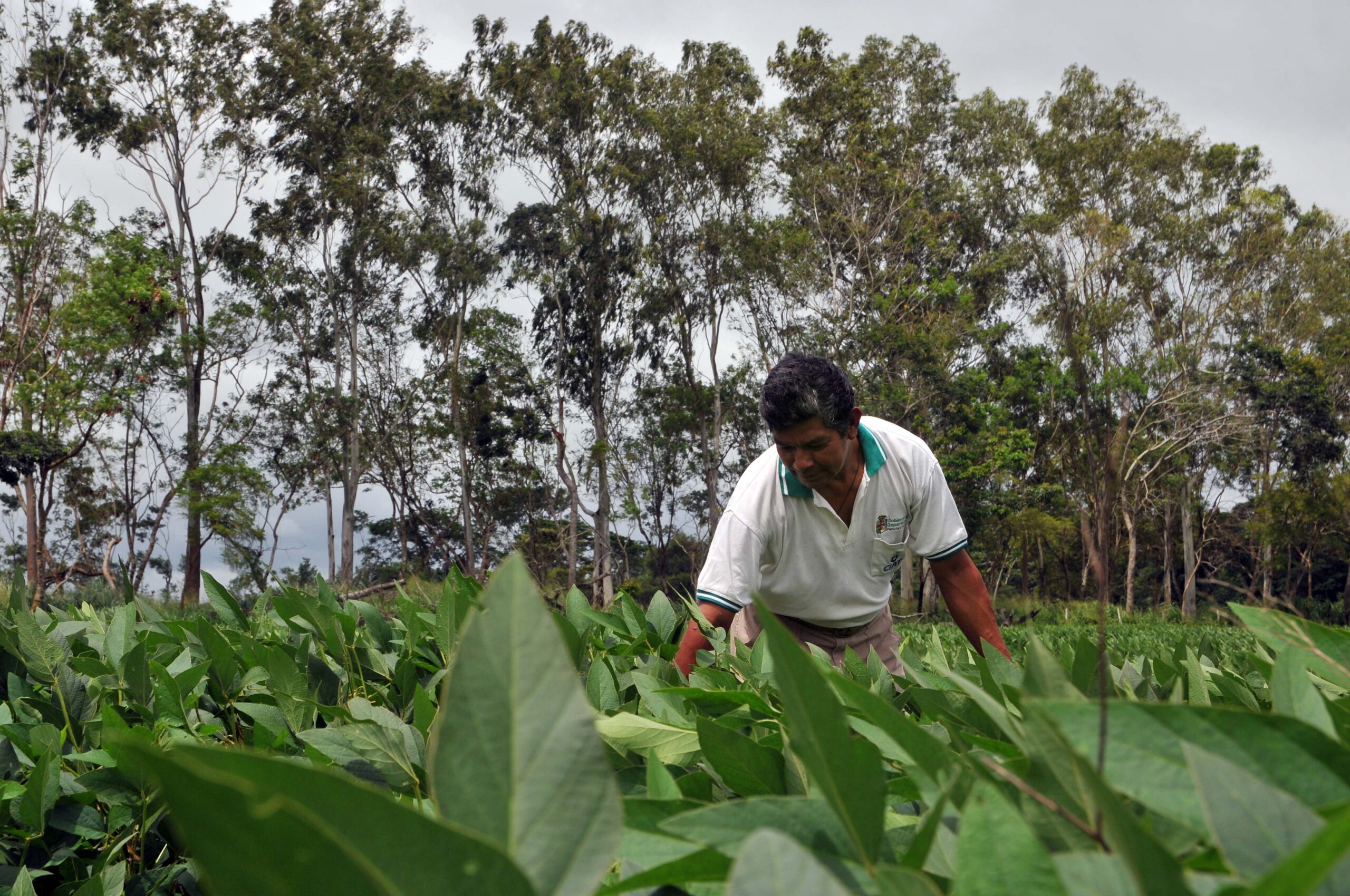
Feeding humanity without destroying the planet is recognized as one of the key challenges of our age. A related challenge—feeding the planet without unleashing political dynamics that foster violent, exploitative and authoritarian tendencies—has received less attention. Yet, at least in some South American countries, these challenges are closely intertwined. The Bolivian case is illustrative in this regard.
The relentless advance of industrial agriculture, which is transforming the plains at the center of South America—from the La Plata basin to the southern and eastern parts of the Amazon Rainforest—into soy and corn plantations as well as pastures, is a critical driver of biodiversity loss, environmental degradation, and deforestation, feeding global warming and impacting local climate and rainfall patterns. Such a transformation, as is well known, is connected to the change in the international division of labor stimulated by China’s rise, which reserved for South America the role of provider of primary commodities to global capitalism—particularly of the soy-based animal feed needed to sustain meat production across the world.
According to data from the Food and Agriculture Organization of the United Nations (FAO), between 1995 and 2024 the top five South American soy producers (Argentina, Bolivia, Brazil, Paraguay, and Uruguay) multiplied the area planted with this crop by almost four times, from around 18.8 to 68.6 million hectares. The growth in corn croplands over the same period was less intense, but also remarkable: from 17.1 to 31.4 million hectares. The political scientist Niels Søndergaard and his coauthors describe the expansion of the agro-industrial complex in Brazil as one of “the fastest and most comprehensive processes of land incorporation in human history.” As the quantity of soy produced surged, from 40 to over 210 million tons over the same three decades, these five countries’ share of global production increased from around a third to over half. In terms of exports, growth was even more pronounced, from a fifth to over sixty per cent.
Soy and the Pink Tide
While these trends are well known, their impact on the political dynamics of these South American countries has been so far overlooked. All five were part of the so-called Pink Tide of the 2000s and early 2010s, when left-of-center parties rose to power on the back of anti-neoliberal protests. Between January 2006 (when Evo Morales became Bolivia’s president) and December 2015 (when Mauricio Macri took over the presidency from Cristina Kirchner in Argentina), these countries, alongside a few others in South America, were governed from the left—with the exception of Paraguay, which was aligned with the regional political trend for a shorter period, only between 2008 and 2012. The ebbing of the Pink Tide in the mid-2010s had many drivers, some of them rooted in specific national processes. But the regional parallelism of their economic and political trajectories was unambiguously influenced by the countries’ vulnerability to primary commodities’ prices and, in the case of the five under consideration, by the political dynamics unleashed by the agrarian transformation.
The Brazilian case has received the most attention. The combination of government support for corporate consolidation in soy and meat supply chains with land-sparing environmental policies formed a pincer movement that subordinated small and medium landowners across the Brazilian countryside, sowing the seeds of an electoral bloc that is one of the main pillars of Bolsonarismo, the Brazilian far-right. In the recent presidential elections, the territorial division of the electorate became even clearer than it was four years ago, with Flávio Bolsonaro gaining ground disproportionally in the municipalities most influenced by the soy-meat complex. In this way, Brazil is perhaps the case in which the connection between ecological and political challenges are most evident: the world’s main agricultural exporter has struggled to shield its ecosystems from the agro-industrial avalanche and has seen the emergence of an electorally competitive far-right movement partially rooted in the countryside.
Yet the perverse combination of these two threats can be identified beyond Brazil’s borders. In Argentina, for instance, there is evidence that the rightward political shift (first with the election of Macri and, then, more radically with the rise of Javier Milei) was an outcome of processes that were initiated with the crisis del campo of 2008, when a political conflict related to the taxation of soy exports led to an extended period of protests that forged a rural political bloc in opposition to the center-left government. In the case of Paraguay, its Pink Tide was cut short due to the impeachment of the center-left president Fernando Lugo in 2012. “Paraguay’s agricultural elite successfully organized to overthrow the country’s first leftist president, Fernando Lugo,” the geographers Gustavo Oliveira and Susanna Hecht write, “when he sought to redistribute farmland dedicated to soy agribusiness.”
The case of Bolivia is interesting because the governments led by Evo Morales (2006–2019) challenged, at least initially, agricultural elites in the name of an “agrarian revolution.” Yet they ultimately failed to prevent a rightward turn that, in line with the regional trend, was also rooted in the dynamics of agrarian change. Thus, examining the Bolivian left’s attempt to address the challenge posed by big capitalist agriculture can be useful to guide future attempts to break the vicious cycle that has been fueling ecological and democratic breakdown in South America.
Persistent agrarian polarization
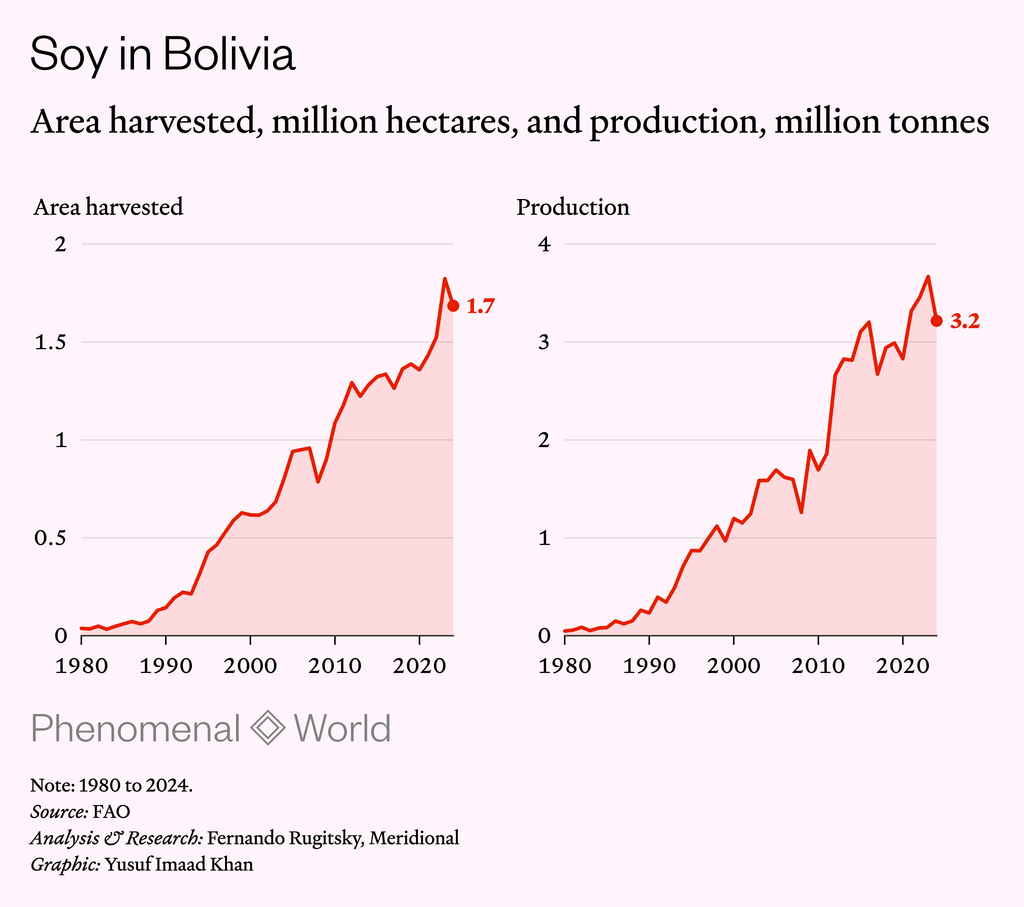
Soy is a relatively new crop to South America, taking off in the 1970s when a Brazilian state-owned agricultural research firm (Embrapa) managed to adapt it to the soil of the Brazilian savanna. According to FAO data, after the initial expansion of soy croplands in Brazil, the grain started to spread to Paraguay and Argentina. Bolivia caught up with the regional trend in the late 1980s, and in the 1990s the rate of growth of the areas cultivated with soy surged—total acreage almost tripled between 1993 and 1999 (see Figure below). In this first stage of the Bolivian soy boom—which took place in its terras bajas (the eastern lowlands), especially in the department of Santa Cruz—the polarized agrarian structure inherited from earlier decades was reinforced, with a minority of powerful capitalist entrepreneurs on one side and a majority of peasants on the other.
Such a polarized structure was the outcome of what the scholars Ben McKay and Gonzalo Colque call “planned two-track agricultural development,” in which from the 1950s onwards “Andean colonists were given 20–50 hectares to produce traditional crops for domestic food supply, while capitalist entrepreneurs and local elites were given between 500 and 50,000 hectares to produce crops for export.” Over time, this two-track development gave a dominant position to industrial capitalist agriculture, which gradually expanded its share of Bolivian agricultural production from 18 to 60 percent between 1963 and 2002, pushing land concentration up. According to an estimate from 2010, around five hundred large producers with properties larger than one thousand hectares controlled 56 percent of soy croplands, while 13,500 small and medium-sized producers controlled the remainder. Thus, more than half of the land was owned by only 3 percent of the producers. In Santa Cruz specifically, concentration was even higher: in 2011, 71 percent of the soybean cropland was controlled by 2 percent of the farmers (again, those with properties of one thousand hectares or more). For comparison, in 2017 in Brazil, the world’s main soy producer, almost 60 percent of soybean cropland was under the control of 5 percent of soybean farmers.
With Evo Morales’ assumption of the presidency in Bolivia in 2006, this agrarian structure was thrown into the spotlight. After all, Morales’ party, Movimiento al Socialismo (MAS), had emerged from a cycle of protests led by an alliance of social movements in which peasants played a central role. The Unity Pact, forged in 2005 between peasant and indigenous groups, formed the backbone of MAS support. The first three years of Morales’ government were marked by a bitter struggle between these social movements and the large landowners in the east over the implementation of agrarian reform after the approval in 2006 of a new law on the subject and the drafting of a new constitution. Available research on this period suggests that its main achievements regarding land policy were expediting land regularization procedures and formally recognizing vast areas as indigenous communities’ communal lands—totaling more than 7.5 million hectares. The elite opposition, meanwhile, organized itself as a secessionist movement, engaging in “extra-parliamentary destabilization,” occupying government agencies, blocking airports and plotting a coup. This acute stage of the struggle ended with the opposition’s defeat, as Morales accumulated electoral victories (in the recall referendum of 2008 and the general elections of 2009) and the right lost support as it resorted to violent action—notably after the murder of dozens of peasants and student supporters in Porvenir.
Yet the intensity of the political conflict was not matched by changes to the agrarian structure. McKay argues that the agrarian reform in this period “is better understood as tenurial reform than redistributive land reform,” that is, regularization of titles rather than expropriation of the latifundios. Similarly, the political scientist Jeffery Webber writes: “there was a dramatic uptick in the efficiency of registration and titling, but…the structural inequality of the Bolivia’s rural class structure remained largely intact.” Perhaps this was partly the result of the fact that the logic of agrarian reform—ensuring that rural properties served an “economic and social function”—aimed at an agrarian reality that had been deeply transformed. Until the 1980s, it would have been easier to find large units that were mostly unproductive, used primarily as a basis for political power and as a store of wealth. After the soy boom, and the agricultural intensification it implied, those easy targets for land reform became rarer. Land expropriation would require an expanded concept of “economic and social function,” focusing more broadly on land concentration and its problematic social consequences rather than only on unproductive farms.
Andean-Amazonian capitalism?
While the agrarian reform stopped short of redistributing land, the government did adopt other policies focusing on supporting smallholders. One of the main ones was probably the creation in 2007 of the state-owned enterprise EMAPA (the Spanish acronym for the Firm for the Support of Food Production). By ensuring small producers’ access to capital, technology and demand at a fair price, EMAPA aimed “to modify the economic structures in the lowlands and reduce the power of agribusiness, which in turn would transform political power within the state,” according to the political ecologists Diana Cordoba and Kees Jansen. EMAPA stimulated the organization of these farmers into collective associations that had between fifteen and 270 members, and offered these associations a premium over the market price for their produce as well as subsidized credit and technical assistance.
The approach explicitly targeted the smallholder subordination that characterizes the soy-dominated lowlands. Nevertheless, two factors limited its impact. First, its restricted scale. Total spending by EMAPA represented a small fraction of public spending, remaining generally below 2 percent of total financing for public companies, and limiting its operational capacity. For instance, in 2011, “EMAPA–Santa Cruz had only nine outreach workers providing technical assistance, covering on average 11,000 hectares, while the recommendation is for one outreach worker to cover 3,000 hectares.” Second, the firm decided to guarantee access to technology by acting as an intermediary between smallholders and big agrochemical corporations. In this way, it aimed to strengthen small producers within the dominant model of agricultural modernization rather than addressing the polarized agrarian structure through the creation of an alternative to conventional industrial agriculture. According to the assessment by Cordoba and Jansen, this strategy ended up deepening “dependency ties” and reinforcing smallholder subordination: “The lack of an alternative proposal to the dominant model of agricultural modernization, together with inappropriate technical advice, low-quality inputs and expensive, oversimplified agriculture packages weaken the position of small producers in relation to other actors in the agro-food chain.”
In 2006 Álvaro García Linera, Morales’ vice president, argued that the government’s goal was to build an Andean-Amazonian capitalism, as a transition stage on the path to socialism. This required, in his words, “building a strong state” that could channel the surplus from the industrial economy to communities, “to power authentic Andean and Amazonian forms of self-organization and of market development.” With hindsight, considering the Bolivian agrarian sector, it is plausible to argue that the government did not succeed in fostering communitarian self-organization, if by that we mean strengthening the peasant associations relative to big agricultural capital. It actually oversaw the further advance of industrial agriculture, the deepening of the corporate concentration of the soy supply chain, and an aggravation of smallholder subordination. Instead of preparing the country for a radical transformation, MAS seems to have built a “compensatory state,” to borrow the phrase from the ecologist Eduardo Gudynas, combining poverty alleviation with a new extractivist development strategy. An approach doomed to be short-lived, grounded as it was on the commodities boom.
Rapprochement
After Morales’ first reelection, in 2009, the government’s agrarian policy underwent a shift. McKay refers to it as a transition from an agrarian to a productive revolution, from an effort to build the state’s popular legitimacy to the prioritization of forging a state-capital alliance. Similarly, Webber interprets the shift as a transition from a period of insurgent contestation to one of an agro-capital-state alliance. The agricultural elites moderated their confrontational stance following their defeats in 2008 and 2009, and opened the way for a rapprochement with MAS. The government, in turn, felt especially compelled to enter what Cordoba and Jansen call a “new productive alliance” after the gasolinazo fuel price spike in 2010, when a reduction of fuel subsidies resulted in food shortages and food inflation. EMAPA tried to address the crisis but ended up being dragged into the controversy, with urban MAS supporters demanding its closure. The government then decided to resort to agro-industrial capital to overcome the crisis, abandoning “its confrontational posture” and promising “financial support and legal security for their land”—a dubious strategy as export agriculture does not guarantee domestic food security. Indeed, food imports increased around 62 percent between 2010 and 2014.
The following year, two developments consolidated the government’s prioritization of its former adversaries over its peasant and indigenous supporters. First, a new law on agricultural policy, initially drafted by members of the Unity Pact, was significantly changed after pressure from the Santa Cruz elites, so that the approved version favored agro-industrial expansion. Agricultural policies would move even further in that direction in 2016, with the Patriotic Agenda 2025, which promised for agro-capital “more public investment in infrastructure for production and transport, as well as guarantees of subsidized energy inputs and exchange rate stability.” Second, in 2011, the government ignored its supporters’ opposition to the building of a highway through an indigenous territory (TIPNIS). After a bitter conflict, the project went forward and two of the five social movements that had formed the Unity Pact exited it, disillusioned with the MAS.
Throughout, the corporate concentration of the soy supply chain continued its advance. ADM and Cargill, two of the world’s four main grain traders, started operating in Bolivia in 1998, and by 2012 controlled almost a quarter of all soy exports (including soybeans and its derivatives). With the authorization of genetically modified seeds in 2005, their capacity to subordinate smallholders increased. ADM extended loans to them to fund the purchase of agricultural inputs (seeds, pesticides, fertilizers, generally from a handful of multinational corporations) and diesel, and in exchange, these smallholders ceded control of their productive practice and risked losing their land. As Cordoba and Jansen put it: “Contracts stipulated that ADM would take possession of the land if production was not carried out well, and that the company would set the price and standard of the beans harvested (usually leading to high discounts owing to dampness or impurities).”
In this context, many smallholders were forced into the partida arrangement—that is, renting out their land for it to be farmed by large agro-capitalists. With the increasing costs of production imposed by the corporate control of the supply chain, several peasants could no longer afford to undertake production themselves. Given the size of their plots and the low value of the land rents they received, they ended up both as petty bourgeois “rentiers” and semi-proletarians, undertaking wage labor to make ends meet. According to McKay and Colque, in some municipalities in the lowlands expansion zone, most small farmers opted for the partida.
Hollow triumph
In Argentina and Brazil, the soy boom gave rise to unified political blocs in opposition to the Pink Tide governments, bringing together relatively subordinated farmers, agricultural elites, and groups involved in services and manufacturing activities connected to industrial agriculture. Such blocs provided a key basis for the rightward political shift. Movements contesting the dominant model of capitalist agriculture were marginalized, with their influence reduced to areas at the margins of the soy avalanche and receiving from the government a fraction of the support it gave to the corporate supply chain.
In Bolivia, in contrast, agrarian conflict between peasants and large agrarian capitalists retained its political centrality, perhaps as a legacy of the bitter disputes of the early years of the MAS government and also due to its connection with deeper racial fractures of society, pitting indigenous groups from the Andes against the mestizos from the lowlands. In fact, since the 1990s, Brazilian immigrants represent a prominent fraction of the agrarian capitalists, but in the eyes of the older Santa Cruz elite “it is the Andean peasants who are the ‘immigrants’ rather than the Brazilian soy producers.” By effectively supporting the advance of industrial agriculture, dividing the peasant and indigenous movements, and taking for granted the support of the popular classes, the MAS dug its own grave. Its initial triumph over the agricultural elites proved to be hollow, having not been seized upon to overcome agrarian polarization.
The main lesson from this experience is probably that overcoming corporate soy requires a transitional strategy of empowering smallholders to adopt agroecological practices that can guarantee affordable food for the domestic market. In this way, the state can count on an alternative power base to challenge capitalist agriculture, reducing the latter’s influence over food availability and prices. In spite of Morales’ initial conflicts with the Santa Cruz elites, his government supported smallholders to become integrated into the corporate chain at the same time as it depoliticized and demobilized the peasant movements. Then, by the early 2010s, it had sabotaged the conditions that once left it poised to transform the Bolivian countryside.
The disarticulation of the opposition allowed MAS to retain electoral supremacy for longer than its Pink Tide peers. But eventually the effects of the end of the commodities boom weakened the compensatory state, reducing Morales’ popular support and emboldening the opposition once again. Morales knew he could no longer count on MAS’s original bases of support in the peasant and indigenous movements, alienated by the government’s agrarian priorities. In a critical moment in the second half of the 2010s, when Morales attempted to change the constitution to allow for an additional reelection, he lost support from the peasant workers’ confederation, one of the key social movements that remained in the Unity Pact. He went forward with the reelection bid anyway and, politically weakened, suffered a coup organized by the right.
Although MAS managed to return to power for an additional term, under the leadership of Luis Arce, its internal fractures could no longer be contained, so much so that in the latest general election the left did not even make it to the runoff stage. Meanwhile, agrarian conflict remains at the forefront: the current government met massive protests when it tried to introduce a law that would further subordinate smallholders. It remains to be seen whether this renewed peasant resistance will be capable of recreating the conditions for a national political project that can point beyond the politically and ecologically toxic dominance of soy.
Further Reading

Soy Republics
Corporate concentration and the far right in South America
The region's role as a key soy exporter has empowered reactionary politics and fuelled ecological resistance, in the biome and beyond.
Bolivia After MAS
A crisis of legitimacy amid institutional collapse
For the past month, Bolivia has experienced massive roadblocks across eight of its nine departments, which have upended logistics, trade, and daily movement. Protesters have...
Battlefield Amazonia?
The political economy of the Brazilian rainforest
How the PT's environmental crackdown undermined its own ambitions for the biome.