October 31, 2026
Analysis
Frozen Map
Prospects for political revolution after the 2026 midterms
Midterm elections rarely bring out the best in presidents. Almost invariably facing electoral headwinds, chief executives often resort to stunts and gimmicks that do little more than confirm the electorate’s dwindling faith in their administration. Franklin Roosevelt’s ill-fated attempt to purge the Democratic Party of opponents of the New Deal in 1938 only reminded voters that there would be no Third New Deal; Gerald Ford’s 1974 “Whip Inflation Now” campaign convinced even Republican economists that the president was a policy lightweight. This year, facing cratering approval ratings, President Donald Trump has used the campaign cycle to brand his party’s candidates with his person and charge them $25,000 to attend the midterm fundraising rally.
But demonstrations of presidential folly are not always followed by electoral routings. In this, an apt historical analogy for November 3, 2026 might be the deeply forgettable midterms of a hundred years ago. In 1926, Republican President Calvin Coolidge, so committed to doing nothing that he was known to nap for hours each afternoon, presided over a booming economy and a Congress that largely left him to do as he pleased. Republicans lost a handful of seats that year, but kept comfortable control of both chambers. The electoral map had barely moved since the great realignment of 1896: Republicans held the Northeast and the Midwest, while Democrats monopolized the South. Neither party could make headway into the fortresses of the other.
But beneath the static surface, both parties were in disarray. The merger of the Republican Party with high finance, while electorally advantageous, was introducing rot into its foundations. Andrew Mellon, one of the richest men in the country, ran the Treasury and the tax system to the direct advantage of his class, while scandals from Harding’s presidency, which began to surface only after his death in 1923, revealed a party where cabinet offices were for sale. The Democrats were in no better shape. Their 1924 convention had to vote 103 times before settling on Wall Street lawyer John W. Davis as their nominee, after delegates tore themselves apart over the Ku Klux Klan and Prohibition. Davis would go on to win less than thirty percent of the vote.
The map looked frozen—until it didn’t. Over the decade that followed 1926’s mundane midterm, the Democratic Party would be the site of one of the most dramatic transformations in American political history—remade by newly mobilized urban, immigrant, and working-class voters—and the Republican Party would be exiled from national power for a generation.
A hundred years later, despite Donald Trump’s deep unpopularity, the roiling dramas of national politics, and talk of a blue wave, the country’s political map looks similarly static. Most psephologists see a twenty seat swing in the House as the outer limit of possible outcomes. In the Senate, even a five seat swing is improbable. The rural-urban divide and gerrymandering have left very few seats in play, and this election is likely to be a pale imitation of recent tumultuous years like 1994, 2006, or 2018, when the balance of power in the House shifted by dozens of seats.
As in the 1920s, the seeming stability of the map conceals deep turbulence in the parties themselves. In their internal institutional configurations, their relationships with their voters, and their sources of funds, both Democrats and Republicans are in very different places than they were a decade ago—with no signs of the pace of change abating. A political system that can register so little of this churn in its electoral outcomes cannot contain it forever.
The decider
Donald Trump’s hold over the Republican Party is unprecedented in American history. While previous presidents, such as Lincoln and FDR, towered above their parties, neither was ever able to consolidate the kind of personalist control that Trump has exercised over the GOP for most of the last decade.
Trump’s rule over the party has been in some sense a replacement for traditional party structures that had been hollowed out over the preceding decades.1For more on this trajectory, see my book (<)em(>)(<)em(>)Rogue Elephant: How the Republicans Went from the Party of Business to the Party of Chaos(<)/em(>) (Verso, 2025).(<)/em(>) Before his meteoric rise, the party’s traditional funders in the business community were becoming more politically fractured, and an increasingly candidate- and PAC-centered fundraising model was transmitting these fractures directly into the party. The result was a kind of Republican civil war from 2008–2016, in which the Tea Party wing of the GOP squared off against its more traditional establishment. Trump seized power in the midst of a stalemate between these two forces, and quickly became the main source of coherence in a party with little agreement across its factions.
While the caprice of a reality TV star became the glue holding the party together, Trump’s whims in his first term were often blocked by institutional inertia, his own administration’s incompetence, and resistance from various Republican apparatchiks. In his second, however, the first and third factor have been overcome to a considerable degree. Where his first administration was staffed by senior figures like John Kelly and Jim Mattis, who viewed their service as a kind of right-wing harm reduction, the leading officials of his second term, like Stephen Miller and Marco Rubio, are eager to pursue even the most demented policy directions that Trump demands. Also unlike his first term, the Republican majority in congress is happy to demonstrate its obeisance, raising no protest at the executive’s seizure of power. All of this has allowed the administration to act with frightening speed to reshape the federal bureaucracy.
At the same time, the officials in Trump’s second administration have given up on trying to steer the president away from rash decisions. As one advisor explained to a journalist, “Why bother? He’s the boss.”2Jim VandeHei and Mike Allen, “GOP Officials Give Up on Futile Trump Persuasion,” Axios, September 9, 2026, (<)a href='https://www.axios.com/2026/09/09/trump-midterms-republicans-popularity'(>)https://www.axios.com/2026/09/09/trump-midterms-republicans-popularity(<)/a(>).
Even as this deference demonstrates Trump’s strength within the party, there is no question that the results have worsened GOP prospects in the midterms.
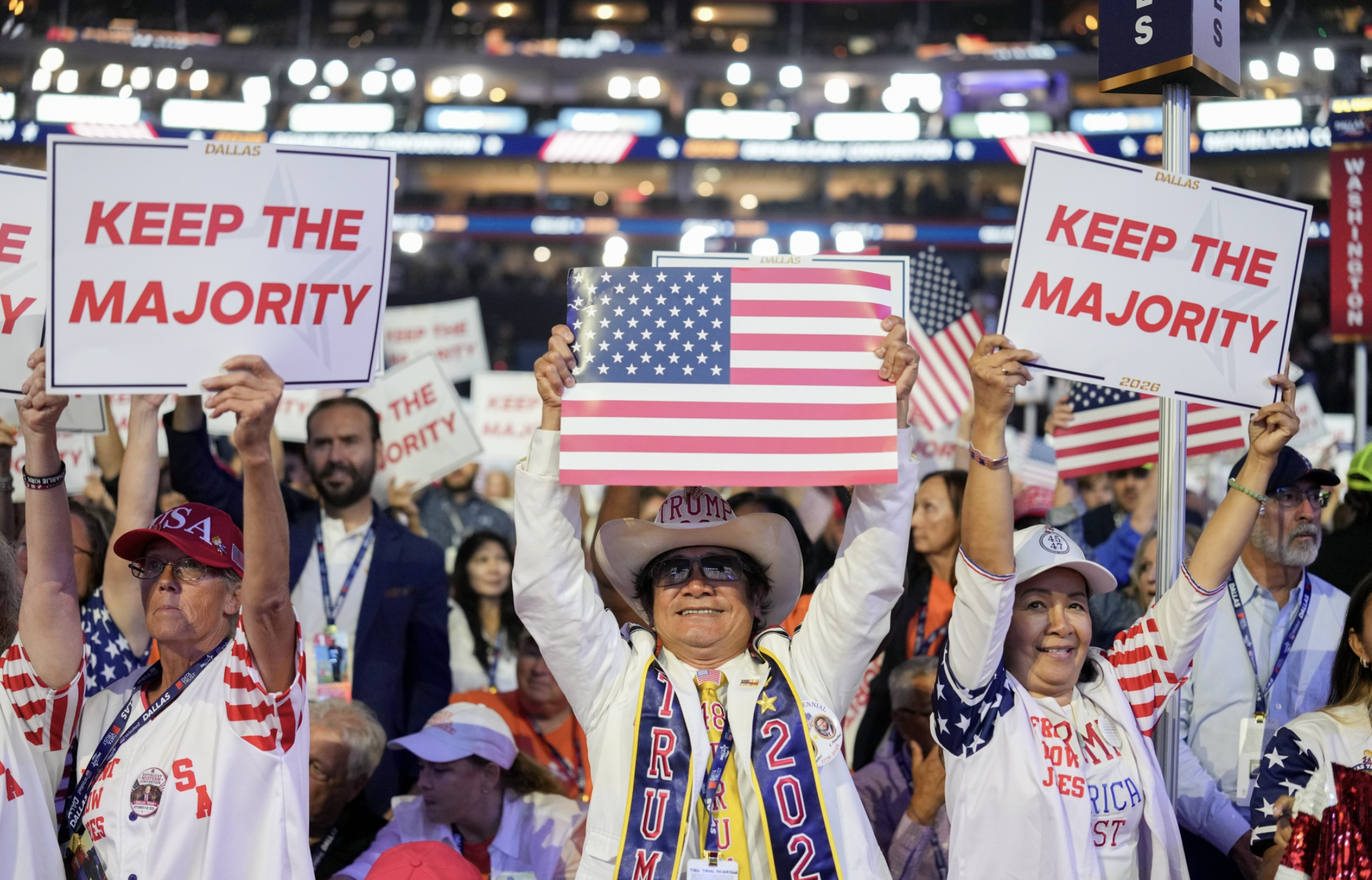
The entire Republican campaign for the midterms has been built around Trump’s monarchical s whims. In place of a real strategy for his cabinet’s role in the campaign, the president has created an Apprentice-style competition where officials like the attorney general and the secretary of defense win status based on how much time they spend making speeches in contested districts. The midterm convention, sold as a spectacle to help the GOP in November, was as much a fundraiser for the President as for the congressional races: the White House charged candidates who attended, and in return put them on television next to a historically unpopular president, who insisted on speaking both nights. It is little wonder that many Republicans in tight races decided to skip the event. Even when Trump has made ad buys in close races from his super PAC, MAGA INC, the ads have largely featured Trump himself.
On the policy side, Trump’s lack of restraint is similarly destructive. For the better part of a year now he has attacked affordability as a “con job” and a “word made up by the Democrats.”3Nick Lichtenberg, “Trump Dismissed Affordability as a Word ‘Made Up by the Democrats’ and Promised Oil Would Come ‘Tumbling Down’—Then It Hit $100 a Barrel,” Fortune, July 23, 2026, (<)a href='https://fortune.com/2026/07/23/trump-dismisses-affordability-democrats-made-up-word-oil-prices-100-barrel/'(>)https://fortune.com/2026/07/23/trump-dismisses-affordability-democrats-made-up-word-oil-prices-100-barrel/(<)/a(>). As concern about artificial intelligence and data center construction rises in the electorate, Trump holds fast to a laissez faire position on both. And to take the most obvious example, Trump’s disastrous war on Iran has become such a liability to the administration that its flacks now spend their time chastising voters that anyone upset over higher gas prices is lacking in patriotism. At every turn, Trump has insisted on defining the Republican brand in terms of his own impulses, regardless of the costs to his party.
In the face of all of this, a few Republicans have begun to attempt to create distance between themselves and the administration.
But Republicans’ ability to distance themselves from Trump is severely constrained. In the spring, the president demonstrated the hold he still has over GOP primary voters, knocking out several incumbent Republicans in administration-sponsored primary challenges. In Indiana, Trump-backed challengers to six state legislators who voted against a new gerrymander of the state all won their races.4“Trump-Backed Candidates Win Indiana Republican Primary,” The New York Times, May 5, 2026, (<)a href='https://www.nytimes.com/2026/05/05/us/trump-candidates-win-indiana-republican-primary.html'(>)https://www.nytimes.com/2026/05/05/us/trump-candidates-win-indiana-republican-primary.html(<)/a(>). In Kentucky, Representative Thomas Massie, the administration’s most vocal critic in the GOP, lost to a challenger.5Grey Anderson, “Costly Signals,” New Left Review, Sidecar, May 28, 2026, (<)a href='https://newleftreview.org/sidecar/posts/costly-signals'(>)https://newleftreview.org/sidecar/posts/costly-signals(<)/a(>) In Louisiana and Texas, incumbent senators have lost to Trump-endorsed challengers, the OpenAI-funded representative Julia Letlow over Bill Cassidy in the former and the scandal-ridden state attorney general Ken Paxton over John Cornyn, a loyal Trumpist but insufficiently enthusiastic in his supplication, in the latter.6“Paxton Defeats Cornyn in Texas Republican Senate Primary,” The New York Times, May 27, 2026, (<)a href='https://www.nytimes.com/2026/05/27/us/politics/paxton-cornyn-texas-republican-primary.html'(>)https://www.nytimes.com/2026/05/27/us/politics/paxton-cornyn-texas-republican-primary.html(<)/a(>). In South Carolina, meanwhile, Trump picked Lindsey Graham’s sister Darline to succeed the deceased senator, and his super PAC spent nearly a million dollars in the final week of the race to ensure Graham’s victory over the ultra-conservative Ralph Norman. Responding to this vulgar display of power, most Republican legislators have been tripping over one another in their attempts to demonstrate their loyalty.
Beyond his army of primary voters, Trump also controls the power of the purse in this election. MAGA Inc has raised a staggering $400 million from a rogue’s gallery of the ultra-rich. The right wing of Silicon Valley is strongly represented, with OpenAI founder David Brockman, the Winklevoss brothers, and Marc Andreessen all contributing more than $10 million each. Financiers like Stephen Schwartzman and Timothy Mellon are also major donors, as are casino magnates Steve Wynn and Bijan Tehrani. Finally, there are Texan oilmen like Kelcy Warren and Tim Dunn, the latter of whom’s Texas Public Policy Foundation has been a key supplier of staff and policy to the second Trump administration. This relatively small group of donors has allowed MAGA Inc to tower above all other super PACs in the race.
As Republicans confront an unfavorable environment, many are counting on a few million from this hoard to get them over the finish line. And while the PAC has been reluctant to spend, recent FEC filings reveal this may be more than mere miserliness on Trump’s part.7Luke Fountain, “Much of Trump’s Promised Midterm Election Spending Has Yet to Surface, New Filing Shows,” CNBC, September 21, 2026, (<)a href='https://www.cnbc.com/2026/09/21/trump-maga-midterm-spending-war-chest.html'(>)https://www.cnbc.com/2026/09/21/trump-maga-midterm-spending-war-chest.html(<)/a(>). Two new super PACs, No Going Back PAC and Safety and Affordability PAC, which share a treasurer and address with MAGA, Inc, were created September 1, and have already placed over $125 million in ad buys.
As such, while many in the party may consider the MAGA brand toxic at this point, Republicans are still dependent on the funds that Trump controls, and it seems unlikely that we will see a large-scale turn away from Trump. Republican candidates may well understand that Trump is the origin of most of their problems, but he is also their only hope for overcoming them.
Modern Republican portfolio theory
In the decades before Trump, the GOP was stereotypically the party of corporate boardrooms. Fundraising took place in large part through the social networks of the corporate rich. Already in the 1980s, it was evident that “the corporation uses its network to evade the limits on the maximum legal donation.”8Dan Clawson et al., (<)em(>)Dollars and Votes: How Business Campaign Contributions Subvert Democracy(<)/em(>) (Temple University Press, 1998), 177. This process reached its apotheosis in George W. Bush’s campaigns. Bush’s longtime advisor, Karl Rove, developed a system where donors who bundled funds by soliciting donations from friends, colleagues, and family members reached different rank status within the campaign: Pioneers bundled $100,000 or more; Rangers bundled $200,000 or more. Fundraising itself functioned as a mechanism of cohesion among the corporate elite.
This apparatus began to break down in the wake of the Citizens United and Speechnow decisions in 2010, which created super PACs. Unlike candidate committees, whose limits on donations gave rise to bundlers in the first place, super PACs can accept unlimited funds from any individual. Whereas the old system privileged donors who were able to mobilize dozens of other like-minded funders, super PACs allowed particularly ideological donors to far outpace what even the most gregarious Ranger achieved. The casino magnate Sheldon Adelson, for example, gave $5 million to Mitt Romney’s super PAC in 2012.9Rachael Marcus, “PAC Profile: Restore Our Future,” Center for Public Integrity, January 30, 2012, (<)a href='http://publicintegrity.org/politics/pac-profile-restore-our-future/'(>)http://publicintegrity.org/politics/pac-profile-restore-our-future/(<)/a(>). The wealthy have been able to economize their social capital and simply spend their money instead.
Over the subsequent decade, super PACs continued to grow more important in the campaign finance ecosystem. While both Democrats and Republicans relied on them, super PACs comprise a much greater share of contributions to the GOP, with its relative dearth of small contributors. In 2024, Trump’s campaign committee raised only about $450 million dollars, less than half of the Biden/Harris haul, and—even more strikingly—about $300 million less than his committee raised in 2020. Some 70 percent of Trump’s money came through super PACs like MAGA Inc. and other outside organizations.10See “2024 Presidential Race,” OpenSecrets, accessed September 27, 2026, (<)a href='https://www.opensecrets.org/2024-presidential-race'(>)https://www.opensecrets.org/2024-presidential-race(<)/a(>).
Super PACs’ ability to direct vast sums from individual billionaires has been a lifesaver for the GOP. Just three families—the Adelsons, the Mellons, and the Musks—contributed over $450 million to GOP campaigns via super PACs in 2024.11 “Billionaire Clans Spend Nearly $2 Billion on 2024 Elections,” Americans for Tax Fairness, October 29, 2024, (<)a href='https://americansfortaxfairness.org/billionaire-clans-spend-nearly-2-billion-2024-elections/'(>)https://americansfortaxfairness.org/billionaire-clans-spend-nearly-2-billion-2024-elections/(<)/a(>). Without this money, it is not clear the party would have won unified control of the federal government. But as the party has become ever more reliant on a small number of hyper-ideological megadonors, its financial base has become much narrower. Where George W. Bush won enthusiastic support from a broad range of the corporate rich, Trump’s Republican Party depends on the largesse of a comparatively miniscule layer of donors. In 2024, the political scientist Adam Bonica calculated that the top 400 donors to the Republican Party accounted for a staggering 60 percent of party funds (the corresponding figure for the Democrats was just above 20 percent).12Adam Bonica, “Striking Shift in GOP Donor Base—Top 400 Donors Now Provide over 60% of GOP Funds, Nearly Double 2020 Levels,” Bluesky, November 20, 2024, (<)a href='https://bsky.app/profile/adambonica.bsky.social/post/3lbfmyq22d224'(>)https://bsky.app/profile/adambonica.bsky.social/post/3lbfmyq22d224(<)/a(>). In a country in which the electorate numbers over 230 million, this is an extraordinarily thin social layer from which to fund a political party.
This reliance on a few megadonors has continued into the 2026 midterms. When it comes to the candidate committees themselves, Republicans are being badly out fundraised. As of late September, Democratic House candidate committees had an aggregate financial advantage of about $200 million, and Democratic Senate candidate committees had an aggregate advantage of about $275 million. Yet despite this advantage, Democrats are being decisively outspent in the final stretch of the race. According to Politico, since August the GOP has outspent Democrats on ad buys by $264 million in Senate races and by $73 million in House races.13Lisa Kashinsky et al., “Dems Are Being Outspent Across House and Senate Races. They Disagree over Where to Put the Money They Have,” Politico, September 24, 2026, (<)a href='https://www.politico.com/news/2026/09/24/democrats-midterms-money-worries-disagreements-01090770'(>)https://www.politico.com/news/2026/09/24/democrats-midterms-money-worries-disagreements-01090770(<)/a(>). The vast bulk of this difference comes from super PACs. As discussed above, Trump’s MAGA Inc has a war chest of about $400 million. At the same time, the Senate Leadership Fund, the McConnell-organized super PAC now controlled by John Thune, has nearly twice the money of its Democratic counterpart. The Congressional Leadership Fund, the Boehner-organized super PAC now at the service of Mike Johnson, has about 50 percent more.14“Democrats, Republicans See Widening Midterms Cash Fundraising Gap,” Politico, July 22, 2026, (<)a href='https://www.politico.com/news/2026/07/22/democrats-republicans-midterms-cash-fundraising-gap-01007270'(>)https://www.politico.com/news/2026/07/22/democrats-republicans-midterms-cash-fundraising-gap-01007270(<)/a(>). Just a few dozen people supply the bulk of this money.
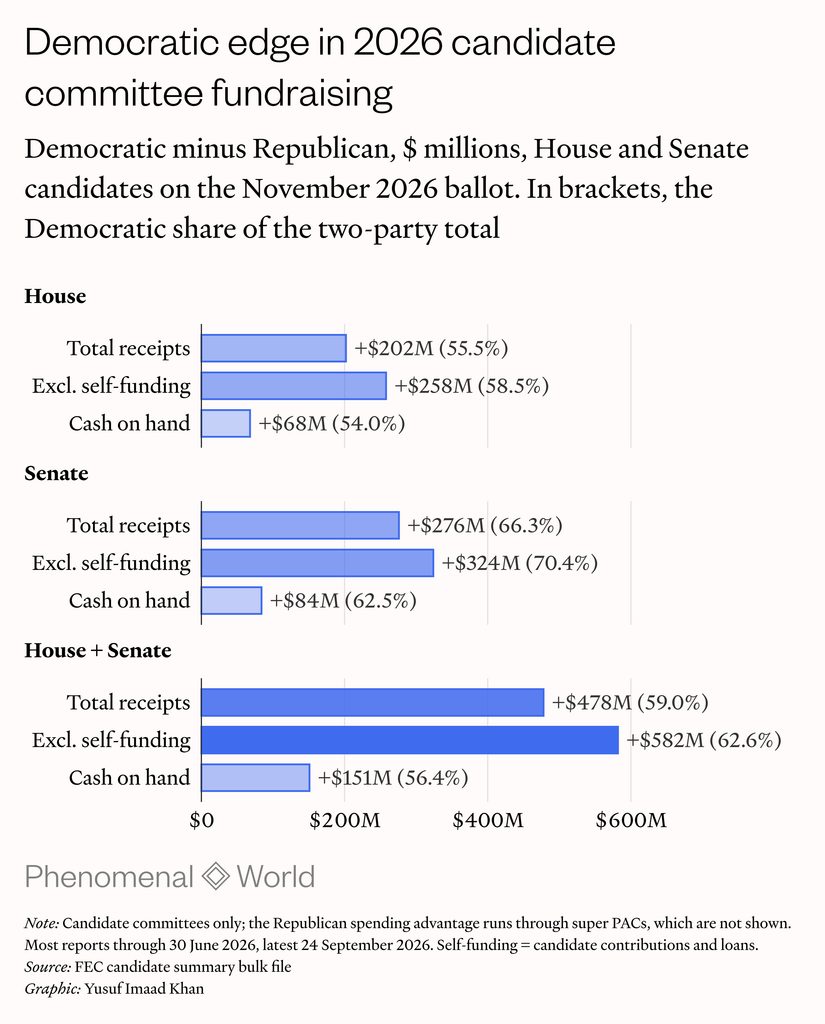
This dynamic has penetrated downballot as well.15Races for state level office are not governed by the FEC and federal campaign finance law, so the institutional ecology can vary quite a bit from state to state, and doesn’t necessarily resemble the strict divide between super PACs and campaign committees found on the federal level. In Wisconsin, for example, two thirds of Republican gubernatorial candidate Tom Tiffany’s money has come from three billionaires (who are also large donors to MAGA Inc), two of whom are married.16Mary Spicuzza and Eva Wen, “3 Billionaires Put Tom Tiffany in a Big Cash Lead over David Crowley,” Milwaukee Journal Sentinel, September 25, 2026, (<)a href='https://madison.com/news/state-regional/government-politics/elections/article_7e33d526-6496-5f12-b391-42bf71301383.html'(>)https://madison.com/news/state-regional/government-politics/elections/article_7e33d526-6496-5f12-b391-42bf71301383.html(<)/a(>). This has allowed Tiffany to outspend his opponent David Crowley by a margin of three-to-one.17Ruth Conniff, “The Real Cost of Tom Tiffany’s Debate Dodge,” Wisconsin Examiner, September 18, 2026, (<)a href='https://wisconsinexaminer.com/2026/09/18/the-real-cost-of-tom-tiffanys-debate-dodge/'(>)https://wisconsinexaminer.com/2026/09/18/the-real-cost-of-tom-tiffanys-debate-dodge/(<)/a(>). Similarly, in Florida, Republican Byron Donalds holds about $45 million in his campaign committee and associated PAC.18A. C. Gancarski, “Polls Say Dead Heat, Money Says Otherwise: Byron Donalds Holds $44 Million to David Jolly’s $6 Million,” Florida Politics, September 2026, (<)a href='https://floridapolitics.com/archives/820861-cash-crunch-continues-for-david-jolly-in-governors-race/'(>)https://floridapolitics.com/archives/820861-cash-crunch-continues-for-david-jolly-in-governors-race/(<)/a(>). A full $10 million of this came from GOP and MAGA Inc. megadonor Ken Griffin.19Matt Dixon, “Republican Megadonor Ken Griffin Gives $10 Million to Boost Byron Donalds’ Bid for Florida Governor,” NBC News, July 24, 2026, (<)a href='https://www.nbcnews.com/politics/2026-election/republican-ken-griffin-byron-donalds-florida-governor-rcna588984'(>)https://www.nbcnews.com/politics/2026-election/republican-ken-griffin-byron-donalds-florida-governor-rcna588984(<)/a(>).(<)br(>) By contrast, Donalds’ Democratic opponent, David Jolly, holds a mere $6.3 million.
The Republican fundraising apparatus is undoubtedly an imposing edifice. Generally, midterm elections see money flow towards the party likely to win, as donors seek to buy access and curry favor with the new majority party. But the GOP’s ability to draw practically unlimited funds from an extraordinarily narrow base of donors has upended this pattern, and given the party a decisive advantage in fundraising. Nevertheless, it seems quite likely that the Democrats will win the House, and a Senate majority is at least within reach. The GOP’s very ability to raise hundreds and hundreds of millions of dollars from a few billionaires has enabled its insouciance towards voter sentiment. Able to throw money at any polling gap they find, the party has felt less need to trim its sails and meet public opinion. In this sense, the new Republican fundraising model may prove to be built on a shaky foundation.
Following the elephant
Many in the Democratic Party would no doubt be happy to have the problems that accompany limitless cash. Today, though Democratic candidate committees are fundraising successfully, the official party institutions and PACs are all falling behind their Republican counterparts. The DNC, in particular, is in more dire financial straits than any time since the late 1960s, when Lyndon Johnson’s efforts to circumvent the party apparatus resulted in the organization being largely unable to assist Humphrey’s 1968 campaign.20Daniel J. Galvin, (<)em(>)Presidential Party Building: Dwight D. Eisenhower to George W. Bush(<)/em(>) (Princeton University Press, 2010), chap. 9. Its accounts are currently several million dollars in the red.
This development is quite recent. On the presidential level, at least, Democratic Party candidates have out-fundraised Republicans in every election after 2004. 21Paul Heideman, “The Party of American Capital,” Jacobin, December 16, 2024, (<)a href='https://jacobin.com/2024/12/the-party-of-american-capital'(>)https://jacobin.com/2024/12/the-party-of-american-capital(<)/a(>).The DNC specifically has often lagged behind the RNC in midterms, but it has not in recent history gone into a cycle in this kind of financial disarray.
There are a few different sources behind the committee’s struggles. The farce surrounding the release of the Democratic Party’s “autopsy” of the 2024 election tarnished Ken Martin’s image as the new chair of the party, and his subsequent attempts at damage control only further undermined his leadership.22Lisa Kashinsky, “‘The Report’s So Stupid’: The DNC 2024 Autopsy Is Roiling Democrats,” Politico, May 21, 2026, (<)a href='https://www.politico.com/news/2026/05/21/democratic-party-2024-autopsy-00931754'(>)https://www.politico.com/news/2026/05/21/democratic-party-2024-autopsy-00931754(<)/a(>).(<)br(>) Central to the debate was the effect of the Biden administration’s support for genocidal Israel on Kamala Harris’ campaign. Martin and others were quick to dismiss the question, but it has lingered, particularly after the autopsy’s hapless author averred that he thought the support had a significant impact.23(<)a href='https://www.axios.com/2026/08/06/dnc-2024-autopsy-author-gaza'(>)https://www.axios.com/2026/08/06/dnc-2024-autopsy-author-gaza(<)/a(>) Since 2024, the issue has shown no signs of abating, from Zohran Mamdani’s vocal support for Palestinians during his mayoral campaign to this year’s suite of successful primary campaigns that foregrounded the war in Gaza.
The rift that support for Israel has opened in Democratic politics has caused a further loss of donor confidence in the DNC. A number of large donors have said that they have stopped giving money to the DNC because they are worried that the party might direct some of that money to anti-Israel candidates.24Samantha-Jo Roth, “Israel Divide Reshapes How Some Jewish Democrats Give,” Washington Examiner, August 8, 2026, (<)a href='https://www.washingtonexaminer.com/in_focus/4668472/israel-divide-jewish-democrats-donors/'(>)https://www.washingtonexaminer.com/in_focus/4668472/israel-divide-jewish-democrats-donors/(<)/a(>). At the same time, groups like Democratic Majority for Israel and AIPAC’s United Democracy Project are routing their donations through other Democratic interest groups like Emily’s List and BOLD America (a group that supports Hispanic candidates). While this may not alter the overall amount of money Democratic candidates receive as a whole, it does deprive the DNC of funds, reducing its ability to strategize across races, and increasing centrifugal forces within the party.
The biggest issue the party confronts, however, is simply that its second defeat at Trump’s hands has shaken its electorate’s faith in the leadership. The situation is almost identical to the one that confronted the Republicans after Barack Obama’s victory in 2008, when the wreckage of the Bush administration and John McCain’s defeated Iraq War-supporting campaign provided the soil from which the Tea Party grew.25Patrick Rafail and John D. McCarthy, (<)em(>)The Rise, Fall, and Influence of the Tea Party Insurgency(<)/em(>), Cambridge Studies in Contentious Politics (Cambridge University Press, 2024), 153.
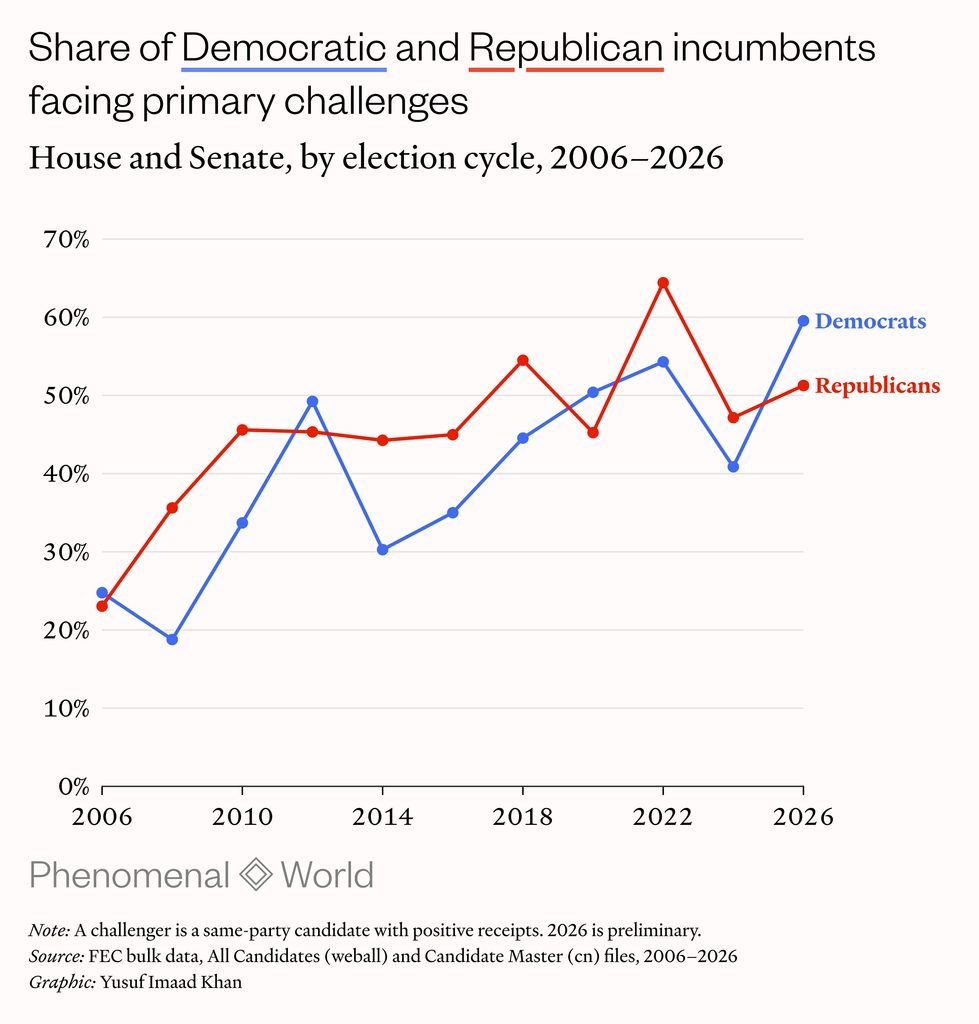
Today, the Democrats appear to be on a similar path. The Tea Party insurgency, which always represented a combination of grassroots mobilization and elite showmanship, manifested as a record number of primary challenges in 2010 began a period of factional warfare that only ended with Trump’s takeover. Today’s left-wing insurgency in the Democratic Party, largely but not exclusively propelled by the Democratic Socialists of America, has resulted in a massive spike in primary challenges to incumbent candidates.
The Democratic Party may be following the same path as the Republican Party, but at a lag, and with some different mechanisms. The Republican Party, as an institution, was hollowed out first by the rise of the super PACs that displaced the official party apparatus, and then by Trump’s personalist rule, which dispensed with the need for any kind of collective decision-making. The Democratic Party appears to be headed in the same direction, but where Trump disempowered the party apparatus by asserting personalist rule, its central institutions are losing power due to a lack of funds.
Similarly, primary voters of each party have begun demanding candidates who will not compromise with the opposition. The Republican electorate rejected the staid politics of partisan compromise in 2010, preferring instead whichever candidate promised the most belligerence against the Obama administration. Democratic voters today demand candidates who promise total opposition to the Trump administration.
Unlike the Tea Party and House Freedom Caucus, however, the DSA insurgency lacks the bases of independent financial and organizational power that sustained the Republican Party civil war. At the federal level, 60 percent of Democratic incumbents faced a credible primary challenger this year, but this number was surpassed by the GOP in 2022. And the leadership style produced by left-wing insurgents is so far distinct from that of the Tea Party revolt. The latter yielded famously obstructionist figures like Ted Cruz in the Senate and the Freedom Caucus in the House, whose refusal to support the party leadership in episodes like the attempt to repeal Obamacare won them massive media coverage and lucrative campaign donations, but also isolation from the rest of their party.
Though the far left of the Democratic Party has, so far, remained much smaller than its counterpart across the aisle, it is nonetheless notable that intransigence has not, by and large, been the strategy of figures like Bernie Sanders and Alexandria Ocasio Cortez. As Abhinav Ramaswamy showed in a recent paper, it has in fact been the right wing of the Democratic Party, the Blue Dog Caucus, which has been most willing to buck party leadership.26Abhinav Ramaswamy, “Donor Networks and the Incentive to Defect in Congress,” SSRN, June 15, 2026, (<)a href='https://papers.ssrn.com/sol3/papers.cfm?abstract_id=7056598'(>)https://papers.ssrn.com/sol3/papers.cfm?abstract_id=7056598(<)/a(>). They are able to do so because they are backed by a network of corporate donors that differs meaningfully from the traditional party network, while many of the left-wing insurgent campaigns have sought to incorporate themselves into the broader party campaign finance operation.
It remains to be seen whether the growing congressional left will adopt the intraparty defiance of the right. Certainly the weakness of Hakeem Jeffries’ leadership in the House creates a tempting target. But the experience of the Freedom Caucus may serve to dissuade left insurgents from following its example. After all, at key junctures the intransigence of the Freedom Caucus led to more liberal, not more conservative, outcomes. In 2019, for example, the caucus’s insistence on the most complete repeal of Obamacare made it impossible for the House version of repeal to pass the Senate. As a result, far more of the Affordable Care Act’s institutions have survived to the present than would have if the caucus had simply followed Paul Ryan’s lead.27Paul Heideman, “Is the Freedom Caucus a Model for Socialists in Office? The Limitations of an Argument by Analogy,” The Democratic Class Struggle (Substack), August 21, 2026, (<)a href='https://paulheideman.substack.com/p/is-the-freedom-caucus-a-model-for'(>)https://paulheideman.substack.com/p/is-the-freedom-caucus-a-model-for(<)/a(>).
Regardless of the strategy of the congressional left, however, it is clear that, like the Republicans after 2008, the Democratic electorate today demands a more ideological and more combative party. Whether the party leadership is willing to meet this demand remains to be seen.
Political revolution?
Despite the wrenching transformations that the major American political parties have undergone over the last decade, the electoral map remains largely frozen in place. Though the Republicans are tethered tightly to a deeply unpopular administration, they are likely to pay a lower electoral price than parties in similar situations in the past. The 2026 midterms will not fundamentally change the grooves on which American politics has been moving.
But over the longer term, it would be a mistake to dismiss the possibility of explosive change. In 2028, for the first time in twelve years, the Republican Party will no longer have Donald Trump as its figurehead. Though speculation about Trump running for a third term has titillated both sides of the aisle, it is at this point more legend than plan. Trump and the GOP have done nothing to lay the foundation for such a brazen violation of the twenty second amendment, and as Trump’s approval ratings continue their steady descent, the upside of such a gambit is becoming vanishingly small. (Moreover, would-be successors JD Vance and Marco Rubio have strong incentives to defect from any such conspiracy.) More likely is that the Trumpian glue that has held the fissiparous party together will disappear.
At the same time, the increasing confidence of the Democratic Party left is creating the potential for increased levels of intraparty conflict. Avatars of the party establishment like Rahm Emmanuel and Neera Tanden are preparing for more sustained conflict against DSA and the rest of the insurgents; if the party’s financial situation continues to deteriorate, they will increasingly view the conflict in existential stakes.
Both parties experienced more intra-party conflict in the 2010s than they had in many decades. But the coming decade may well make those years look tame in comparison.
Further Reading

Political Investments
An interview with Thomas Ferguson on the 2024 US election
As the nation prepares for a second Trump administration, the mood among many Democratic Party officials has been one of bafflement and astonishment. How could...

Trumpian State Capitalism
Critical minerals security and US economic interventionism
From acquiring government equity stakes in private industries and threatening to seize defense contractors, to signing revenue-sharing agreements with chipmakers and announcing a slew of...

Class Cleavages
The irrationality of American business partisanship is a symptom of its own success
Within the American business lobby, it seems there is no classwide consensus about the direction of the country’s future. The large blocs of organized money...