Analysis
We are in a new age of logistical prowess, led by the dynamism of Amazon as it strives to carry out dizzyingly complex forms of order fulfillment and delivery. With the age of agentic commerce just around the corner—think of going to ChatGPT and having an AI agent scour every website for the cheapest offering of the specific dog food you buy—there is an expectation that the future of retail is near infinite assortment and ultra-fast delivery. Consumers want the exact flavor of the exact thing that they’re looking for, and they want it at their doorstep now. It seems sometimes that we are testing the bounds of infrastructural capacity and automation in logistics to fulfill this dream.
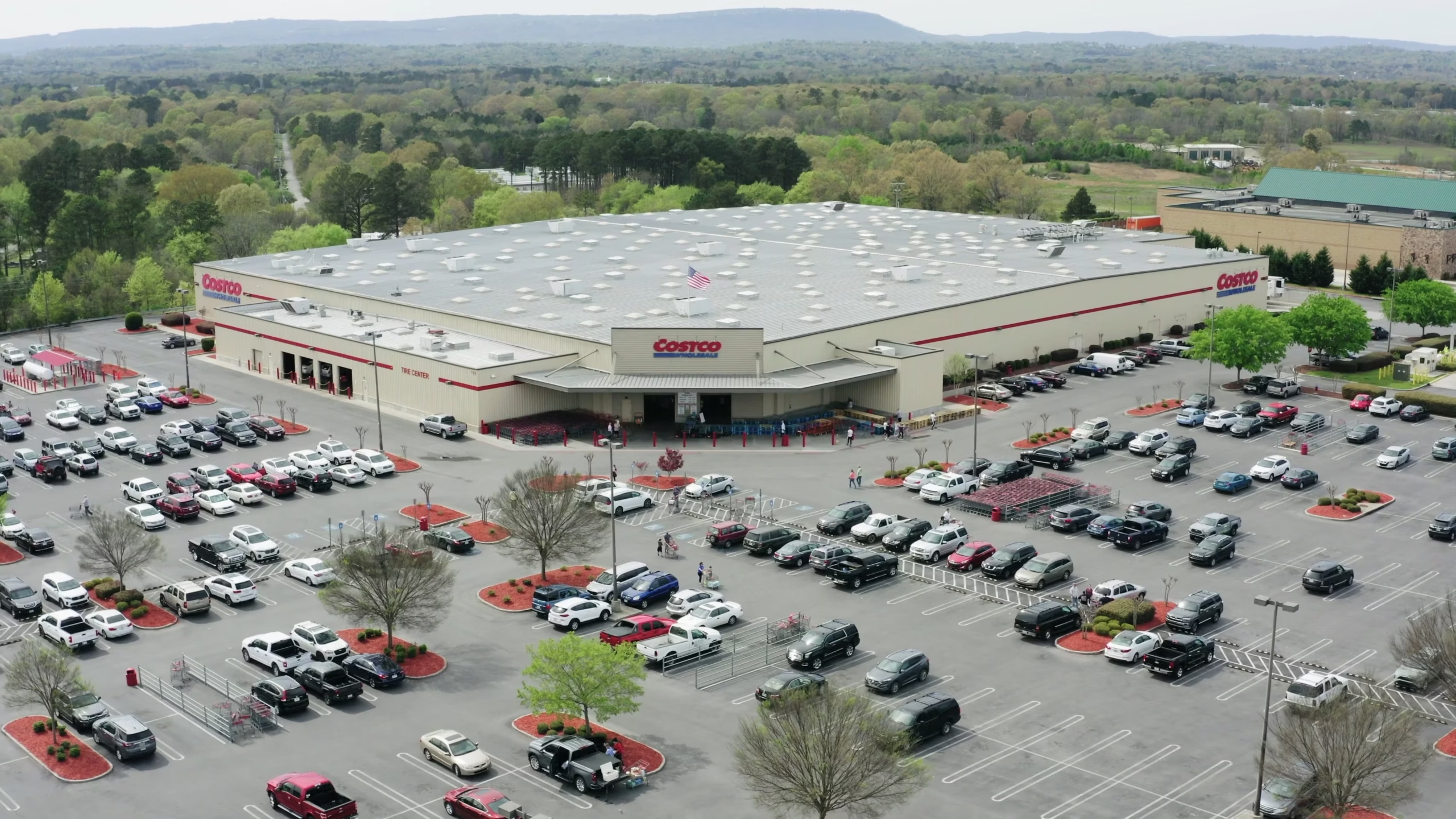
There are a few things wrong with this dream, however, and the first, as I’ll review in a moment, is simply that it might not be so desirable. Even if you think it is preferable at an individual level, there are good reasons to question the social value of the logistical complexity that it necessitates. Home delivery of single-packaged items entails an entirely different cost structure than freight trucks driving to consumer-facing warehouses delivering entire pallets of goods to be driven home by customers themselves. Two companies have emerged with ideal-type business models that dramatize the different economies at each end of this spectrum: Amazon and Costco. Late to the e-commerce game, minimally invested in their distribution network, and committed as ever to an artificially-limited assortment, Costco is the anti-Amazon. It embodies the precise opposite of everything imagined by the e-commerce futurists—and yet somehow its revenue has grown by an average of more than 10 percent every year for the last five years.
Constraint and sociality
In some cases, consumers might want access to full product assortment: when, for instance, there’s a spot in the home that only fits a furnishing of certain dimensions, or when making a major electronics purchase. But in general, scrolling through options and reading through reviews online for every consumption choice is overwhelming and anxiety-producing: “infinite, meaningless options can result in something like a consumer fugue state,” The Atlantic once argued.
One brilliant feature of the Costco experience is, paradoxically, the constraint: as opposed to Amazon, with its near infinite assortment, or even Walmart, which has approximately 130,000 SKUs (stock keeping units, or distinct items) in the average Supercenter, any given Costco will only hold 4,000 SKUs to choose from. While most retailers today assume that consumers want ever greater assortment, Costco’s popularity speaks to a countervailing desire for less choice. Indeed, the pre-selection of items for sale in their warehouses is part of the value proposition: not only are you going to get a lot of a particular thing for a good price, but you also won’t have to deliberate over micro-differences in a more robust assortment.
In other words, winnowing selection is a service, not a limitation—especially with Costco’s product catalog. Costco is not known for having the cheapest goods, but it is known for having the cheapest price on its goods, and that is because its buying team has closer relationships with suppliers than any other big retailer. Such scrutiny and communication point away from low-road suppliers. This is a structural effect of Costco’s conscious choice to offer a low SKU count: fewer products to investigate means more time to investigate each product, and a natural gravitation away from the bargain basement. That its member-customers have come to expect a certain quality of everything in their stores reinforces this dynamic.
The low SKU count also allows Costco naturally to do something that Amazon does by squeezing suppliers: a low or even negative cash conversion cycle (CCC). The CCC is a corporate finance measure of how long it takes to turn inventory into cash through sales. Amazon often negotiates delayed payment terms with suppliers, leaning on them to allow payment windows longer than the thirty-day industry norm. Meanwhile, given the speed of its e-commerce business, Amazon is often receiving payment from consumers way before it has to pay suppliers, essentially giving the retailer interest-free cash. Costco enjoys the same benefit of a short or negative CCC, but without having to anger suppliers simply because fewer SKUs means a faster-moving inventory for the SKUs that they do carry. In other words, when a Costco store receives a shipment of a particular item from a supplier, it is often going to sell every unit in that shipment in less than a month, thanks to its scale and the simple fact that that particular item is going to be the only variety in store.
Costco’s in-store experience is another draw for customers, and this too runs counter to the prevailing view in the “future of retail” conversation. While the e-commerce share of retail has been steadily growing, it’s still under 17 percent in the United States, and one wonders in a society as anti-social as our own if customers find in-person shopping, degraded a “social” venture as it is, desirable even in its inconvenience.
Shopping at Costco is always somewhat harried: no shopper can avoid lines at the registers or traffic jams in the aisles, even on the weekdays. It is the precise opposite of e-commerce convenience. And yet members not only don’t seem to mind the nuisance, they positively embrace it. Costco notably spends very little on advertising, but it doesn’t really need to, given the remarkable amount of free attention it gets by word of mouth and on social media from enthusiastic shoppers “talkin’ deals.” Costco has become a retail destination with a very loyal membership base (its annual membership renewal rate is typically above 90 percent) while offering a sparse, no-frills retail experience.
Benefits of simplicity
But consumer preference is only one metric by which to judge the desirability of “assortment and home delivery” vs. “constraint and in-person shopping.” It should be remembered that the term “logistics” comes from a military context—the French word for the “art of moving, quartering, and supplying troops”—and logistical success in business means most fundamentally the success with which goods are supplied to the customers who need them. Applied socially, our understanding of logistical success must be based not only on how goods are being supplied to any particular person, with their own smattering of individual preferences, but also on how they are being supplied as a whole.
At the social level, logistical success can be measured in terms of cost efficiency. This cost can be understood in accounting terms as overhead: the warehouses, the vehicle fleet, fuel costs, forklifts. An enterprise is more efficient when it can spread these costs over a larger volume of goods. A cost-efficient operation is also simple, in that it’s reliable and not prone to disruption. The more complicated an operation, the more likely it is to fail. A simple operation also puts fewer demands on transportation infrastructure—an urgent question in congested urban environments.
To put it crudely, having someone in a Sprinter van deliver a recently-purchased toothbrush to your doorstep is simply not a universalizable action, from either a business or logistical standpoint. It is a modern feat that Amazon is capable of doing this, but that it can be done does not mean that it should, nor even that it can be done writ large. For most consumption, it is far more efficient for people to handle the “last-mile delivery” themselves by going to stores and buying a good amount of stuff when they do so. This keeps delivery vans off the road, and it minimizes car trips for necessary purchases. For the retailers, it suppresses unnecessary mark-up both by keeping overhead costs low and by simplifying overall logistical operations.
Costco’s income statements as reported in its Form 10-K include the standard operating expense category for “Selling, General, and Administrative” costs. This category is consistently and qualitatively lower than any of its competitors’—10 percent of sales, compared to Amazon’s delivery costs of 40 percent of non-AWS sales. One of the reasons for this is the bare bones nature of the Costco distribution network. At Costco’s “depots” (as opposed to their stores, which the company calls “warehouses”), all in- and outbound inventory is cross-docked in pallet quantities: full pallets come in from suppliers on one side of the building, workers on electric pallet jacks move those pallets from one side to the other, and full pallets are loaded onto trucks bound for stores. There is no pallet breakdown at a Costco depot, no conveyor belts, no fancy automation.
Such low overhead not only allows Costco to deliver on low prices to their customers; it also allows the company to pay relatively high wages to their workers. According to Indeed, Walmart pays retail sales associates an average of $16.23 an hour, and Amazon pays warehouse associates an average of $19.14 an hour. Costco pays front end associates an average of $21.29 an hour. This has allowed Costco to achieve an astonishingly low rate of labor turnover: compared to 60 percent turnover in retail generally and 150 percent in Amazon warehouses, the annual workforce turnover rate at Costco is just 6 percent. This is often treated in the business press as a matter of company “culture,” but it has a clear economic underpinning. When you minimize overhead, you can simply pay workers more without squeezing your overall margin.
As I’ve said elsewhere, it’s ironic that Jeff Bezos originally got the idea for Prime, Amazon’s membership model, from former Costco CEO Jim Sinegal. Prime entitles members to free two-day delivery on over 300 million products (in addition to streaming services). With such a wide range of possible single-item orders, free delivery encourages less bundling of customer purchases. Whereas Costco membership helps to reduce overhead, Amazon membership increases it. Meeting two-day delivery demand requires dramatic investments in their distribution network, which is reflected in the higher share of sales accounted for by Amazon’s delivery costs. Lower overhead means more for workers, but it also means less organizational stress on those workers, as Costco employees are not subject to the quotas and surveillance that Amazon’s e-commerce business demands.
We don’t typically praise Costco for its logistics in the way that we do Amazon. But the former in fact offers a far more logistically elegant and socially beneficial model of goods provision than the latter. Amazon dominates when it comes to logistically-complex operations, but there is no inherent reason to prefer complicated operations to simple ones. If anything, simplicity should be the rule. Why do you need to figure out how to integrate robotic arms into a fulfillment operation dominated by autonomous mobile units when you can cross-dock full pallets? Is it more logistically impressive to solve difficult problems or to eliminate the need to solve them in the first place?
That said, there is no question that, in a better society than the one we have, key parts of Amazon’s operation would be retained for offering functions that contribute to the social good. The capacity to deliver prescription medicines same-day to the elderly is a genuine social contribution. (Academics who like to talk about “counter-logistics,” a political orientation aimed at dismantling logistical power, tend to ignore the positive social benefits that modern logistics provides.)
But if we’re looking for a generalizable model for the social provision of goods, Costco offers a foundationally useful blueprint for everyday personal consumption while Amazon does not. Amazon is hoping that its foray into grocery and everyday essentials will encourage more order bundling, and given the importance it’s according to this segment, it will no doubt continue to make headway there. But to date it has still not been able to make the conversion away from being an online convenience store, which tells you something important about its model: Amazon is there to fill in the gaps of a dominant mode of goods procurement, not to replace it.
Lessons for public grocery
In May, New York City mayor Zohran Mamdani reiterated his dedication to creating a public option in grocery, announcing plans to roll out one public grocery store in each borough, with two locations in the Bronx and Manhattan already scouted. The public grocery store is a model long overdue for widespread testing out, and as ex-Whole Foods Vice President Errol Schweizer has forcefully argued, there is already a shining example of it in the military commissary system. Commissary prices are typically 25–30 percent lower for veterans and military families.
The mayor’s critics have unsurprisingly settled on the critique that Mamdani’s plan will use taxpayer dollars to make life even harder for struggling grocers in NYC—conceding the idea that it will indeed result in cheaper groceries for New Yorkers. This is the terrain on which they want the discourse to play out because they expect, not without some justification, that spending on this project will involve an inefficient use of resources that is not worth the social benefit it provides. They will be combing through the receipts to find that one expense that illustrates government inefficiency or even graft.
One simple way to keep overhead low and stay cash positive is to follow the Costco model: low SKU count, high volume. The low SKU count is not only a way to have a desirable cash conversion cycle (an important way of beating back critics on the right); it also creates the opportunity to develop relationships with good suppliers. There will be a temptation to invest in giving these stores that “retail look,” with consultants jumping in to emphasize the importance of shelf placement and signage. To my mind, the aisles could look much more like Costco warehouses, but with full case stacks instead of pallets, provided that shoppers know the city has made the effort on the front end to work with high-road suppliers. A solid marketing campaign around the relationships that the city has developed with local suppliers will do more to drive traffic than the usual retail gimmicks.
Volume is the other key consideration, and if I were on Mamdani’s team, I would deemphasize the “one in each borough” line. Mamdani has said that these stores will “buy and sell at wholesale prices” in part by “centraliz[ing] warehousing and distribution,” but central warehousing and distribution on five stores doesn’t mean much. When Costco had five stores, they had no central distribution network because they didn’t need it. Volume will be what makes centralizing warehousing and distribution worthwhile, and for that Mamdani’s team will need to be open to achieving the scale economies that the math will point to. Errol Schweizer and food systems expert Raj Patel have argued as much elsewhere, suggesting at least twenty stores.
There are many other lessons to learn from Costco, but one that sticks out to me as perfectly reproducible within the context of public grocery stores is choosing a single loss leader that the system becomes known for: in Costco’s case, the $1.50 hot dog and soda combo (that price has not changed for over forty years). For NYC’s public grocery stores, how about a $2.12 halal wrap?
It’s worth noting that Costco traces its lineage back to Fedco, or the Federal Employees Distributing Company, a membership store started by post office employees in 1948. Fedco was essentially copied by Sol Price when he created Price Club, Costco’s primary competitor until the two merged in 1993. The basic idea behind Fedco was that federal employees could leverage their collective buying power to eliminate traditional retail store markup. It was, in essence, a remarkable testament to the power of the public purse, one that inspired the creation of a retail behemoth that naturally holds lessons for exercising that power once more.
Further reading from Labor & Logistics
Overexpectations in e-commerce?
A story told through the clash of the world's two largest corporations by revenue
Home Depot’s New Last Mile
Unstitching America
No private company is logistically capable of delivering the mail. So what does privatization of the US Postal Service mean?
Further reading from Labor & Logistics
Overexpectations in e-commerce?
A story told through the clash of the world's two largest corporations by revenue
Is brick-and-mortar retail bound to lose ground to the new portals of infinite choice and doorstep delivery? The picture is more complex than it might...
Home Depot’s New Last Mile
Home Depot has been on a building and acquisitions spree, rapidly taking over a half-dozen logistics companies. Is it also creating an opportunity for organized...
Unstitching America
No private company is logistically capable of delivering the mail. So what does privatization of the US Postal Service mean?
No private company is logistically capable of delivering the mail. So what does privatization of the US Postal Service mean?