Analysis
The Apotheosis of Point of Sale Data
The complex logistics and labor costs that make same-day delivery possible
Many factors contributed to the so-called retail revolution of the late-twentieth century, when retailers like Walmart, Target, and Home Depot grew in size and power. But arguably the most important was the lowly barcode. Barcodes enabled retailers to compile point-of-sale data, which allows them to digitally track consumption behavior, and this in turn gave them more fine-grained control over what to stock their shelves with, when, and in what quantity. This new data-enabled inventory precision accompanied increasing sales volumes, as the retail giants remade the American commercial landscape.
Before the retail revolution, Christmas season came along and retailers put an array of Christmas items on their shelves. Much of the time, they’d guess incorrectly about how much of which items would be purchased—warehousing the excess, selling it on the cheap, or missing out on lost sales. Today, with decades of barcode system data, retailers can examine past Christmas seasons to predict by store and day the exact quantity of Christmas lights, wrapping paper, snow globes, and so on, they’ll need. Conversations with suppliers used to be real conversations; now the big retailers dictate the terms and can do so thanks to their size.
Rather than making sales predictions and inventory decisions at the level of the store, point-of-sale data is used by e-commerce retailers to predict individual or household consumption in a particular geographical area. For the world’s largest e-commerce company, Amazon, this data has made possible a new kind of distribution node, which appeared a few years back and is rapidly growing: the Sub-Same Day (SSD) center. The SSD is not only at the frontier of speed in parcel delivery; it’s also a unique organizational and labor experiment that presents the key to Amazon’s growth strategy in e-commerce—an industry that expanded rapidly in the first year of the Covid-19 pandemic but whose market share has not grown significantly since.
The Goldilocks proposition
In a typical Amazon order, the product’s journey from the warehouse to the customer’s doorstep—its outbound arc—is a three-stage logistics process: fulfilled at a one million square foot-plus Fulfillment Center, it is then sent to a Sortation Center for routing by zip code, and then on to a Delivery Station, where it is picked up by a driver and headed for your home. Despite going through three separate buildings, Amazon very often completes this process in a single day, and it mostly does so easily in less than the two days it promises its 240 million Prime members.
SSDs combine all of the typical Amazon outbound operations into one building (averaging about 220,000 square feet), effectively combining the functions of Fulfillment Centers, Sortation Centers, and Delivery Stations. Their product inventory is limited to the roughly 100,000-150,000 fastest moving items (SKUs) in a particular area—electronics accessories, household essentials, dry grocery. As an Amazon corporate worker, Taylor (like all interviewee names used here, a pseudonym), explained to me,
They have a huge body of data, twenty years to draw on. And having a model trained on that makes them very good at figuring out something like, “Across all of the different fruit we sell, people in California are more likely to buy this fruit than any other fruit, and they tend to buy it more at a certain time of day.”
In stocking SSDs with those items that they know will be frequently purchased, Amazon can get you them in a couple of hours, rather than the day or two it would take from the Fulfillment Center. There is a kind of purity to point-of-sale data usage with SSDs: no concern with variety, product placement on shelves, signage, or store experience, just raw physical adaptation to demand prediction.
The SSD is not Amazon’s first attempt at ultra-fast delivery: in 2014, the same year it really started to build out their outbound network of Sortation Centers and Delivery Stations, Amazon created Prime Now, a one-to-two hour delivery option for Prime members. This program started in New York City but soon spread to other large urban centers, and it was made possible by very small fulfillment/delivery operations for only the most high velocity SKUs (around 15,000). The Prime Now program was shuttered in 2021, and it was around this time that Amazon started building SSDs.
SSDs could be thought of as a kind of Goldilocks proposition: not as “slow” as normal Amazon outbound but not as fast as Prime Now, with a broader number of SKUs available than in Prime Now but narrower than in their sortable Fulfillment Centers. The appeal is intuitive: if you’re at work and remember you need dish soap, you don’t need it there in one-to-two hours because you’re not going to be home by then. But in two days, you’ll have dishes piled up. Having it on your doorstep when you get home? Just right.
The SSD labor process
Making this all work entails its own operational challenges. SSDs combine the typically distinct operations of fulfillment and sortation in one building. Darius, a sortation-side worker in a SSD who I spoke to, explained how the layout of the SSD keeps these operations physically divided:
Although everything is under one roof, even internally, the sortation and fulfillment sides are kept separate. Digitally, they’re coded as two different buildings. But there’s also a chain-link fence that separates the two sides, with black mesh so it’s hard to see through. And access between the two parts of the building is controlled by your ID.
One might wonder why two sides of the same building are separated so rigidly. As Darius understood it,
The sortation side of the building is open to drivers to come in and get their routes. This is like at Delivery Stations, where there is light access control. You have to badge in, but there’s no metal detectors, sometimes no security. You can go in, you can go out. They’ll have huge bay doors open to let vans in and out.
But at Fulfillment Centers, there’s security guards at all the entrances, metal detectors. And that’s because at Fulfillment Centers you’re dealing with [unpackaged] merchandise. Theft is much more of a concern because you can tell how valuable a thing is when you’re handling it. But on the Delivery Station side everything’s inside of an envelope, so you don’t know whether you’ve got an iPhone or an iPhone case. So it’s similar at an SSD: the fulfillment side is heavily guarded, sortation is more open.
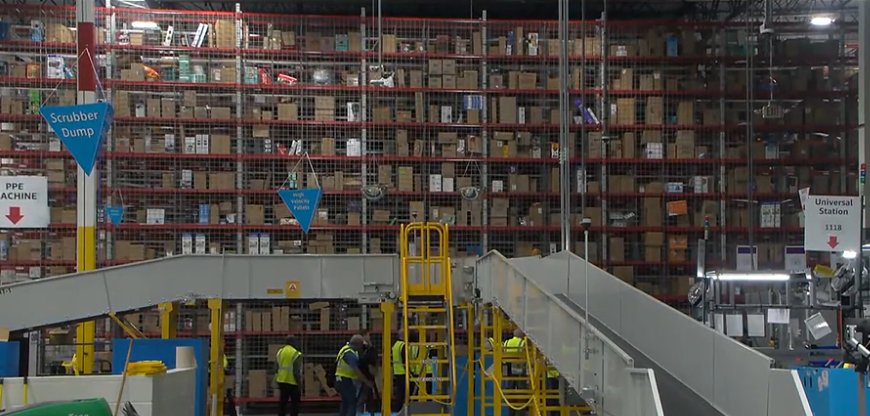
The fulfillment side of an SSD consists of two main areas where inventory is stored that take up most of the building (eighty percent-plus). The first is a floor of Amazon Robotics (AR) mobile units for sortable inventory, in other words, a floor of Kiva robots moving about with 1,000-pound inventory stacks on top for sortable inventory (items under twenty pounds each). The first generation of SSD were all manual—lots of human workers with scanners in hand moving inventory onto shelves, picking and packing it when ordered, and then sorting packages to stage for pick up. SSDs got AR floors in the 2.0 generation, and they’re currently up to 3.0.
The second, smaller inventory area is known as VNA (standing for “Very Narrow Aisles”). This is where large, non-sortable items (oversized items, large boxes of food items, kitty litter, and so on) are kept on forty-foot high shelves. Bryn, who mostly works VNA, uses “OPs, or order pickers,” which they describe as “essentially forklifts that can go up in the air to the height of the highest bin. So we’re strapped into harnesses, and we wear helmets, and we go about forty feet in the air to pick packages.” Bryn also sometimes works on the inbound dock at their SSD and noticed a peculiar feature there:
It’s pretty common that we’ll get an entire fifty-three foot trailer full of maybe two-to-three pallets, or a box truck with one cart of products. And that’s because it needs to get out immediately. It seems like such a huge waste of time and resources.
On both the inventory and package sides of the operation, items are received and sent out according to customers’ same-day demand, and sometimes that means pretty empty vehicles.
When an order is placed for same-day delivery, it’s picked from either the AR floor or VNA, packed up, and then sent over to the sortation side. There is a conveyor belt for sortable items to pass over from one side to the other, while oversized items must pass through a gate through which only supervisors can pass. At the newest generation of SSDs (3.0), sortable items will pass through the “Auto-SAL” tunnel, where they’re automatically affixed with a “Sort Assist Label” (SAL), which in turn lets the Auto-Divert-to-Aisle (ADTA) system know which packages to kick to which carts for drivers.
In 2024, each SSD employed about 400 people on average. As reported by Luis Feliz Leon, the ADTA system reduced sortation staffing by about twenty percent at Delivery Stations where it is used. In Amazon Unbound, Brad Stone estimates that AR mobile unit technology increased stow/pick efficiency at least three-fold, meaning a reduction of the stow/pick workforce by about two-thirds for a given volume of sales. As human sorters comprise roughly fourteen percent of an SSD 3.0 workforce, and stowers and pickers about thirty percent (both according to anonymous reports provided to me), the transition from Gen 1.0 to 3.0 in SSDs could be estimated to have reduced the total SSD workforce by about 39 percent at any particular building, not counting displacement from the Auto-SAL.
In part because of this automation, but also in part due to the fact that SSDs only handle packages less than 40 pounds, Bryn told me that “the physical workload is not very strenuous. People don’t actually take issue with that part of the work. Compared to a lot of other warehouse jobs, the physical work at an SSD is pretty easy, and it’s also a competitive starting wage.” But there are plenty of other issues for workers at SSDs, including the pace of the work and management favoritism. Bryn estimated that about 40 percent of their co-workers quit in a roughly eight–month period last year.
Flex delivery
Unlike Delivery Stations, SSDs are exclusively serviced by Amazon Flex drivers, in other words, gig workers delivering packages from their own vehicles. Flex drivers typically sign up for shifts—typically between three to four hours, involving the delivery of about 35–40 packages on average—called “blocks” on the Amazon Flex app. But sometimes Amazon simply wants people on call, and so drivers will show up to an SSD and wait for routes to be assigned there. Flex drivers are paid according to the block, which are priced differently in the Flex app.
Last-mile delivery is the most expensive leg of any package’s journey. To reduce these costs, Amazon has aggressively subcontracted the bulk of its traditional delivery from Delivery Stations in the form of third-party “Delivery Service Providers” (DSPs, the entities that run Amazon-branded fleets of vans for the company). But Amazon also has a wide range of other last-mile experiments, including its Flex program, drone delivery, and e-bikes. Flex is by far the most successful of these experiments, and I have heard anecdotally from one warehouse worker in a rural facility that some warehouse workers there are also signing up for blocks on the Flex app. Gigification does not make sense for most Amazon work, as it does not typically allow the company the precise labor control it desires. But on the fringes, Amazon is happy to experiment with it, and it provides a convenient duplication in the event of labor disruption at the DSPs (the Teamsters, for example, are particularly active at Delivery Stations and amongst DSP drivers).
Flex drivers also make sense at facilities where orders are being processed in real time, rather than collected in larger batches. At Delivery Stations, a shift’s worth of packages are inducted, routes generated for the day based upon what’s inducted, and then inducted packages will be mass sorted into routes. At SSDs, by contrast, routes are being generated throughout the day, on the fly—and thus the need for a continuous stream of drivers for the smaller batches of packages that go out, rather than the larger batches carried by delivery vans.
This system leads to great frustration but occasional celebration for Flex drivers. Amazon has some idea of how packages should be assigned to routes ahead of time, but sometimes they’ll need to merge a few smaller routes together last minute. Sometimes they’ll shoehorn a random dropoff or two into an otherwise sensible route. And sometimes, they’ll only get a handful of packages for a route and have to send it off anyways. As the pay-per-block is fixed beforehand, this means the amount of work a driver has to do is, on occasion, significantly less—though these occasions are celebrated only as exceptions.
While the SSDs themselves are open and running 23 out of every 24 hours, every day of the week, Flex drivers are typically scheduled for pickups only between 3am and 8pm, so as to meet desirable dropoff windows. Drivers arrive continuously throughout this time, but they tend to cluster in five waves just after what are called “critical pull times,” or CPTs. As Darius explained,
On every package label for a package delivered from an SSD, there’s a delivery window printed on there, and the CPT is the deadline for inducting a package into the system to make that delivery window. When I was at Auto-SAL, which is where inducting happens, management would get up in a tiz as we approached CPT trying to push stuff through the scanners. Because if they missed the CPT, they missed delivery windows.
According to Fred, who works a variety of roles on both the fulfilment and sortation sides of an SSD, the busy arrival periods for Flex drivers are “all linked to CPT times. There’ll be waves of drivers around there. Our parking lot can probably hold about 100–120 cars, but cars are constantly coming and going. It’s never 100 percent full, but it can get close around CPTs.”
Amazon’s retail strategy: SSD expansion
In February, Amazon reported that it delivered 70 percent more items same day in 2025 than in 2024. SSDs are what made this possible. In 2023, Amazon had forty-six SSDs, and by my current count, there are seventy nine, with more coming online all the time. An anonymous source told me that Amazon plans to roughly double the current count by 2027, and that is because Amazon is betting on them as the key that will unlock new retail growth.
In December 2025, Amazon announced same-day grocery delivery in over 2,300 cities with no extra fees. Fulfilling the desire for same-day delivery is the main reason for the SSD expansion, but these buildings also make such experiments in new product lines possible. The grocery policy applies only for Prime members, only on orders of $25 or more. (The prior “Fresh” grocery offering was free delivery on orders of $100 or more.)
In late January, Amazon announced that it will close all of its Fresh and Go stores, making Whole Foods and same day grocery delivery its key grocery plays. To my knowledge, SSDs are not yet doing perishables, but they are doing dry grocery on these orders. Fred has noticed a sizable uptick in groceries at his facility: “Since I first started work, there’s definitely a lot more grocery in our facility. Dry grocery. A lot of it is food, and I hate having to stow it. Twelve packs of soda, energy drinks, protein drinks. It’s all still sortable, but it’s a hassle to stow.” Perishables, meanwhile, still come from Amazon’s Grocery Fulfillment Center network, a separate cold chain fulfillment network for Amazon Fresh, that is also almost exclusively serviced by Flex drivers.
Given its razor thin margins, grocery might seem like an odd thing for Amazon to be prioritizing when it’s got cash cows in Amazon Web Services and its advertising business. Free same day delivery on orders of $25 or more probably eliminates whatever normal grocery margins there are. But Amazon understands grocery to be a key gateway category: if people are buying groceries on Amazon, as well as what they call “everyday essentials,” they’re probably buying much else besides.
In addition to groceries, SSDs are the key buildings out of which Amazon Pharmacy is operating. According to Darius, the pharmacy department in his SSD is housed in a “completely inscrutable gray cube,” a roughly twenty-by-twenty foot windowless box in the middle of the facility. Fred echoed the isolation of the pharmacy department: “Pharmacy is its own separate room, it’s all sealed. You have to have a proper badge to get in. The pharmacists will take their breaks in the break room, but there’s not any real socialization. But they’ll come out periodically and put stuff on the conveyor belt.”
Taylor added that one problem for both grocery and pharmacy is that Amazon’s not actually that great at tracking expiration dates.
In Amazon’s original system, they were designed for books. Occasionally you get a new volume, but you put it on a shelf, and it’s good forever. When Amazon moved into supporting food and other products that expired, they had to build new systems to track that. These systems were set up with different infrastructure, and they don’t always work together well.
This could be why pharmacy and perishables are still isolated from the broader operations of SSDs.
Finally, SSDs also allow Amazon to continue what it aimed originally to do with the now-defunct Prime Now hubs: ultra-fast, one- and three-hour delivery. As Bryn explained in February,
In our building we do both express (one hour) and rapid (three hour) deliveries. We started doing that in the last four months, maybe. It changed the workflow in VNA pretty drastically. We have one person dedicated to just getting the rapids. They’re picking maybe two-to-ten packages every thirty minutes, whereas normal VNA picking is about 100 packages/hour.
These orders are picked up by Flex drivers in shorter, one-to-two package routes. In the Flex app, they are typically advertised as hour-long blocks, paying somewhere between $27 and $30 each. As with the inbound side of the operation, the dispatch side entertains quite a waste in the name of ultra-fast delivery. With delivery expenses like that, one wonders how long this new program can last.
SSDs have nonetheless become a cornerstone of Amazon’s distribution network, and they may be the key that unlocks what I believe is the most important problem for Amazon’s retail growth: the stubborn persistence of the American e-commerce share of retail around 16 percent. As Consumer Intelligence Research Partners has demonstrated, “shopping basket” is an inappropriate term in Amazon world, where customers go to the site typically to buy one or a few items. The existential question for Amazon retail is if it can get its customers to move away from thinking of it this way—as a convenience store—and toward thinking of it as a grocer or supercenter, where items are bought in larger quantities. Thus the importance Amazon accorded to the increase of sales in grocery and everyday essentials on its most recent quarterly earnings call, both low-margin categories but ones that indicate purchase bundling. SSDs are crucial for both, and should be understood as the most important physical infrastructure for Amazon’s growth outside of its data centers.
Further Reading
Overexpectations in e-commerce?
A story told through the clash of the world's two largest corporations by revenue
Is brick-and-mortar retail bound to lose ground to the new portals of infinite choice and doorstep delivery? The picture is more complex than it might...
Home Depot’s New Last Mile
Home Depot has been on a building and acquisitions spree, rapidly taking over a half-dozen logistics companies. Is it also creating an opportunity for organized...

Two Paths for Rideshare Organizing
Can rideshare drivers be successfully organized without being classified as employees?
One of the greatest impediments to unionization in the neoliberal period has been what economist David Weil calls “workplace fissuring”—a business model that, whether through...