June 25, 2025
Analysis
Pay Equity at Kroger
Wage inequality through occupational segregation
In June 2023, the annual meeting of Kroger shareholders heard a motion requesting the company to annually report pay gaps across race and gender among its 430,000 workers. Introduced by Sam Dancy, an African American worker at the company and thirty-year member of the Seattle-based United Food and Commercial Workers’ Local 3000, the motion resulted in the unusual interruption of the meeting by Kroger’s then-CEO Rodney McMullen, who personally apologized to Dancy for discrimination he had faced in the workplace. However, McMullen then urged the shareholders to vote down Dancy’s proposal, arguing that such reporting was unnecessary because Kroger’s employees were represented by the UFCW.
Despite the CEO’s protest, the motion passed with 51 percent of votes. In response, Kroger has for the past two years been engaged in enhanced disclosure, issuing financial and corporate statements and data necessary to comply with the shareholders’ decision.
In their most recent disclosure, in April 2025, the company claimed straightforwardly that their workers do not face a racial or gendered wage gap. As Kroger shareholders convene for their 2025 meeting on June 26, it is therefore worth considering how the company came to this conclusion and how it compares to raw payroll data UFCW has for Kroger grocery stores where its members work.
Control in the workplace
At unionized businesses, the union is not only a way of increasing wages for workers, but also of leveling the playing field among them. In general, the collective bargaining process limits managers’ discretion over pay and so tends to flatten racial and gendered wage gaps within occupations. But control does not stop at the contract. Substantial sociological research shows that managers contribute to occupational segregation by “relying on racial and gender stereotypes in assessing workers, using those stereotypes to recruit workers thought to be most subservient, recruiting through specific worker networks, and telling stories about worker groups that naturalize unequal outcomes.”1Jill Lindsey Harrison and Sarah E. Lloyd, “New Jobs, New Workers, and New Inequalities: Explaining Employers’ Roles in Occupational Segregation by Nativity and Race,” (<)em(>)Social Problems(<)/em(>) 60(3) (2013: 281–301). doi:(<)a href='https://doi.org/10.1525/sp.2013.60.3.281'(>)10.1525/sp.2013.60.3.281(<)/a(>). In this way, in both unionized and nonunionized workplaces, managerial discretion over hiring, promoting, and firing can lead to increased wage inequalities.2John-Paul Ferguson, “The Control of Managerial Discretion: Evidence from Unionization’s Impact on Employment Segregation,” (<)em(>)American Journal of Sociology(<)/em(>) (<)em(>)121(<)/em(>) 3 (2015: 675–721). doi:(<)a href='https://doi.org/10.1086/683357'(>)10.1086/683357(<)/a(>).
The decline of the labor movement and the growth of corporate power has meant that both racial and gendered wage gaps have widened within and between occupations,3Jake Rosenfeld and Meredith Kleykamp, “Organized Labor and Racial Wage Inequality in the United States,” (<)em(>)American Journal of Sociology(<)/em(>) (<)em(>)117(<)/em(>) 5 (2012:1460–1502). doi:(<)a href='https://doi.org/10.1086/663673'(>)10.1086/663673(<)/a(>). with firms having increasing control over workers’ lives in and outside of the workplace.4Elizabeth Anderson, (<)em(>)Private Government: How Employers Rule Our Lives(<)/em(>), Princeton Oxford: Princeton University Press (2017). Even when unions are present, managerial discretion impacts occupational segregation and inequality within the workplace, as managers who control hiring and staffing determine which workers are in which occupations. While UFCW can impact the wages of employed workers and prevent firings, it is not able to control who is hired into the workplace. Kroger’s shareholder resolution offers a case study of how occupational segregation can limit a union’s powers to reduce inequalities, but also how unions can respond.
Corporate power in action
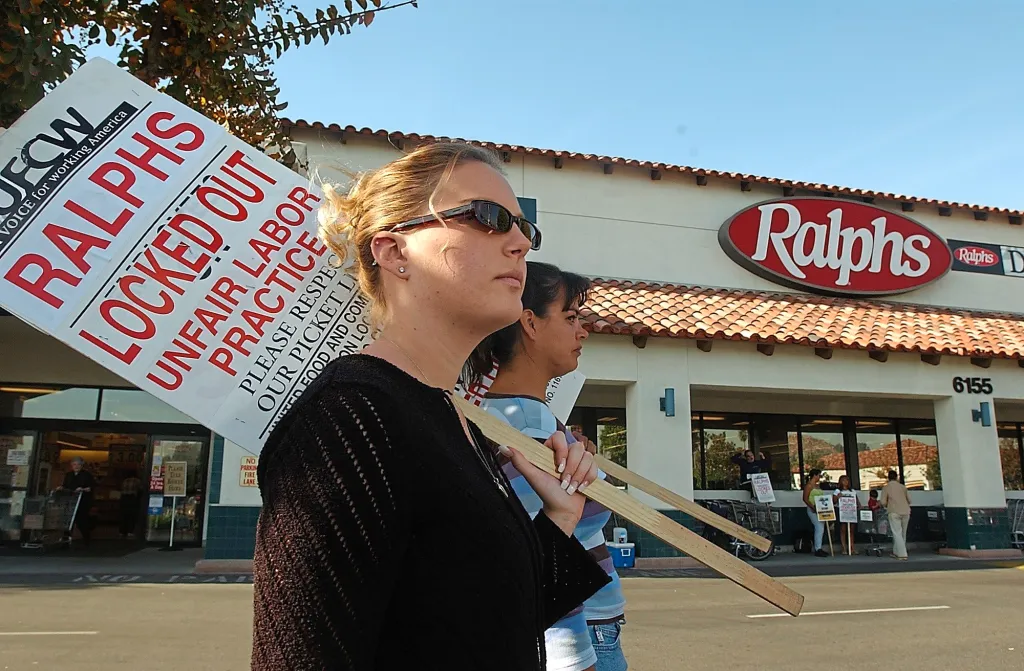
UFCW is no stranger to labor strife in California. In 2003, having reached an impasse over contract negotiations, Albertsons, Safeway, and Kroger locked out 59,000 workers for 145 days after workers went on strike against cuts to healthcare and retirement benefits.5Joel Jordan, “‘With Such Victories, Who Needs Defeats?’: The Southern California Grocery Strike,” (<)em(>)New Labor Forum(<)/em(>) (<)em(>)13(<)/em(>) 3 (2004: 46–55). This protracted conflict lasted until February 29, 2004, when the union membership voted to accept a tentative agreement. The result of the lockout was a concessionary contract, one which contained a “two-tier” provision where members who were hired after that date would receive lower pay and fewer benefits than veteran workers. This two-tier contract caused considerable workplace inequality, and the generational divide among employees has hindered the union’s efforts to build solidarity and fight for a better workplace. In subsequent rounds of negotiations, UFCW locals around the country have attempted to reverse the effects of this two-tier system.
The showdown between the union and grocery companies in 2003 was a notable moment in a longer history of change in the grocery industry. Retail work has become increasingly feminized; the percent of female grocery workers grew from 21 percent to 42 percent between 1963 and 2024.
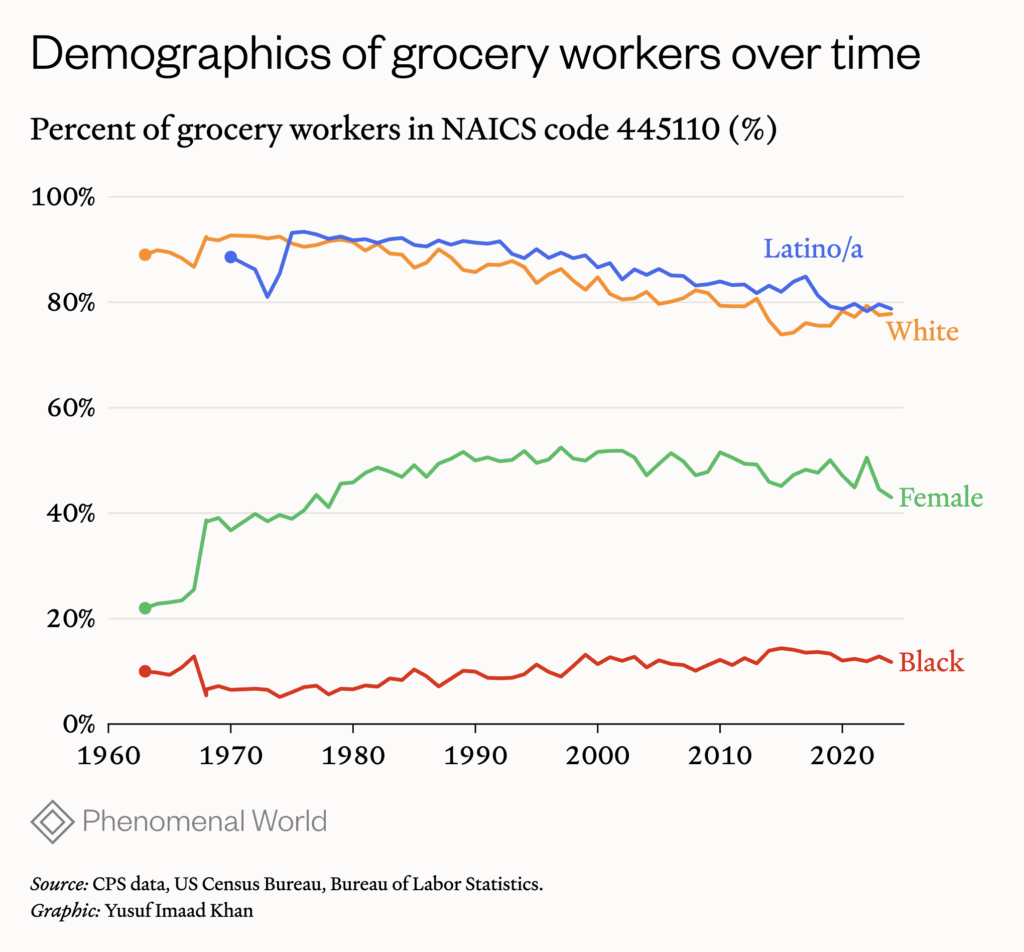
This shift was accompanied by the degradation of conditions for grocery work. Just as the demographics of the retail grocery workforce have shifted toward women, the lifelong, well-paying career of grocery store clerks has gradually become increasingly part-time and unstable.
Occupational segregation at Kroger
In April 2025, Kroger—which operates two subsidiaries in Southern California: Ralphs and Food 4 Less—released its shareholder-mandated report on wage disparities within its workforce by race and gender. The unsigned, one-page disclosure argued that there are no significant differences in pay by racial group when controlling for “position, tenure, hours worked, performance, geographic location, and collective bargaining unit.”
The reality, however, is more complicated. Union contracts standardize pay rates both across and within different job categories. At UFCW, these categories are called wage classifications. Kroger has nine wage classifications in the Southern California contracts: Food Clerks, Courtesy Clerks, General Merchandise Clerks, and Meat Cutters at Ralphs; All-Purpose Clerks, Fuel Clerks, Utility Clerks, Warehouse Clerks, and Meat Service Clerks at Food 4 Less. These different wage classifications comprise all job titles of workers included in the bargaining unit.
Because workers within the same wage classifications are paid roughly the same (accounting for wage steps, which are based on career hours worked in that job title), Kroger’s statement is both true and unhelpful. The second figure below displays demographic and job related wage predictors for 18,662 Kroger workers in UFCW Locals 770 & 324, who are 40 percent female, 8 percent Black, 49 percent Latino/a, and 22 percent white. It shows that controlling for wage classification nullifies any significant effects of race and gender on wages.
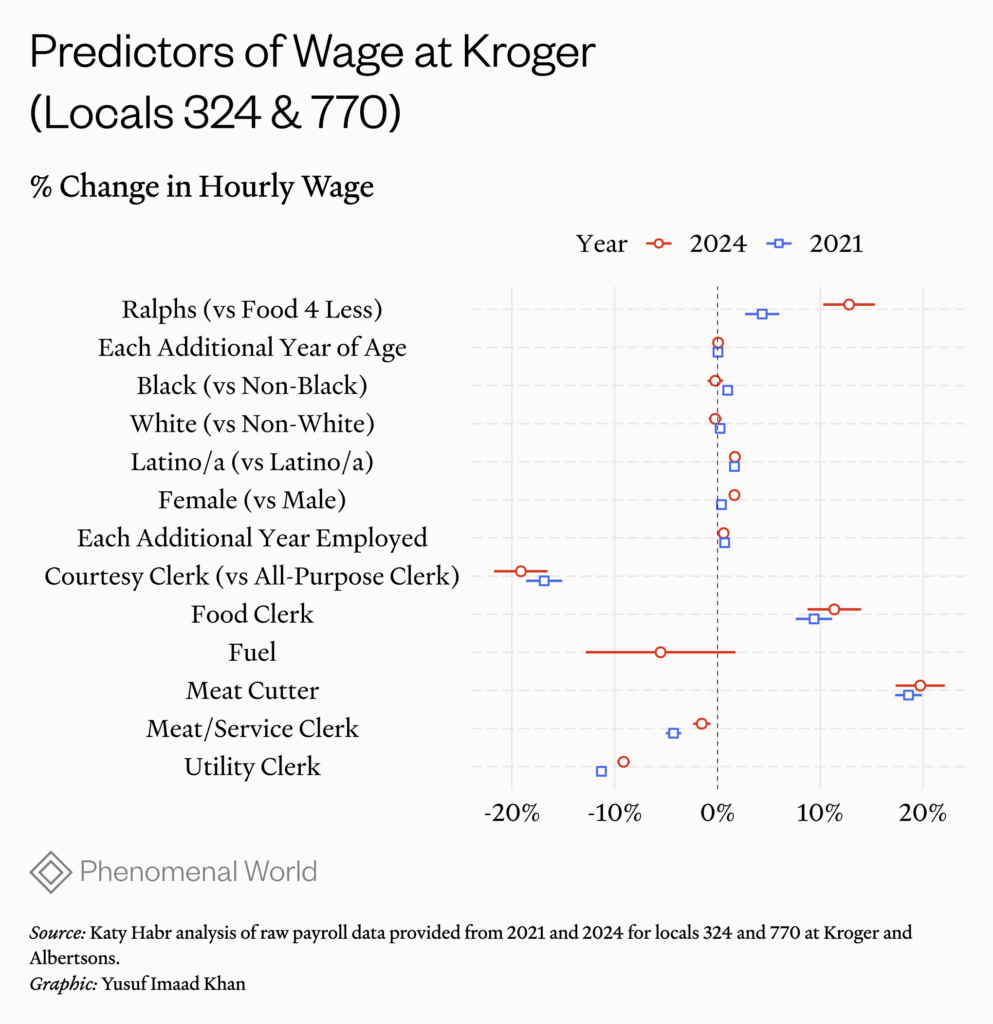
If controlling for job titles shows no pay disparities, this demonstrates that the union contract is working, and wages are standardized. However, it does not tell us much about the reality of inequality in the grocery industry.
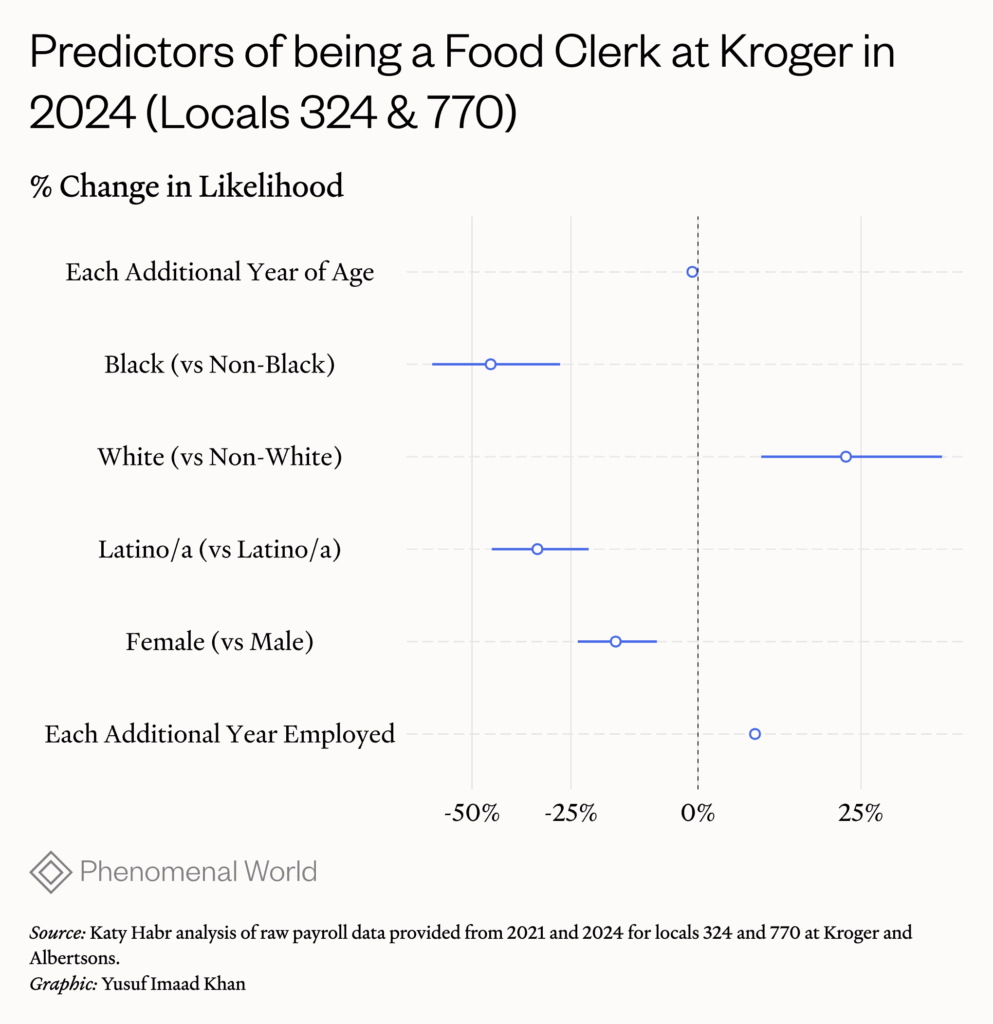
As some UFCW leaders have long suspected, Kroger’s hiring and promotion into each wage classification are heavily racialized and gendered. Drawing from the same Kroger payroll data, we see substantial occupational segregation. For example, 96 percent of workers classified as Meat Cutters are male. As the figures below shows, Kroger tends to hire particular demographics into its Food Clerk and General Merchandise Clerk wage-classifications.
White workers at Kroger are 1.26 times or 26 percent more likely than non-white workers to be Food Clerks. Women at Kroger are 14 percent less likely to be Food Clerks than men. Food Clerks are also more likely to have moved up to the top rate of pay within that wage classification: 85 percent of workers in the Food Clerk Classification are paid the highest rate or are department heads. In contrast, Kroger’s General Merchandise Clerks, who work in apparel, floral, and non-food areas, are 1.45 times or 45 percent more likely to be women.
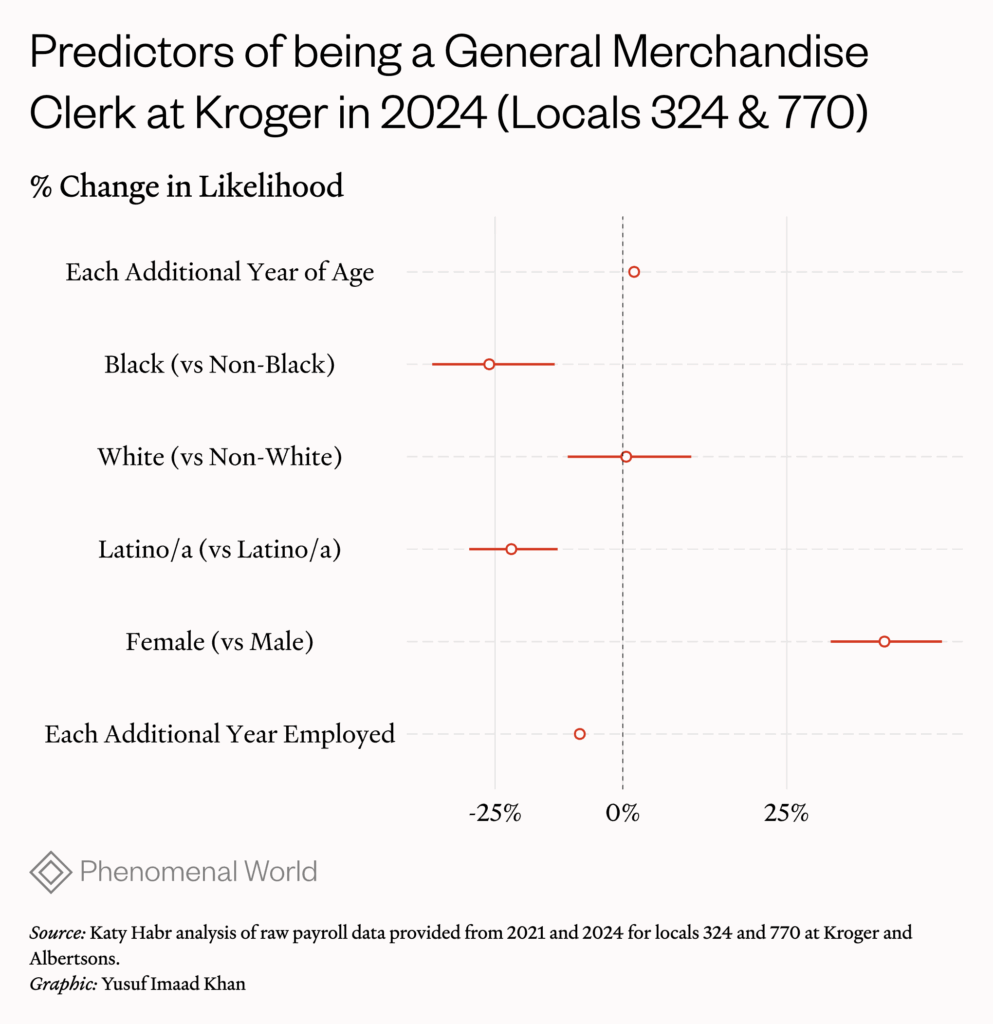
The median hourly wage for Food Clerks in California is $26.75, while for General Merchandise Clerks in was $17.98 in 2024. There are also more General Merchandise workers than Food Clerks at Kroger, with General Merchandise Clerks making up 35 percent of the sample in contrast to 24 percent for Food Clerks. With these large wage differentials, Kroger’s occupational segregation only further exacerbate wage inequality within its workforce.
As these figures show, the wage inequality happening at Kroger is not because of the company’s discriminatory treatment within each job title, but because of how the company hires and promotes people into different job titles. Observing this occupational segregation reveals significant racialized and gendered wage disparities.
Similar analysis shows that the same dynamics are present at the grocery chain Albertsons, which owns the subsidiaries Vons and Safeway in Southern California and has many of the same wage classifications as Kroger, and which negotiates its collective bargaining agreement with UFCW at the same time as Kroger does.
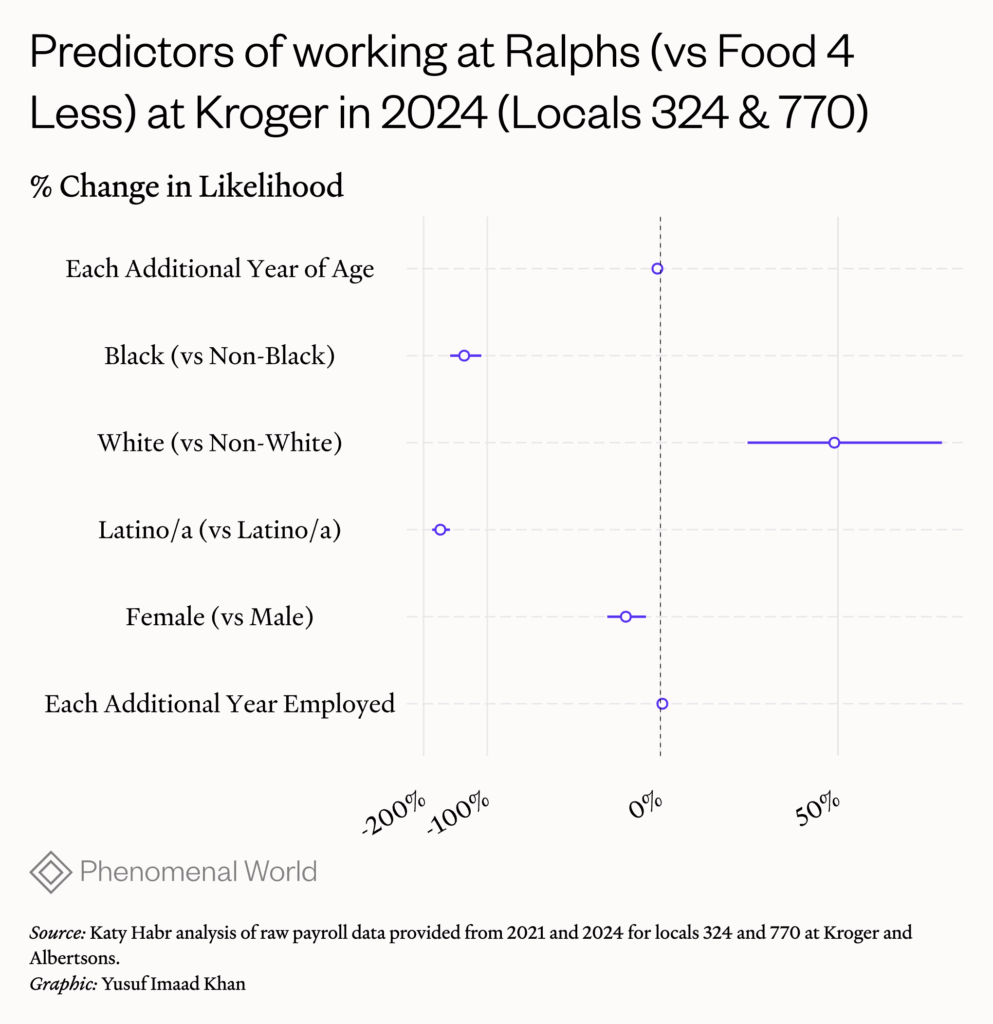
As the figure above shows, racialized and gendered divides exist not only within the same workplaces but across Kroger’s different subsidiaries. Ralphs is Kroger’s higher-end subsidiary that serves wealthier customers—the median household income in zip codes with a Ralphs is $99,584. At Ralphs, workers are 63 percent more likely to be white than non-white. Men are 14 percent more likely to work at Ralphs than women.
Meanwhile, workers at Food 4 Less, a low-cost Kroger subsidiary (in zip codes where median household income is $66,724), are 1.14 times or 14 percent more likely to be women. Workers at Food 4 Less are 253 percent more likely to be Black, and 409 percent more likely to be Latino/a. This segregation across subsidiaries has a significant impact for workers. Workers at Ralphs are paid on average $2.24 more dollars per hour than those at Food 4 less.
What is there to do?
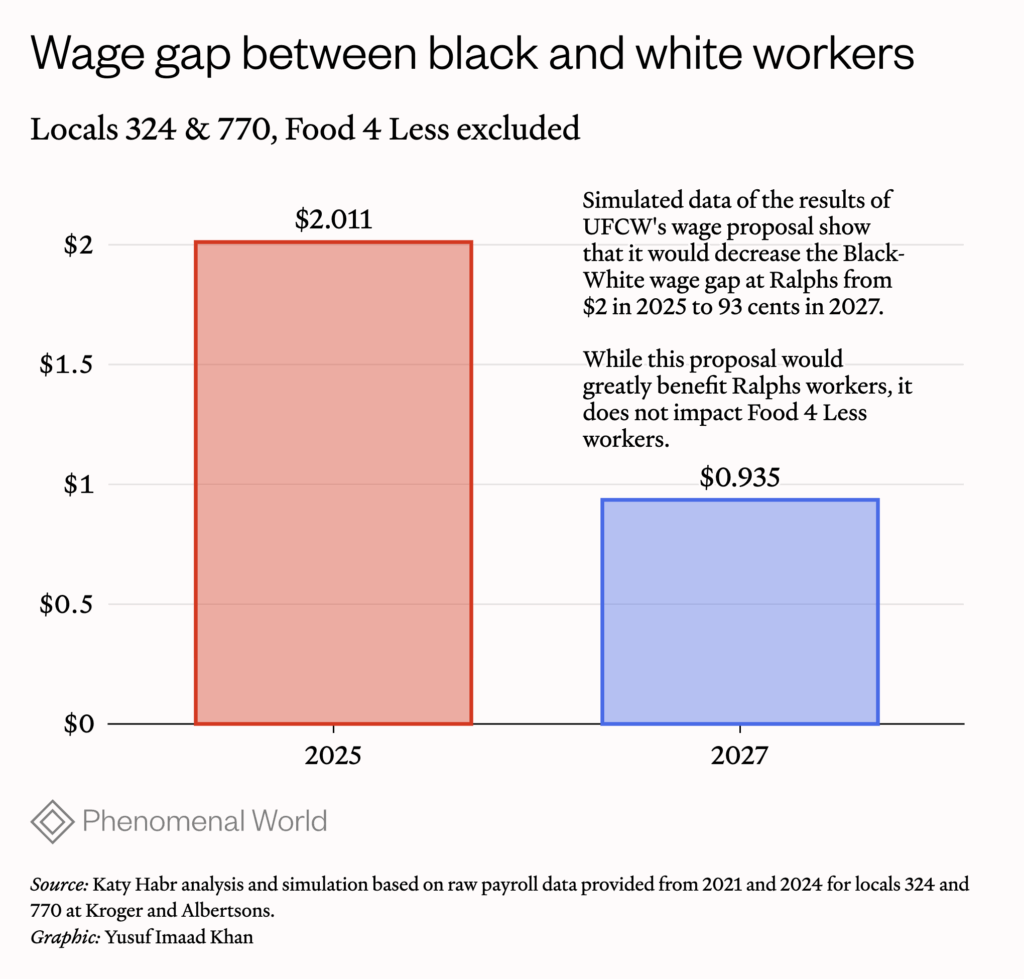
Despite Kroger’s assurances that pay gaps do not exist within its workforce, UFCW is not convinced. In Southern California, the union has introduced a bargaining proposal that aims to bridge the wage gap. This proposal would do two things: First, it would make the wages of General Merchandise Clerks equal to that of Food Clerks within three years. Second, it would decrease the number of hours it takes to move up between wage steps, from 900 to 600 hours, and therefore the amount of time required to reach the top level of pay. This means workers would reach the top pay level after 5,400 hours instead of 7,800.
By bringing the wages of General Merchandise Clerks up to those of Food Clerks, and making it easier to reach the top level of pay, UFCW is hoping to close the gap between workers of color and white workers. Simulated data of the results of this wage proposal, included in the figure below, show that it would decrease the Black-White wage gap at Ralphs from $2.00 in 2025 to 93 cents in 2027. While this proposal would greatly benefit Ralphs workers, it does not impact Food 4 Less workers, whose lower pay will need to be addressed with more comprehensive changes to the company’s wage scales in the next Food 4 Less bargaining round.
Union representation and collective bargaining are effective in reducing inequality between workers with the same jobs. However, the gendered and racialized ways in which workers are slotted into different jobs remains a problem that unions must creatively solve. Managerial rights, a clause included by default in almost every collective bargaining agreement, reduces the ability of unions to close wage gaps by allowing managers to hire and promote workers in ways that perpetuate racial and gendered inequalities. External factors such as residential segregation, educational disparities, and other forms of structural inequality also contribute to this occupational segregation, underscoring the need for unions to bargain beyond bread and butter issues. These facts belie Kroger’s claim that its workforce is not segregated by race and gender, and bring into question its report to its shareholders.
Method Note: figures based on raw payroll data provided from 2021 and 2024 for locals 324 and 770 at Kroger and Albertsons.
Further Reading

Supermarket Economics
An interview with John Marshall of the United Food and Commercial Workers, Locals 324 & 3000
Behind the retail grocery industry’s image of public routine churns an incredible and evolving feat of collective enterprise. The companies that own and operate grocery...

Wages of Citizenship
The undocumented worker represents the future of labor relations in the US, not its past
What will the Trump administration’s immigration crackdown mean for the undocumented workplace? For decades, the US immigration system has run not on the enforcement of...

Adverse Terrain
Brazil’s experiments in labor law
The 2017 reform of Brazil’s labor law is part of a broader movement that arose over the first two decades of the twenty-first century, especially...