19 de março de 2026
Pinto’s Lesson

It is still too soon to fully understand the conditions that enabled the worldwide ascent of the far right over the past decade. But deepening material divisions within the working classes seem to have played a key role, unraveling historic solidarities that were once the basis of left politics. While capital’s relentless drive to accumulate “division and difference within the working class” is nothing new, neoliberalism seems to have intensified it. Dylan Riley recently suggested that, in the case of rich countries, the problem “is not so much that workers as a whole are turning to the right as that the class is fundamentally fractured by the material interests deriving from the market position of its component parts:” a fracture that has been seized upon by the MAGA movement.
The tradition of critical political economy in Latin America has much to say about this dynamic of division among the working classes. In the 1970s, one of the high points of critical thought in the region, a central concern was to grasp how the sectoral characteristics of capital accumulation affected the class structure, and how shifts in the latter conditioned the politics of development in turn. The changing stratification of the labor force was at the heart of efforts to investigate the transformation of the economic structure and its political implications.
Few took this line of inquiry further than the Chilean economist Aníbal Pinto. Bringing together structuralist thinking from CEPAL—the United Nations Economic Commission for Latin America and the Caribbean—and the analysis of class politics developed by dependency theorists, Pinto developed a means of investigating capitalist societies that was both remarkably insightful at the time and continues to shed light on present-day dilemmas. This year is the fiftieth anniversary of one of his most important articles, “Styles of Development in Latin America.” To mark the occasion, I will briefly contextualize Pinto’s work within the contemporary debates on development and show how he effected a creative synthesis of cepalino and dependentista theory. Born in Chile in 1919, Pinto joined CEPAL in 1957 and remained at the institution until his death in 1996. The story I want to tell starts in the early 1950s, a few years before he arrived on the scene, when development economics was still in its early days.
High Hopes
Development was, at this time, understood essentially as industrialization. The standard view was provided by Arthur Lewis, who, in his classic article from 1954, wove together various concepts taken from other economists to create a unified model, based on the assumption that peripheral economies were divided into two sectors: a capitalist one and a subsistence one. The capitalist sector was defined by the use of “reproducible capital,” whereas the subsistence sector referred to the vast pool of underemployed workers, from peasants to urban casual and domestic workers, which Lewis saw as an “unlimited” supply of labor.
In this framework, development meant reallocating labor from the subsistence to the capitalist sector; that is, cultivating a manufacturing industry and promoting a capitalist transformation of peasant agriculture. The main barrier to this reallocation was the accumulation of capital, since one would need to build factories and buy machinery to be able to employ labor in the capitalist sector. But once the process started it tended to gather pace. Given the unlimited supplies of labor, capitalists could hire workers paying little more than the average, very low, income of the subsistence sector, so that profits tended to be large. In Lewis’s view, the funds to increase the capital stock would come precisely from these profits. Hence the cumulative process: profits allowed for capital accumulation that, in turn, absorbed labor into the capitalist sector, increasing profits further and thereby accelerating accumulation. “Once a capitalist sector has emerged,” Lewis wrote, “it is only a matter of time before it becomes sizeable.”
The available data suggests that, at least for a time, the “capitalist sector” did indeed grow in some parts of the global periphery. The share of manufacturing in GDP, for instance, increased between 1950 and 1960 from 19 to 30 percent in Brazil, from 15 to 19 percent in Taiwan, and from 16 to 20 percent in South Africa. Brazil caught up with the average share for the “advanced economies,” which inched up from 29 to 30 in the 1950s. For Latin America as a whole, the manufacturing share approached that level a decade later, in the early 1970s. Besides, the early movers (like Brazil, South Korea, Taiwan and Turkey) saw their GDP per capita and labor productivity levels climb towards those of the capitalist core, between the 1950s and the 1970s. But while some Asian countries managed to stay on this trajectory into the 1980s and beyond, Latin America had its gains reversed.
Tensions
The social and political implications of development had already begun to worry cepalinos in the 1960s, two decades before catching up morphed into falling behind. Despite the continuous advance of manufacturing production, its capacity to absorb surplus labor was rapidly reduced. In 1968, Albert Hirschman noted “considerable disenchantment” with industrialization as a “particular solution of the development problem,” noting, somewhat tongue in cheek, that “Industrialization was expected to change the social order and all it did was supply manufactures!” The fundamental prediction of Lewis’s basic model—even if Lewis himself was more cautious in some of his writings—was seemingly falsified by historical experience. Whereas he had thought that the dualism of the capitalist and subsistence sectors was only a transitory phase, and that the former would eventually absorb the latter, in fact this polarity persisted. In reality, the capitalist sector continued to grow, but drew in less and less labor from the subsistence sector. This turned the division of the peripheral working classes, split between waged workers and marginalized groups, into a permanent affliction.
In 1964, Pinto commented on the “acutely unbalanced character” of Latin American economic development, most clearly demonstrated by the “‘marginalization of rural populations and those of the urban peripheries.” A few years later, he referred to the growth of the “marginalized mass of the urban peripheries” as “the most significant phenomenon of the last decades.” Instead of the gradual absorption of the subsistence sector by the capitalist sector, the expansion of capitalist industries had led to the multiplication of slums.
A 1961 report by the ILO suggested that one of the drivers of this “employment problem” was the “choice of techniques:” industrialization was excessively capital-intensive, inadequate to the factor endowment that prevailed in the periphery. (Aaron Benanav’s history of ILO efforts to deal with this topic is worth a read.) In simple terms, this meant that manufacturing relied too much on mechanization instead of taking advantage of the abundance of workers. While mechanization, or capital “deepening,” was expected in a model like Solow’s, which assumed labor scarcity, Lewis explicitly argued that unlimited supplies of labor would allow for unlimited capital “widening.”
In the conventional economists’ world that may have sounded logical, but it was entirely at odds with the actual course of development—and, of course, with the predictions of other economists like Nicholas Kaldor (see his “growth laws”). As smokestacks multiplied in the periphery, they brought with them higher capital/labor ratios. It was simply not realistic to assume that one would be able to produce steel, cars, or electric appliances with simple tools, replacing expensive machinery and modern installations with a larger number of workers. Technology was much less flexible than anticipated.
In the mid-1960s, the Brazilian economist Celso Furtado, one of the most influential cepalinos, revised the Lewis model to account for the capital-intensive character of peripheral industrialization. For Furtado, it was important to consider the demand conditions faced by the “capitalist sector:” the unlimited supplies of labor implied stagnant incomes for the vast majority, which meant that a booming mass market for consumption goods would not develop. On the contrary, incomes appropriated by the rich and by the white-collar workers tended to grow significantly, creating a profitable market for luxury goods, whose capital-intensive production reduced the capacity of industrialization to transform the overall employment structure. In other words, Furtado forecast that the exhaustion of the unlimited supplies of labor would be postponed indefinitely. In his model, stagnant wages polarized the consumption market, biasing industrialization towards capital-intensive industries, decelerating employment creation and entrenching stagnant wages.
Critical Reflection
The cepalinos were not only concerned with the economic aspects of the Latin American experience. They were also reacting to the political turmoil that was then engulfing the region. The five years between the revolutionary forces seizing power in Cuba (1959) and the military coup in Brazil (1964) proved decisive to CEPAL, as Margarita Fajardo has shown. Under pressure from the most left-leaning members of the commission’s staff, Raúl Prebisch—the commission’s secretary-general at the time—agreed to establish a technical mission to assist Fidel Castro’s government. The plan followed in the footsteps of previous CEPAL missions to Argentina, Brazil, and Chile, providing training on planning techniques and helping to formulate economic policy. Yet the Cuban mission was much more controversial, placing CEPAL at the middle of the crossfire between the Caribbean island and the US. Concerned from the beginning with the political implications of the commission’s involvement, and reacting to pressure from the US State Department, Prebisch unilaterally put an end to it in 1960.
The following year, the US government launched an aid program for Latin America called the Alliance for Progress, in response to the Cuban revolution. The goal was to contain the spread of revolutionary movements in the region. CEPAL was initially asked to contribute to its design and agreed to take on the assignment. Though it was quickly sidelined, the reputational damage was done. As Fajardo wrote, CEPAL’s “position had shifted from allies of the [Cuban] revolution to partners of counterrevolutionaries, especially as they aligned with the US foreign aid program.” The image of the commission was transformed “from an embodiment of a revolution against global inequality into a force against radical change and social justice.”
Meanwhile in Brazil, Furtado, who had left CEPAL a few years before, was now heading up SUDENE, a government agency focusing on the development of the country’s poorest region. Constrained by lack of resources, he placed his hopes on getting funds from the Alliance for Progress. The US government, however, had other ideas, directing money to what Furtado branded “simple façade operations.” More significantly, as the Brazilian government began leaning left to navigate conditions of deepening class conflict, Alliance funds dwindled and the CIA stepped in to back a military coup. Soon after, Furtado was forced into exile, returning to CEPAL in Santiago.
Discredited with the left and dismissed by the US government, cepalinos lost influence and became vulnerable to challenges from more radical quarters, opening the door for the dependency theorists. “The Alliance for Progress,” Pinto remarked in an interview in 1971, “was the swansong of the industrialization approach, of the moderate agrarian reform.” “The Cuban Revolution [and] the stagnation of Latin America precipitated the critical reflection.”
Styles of Development
Furtado’s account of industrialization’s bias towards luxuries, put forward in the aftermath of the military coup in Brazil, was his first attempt to adjust his theoretical outlook to the experience of political defeat. Pinto, who had been directing the office of CEPAL in Brazil in the first half of the 1960s, had observed this defeat up close. His first reaction, in an article published in 1964 under a pseudonym, was to focus on the political dynamics, as opposed to the economic conditions, that led to the power-grab. His starting point was Lenin’s argument that a pre-revolutionary situation requires both a deep crisis of the existing order and a revolutionary political instrument that can exploit it, supported by a significant part of the working classes. In Pinto’s view, the absence of such an instrument in Brazil was what allowed the military to step in and preserve the ruling order. This, he argued, was the result of the left parties’ failure to address the fractured character of the working classes. The Communist Party had not reached the new industrial proletariat and the urban peripheries, while “the political movement in the rural areas has been fragmentary and sporadic, failing to organically integrate with the fragile political machine of the left.”
In 1970, back in Santiago to run CEPAL’s Development Division, Pinto turned his focus to the concept of “structural heterogeneity,” a result of the “great contradiction” of the Latin American development model about which Furtado had written. Latin America had attempted to reproduce the productive structure of the “opulent consumption society” of the capitalist core at much lower levels of income per capita. The result was that growth was forced to rely increasingly on the consumption demand of the very rich, in the absence of a mass consumption market that could afford the goods produced. Echoing Furtado, Pinto argued that this implied a reversal of the expected tendency towards economic homogeneity in terms of income and productivity levels: “the irradiate or pull capacity of the ‘modern sector’ turned out to be, to say the least, much weaker than expected. In this way, instead of a progress towards ‘homogenization’ of the whole structure, a deepening of its heterogeneity is identified.”
From the mid-1960s to the mid-1970s, some Latin American economies demonstrated that this model could sustain itself, from the standpoint of capital at least, in spite of its “great contradiction.” While the cumulative process reproduced the fractures in the working classes, preventing the exhaustion of the unlimited supplies of labor, it did not lead to stagnation, as Furtado had assumed it would. In the early 1970s, under the guidance of Pinto, Maria da Conceição Tavares and José Serra examined the so-called Brazilian economic miracle—the sudden growth spurt unleashed by the military dictatorship—as a refutation of Furtado’s stagnationism. “Brazilian capitalism develops satisfactorily,” they wrote, while “the majority of the population remain in a condition of great economic deprivation, and this results mainly from the system’s dynamism or rather the kind of dynamism that characterizes it.”
Furtado had not seriously considered the possibility that Latin America could continue to grow and become industrialized without addressing the persistent marginalization of most Latin Americans. It was down to Tavares, Serra, and especially Pinto, to delink the cumulative process he identified from the stagnation he predicted. It was not necessarily a vicious circle that led to low growth; it could rather be an unequalizing spiral generating high rates of capital accumulation. In his famous 1976 paper on “styles of development,” Pinto set out this argument systematically. Much as Lewis had codified his optimism in 1954, Pinto did the same for disenchantment and defeat two decades later.
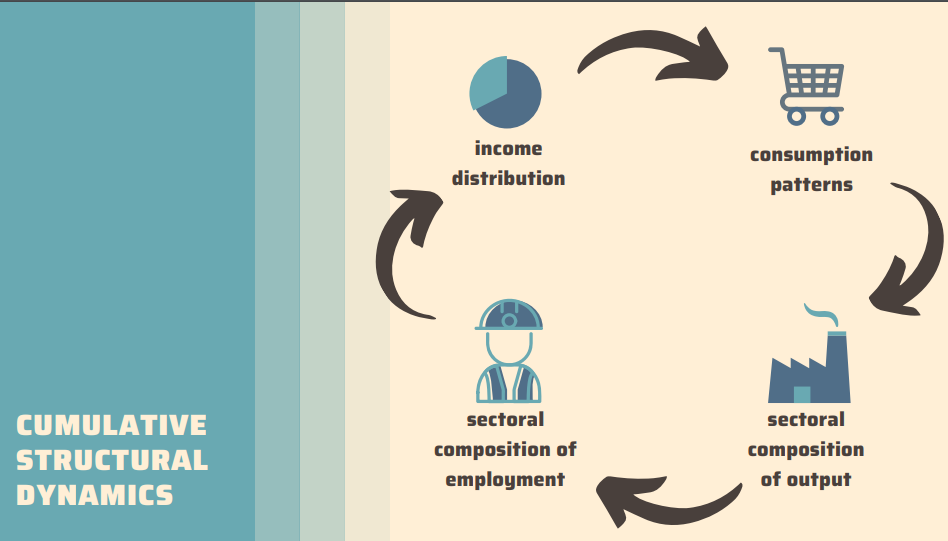
Pinto defined a style of development as a cumulative process between the structures of demand (the consumption pattern and the income distribution) and supply (the sectoral composition of output and employment), as per the figure below. A significant increase in inequality—like the one promoted by the Brazilian dictatorship, squeezing the minimum wage and repressing unions—shifted the consumption pattern towards luxuries (which, at the time, included cars and electric appliances). Data presented by Pinto showed that, in 1970, 85 percent of the vehicles in Latin America were sold to the richest 10 percent of the population, along with 74 percent of the furniture and 50 percent of the electrical and mechanical appliances. The most important aspect of a style of development, he argued, was “for whom” it produced.
Such a biased consumption pattern would be reflected in the sectoral composition of output and employment, creating few jobs—relative to the rate of growth—and expanding disproportionately managerial positions. As a result, the polarization of income distribution, separating the vast majority with stagnant wages from the minority of capitalists and integrated professionals, would widen, and the cycle would restart. This style of development was “a cumulative phenomenon which gradually strengthens the tendencies towards greater…inequality.” In a simulation offered toward the end of the paper, he indicated that the continuation of that style of development would reduce the share of the Latin American labor force that was underemployed from 53 to 45 percent between 1970 and 2000. At this pace, exhaustion of the unlimited supplies of labor would have to wait until the middle of the 22nd century.
Marxist Keynesian
Rejecting the catastrofismo he attributed to some dependency theorists, Pinto insisted on outlining possible alternatives. Yet as a careful political analyst as well as an economist, he did not assess such alternatives solely from a technical perspective but discussed at length the political conditions that could allow for their realization. (He was fond of invoking Marx’s line in the Eighteenth Brumaire that men make history but under conditions already given.)
In 1968, for instance, he had offered a detailed class analysis of the Chilean case, mapping different fractions of the ruling and working classes, and carefully examining the obstacles to building a popular majority. When Salvador Allende was elected as president in 1970 and started building the “Chilean path to socialism,” Pinto remarked that “Allende captured with great clarity the fundamental tasks,” adding that he was “impressed by the seriousness of the Chilean process and of its leaders, by their rejection of populism and easy alternatives.” He interpreted Allende’s election as the rise to power of the organized fraction of the working classes and argued that the decisive question for the future of Chile was whether the left would be able to fulfil the “historical task” of the “real incorporation” of the marginalized masses into society. The answer, of course, was preempted by Pinochet’s coup in 1973.
This kind of study, examining the dynamics of class structures of peripheral societies and their political implications, is today usually associated with the dependency theorists, yet Pinto had undertaken it as early as 1963, in parallel with his work on structural heterogeneity and the styles of development. The significance of conceptualizing styles of development was to offer a way to analyze, together, the sectoral characteristics of capital accumulation (with its macroeconomic consequences) and the transformation of class structure and class struggle—thus combining the best insights from cepalinos and dependentistas.
Pinto’s approach, in other words, points toward a sophisticated political economy of development that takes both politics and economics seriously. This is something that is increasingly hard to find, as disciplinary specialization continues to sterilize critical thinking. Describing his theoretical background, Pinto said that he was “a kind of Marxist Keynesian” and that, for him and his generation, CEPAL’s thinking offered a “great perspective for the interpretation of the Latin American phenomenon.” His disciples saw the potential of this combination up close and took advantage of it. “All my heretical thinking,” Tavares remarked, “I inherited from him.”
The power of Pinto’s legacy was manifest in some analyses of the Latin American Pink Tide of the 2000s and early 2010s, which drew on the styles of development thesis to examine the sectoral pattern of accumulation and its macroeconomic, distributional, and political implications. Works on the cases of Brazil and Argentina identified an equalizing spiral in which, paradoxically, falling wage inequality and structural regression interacted in a cumulative way. This style of development also squeezed profits and the income share of the middle classes, bringing class conflict to the fore, at the same time as it concentrated the working classes in weakly unionized sectors. Such an account of the political economy of this recent experience is arguably a key starting point to understand the crisis that followed and the rise of the far right in these countries. Meanwhile, in the capitalist core, research on duality and sectoral dynamics has so far been inspired mostly by Lewis’s writings—which, insightful as they are, tend to overlook the cumulative interaction between the structures of demand and supply and its dynamic implications for the class structure. Half a century on from his landmark essay, Pinto still has a lot to teach us.